





























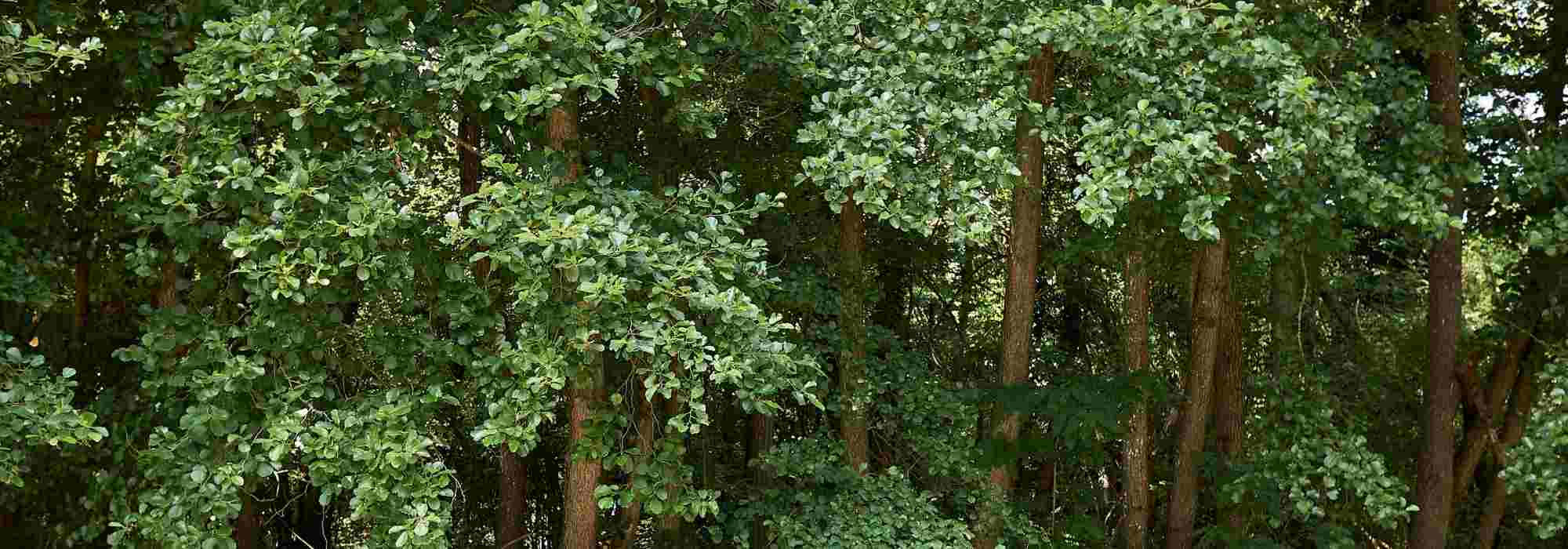
10 trees for heavy, wet soil
Some planting ideas...
Contents
“The right plant in the right place!” No matter the texture or quality of your garden’s soil, it will always be suitable for a group of plants. This holds true even for challenging and unyielding soils, such as heavy and constantly wet soils. When choosing trees for planting, select species that naturally grow along waterways, within marshes, or near marshlands. Trees that are unafraid to plunge their roots into clayey, heavy, and wet soil all year round. Yes, indeed, they exist!
→ Discover our little selection of trees for heavy and wet soil!

Black Birch or Betula nigra
Black Birch (Betula nigra) is a deciduous tree native to the southeastern United States. In the wild, it can be found along waterways or within swamps. The Anglo-Saxons have aptly named it “River birch“.
The Betula nigra ‘Shilo Splash’ is a lesser-known selection of the common black birch. Its foliage is beautifully variegated with cream white, tinged with pink during the bud burst period. However, the leaves turn golden yellow in autumn, adding a season of interest to this lovely tree. With a rather upright habit, it also charms in winter, adorned with bark that exfoliates in large undulating plates to reveal a shiny, copper-brown skin.
The black birch is a vigorous species that is quite resistant to diseases and pests. The ‘Shilo Splash’ has a slower growth rate than the typical species and can even be trained into a large bush. However, it can reach up to 9 m in height and 5 m in width after a few years. It is perfect for brightening shaded areas of the garden, thriving in waterlogged soil in both warm regions and cold climates.
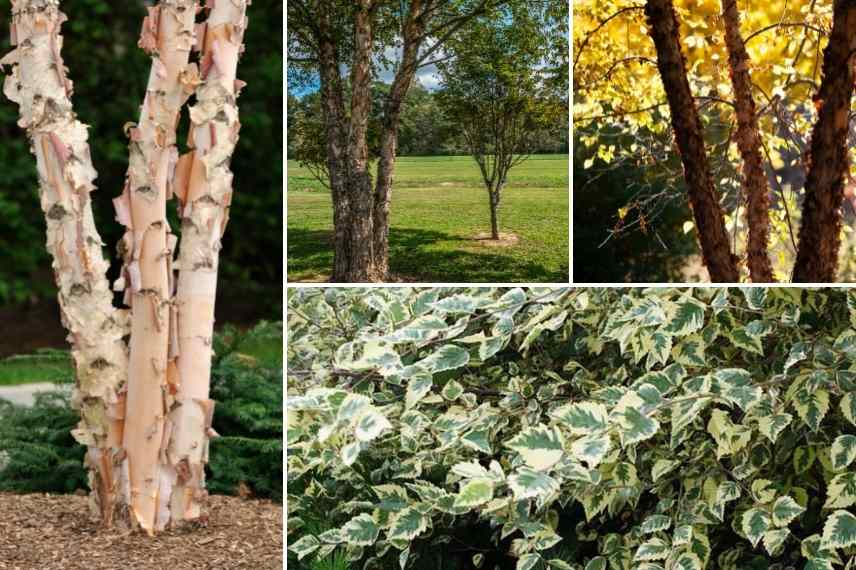 Betula nigra, bark, habit, and autumn foliage. In the bottom right, the variety ‘Shilo Splash'</caption]
The Weeping willow: the romantic charm
The weeping willow is so famous that it would have been remiss to forget it in this selection. In reality, there are several varieties and hybrids of willows that are referred to as “weeping willow.” Here, we will discuss Salix alba ‘Tristis’ or Salix (x) sepulcralis ‘Chrysocoma’. Both names are synonymous.
The Salix alba ‘Tristis’ is a large tree (20 m in height) with a broad rounded crown, featuring green foliage that turns yellow in autumn and drooping branches that reach the ground, creating a romantic atmosphere in the garden. It is perfectly hardy in our climates. In addition to its distinctive habit, the tree produces light yellow flowers in aments, measuring 4 to 8 cm long, in spring.
The willow is easy to cultivate and grows admirably in any cool, even moist, fairly heavy soil, rich but preferably non-calcareous. Fast-growing, plant it in full sun and in isolation or at the edge of a water feature in large gardens. Its roots are running and can easily spread 20-30 m in the soil: do not plant it too close to buildings!
→ Willows are generally (though there are exceptions!) trees and bushes that thrive in heavy, moist soils. Discover all our finest willows in our online nursery.
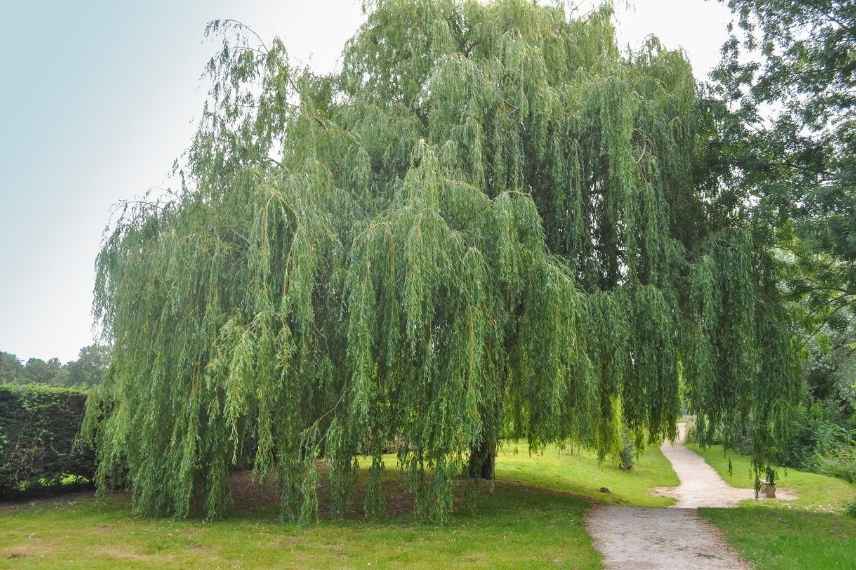
Salix alba ‘Tristis’
Discover other Trees and large shrubs
View all →
Available in 1 sizes
Available in 1 sizes
Available in 1 sizes
Available in 1 sizes
Available in 1 sizes
Available in 1 sizes
Available in 1 sizes
Available in 1 sizes
Available in 1 sizes
Available in 1 sizes
Nyssa sylvatica: the fire in autumn
The Nyssa sylvatica, also known as Black Gum or Tupelo, is a deciduous tree native to the United States. Its foliage adorns itself with sumptuous autumn hues of orange-red from September to November, before falling and revealing its naked bark in winter.
The Tupelo can reach 20 m in height in our gardens, and its growth is quite slow. This tree has a broad conical habit and a curious trunk covered with grey-brown bark that scales and develops furrows in older specimens. The foliage is dark green to yellow-green before turning into a fiery orange-red. A very discreet flowering occurs in summer, followed by dark purple berries that are highly appreciated by birds.
The Nyssa sylvatica is grown as an ornamental tree in large gardens, preferably in isolation to prevent competition from its neighbours and to develop a harmonious habit. The Black Gum requires neutral to acidic, fertile, waterlogged or moist soil all year round, in full sun or partial shade. This tree is well resistant to wind and is very hardy.
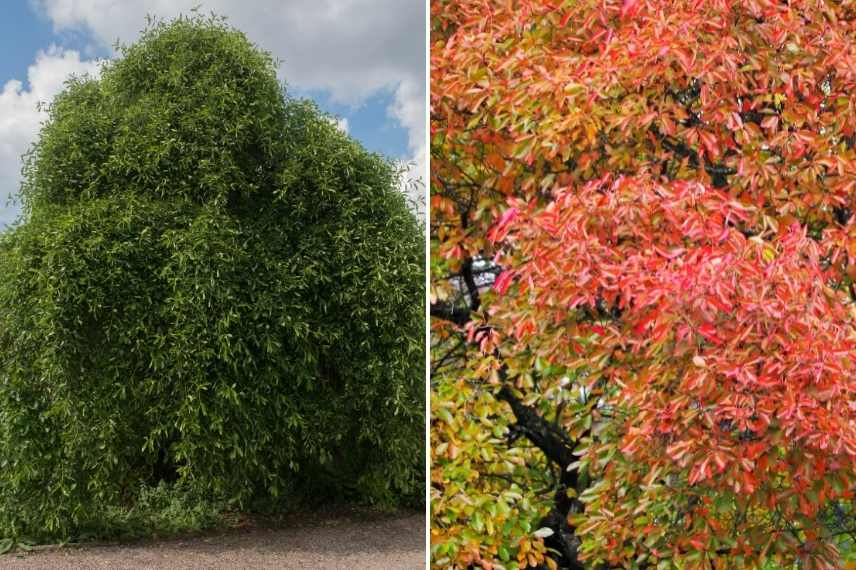
Nyssa sylvatica, habit and autumn foliage on the right
Bald Cypress: a conifer with its feet in water
The Taxodium distichum, also known as Bald Cypress or Louisiana Cypress, is a large deciduous conifer native to the swampy regions of the southeastern United States. It is hardy and particularly well-suited to waterlogged to moist soils. The name “bald cypress” comes from the fact that its foliage is deciduous, which is quite rare among conifers.
The Bald Cypress grows straight like an “i” and its trunk is covered with beautiful reddish-brown bark that is deeply fissured. The light foliage takes on magnificent rusty red hues in autumn, then golden brown before falling before winter. If grown by the water or in regularly submerged soil, it can produce respiratory roots, called pneumatophores, which help oxygenate the root system and anchor it in loose soils. The Louisiana Cypress produces both male and female cones on the same tree. The female cones are round and purplish in colour when mature. In our climates, it maintains a very beautiful pyramidal habit, reaching a height of 20 to 25 m. Its growth is relatively rapid, and it can live for up to 500 years.
The Taxodium distichum will thrive in a large garden and will grow in ordinary, deep, cool, or even moist soil in a sunny position.
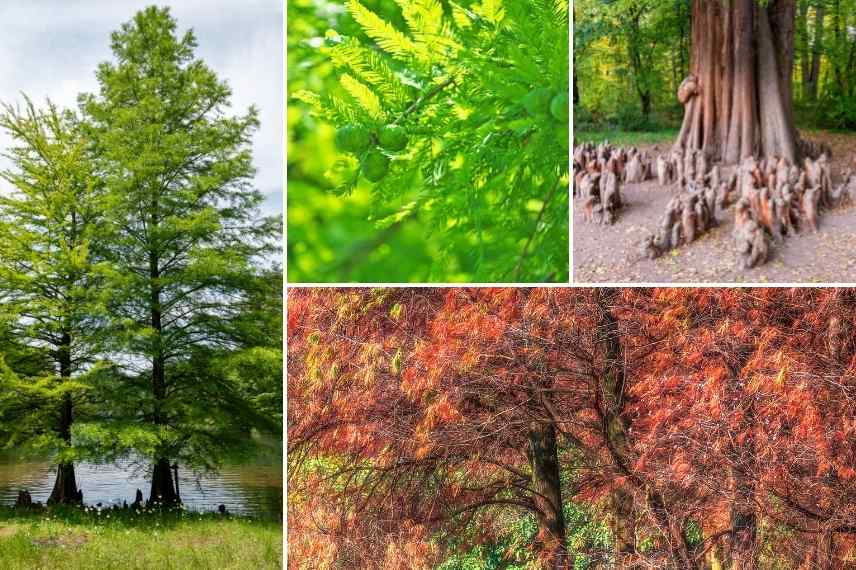
Taxodium distichum: habit, foliage, and autumn foliage. In the top right, pneumatophores on an older specimen
Common Ash: a tree of our forests
Fraxinus excelsior, or Common Ash, is a large and very common tree that grows naturally in France. It can be found along the banks and shores of watercourses, as well as in certain forests. It is easily recognised by its black flower buds and lanceolate leaves, dark green, turning yellow in autumn.
Over the years, this tree takes on an elegant habit, consisting of a very vertical trunk supporting a light and elongated crown. The bark becomes grey, deeply fissured, and scaly. The deciduous foliage consists of compound leaves with 9 to 13 narrow, lanceolate leaflets. Dark green in season, the leaves take on a beautiful yellow hue in autumn. The flowering, relatively discreet, occurs in April before the leaves appear, in the form of cream-yellow panicles.
Very cold-resistant and easy to cultivate, the common ash tolerates all types of non-scorching exposure and adapts to any ordinary soil, even calcareous. However, its growth will be greater in fertile, deep, and cool soil. It will then reach between 30 and 40 m in height with a spread of 20 m at maturity. The Fraxinus excelsior will find its place as a specimen tree in a large garden, where it will provide pleasant shade in summer.
Note: Since the early 1990s, a fungus has caused a disease in Ash trees: Chalara or Ash Wilt Disease. This disease has devastated populations of European Ash trees. Fortunately, recently, some cultivated clones have shown resistance to chalara. This is something to keep an eye on!
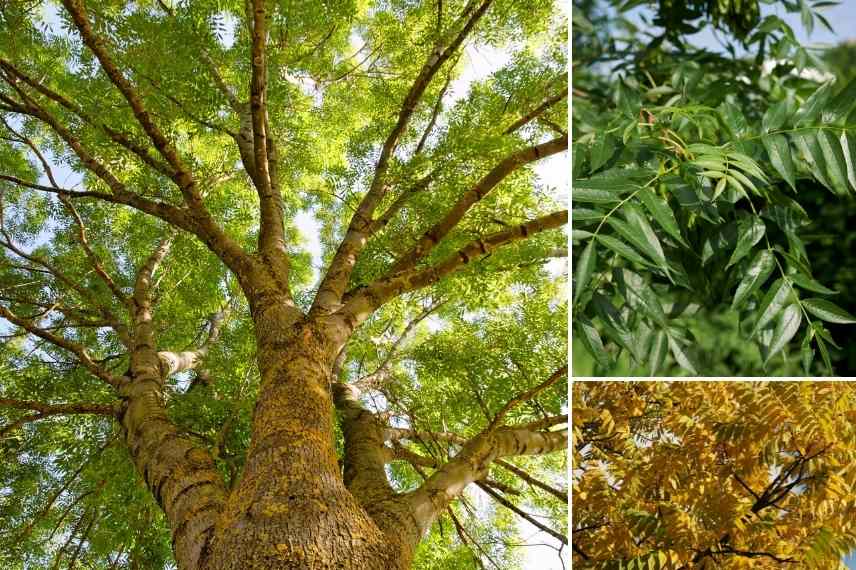
Fraxinus excelsior, detail of the foliage and autumn coloration
The glutinous alder: the tree of our wet mediums
We all know the Glutinous Alder (Alnus glutinosa), also known as Black Alder, or Vergne, a pioneering tree in our flora that grows in wet, even waterlogged soils. There is a remarkable variety of this native species thanks to its foliage: the Alnus glutinosa ‘Imperialis’.
The Alnus glutinosa ‘Imperialis’ indeed boasts very beautiful laciniate foliage, meaning it is cut into narrow, pointed lobes, somewhat reminiscent of fern fronds. Its branches are adorned early in spring with numerous pendulous yellow-green aments. The ‘Imperialis’ alder has a pyramidal and airy habit, growing relatively slowly, reaching heights of 8 to 10 m and widths of 3 m. Its deciduous foliage, although it remains on the tree for a long time, is light green and slightly glutinous to the touch. The fruit is a type of small cone called a strobilus (resembling mini pine cones), measuring 2 cm long and containing tiny winged seeds.
Suitable for medium-sized gardens, this small pyramidal tree is also very resistant to diseases and pests. Highly cold-resistant, it thrives in waterlogged and poor soils. It is an elegant small tree with the appearance of a giant fern, to be planted in cool to moist, humus-bearing, even peaty and poor soil, preferably acidic, in full sun or partial shade.
Note: The alder has an extremely developed root system (up to 4 m deep), so keep it away from foundations and buildings! It is also worth noting that the glutinous alder is a tree that purifies and enriches the soil in which it is planted, as its roots transform atmospheric nitrogen into plant proteins.
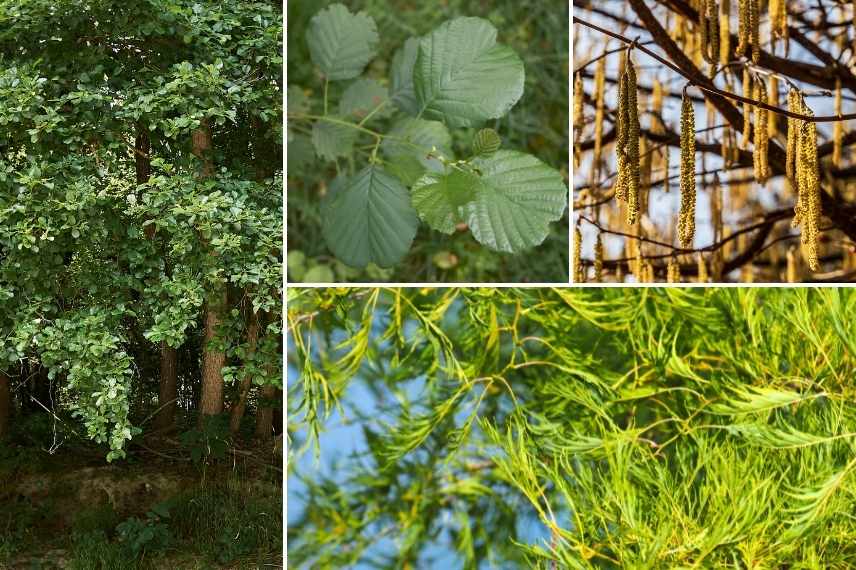
Alnus glutinosa
Eucalyptus stellulata: a touch of exoticism
L’Eucalyptus stellulata is a species native to the mountains of South-eastern Australia, typically found near waterways and marshy areas. It is valued for its beautiful stature, decorative bark (black at the base), umbel habit, and white pompom-like flowering that occurs in late winter in our climates (February to March). This lovely tree also features a grey-green-blue evergreen foliage.
This gum tree develops multiple trunks from its base, topped by a wide yet airy crown, and has a slightly weeping habit. Over the years, it can reach a height of 15 m with a spread of 8 m. It is moderately hardy, but a well-established specimen will withstand short frosts down to -14 °C. The evergreen foliage releases a peppermint scent when crushed. The old black bark exfoliates in large flakes each year, revealing a fresh bark striated with white and olive green.
This eucalyptus will adapt to many regions and will appreciate a well-prepared, moist, fresh to wet soil, not too calcareous, in a warm and sunny position. It is a large tree best suited for spacious gardens where it will make a stunning specimen to place in isolation.
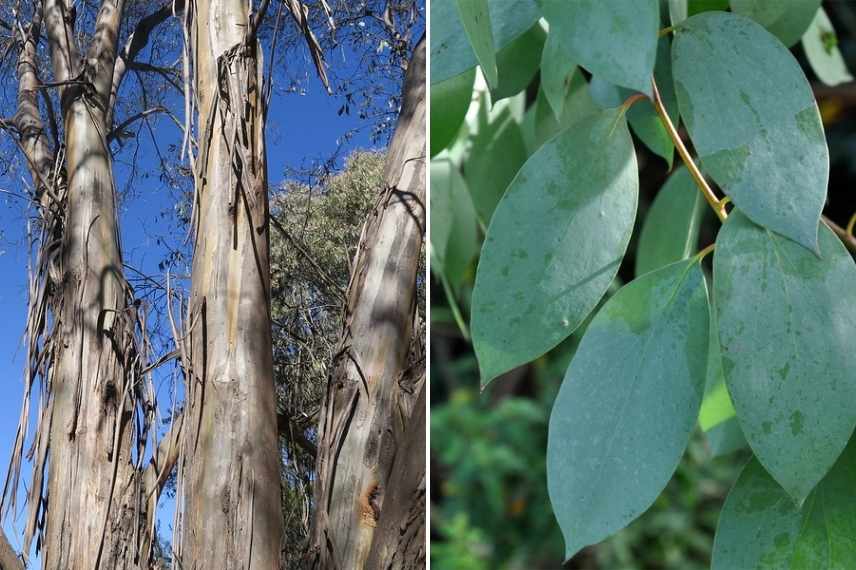
Eucalyptus stellulata: bark (© Harry Rose) and detail of the foliage
The Large-leaved Maple: little known, but stunning!
The Acer macrophyllum, or Big Leaf Maple, is a tree native to the west coast of the United States, found along rivers, in woods, and in wet valleys. It is a deciduous tree with large leaves (hence its name!) that are truly spectacular.
The young leaves emerge in a bronze-green hue. They unfold during April, coinciding with the flowering. Each leaf, divided into 3 to 5 lobes, measures between 15 to 30 cm. Its large size (up to 12 m at maturity) and clusters of yellow, fragrant flowers followed by beautiful winged samaras add to the remarkable nature of this rare species in cultivation. Like many maples, it displays beautiful foliage colours in autumn: coppery brown.
Cold-resistant, the Acer macrophyllum will thrive in deep, cool to moist soils, in a sunny position. It struggles in heatwaves and does not tolerate dry soil. Due to its size, it is best suited for parks or large gardens.
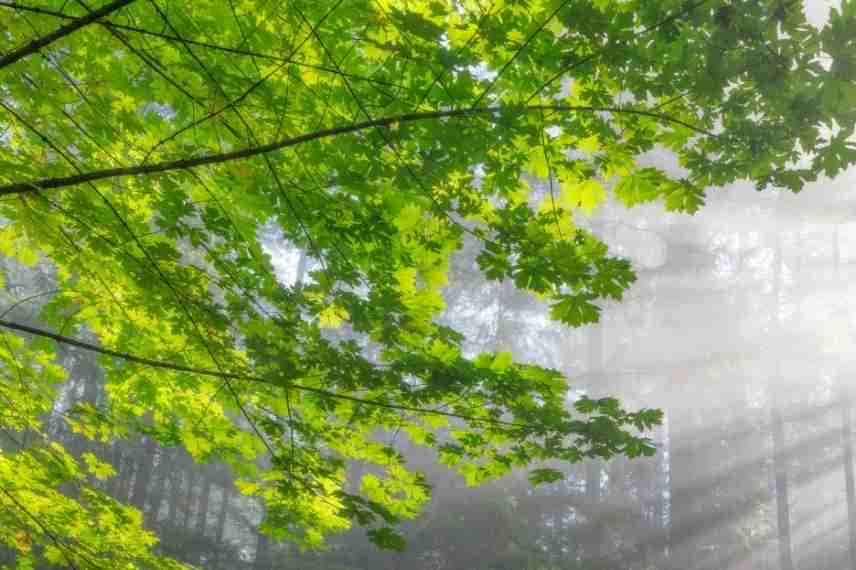
Acer macrophyllum
The Italian Poplar: iconic and timeless
The Populus nigra ‘Italica’, or more simply, Italian Poplar, is, in our region, the quintessential alignment tree along rivers, canals, banks, and roads. It’s hard not to recognise this tall tree with its dark, slender silhouette and almost columnar habit. This poplar is considered a subspecies of black poplar (or sometimes just a simple cultivar), introduced to Italy as early as the 18th century, originating from Afghanistan and Iran.
The Italian Poplar has deciduous foliage of a glossy dark green, turning a beautiful golden yellow in autumn. Its triangular, dentate leaves appear in early spring. The tree develops a vertical trunk rising to the crown, without large secondary branches, but with multiple fine, almost vertical branches, all tightly pressed against the trunk. The inflorescences take the form of pendulous aments, appearing in March-April. After wind pollination, the female trees (Populus nigra is a dioecious species) bear ovoid capsules grouped in chains, from which the cottony seeds will be dispersed by the wind.
Fast-growing, the Italian poplar can reach 30 m in height and 5 m in width. Its root system is very spreading and extensive, and the tree tends to sucker. So, plant your Italian Poplars away from buildings (at least 30 m)!
Very hardy and accommodating, this robust poplar adapts to all soils that remain cool to moist, even clayey or calcareous. This tree prefers a well-sunny position. The Italian Poplar is best reserved for large gardens, landscaping in parks, or planted along waterways or near ponds.
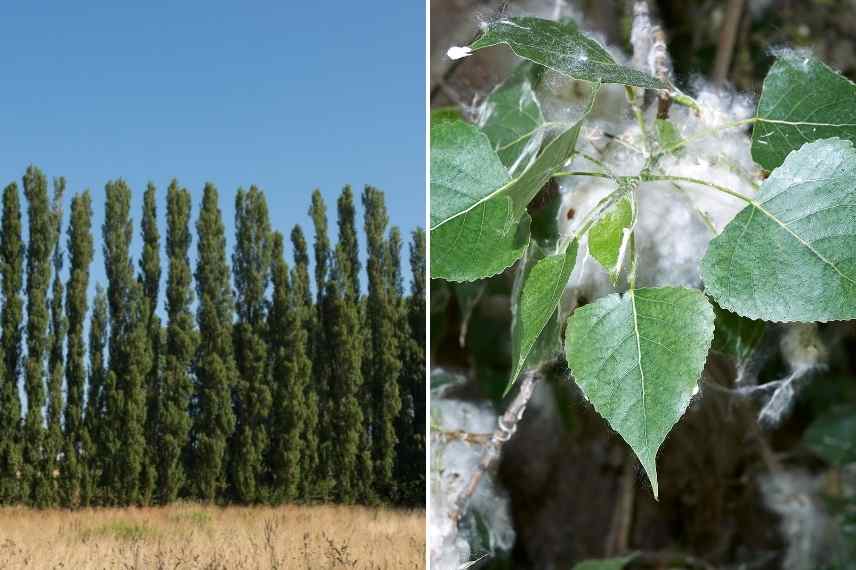
Populus nigra ‘Italica’
Metasequoia: the conifer thought to be extinct
The Metasequoia glyptostroboides ‘Gold Rush’ is a beautiful Japanese selection with golden foliage from a species of large deciduous conifer that was thought to be extinct for millions of years. The Metasequoia glyptostroboides, also known as Water Fir or Chinese Redwood, is native to China and was only discovered in 1941 in Sichuan. It is the only surviving species of a very ancient genus, dating back to the Cretaceous period, which saw the extinction of terrestrial dinosaurs and the beginning of an ice age.
This large deciduous conifer develops very bright light yellow foliage in spring, turning green-yellow in summer, then golden, before changing to rust in autumn, before shedding. It grows more slowly than the typical species and its development is also less significant: 15 m tall nonetheless! It develops a lovely trunk that is clearly visible in winter, covered with cracked reddish-brown bark. Flowering occurs on mature specimens. The inflorescences are globose, scaly cones.
It is best to plant the Metasequoia glyptostroboides ‘Gold Rush’ in a garden that is large enough: for its 15 m height, it can indeed spread 5 m in width. This conifer should be planted in deep soil, close to neutral or slightly acidic, rather fertile, fresh to moist. It tolerates heavy, clayey soils well, but prefers looser, loamy or sandy soils, not too calcareous. The Metasequoia enjoys a sunny and well-exposed location. This hardy conifer is wary of scorching summers and overly dry soils.
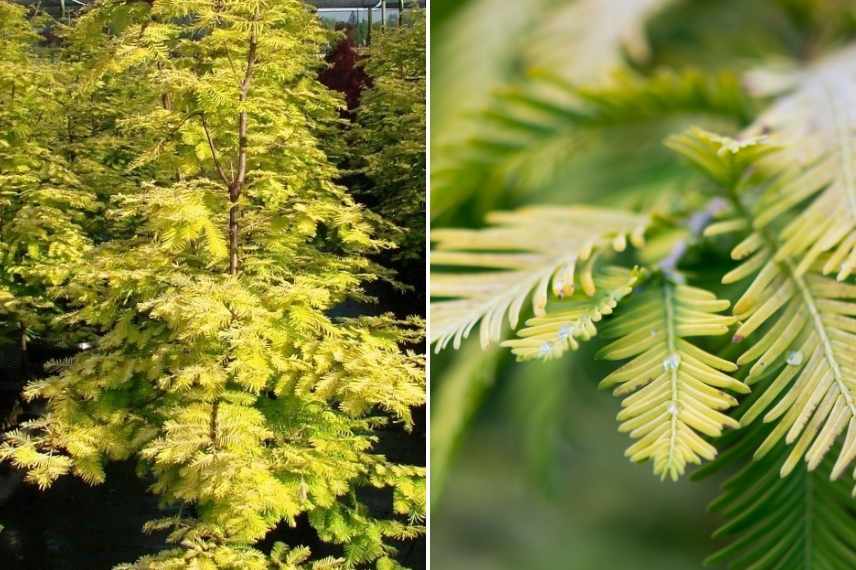
Metasequoia glyptostroboides ‘Gold Rush’
For further reading...
If you can’t find what you’re looking for in this selection of trees for heavy, wet soil, or if your garden is a bit too small to accommodate large trees, discover: 10 bushes or small trees for heavy, wet soil.
Also read: What to plant in clay-limestone soil? Tips and suitable plants.
- Subscribe!
- Contents
Comments