





























3 ideas for beautiful winter flower beds
Dare to add colour in the garden this winter!
Contents
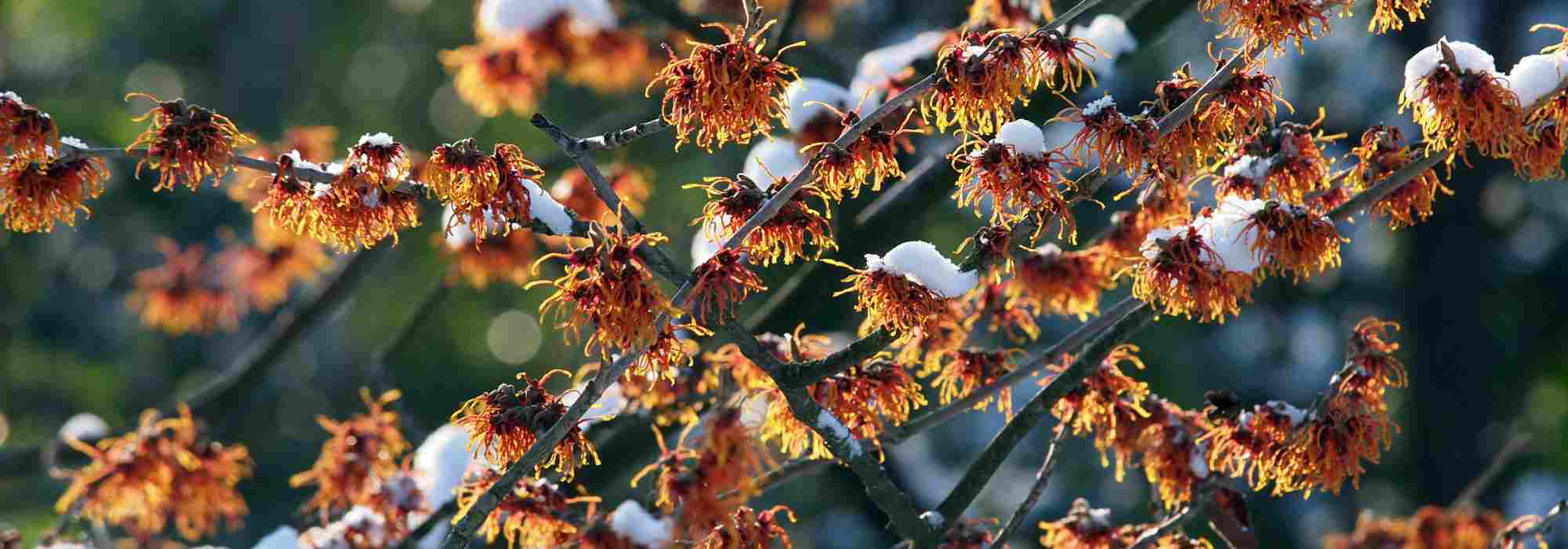
Winter has settled in our gardens, and sometimes we regret not having made more room for plants that thrive in this cold season, adorning the garden with often surprising colours and textures. By positioning a winter-toned bed near an entrance or visible from the window of a living room, we can enjoy the grace of these colourful plants for many weeks. Hamamelis, cornus, dwarf conifers, bare bark, hellebores, and other Daphne come into play and combine with other graphic or fragrant plants to bring brightness back to the garden and comfort to the heart of winter!
We offer you some ideas for beds to create in the garden on this advice sheet. You can also draw inspiration from these displays to enhance a base that lacks flair.
→ Read also: The Winter garden.

A large fiery flowerbed
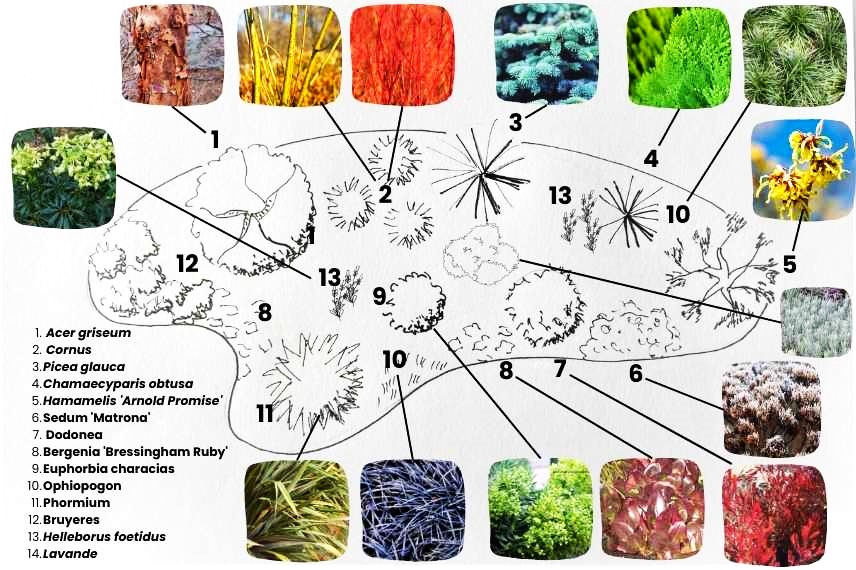
Let’s first address the idea of a generous border that would take place in a large garden, in a sunny position. The aim here is to mix different types of plants, focusing primarily on the fiery effect the whole will have in the depths of winter, in a very winter garden style that our English gardening friends excel at.
This type of border is based on plants with strong personalities, either through their shape or texture, and on colour contrasts to create a vibrant plant tableau. We use the palette of blues and yellows in conifers (Picea pungens ‘Thuem’ and Chamaecyparis obtusa ‘Aurora’) and a Euphorbia characias ‘Wulfenii’. Additionally, we add a fiery yellow and red base with coloured-stemmed Dogwoods (Cornus sanguinea and Cornus sericea), a few touches of purple with a Dodonaea viscosa ‘Purpurea’ or a semi-evergreen Berberis thunbergii ‘Atropurpurea’.
The idea is to balance this large border with a remarkable bark tree, such as an Acer griseum (but it could also be a birch with white trunks or a David maple with snake-skin bark), evergreens with interesting foliage (Pittosporum tenuifolium, variegated euonymus, as well as perennials like Hellebores argutifolius or foetidus), to distribute some blooms such as those from heathers (Erica x darleyensis and Erica carnea), and a Hamamelis in yellow or orange. Leave some space for plants that will bloom a bit later in the season, so that this border remains attractive throughout the year (like Bergenia ‘Bressingham Ruby’, a lavender, or a Santolina chamaecyparissus).
A Phormium tenax and a beautiful mass of Sedums ‘Matrona’ complete the border: one chosen for its graphic quality and colours, the other for the brown touch it brings to this setting (and the essential late summer bloom). Finally, elegant little tufts of Ophiopogon, in black and light green, will be placed in the gaps to form a persistent groundcover and contrast with the other plants.
If your border is smaller, you can replace the trees with one or two shrubs like Mahonia, or a lovely winter viburnum (Viburnum bodnantense), and adjust the size of the conifers by choosing from elegant dwarf conifers.
@ Gwenaëlle Authier
A small semi-shaded bed
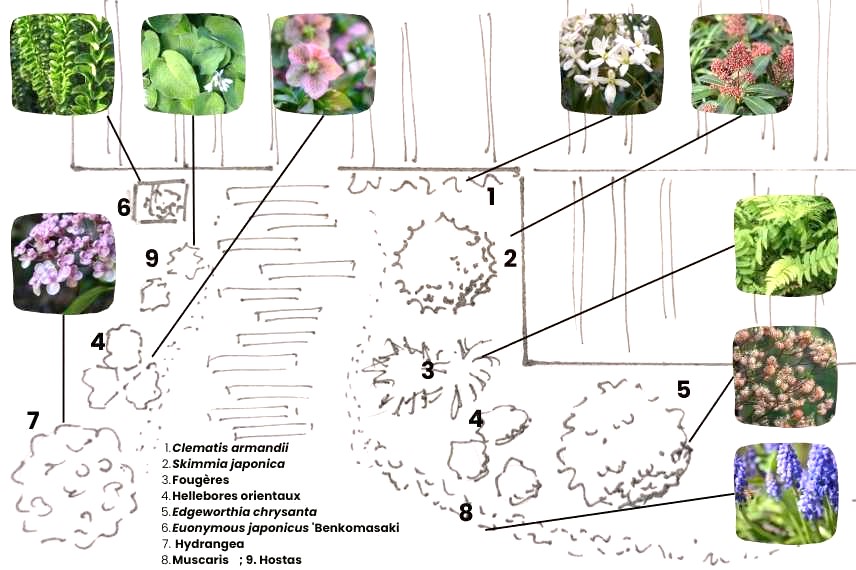
Winter beds often require bright light to reveal their vibrant colours. However, one can also consider a medium-sized bed in a semi-shaded area to bring a touch of cheer near an entrance or a pathway leading to the house, for example, every time one returns home.
This type of small bed, which will receive morning or late afternoon sun, is based on a vertical element provided by a winter clematis climbing along the wall (a Clematis cirrhosa ‘Wesley Cream’), or, later, a fragrant Clematis armandii. At its base, hellebore plants chosen to bloom for a long time until April (Oriental Hellebore and Hellebore foetidus) and a Skimmia japonica like the very colourful ‘Rubella’, whose buds appear in mid-winter for flowering around March. A lovely fern such as Dryopteris cycadina will take its place. Choose the small bulb you like best to further brighten the area at the end of winter (here the muscari).
To echo this long-lasting ornamental bed, place a beautiful container near the house featuring another original evergreen, such as the upright spindle tree ‘Benkomasaki’. The other side of the path will feature a group of hellebores, surrounded by more attractive plants in summer such as hostas and a lovely lilac-flowered hydrangea.
If you have more space, integrate a small shrub of winter interest at the back of the plan, such as Edgeworthia, a superb shrub also known as paper bush, which will bloom as early as February with its unusual yellow or orange bell-shaped flowers, depending on the cultivar. Its foliage and silhouette remain very ornamental once flowering is over, at the end of April.
@ Gwenaëlle Authier
Bark, grasses and conifers
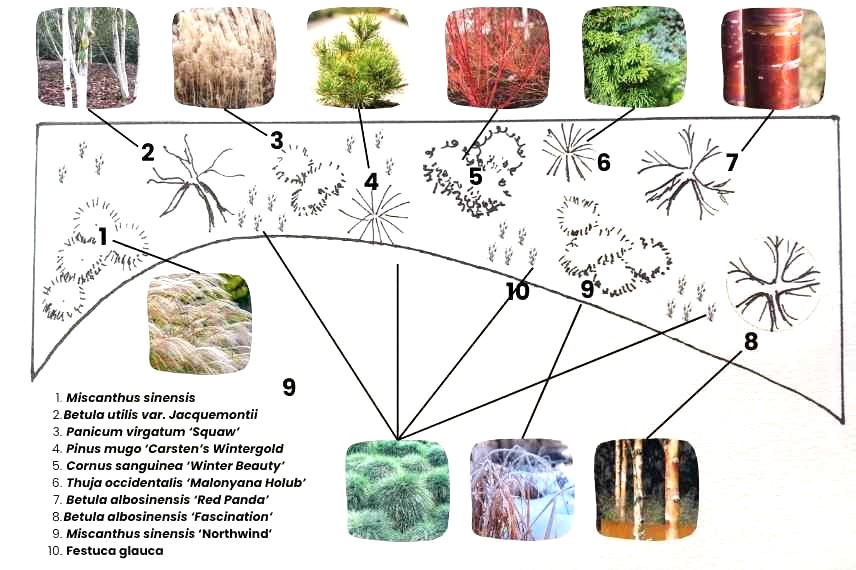
The winter bed can also be designed solely around attractive evergreen foliage for their contrasting colours and colourful wood, combined with the bark of a beautiful tree or bare purple or red branches. Here, there is no need for flowering; the aim is to highlight the most spectacular colours rendered by the cold and to associate them with one another. Thus, a more graphic aspect is desired, in the purest spirit of a winter garden.
In this example exposed to the sun, we rely on three beautiful trees with colourful bark: a Betula albosinensis ‘Fascination’, orange, and a Betula albosinensis ‘Red Panda’, more reddish (it could also be a beautiful bark like that of the Cyprus strawberry tree, Arbutus andrachne), which is evergreen. We add to one side of the bed the whiteness of the bark of a Betula utilis var. jacquemontii, ideally trained as a coppice.
When it comes to conifers, the choice is vast, we select in this example two conifers of complementary sizes: a Pinus mugo ‘Carsten’s Wintergold’ for its golden colour, and a Thuja occidentalis ‘Malonyana Holub’ for its original habit.
Some low and taller grasses will be placed in the centre and on the edges of this large bed for effects of lightness and incomparable charm under the frost: Miscanthus sinensiss, Panicum virgatum ‘Northwind’ and ‘Squaw’, as well as a number of blue fescues or Helictotrichon lower down to fill the bare spaces and add a bluish touch.
Finally, three dogwoods with colourful wood like Cornus sanguinea ‘Winter Beauty’ will ensure a blaze during the long winter months.
If you absolutely want to add some flowering, focus solely on heathers planted in masses to create a low undulation, stretching (almost) throughout the year by choosing the right species (read How to choose a heather? for this). They can replace the clumps of fescue. Otherwise, lavenders will provide a beautiful persistent greyish spot in winter, and their mauve spikes for summer!
@ Gwenaëlle Authier
Read also
Mahonia: 7 companion planting ideasThe plant palette
For better readability on plants, we list here the plants and bushes from our winter border examples:
Sunny border all fire and flame
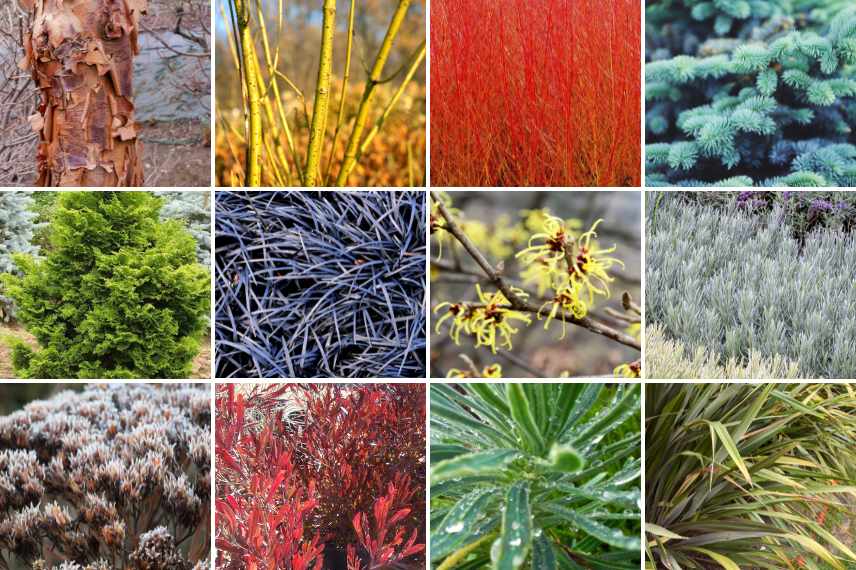
From top left to bottom right: Acer griseum, Cornus sericea, Cornus sanguinea, Picea pungens, Chamaecyparus obtusa, Ophiopogon planiscapus ‘Nigrescens’, Hamamelis ‘Arnold Promise’, lavender, Sedums, Dodonea purpurea, Euphorbia characias and Phormium tenax
Small semi-shaded border
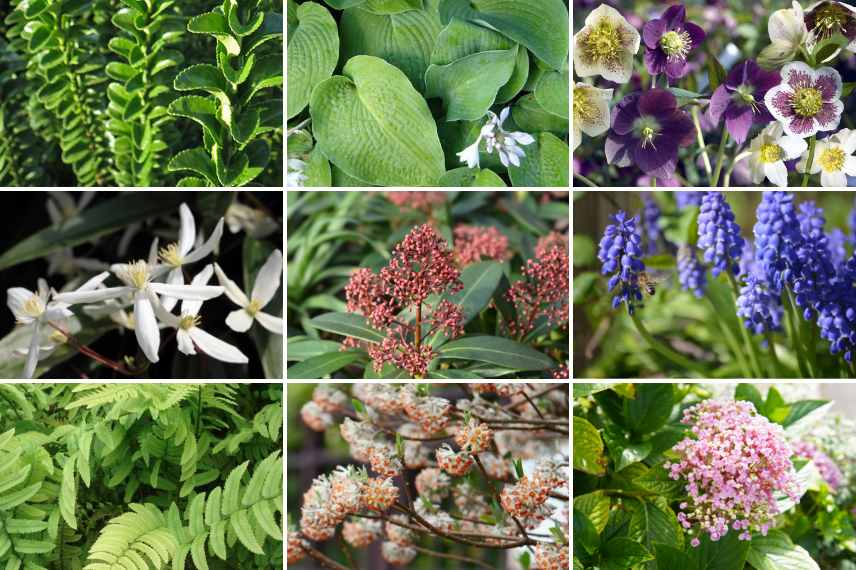
Euonymus japonicus ‘Benkomasaki’, Hosta ‘True Blue’, Hellebores, Clematis armandii, Skimmia japonica, Muscaris, Dryopteris cycadina, Edgeworthia chrysantha ‘Red Dragon’ and Hydrangea macrophylla ‘Ayesha’
Barks, grasses and conifers
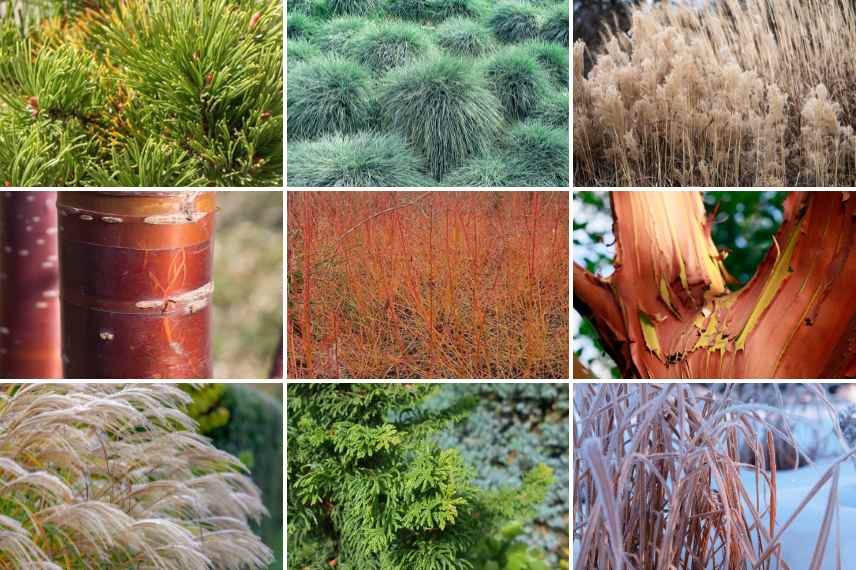
Pinus mugo ‘Carsten’s Wintergold’, Festuca glauca, Panicum virgatum ‘Squaw’, Betula albosinensis ‘Red Panda’, Cornus sanguinea ‘Winter Beauty’, Arbutus andrachne, Miscanthus sinensis, Thuja occidentalis ‘Malonyana Holub’ and Miscanthus sinensis ‘Northwind’
- Subscribe!
- Contents

Comments