





























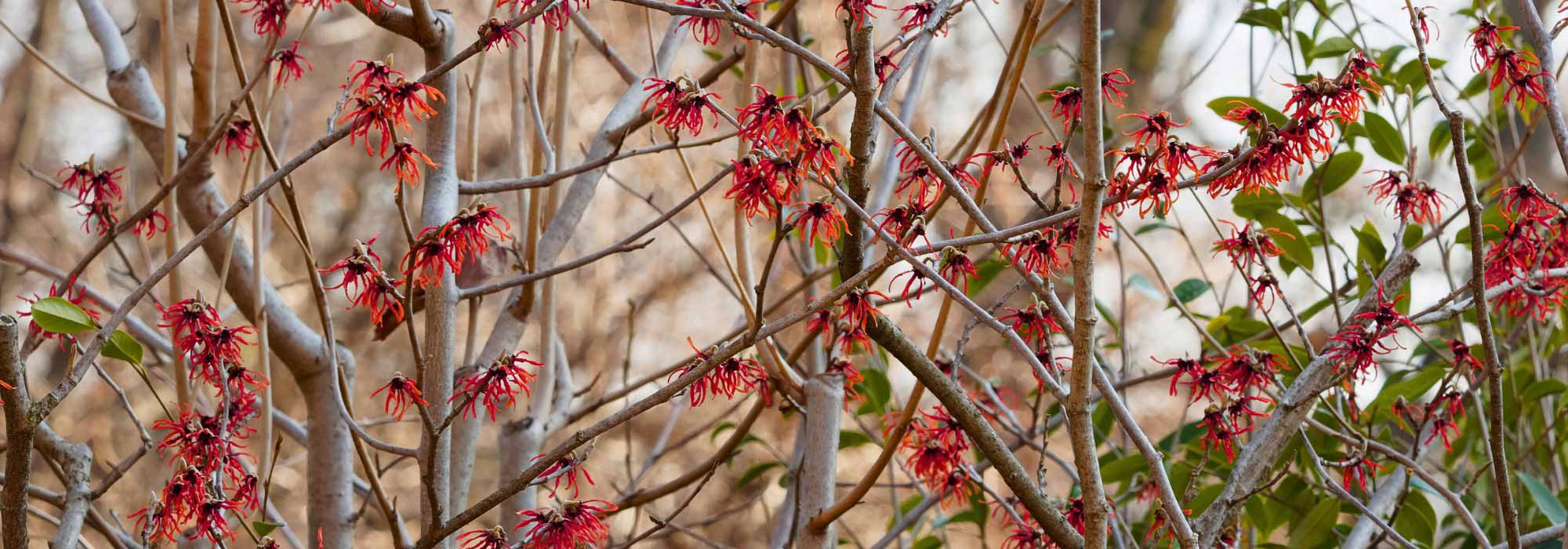
4 red-flowered Hamamelis for a dazzling winter garden
Ideal varieties to liven up your garden in winter
Contents
The Witch Hazel is an elegant shrub particularly sought after for its spectacular and fragrant flowering in the heart of winter. Its strange flowers, resembling small coloured spiders, bloom on the naked branches, igniting the garden still asleep in the cold. Delightfully scented, they emerge before the leaves appear, defying snow and frost. Its deciduous foliage also extends the enchantment from autumn, displaying all the warm hues. Flowering most often in golden yellow or coppery orange, the red colour is rarer in this shrub, making it all the more dazzling. Hardy, Witch Hazel thrives in most of our regions and enjoys sun or partial shade and heather soil that is not calcareous. Discover our selection of red-flowered Witch Hazels that will set your garden ablaze during the cold season.
→ To learn more, check out our complete guide on Witch Hazel: planting, growing, care, and pairing ideas.

Hamamelis (x) intermedia ‘Rubin’
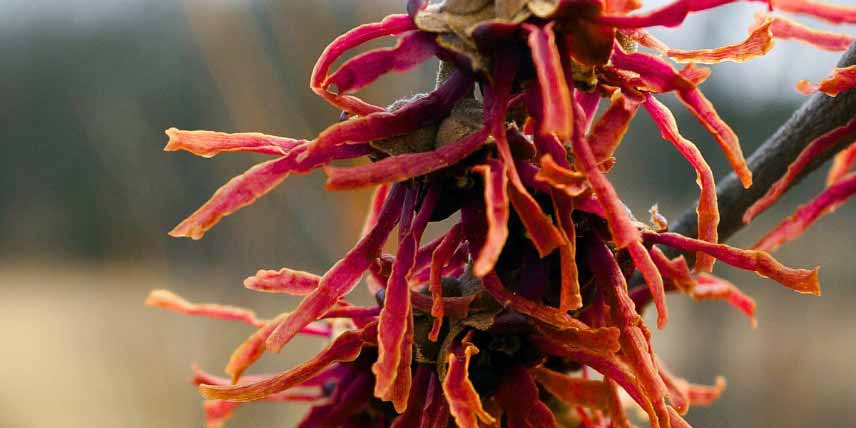
Considered as one of the best varieties with red flowers, ‘Rubin’ has received the Award of Garden Merit from the Royal Horticultural Society (RHS) in England. This hybrid cultivar, resulting from the cross-breeding of Hamamelis japonica and Hamamelis mollis, stands out for its fiery winter flowering that brightens the garden while it is still asleep. It has a spreading and elegant habit, typically reaching 3.20 m in all directions. Its flexible, spreading branches create a graceful silhouette, perfect for small gardens. It is in winter that Hamamelis intermedia ‘Rubin’ reveals its full beauty. Its dark red flowers, shaped like small frayed ribbons, claw-like like witch’s fingers, appear directly on the bare branches, often as early as January and into February. The fine, twisted petals resemble crumpled silk ribbons. These flowers emit a light fragrance and last for several weeks, enduring the winter weather.
The deciduous foliage of this shrub is just as interesting as its flowering: the ovate leaves, initially yellow-green with bronze highlights in spring, turn dark green in summer. As autumn approaches, they don vibrant hues ranging from yellow to coppery orange.
Thanks to its elegance, this shrub particularly thrives when planted alone or in a border where it will be the winter focal point alongside, for example, Chimonanthus praecox with its sulphur-yellow flowers, another winter-flowering shrub.
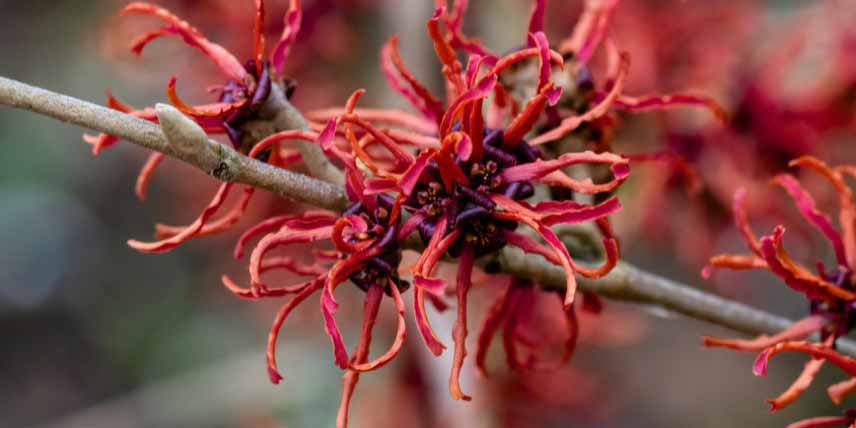
Hamamelis intermedia 'Diane'
Another variety awarded the prestigious Award of Garden Merit, Witch Hazel ‘Diane’ also boasts ruby-red flowering that brightens the garden in the heart of winter. From December, while the garden is still dormant, Witch Hazel ‘Diane’ unfurls its flowers in clusters along its branches, still bare of leaves. These flowers are characterised by fine, undulating petals of an intense red, opening in small tufts reminiscent of delicately crumpled ribbons. Sumptuous, they capture sunlight through dew and frost. Unlike other varieties, the red hue here is more pronounced, sometimes with hints of purple, adding a splash of vibrant colour that draws the eye in an often dull landscape. In addition to its beauty, this flowering is accompanied by a light fragrance, enhancing its appeal at a time when few plants are in bloom.
The foliage, although not evergreen, contributes to the interest of the bush during the other seasons. In spring, the young leaves emerge with a slightly bronzed yellow-green, then in autumn they adorn themselves with vibrant colours ranging from golden yellow to coppery orange, often mixed with deep red, extending the display of colours before the leaves fall.
With its bushy silhouette reaching heights of 3 to 4 metres, it is perfect for enlivening a hedge in autumn and winter, combined with evergreen foliage that will highlight its beautiful flowering, such as a Autumn Camellia. In a winter bed, it can be paired with some Cornus alba ‘Baton Rouge’.
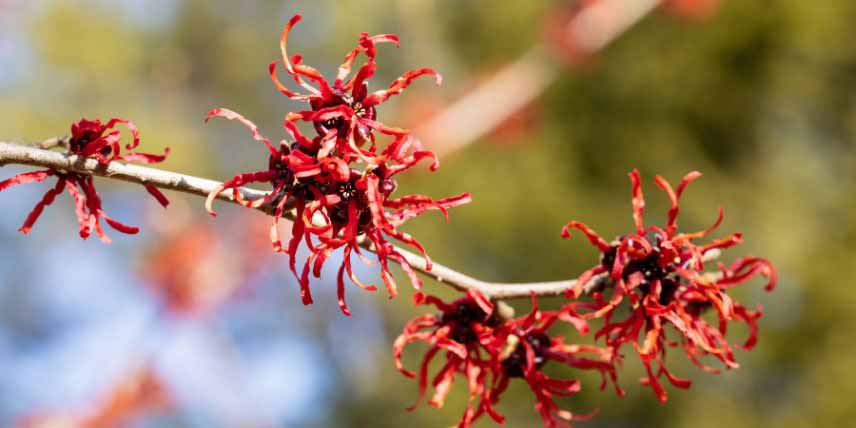
Hamamelis intermedia 'Ruby Glow'
Hamamelis ‘Ruby Glow’ is another remarkable variety that draws attention with its unique winter flowering. The flowers, with their spider-like shape, are a coppery red, featuring fine, fringed petals that seem to delicately float on the naked branches. Like spiders, they dot the bare twigs before the foliage appears. The narrow, undulating petals in shades of purple-red form dishevelled clusters, giving the bush a singular and flamboyant appearance. Their abundance, fiery hues, and the heady fragrance of hyacinth, honey, and mixed daffodils warm up the winter. The deciduous foliage also ignites in autumn, taking on golden and orange hues before falling. In terms of size, ‘Ruby Glow’ typically reaches between 2.5 and 3 metres in height, with a similar width. For a colourful winter garden, you can pair it with one or more ornamental fruit shrubs such as the ornamental apple Malus toringo ‘Tina’. At its base, you could plant, for example, winter heathers.
Read also
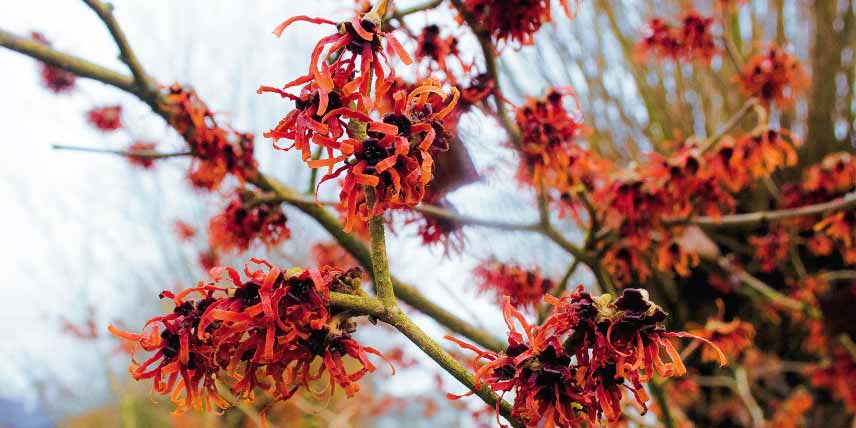
Hamamelis: the most beautiful varietiesHamamelis vernalis 'Washington Park'
In the heart of winter, from January to March, the Hamamelis vernalis ‘Washington Park’ delights us with its abundant flowering on its naked branches. A multitude of small flowers with fine, twisted petals in a purplish-red colour bloom like tiny, colourful spiders. They release their sweet and slightly spicy fragrance in the midst of winter. Unlike other witch hazels, this variety offers a longer and particularly generous flowering, lighting up the garden for many weeks. The foliage, rather ordinary during the growing season, transforms in autumn to provide a spectacular display. The dark grey-green leaves in summer take on orange and intense red hues as the days shorten, thus extending the decorative interest of the bush after flowering. In this variety, they persist for a long time on the branches before falling. In a mild climate, it will look magnificent alongside a Grevillea victoriae and a Loropetalum chinense ‘Black Pearl’, which will echo its flowering with their curious strap-like flowers in a very bright pink-red. The base of the bush can also be dressed with Hellebores that, with their elegant flowering, will enhance its enchanting winter appearance.
- Subscribe!
- Contents
Comments