





























5 great pairing ideas with bulbine
Successful plant combinations for the garden or in pots
Contents
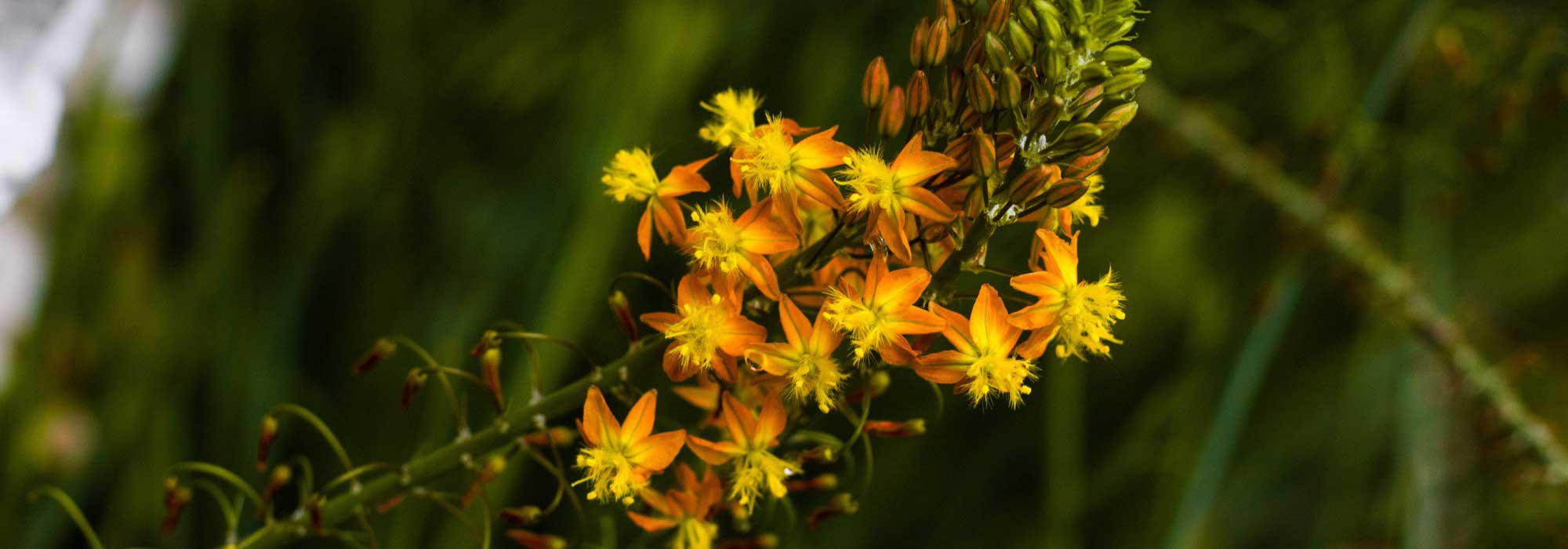
Bulbine frutescens is a beautiful South African perennial, exotic and drought-tolerant, ideal in arid Mediterranean rockeries or dry coastal gardens. It forms a dense groundcover, at least 60 cm wide and 30 cm tall, with succulent leaves, from which emerge, from spring to autumn, spikes of star-shaped flowers, orange or yellow. In mild climates, it can flower year-round, especially if protected from winter cold, as it is rather frost-tender (-6°C in dry soil). Cultivated in a large pot on a terrace or balcony, it can be overwintered indoors or in a conservatory to prolong its flowering. Its main requirement is well-drained soil and a sunny position. It is very easy to pair, as it harmonises with hardscape as with planting. Whether in a sunny rockery, on a large slope, in a pot, on a terrace or in a border, Bulbine pairs with all plants suited to dry soil. Discover our five pairing ideas to accompany this succulent, floriferous plant!

In a sunlit rockery
Bulbine frutescens has its rightful place in a sunny, Mediterranean-style rock garden. It’s a very pretty plant for a drought-tolerant, waterwise garden. It pairs wonderfully with a range of plants that share its heat tolerance and its ability to thrive in arid conditions. For example, pair the Bulbine frutescens ‘Medicus’ with its bright yellow flowers, with rockroses such as rockroses, rosemaries, lavenders and Santolines which will form a very ornamental evergreen base. It forms a magnificent pairing with l’Allium karataviense ‘Red Giant’, whose globose inflorescences in purplish-red add a sculptural and contrasting touch. In pursuit of harmony, the chartreuse-green and golden flowers of Euphorbia myrsinites, the Calylophus serrulatus ‘Superlophus Yellow’ in large lemon-yellow cups and the lime-green foliage of a Coleonema pulchellum or of Pittosporum tenuifolium ‘Gold Star’ will echo Bulbine’s flowering, while the garnet-red flowers of Pelargonium sidoides will bring a bright, contrasting splash of colour.
In a more contemporary rocky setting where all the plants share the same undemanding temperament, alongside bulbines, the presence of Aeonium ‘Schwarzkopf’ will add a dramatic note thanks to its dark foliage and the Agave desmetiana ‘Variegata’ will form very bright rosettes of evergreen leaves. A Beschorneria yuccoides, more graceful, will finish shaping this exotic and mineral composition.
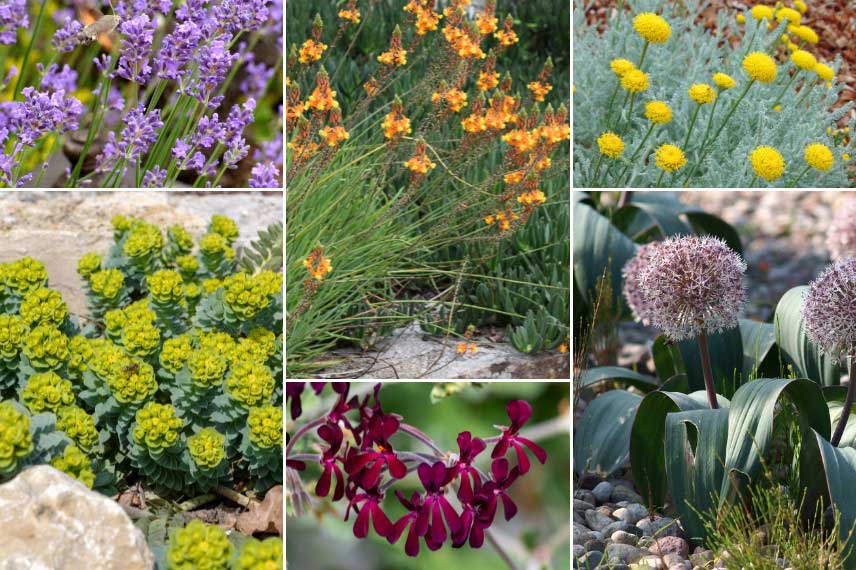
Lavandula angustifolia (photo: Niepokój Zbigniew), Bulbine frutescens, Santolina chamaecyparissus, Euphorbia myrsinites, Pelargonium sidoides and Allium karataviense
Read also
Bulbine: planting, growing and caringOn a large slope
An ultra-drought-tolerant plant, Bulbine frutescens thrives in a dry space and takes root on contact with the soil, gradually forming a dense groundcover. In this setting, it is interesting to pair it with grasses growing in low cushions, such as Stipa tenuifolia, golden with a tousled head or with greyish tufts topped with yellow flowers, with Santolina chamaecyparissus and Helichrysum italicum. Complete your dry slope with a few bushes bursting with flowers such as the Cistus (x) purpureus ‘Alan Fradd’, perfectly drought-tolerant and suited to rocky soils. The prostrate rosemary can mingle with this display by forming a fragrant groundcover.
With its small white and pink daisies, a Dimorphotheca or Osteospermum will fill the gaps, just as Delosperma, and small sedums. The Agave americana ‘Variégata’, with its broad leaves edged in yellow, and the Yucca, imposing in their structure, provide strong architectural accents that stand out on the slope.
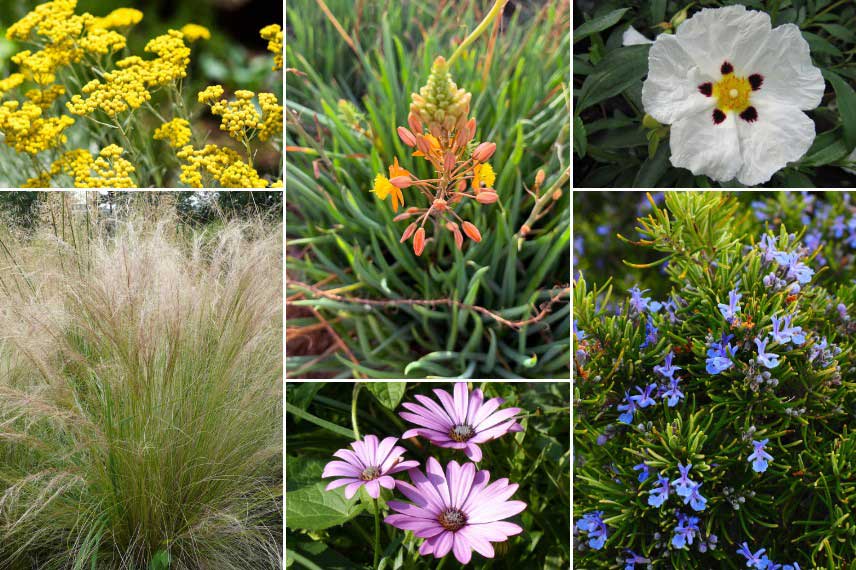
Helichrysum italicum, Bulbine frutescens, Cistus ‘Alan Fradd’, Stipa tenuifolia, Osteospermum ‘Summersmile Soft Violet’, Rosmarinus officinalis ‘Prostratus’
In a seaside garden
The Bulbine frutescens is an excellent plant for a coastal garden. In a coastal garden, its flowering can renew itself all year round if the winter is very mild. It thrives in full sun, in soil that is very well drained, even stony, among plants that, like it, tolerate salt spray and require virtually no maintenance or watering. It will form pretty, contrasting—indeed striking—associations with the agapanthus, elegant and so graceful. Choose varieties bearing blue umbels, very dark, almost black, such as the Agapanthus ‘Black Magic’ for example. For a striking, truly exotic display, pair the Bulbine with Echium candidans, or Viper’s Bugloss, consisting of long spikes of spectacular blue-violet flowers. It also thrives in coastal gardens in the company of small South African daisies such as the Lampranthus aurantiacus with sun-yellow flowers. The Pittosporum tobira ‘Nana’ and a Ulex europaeus will form a permanent, dense and colourful ground cover. The trumpet-shaped yellow flowers of a trumpet vine Campsis radicans ‘Yellow Trumpet’, this exuberant climbing vine, will, in a harmony of tones, echo the Bulbine’s colours. Finally, Phormium tenax will provide exoticism and structure in this garden with little risk of frost.
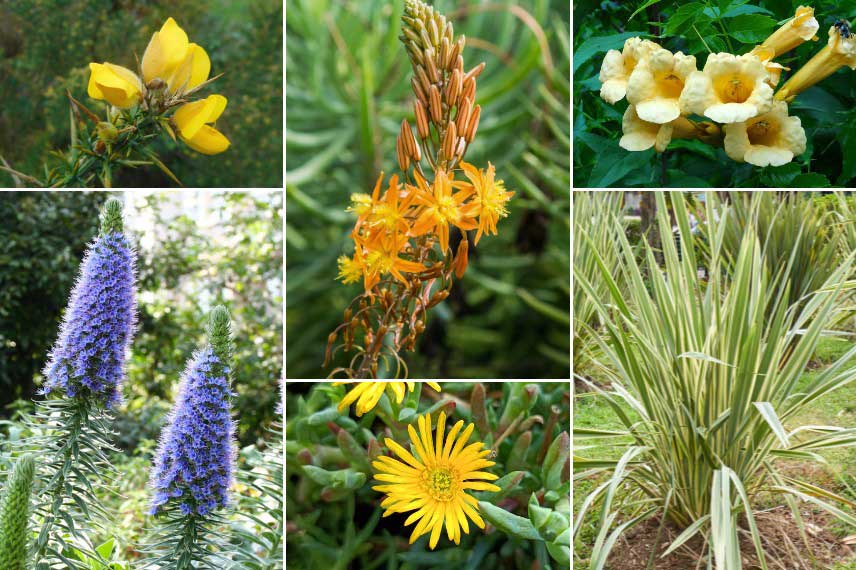
Ulex europaeus, Bulbine frutescens, trumpet vine Campsis radicans ‘Yellow Trumpet’, Echium candidans, Lampranthus aurantiacus, Phormium tenax
Read also
How to propagate Bulbine?In a colourful and lush flower bed
With its exotic charm and slender habit, the bulbine helps create lush scenes in midsummer with very floriferous dry-soil perennials. Arrange around a Bulbine frutescens ‘Hallmark’ a naturalistic, slightly wild feel with tall perennials. The bulbine threads its way through the light mist of the Foeniculum vulgare, placed at the back of the border, and brings bright highlights with its orange flower spikes. Echinacea ‘Tomato Soup’, with its large vibrant tomato-red flowers, adds depth, while the Kniphofia ‘Papaya Popsicle’ strengthens the exotic look with its warm-toned spikes of flowers. A Rudbeckia fulgida, with its large yellow flowers and dark centres, offers generous and radiant flowering until autumn. The Sedum autumn ‘Touchdown Teak’ with its deep pink inflorescences that fade to red, provides a beautiful colour transition along the bed border. Perovskia atriplicifolia, Buenos Aires Verbenas and Verbascum phlomoides ‘Spica’, to choose from among them, will bring colour contrast, a great sense of lightness and a handsome verticality to this scene, while their lilac, airy flowering drifts with great elegance. Some Achillea millefolium that tolerate drought will also be welcome in this opulent and melliferous setting. The Panicum virgatum ‘Squaw’, with its graphic foliage and reddish tones, structures the whole and adds movement. Finally, autumn asters, with their abundant small flowers, will prolong flowering until the first frosts.
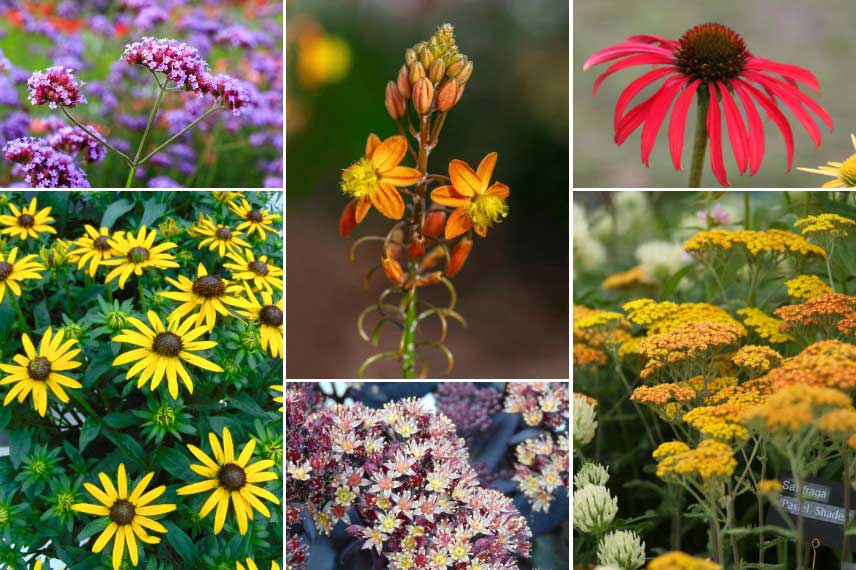 Verbena bonariensis, Bulbine frutescens, Echinacea purpurea ‘Tomato Soup’, Rudbeckia fulgida ‘Little Goldstar’, Sedum ‘Touchdown Teak’ et Achillea ‘Terracotta’
In a pot on the terrace
If temperatures in your area frequently fall below -10°C, favour growing in pots, bringing it indoors as soon as frost is forecast.
Bulbine frutescens becomes a real focal point when showcased in a handsome pot, wider than tall, where its tufted habit and tall, graceful flower stems naturally draw the eye.
In pots, this radiant perennial will form handsome associations with a Salvia ‘Victoria Blue’, a shrub sage with blue-violet flowers, blooming from May to autumn, a valuable ally for sunny and hot terraces, or even a south-facing balcony.
Gaura lindheimeri, with its delicate white flowers, will also be perfect in a neighbouring pot or in the background, where it will add an airy and light touch to the display, without competing.
For a more exotic and graphic touch, plant at the foot of your Bulbine some succulents such as houseleeks or small sedums in chocolatey or purplish tones; they will form a pretty drift of vegetation.
Placed not far away, a Cycas revoluta (in mild climates) or an agave will also provide a striking contrast of colour and foliage.
Finally, for a more ephemeral display, also consider annuals, nasturtiums and Thunbergia (Black-eyed Susan) which bloom in summer in the same warm tones.
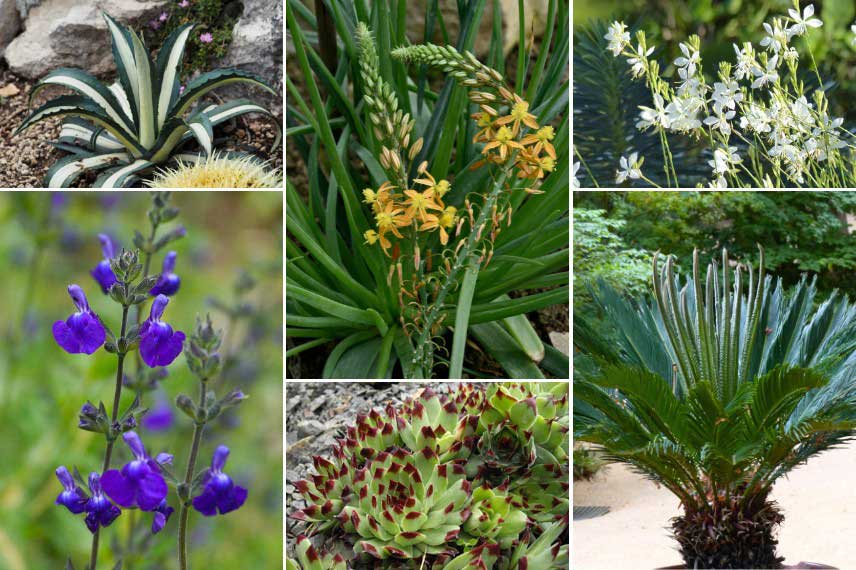
Agave americana ‘Mediopicta’, Bulbine frutescens, Gaura lindheimeri ‘Snowbird’, Salvia ‘Victoria Blue’, Sempervivum calcareum, Cycas revoluta
- Subscribe!
- Contents
Comments