






























5 mountain shrubs to revegetate a slope
Selection of hardy groundcover shrubs that withstand the harsh growing conditions of slopes
Contents
A mountain shrub is designed to withstand extreme conditions. Extremely hardy, it fears neither frost nor snow, which can persist for days, or even several weeks. However, it will also adapt to short, rather cool summers. These challenging cultural conditions have allowed them to adapt, and these mountain shrubs often display prostrate, dwarf and ground-covering habits. Characteristics that make them ideal plants for covering slopes, as well as garden areas subjected to harsh growing conditions. These mountain shrubs will need to withstand periods of drought, tolerate often poor soils, require only minimal maintenance, and offer dense, compact and ground-covering foliage. Likewise, they must adapt to slopes. And if, on top of that, they offer pretty flowering displays or colourful foliage, that’s even better.
Discover our selection of five mountain shrubs that can easily be grown on a slope in front of a house.

Winter heather or snow heather (Erica carnea)
Winter heather or snow heather (Erica carnea) is a small shrub with a low, spreading habit that quickly forms carpets of flowers in midwinter. It is not uncommon for the bell-shaped flowers of this heather to pierce the snow cover. The flowering in white, pink or reddish-purple generally begins in December and ends in March–April. The flowers are all the more visible as they unfold on dense foliage, composed of small, fine needle-like leaves, a rather dark green.
Native to the Alpine mountains, this perennial has every advantage for greening a slope. It is, first and foremost, extremely frost-hardy (between -20°C and -30°C depending on the variety), and stands up to winds. It also makes an excellent ground-cover plant that grows no more than 30 cm tall with a spread of 40 to 50 cm. Its vegetation is low and mat-forming, and above all evergreen, which makes it attractive all year round. Some varieties even offer foliage that changes with the seasons. Thus the leaves of Erica carnea ‘Foxhollow’ transition from bronze to golden-green between spring and summer before turning orange to red in winter.
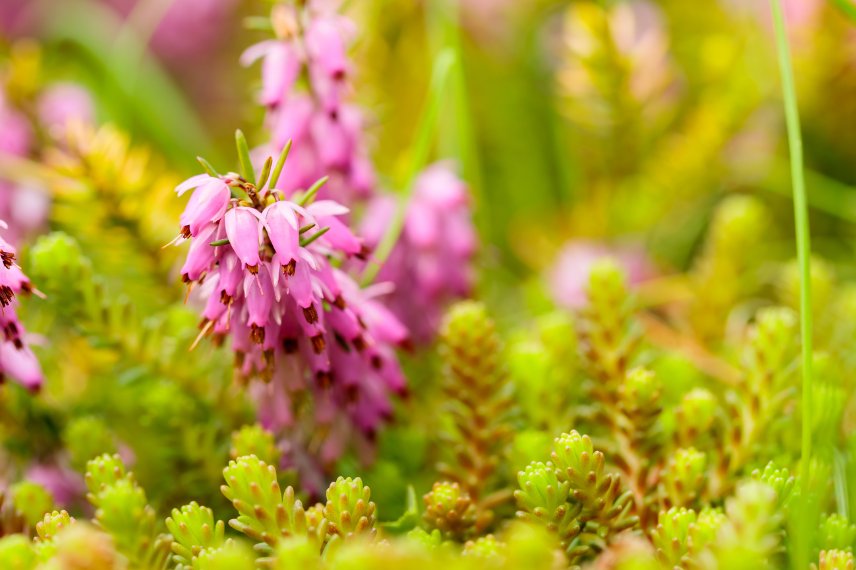
Winter heather or snow heather (Erica carnea)
Winter heather is above all an easy-to-grow shrub that can be planted in all soil types, including slightly calcareous or slightly acidic soils. The soil must, above all, be well-drained, which is the case on a sloping bank. It does not tolerate overly damp soils. It adapts just as well to sunny as to partly shaded positions. It can withstand some drought, provided it is planted in a moist, cool soil. On a slope, it is advisable to plant winter heathers in groups, combining varieties of different colours. They also pair very well with creeping conifers such as dwarf junipers.
Dwarf and creeping junipers (Juniperus)
Junipers (Juniperus) are conifers with evergreen foliage, particularly hardy, and therefore well suited to cold, frost and snow. Most of them are hardy far beyond -20°C. They are also resistant to high heat, even heatwaves and drought. So they will readily find a place on a slope. Provided you choose species with a creeping, low, prostrate habit, spreading widely. With its main branches truly prostrate on the ground, vigorous and long, and its short secondary branches, the creeping juniper (creeping juniper (Juniperus horizontalis)) is very well suited to slopes. It is an excellent groundcover with soft foliage that can spread 2 m to 2.50 m wide, rarely exceeding 30–40 cm in height. This species of juniper offers foliage in colours: ‘Blue Chip’ has blue-grey foliage that becomes purplish in winter, ‘Golden Carpet’ is light green with golden tips, ‘Limeglow’ shifts from lime-green to golden yellow in summer before turning bronze-purple in winter.
Another juniper is particularly well suited to slopes: the scaly juniper (Juniperus squamata) recognizable by its foliage in the form of alternate, incurved and very tight needles arranged in whorls of three. These needles are fairly broad, rigid and sharp. This shrub spreads 1 to 2 m wide and stands 30 to 50 cm high. Its foliage varies considerably with the varieties: ‘Blue Star’ offers blue-silver needles, as do ‘Blue Carpet’ or ‘Blue Spider’, while the foliage of ‘Holger’ is rather pale yellow and blue-green, and that of ‘Dream Joy’ yellow (the young shoots) and blue steel to blue-green (the older branches).
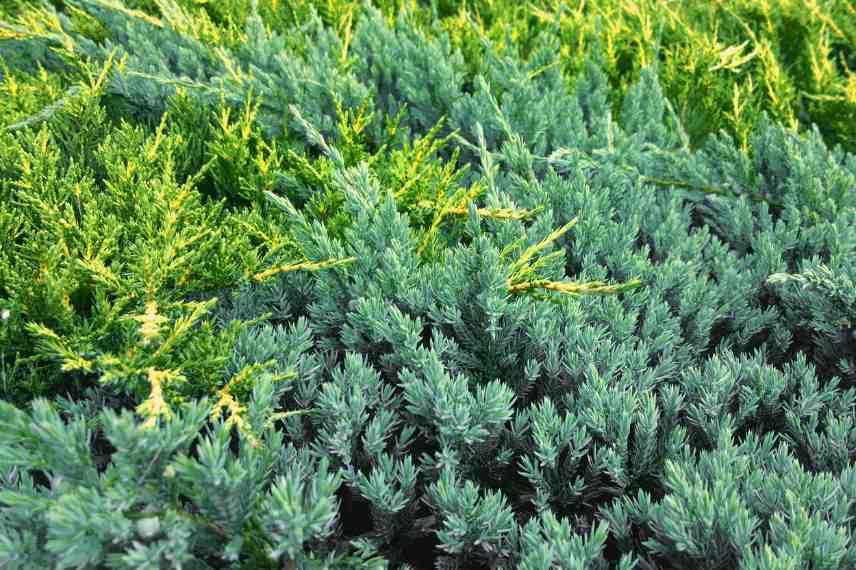
Juniperus horizontalis ‘Golden Carpet’ et Juniperus squamata ‘Blue Carpet‘
These creeping, low-growing junipers with a spreading habit prefer well-drained soils, from ordinary to poor, including calcareous, and sunny locations. They will need a little water in their first two years. After that, they will manage. They are wonderful as groundcover on a slope, but can also be planted above a wall or a low wall. They look stunning when paired with winter heathers, and grasses such as Stipa and the Miscanthus.
Mugo pine (Pinus mugo)
Mountain pine (Pinus mugo) is a dwarf pine, with a spreading habit, often quite contorted. With its twisted, usually creeping branches, and its knotted trunk, it is often described as a ‘lying pine’. Endemic to Europe’s mountains, it is hardy to at least -30°C, making it perfectly suited to montane climate. It is ideal for banks and slopes, as well as windy, exposed or stony sites. Depending on varieties, it can spread 2 to 2.5 m wide. Most mountain pines carry dark green needles, but some cultivars boast golden-yellow foliage such as ‘Mops Gold’. As for ‘Ophir’, it forms a compact ball of 1 m in diameter, with bright light-green foliage that turns to golden yellow in winter. By contrast, the variety ‘Varella’ stands out for its very long, slightly undulating needles. It forms a pretty ball with very dense foliage.
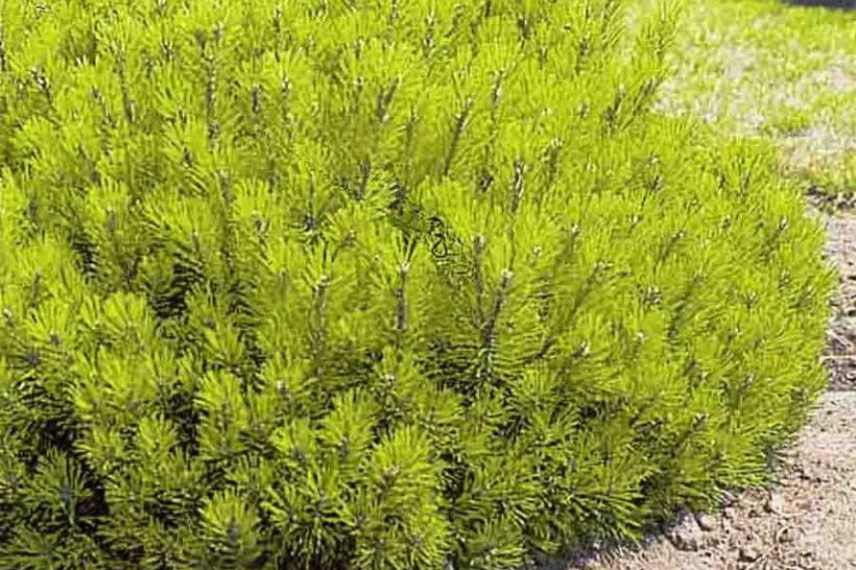
Mountain pine (Pinus mugo) ‘Ophir’
Mountain pine tolerates all soil types, even poor or slightly calcareous ones, provided they are well-drained and not too dry. It will require a sunny or lightly shaded position, but it is somewhat sensitive to heatwaves.
Read also
Garden landscaping in mountain areasPolium-leaved Andromeda (Andromeda polifolia)
The Polium-leaved Andromeda (Andromeda polifolia) is a dwarf shrub that reaches about 30–40 cm across. Hardy to -40°C, it features evergreen foliage, quite similar to rosemary. It forms a shrub with a spreading, rounded habit, with slender twigs bearing leathery, linear and pointed leaves. From April to June, it is covered with bell-shaped flowers, hanging on arched pedicels. Depending on the varieties, the flowers are pink or white. It is a little-known shrub, perfect as a groundcover on a slope with acidic soil.
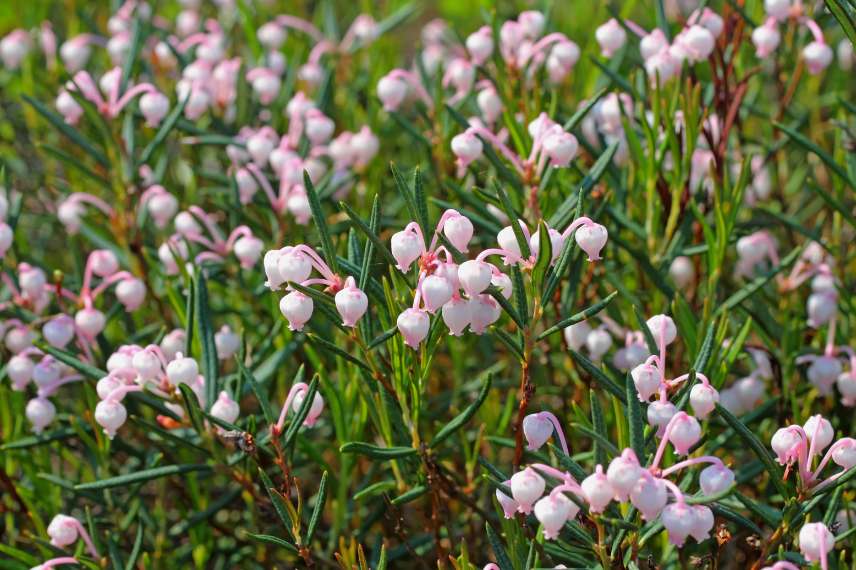
Polium’s Andromeda (Andromeda polifolia)
The ‘Blue Ice’ variety is quite remarkable thanks to its silvery-blue foliage and its small flowers in a fairly vivid pink.
This small shrub needs acidic, cool to moist, light and well-drained soil. It thrives in sun provided it is not scorching or in partial shade. A mulch of pine bark will enhance the delicacy of its flowering.
Partridge berry (Mitchella repens)
Partridge berry (Mitchella repens) is a shrub with a prostrate and creeping habit and evergreen foliage. Hardy to the harshest winters, it grows naturally on sandy slopes or along watercourses in North America. It is a small shrub that spreads to about 1 m in width and does not exceed 10 cm in height. That makes it ideal for slopes. Its short, broadly ramified shoots bear small, thick, leathery leaves in a very bright emerald green. From May to July, it bears an abundant, white, melliferous and fragrant flowering. However, the flower buds are pale pink. A few red fruits may form after the flowers, pleasing birds, including partridges (which is how it got its name!).
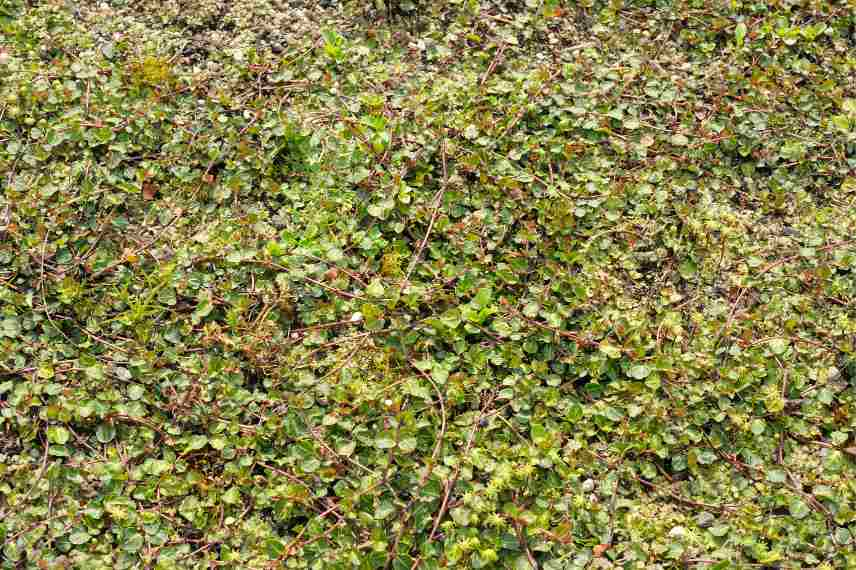 Partridge berry (Mitchella repens)
This shrub is ideally suited to shaded or partly shaded slopes on well-drained soil. It adapts to all soil types except calcareous soils. If it tolerates cold climates, it dislikes excessive heat.
A few more varieties...
- The creeping willow (Salix repens) with its arching branches, its velvety grey foliage, its catkins flowering and its hardiness to -30°C. Plant in neutral to acidic soil, cool to moist, clay-rich and deep
- The creeping cotoneaster (Cotoneaster adpressus) with its deciduous light-green foliage in spring, dark green in summer, and red in autumn. Its white flowers yield bright red berries. It can be planted in all soil types. The variety ‘Little Gem’ stands out for its more compact foliage and the absence of flowers and berries
- The black crowberry (Empestrum nigrum) with its evergreen foliage reminiscent of heathers, its small pink flowers and its black berries. It is hardy to -45°C and it spreads to 50 cm
- The Canadian hemlock (Tsuga canadensis) ‘Nana’ is a small conifer with a horizontal, slightly weeping, spreading and very ramified habit. It thrives in shade in cool, well-drained soil, neutral to acidic.
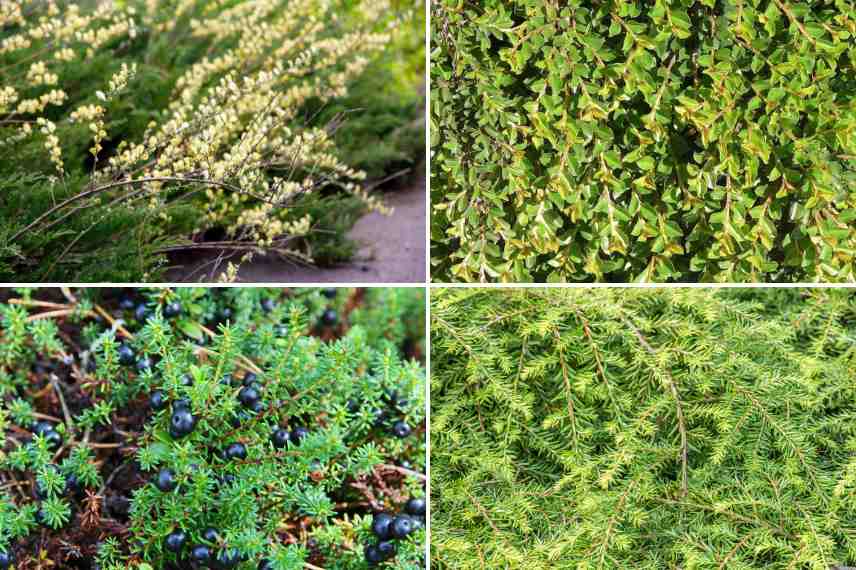
Creeping willow, creeping cotoneaster, black crowberry and Canadian hemlock
- Subscribe!
- Contents

Comments