






























6 decorative-leaved ceanothus
Bright and original!
Contents
Also known as “California lilac,” ceanothus is a charming shrub with lovely clusters of pyramid-shaped flowers called thyrses, most often blue, although white and pink varieties can also be found. Fragrant, they bloom depending on the species in spring or summer. There are evergreen ceanothus, which offer flowering from March-April to June, and deciduous ceanothus that bloom throughout the summer, from August to October, and are more cold-resistant (down to –15°C). Highly floriferous and melliferous, the ceanothus can measure between 45 cm and 10 metres and displays various habits: upright, prostrate, creeping, or arching. In terms of foliage, diversity is also present, as there is a wide range of colours. Green, variegated, yellow, purple, or nearly black, the foliage of the ceanothus invites you to create beautiful original scenes in your garden. Discover our selection of ceanothus with decorative foliage.

Ceanothus impressus 'Cool Blue', an elegant variegated cream foliage
The Ceanothus impressus ‘Cool Blue’ features elegant dark green variegated foliage edged with cream. Evergreen, it is formed of small, ovate, alternate, and glossy leaves. It provides a stunning backdrop for the light blue inflorescences measuring 5 cm that appear in March and April. It forms a shrub 2 metres high and 1.5 metres wide, expanding over the years. It is delightful in a city garden or grown in a pot. It thrives in full sun in ordinary soil, even dry in summer. This recent variety is hardy down to -15°C and won the Gold Medal at the Plantarium in Boskoop, Netherlands, in 2015.
The Ceanothus ‘Cool Blue’ can be used in a hedge, a border, a dry garden, or grown in a pot. It pairs well with Buddleja davidii Rêve de Papillon® White, which produces large white flowers from July to September, or with white roses such as the clustered rose ‘Iceberg’.
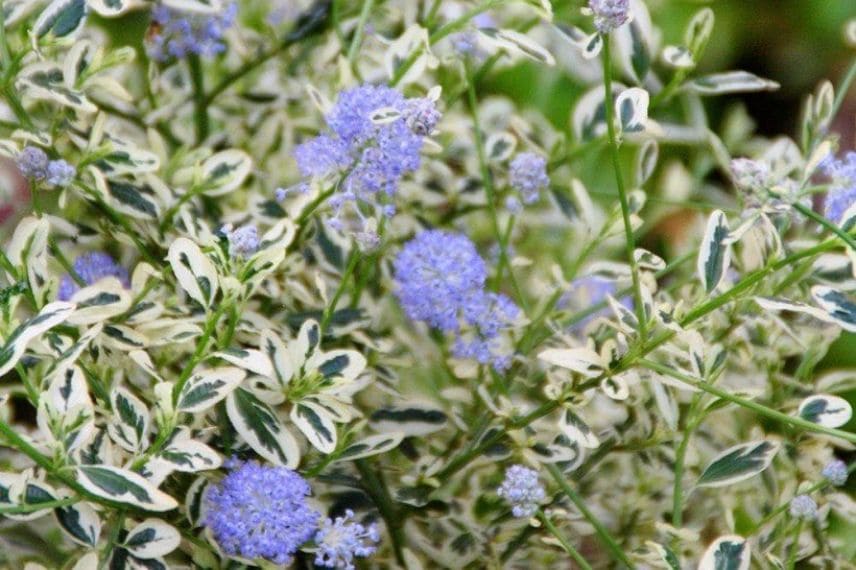
Ceanothus impressus ‘Cool Blue’
Ceanothus impressus 'Lemon & Lime', a bright yellow and green foliage
Thanks to its unusual foliage, dark green variegated with yellow, the Ceanothus impressus ‘Lemon & Lime’ brings light to your garden. Its frame of small ovate, elongated leaves with dentate edges highlights its intensely blue flowers, which bloom from April to May. Slightly fragrant, they appear in dense panicles, composed of tiny flowers with prominent stamens. At maturity, this ceanothus reaches 2.5 metres high and 2 metres wide.
It fits well in a border or a free-standing hedge, illuminating the area with its beautiful foliage that lasts even in winter. It withstands cold down to -10°C as well as summer drought and poor, even sandy soils. It enjoys mild winters and thrives by the sea. To accompany it, consider pairing it with other evergreen shrubs such as the laurustinus with winter flowering, the photinia which will enhance its red foliage, or the Mexican orange blossom with its fragrant white flowers.

Ceanothus impressus ‘Lemon & Lime’
The Ceanothus 'El Dorado', a long flowering period in a Mediterranean climate
The ceanothus ‘El Dorado’ features variegated foliage, dark green with a lemon yellow edge. Its small, elongated ovate leaves are finely dentate and evergreen. They brighten up a wall, a border, or a hedge. The generous flowering begins in March-April and can last until May and June. A second flowering can be observed in Mediterranean climates in September and October. The blue flower buds are striking and beautifully highlighted by the yellow of the foliage. This shrub has an upright and bushy habit with flexible, slightly arching branches. It reaches a height of 3 metres and a spread of 2.5 metres.
It is a horticultural variety derived from the Ceanothus thyrsiflorus, native to California and Oregon. Quite tender, it withstands temperatures down to –7°C and prefers coastal climates. This semi-hardy shrub may freeze in cold regions with wet winters. However, once well established, it is not afraid of sun, summer drought, or sea spray. It can be planted as a specimen on a lawn or inserted into a border or hedge. It is well-suited for creating a Mediterranean or oceanic garden. You can pair it with rosemary, lavender, perovskia, and an olive tree to create a Mediterranean coastal atmosphere.
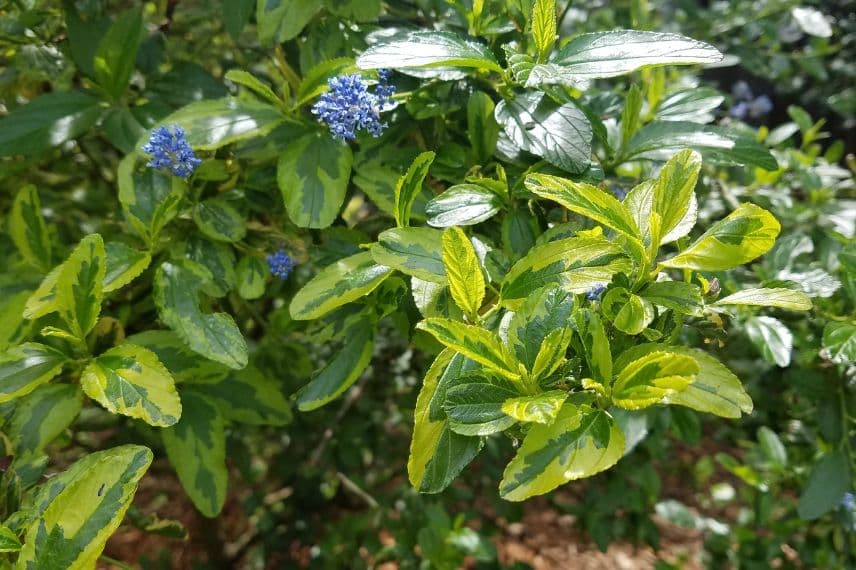
Ceanothus ‘El Dorado’
The Ceanothus 'Tuxedo,' an unusual foliage that is almost black
Very original with its almost black purple foliage and veining, the ceanothus ‘Tuxedo’ is a recent horticultural variety. When it blooms from May to July, it offers a spectacular contrast between the dark tones of its leaves and its globular panicles of sky blue. This bushy, upright shrub grows up to 3 metres tall with a spread of 2 metres. Its habit is bushy and spreading, making it a good candidate for the background of flower beds or in a free-standing hedge.
This ceanothus withstands cold down to –10°C. It enjoys full sun, well-drained soils, and is best suited for regions with a mild climate, typically located by the sea. Outside of these areas, you can plant it against a wall, sheltered and in the sun to protect it from the cold. It can be paired with flowering or yellow-foliaged shrubs, which will provide a stunning contrast to its purple, even black, foliage. Consider, for example, Spanish brooms in a free-standing hedge or the Mexican orange blossom Choisya ‘Goldfinger’ with its golden foliage.
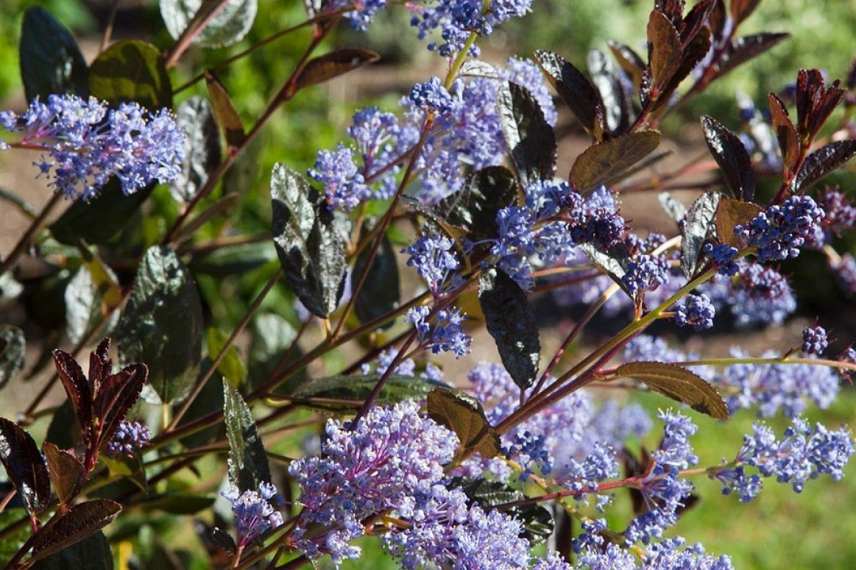
Ceanothus ‘Tuxedo’
The Ceanothus Blue Sapphire, a flowering of intense blue.
The ceanothus ‘Blue Sapphire’ produces an exceptional flowering display, with its spikes of intense sapphire blue and its dark green, finely dentate foliage. This shrub flowers from April to July and is adorned with a stunning bluish hue. Its small evergreen leaves are tough and fuzzy. It reaches a height of 1 metre and a width of 1.5 metres, fitting beautifully into a hedge or a border. With its bushy and creeping habit, it can also be used as groundcover. It prefers dry, poor soils and tolerates salt spray and pollution well, making it a good choice for a seaside or urban garden. It withstands cold down to –10°C.
If you love the contrast between bright and dark colours, the ceanothus ‘Blue Sapphire’ pairs uniquely with yellow or gold. In a border, a free-standing hedge, or against a wall, it can be combined with the sunny flowering of the Fremontodendron californicum, a shrub that offers a dense, rounded silhouette and golden yellow flowers in June and July. Another idea is to plant it in a Mediterranean-style garden alongside Yucca gloriosa and creeping rosemaries.
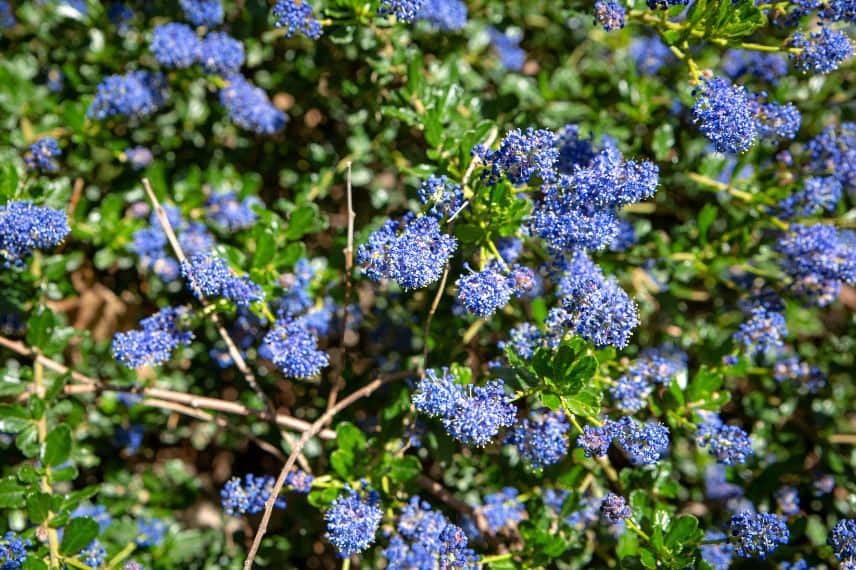
Ceanothus ‘Blue Sapphire’
Ceanothus thyrsiflorus 'African Queen', a golden foliage
The Ceanothus thyrsiflorus ‘African Queen’ catches the eye in a garden, with its very sunny golden-green foliage. This shrub with an upright habit bears small, evergreen, oval leaves that are strongly dentate and trinerved. In May and June, this superb foliage is covered with sky-blue flowers measuring 5 cm. The shrub reaches a height of 3 metres and a spread of 2 metres. It withstands cold down to –10°C and thrives in regions with a mild climate or by the sea. It prefers a substrate that is low in, or not at all calcareous, and well-drained. It should be planted in full sun or sheltered from wind and cold, against a south-facing wall, for example.
It pairs well with other plants that have yellow flowers, such as the Banks rose ‘Lutea’, charming with its generous flowering of small, very double, butter-yellow roses from April to June. It can also be associated with shrubs that have purplish foliage, such as Loropetalum chinense ‘Fire Dance’ or Osmanthus heterophyllus ‘Purpureus’.
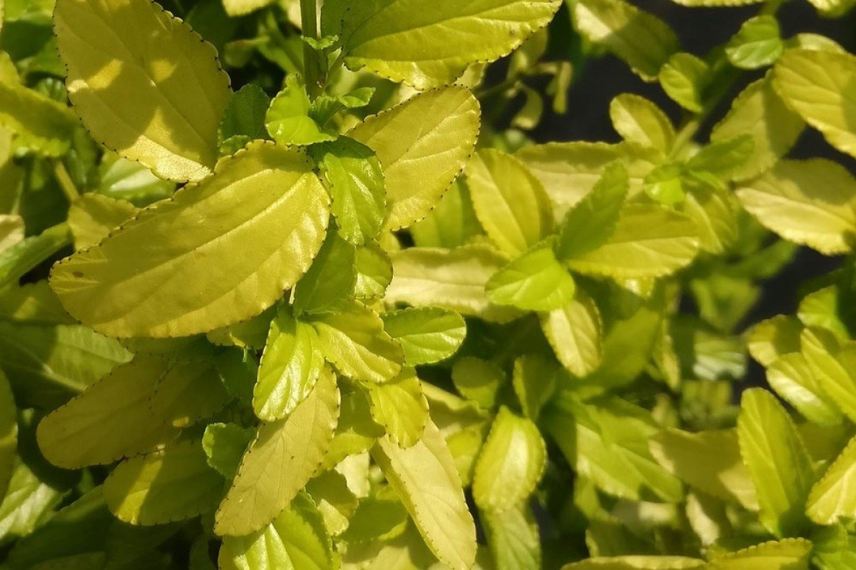
Ceanothus thyrsiflorus ‘African Queen’
- Subscribe!
- Contents

Comments