


6 pairing ideas with Caesalpinia gilliesii
to create bright and colourful flower beds!
Contents
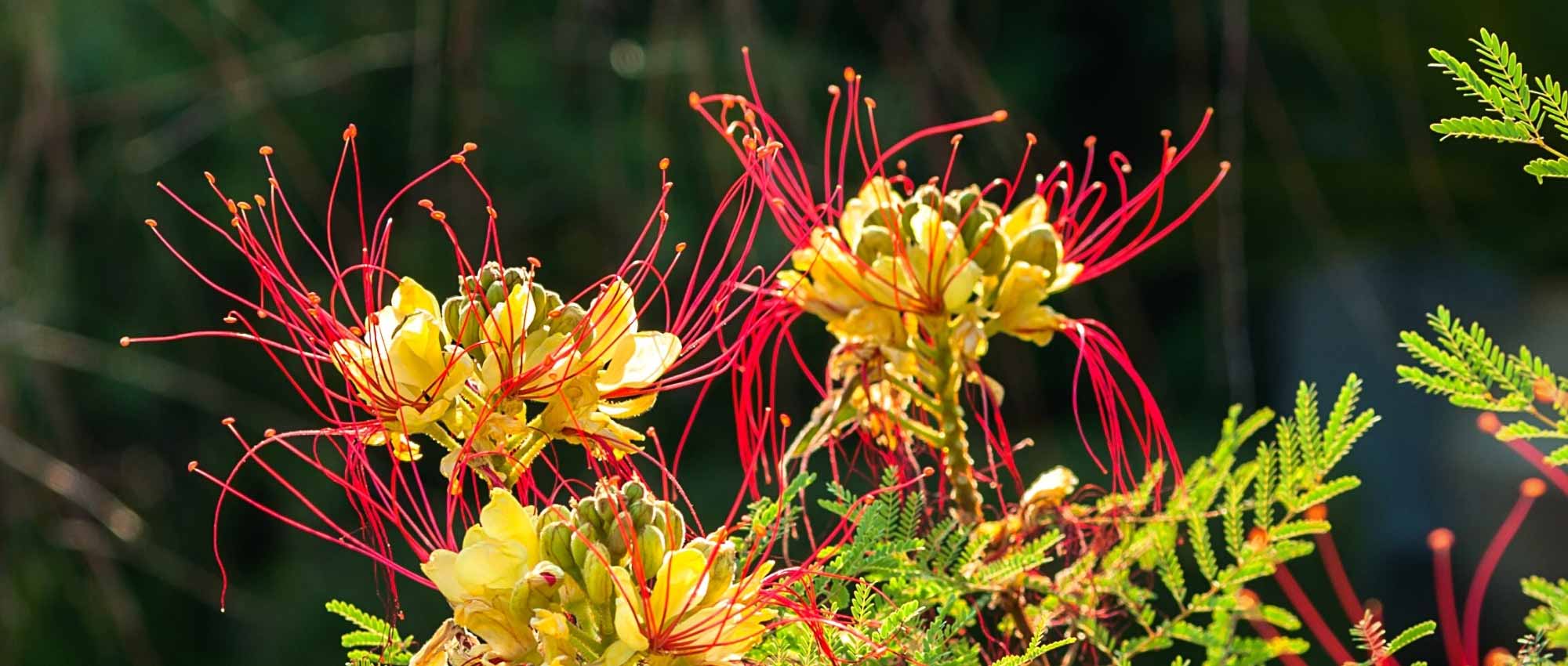
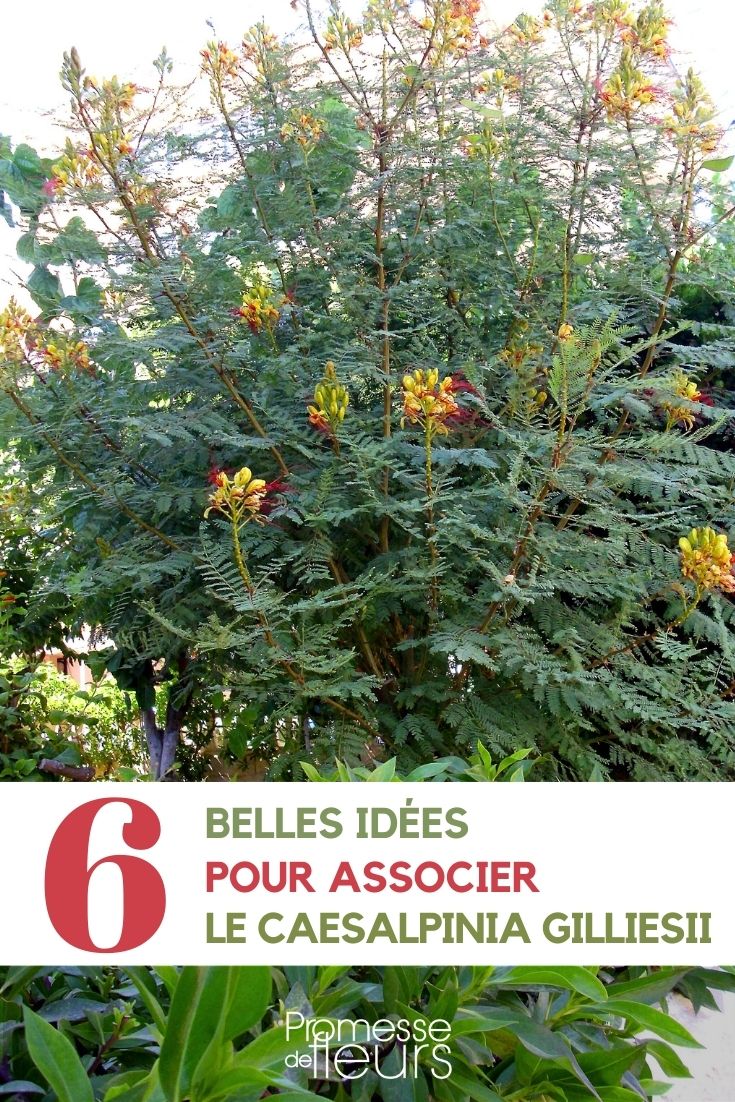
Caesalpinia gilliesii, also known as Bird of Paradise, is a shrub that stands out for its spectacular and exotic flowering. It produces bright yellow flowers with long red stamens in summer, and also features finely dissected, deciduous foliage. This shrub, native to South America, reaches a height of 1.5 to 2 metres at ripeness and is hardy down to -10 / -12 °C in well-drained soil. It is easy to grow in a mild climate, in any soil, even poor and dry. It requires a warm, sunny position and should be sheltered from the wind. With its stunning flowering, this little botanical gem is perfect for adding a splash of colour to your garden. We present 6 ideas for creating harmonious and dynamic plant associations with it.

In a jungle garden
Caesalpinia, with its yellow flowers and long red stamens, can easily become the focal point of an exotic-style garden. Create a true tropical jungle around it by pairing it with plants that have lush foliage, such as Tetrapanax, Fatsia japonica, Gunnera, and Datisca cannabina as well as tree ferns. Feel free to include a banana plant, such as Musa basjoo, hardy down to -15 °C, or if you live in a region with a mild climate, the splendid red banana Ensete ventricosum. Discover Colocasia ‘Pink China’, which can withstand temperatures around -12 °C. You can install some climbing plants, like akebias, which will evoke lianas and give a wild and natural feel to your garden. You will easily achieve a captivating atmosphere that immerses you in a tropical forest setting! Add some touches of colour in warm tones with the flowering of crocosmias, cannas, kniphofias, and daylilies.
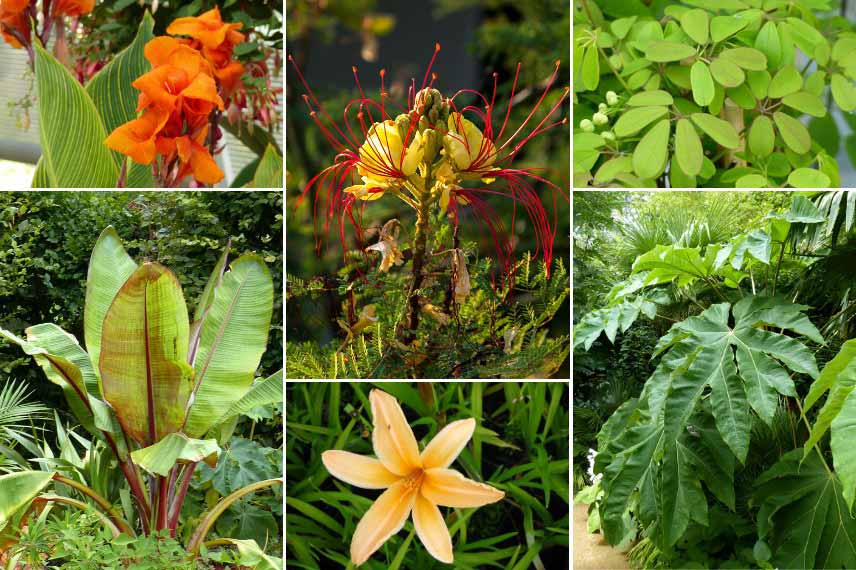
Canna striata, Caesalpinia gilliesii, Akebia quinata, Ensete ventricosum ‘Maurellii’, Hemerocallis ‘George Cunningham’, and Tetrapanax papyrifera ‘Rex’
In a bed of warm tones
The vibrant flowering of Caesalpinia gilliesii will blend beautifully into a bed with warm tones. Pair it with perennials that bloom in yellow, orange, and red shades, such as Echinacea ‘Summer Breeze’, Achillea ‘Terracotta’, daylilies, and Sage ‘Reve Rouge’. Ornamental grasses in golden tones, such as Stipa tenuifolia or Pennisetum orientale ‘Shogun’, will add lightness. The harmonious and dynamic colour palette of this bed will attract all eyes.
Take the opportunity to create a bohemian atmosphere, which will be very pleasant around a terrace or garden lounge. Consider monardas, dahlias, verbascums, agastaches, and echinaceas, accompanied by numerous clumps of grasses that will create a sense of movement. Add decorative elements: colourful furniture and cushions, fairy lights, lanterns… For shrubs, consider Lagerstroemia, and if you wish to install climbing plants, think of trumpet vine.
Feel free to consult our advice sheet: “Creating a Bohemian Garden”
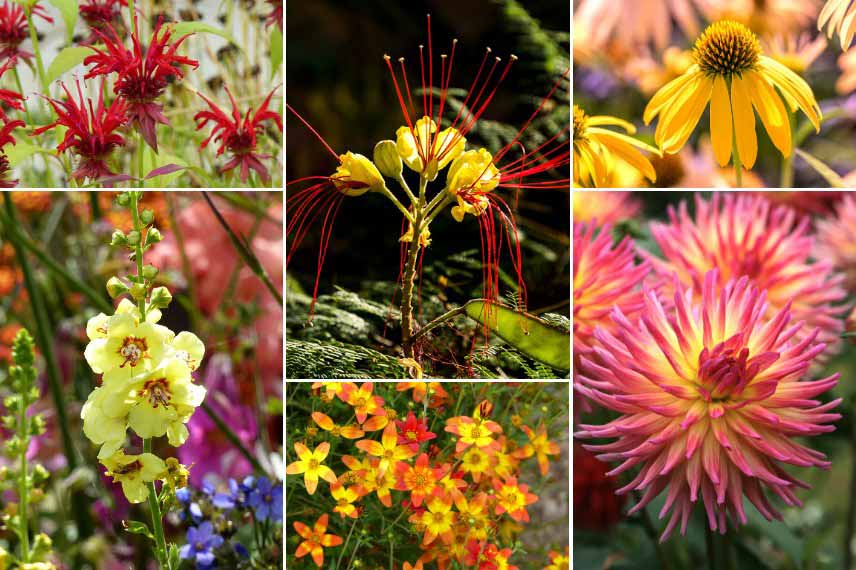
Monarda ‘Jacob Cline’, Caesalpinia gilliesii, Echinacea purpurea ‘Summer Breeze’, Verbascum ‘Costowld Queen’, Bidens ‘Campfire Fireburst’, and Dahlia ‘Karma Sangria’
In a Mediterranean-style garden
Caesalpinia gilliesii pairs beautifully with Mediterranean plants. For example, plant it in the company of lavenders, rosemaries, and santolines. It will be perfect to accompany the twisted silhouette and silver foliage of an olive tree. When it comes to bushes, also consider strawberry trees, pomegranates, and oleanders. Discover the stunning Anthyllis barba-jovis, a small Mediterranean bush that does not exceed 1.5 m in height and is distinguished by its very fine silver foliage and pale yellow spring flowering. Bring an exotic atmosphere with the finely cut foliage of a palm, such as the Chamaerops humilis, one of the few palms that grows spontaneously in Europe, around the Mediterranean. Notably, discover the variety ‘Cerifera’, with bluish-grey foliage. To complete the picture, consider helianthemums, agapanthuses, and the Corsican spurge, Euphorbia myrsinites, a small carpet-forming perennial with bluish foliage.
Discover our articles: “Mediterranean Garden: 10 Iconic Plants to Landscape It” and “7 Tips for Designing and Succeeding in a Mediterranean Garden”
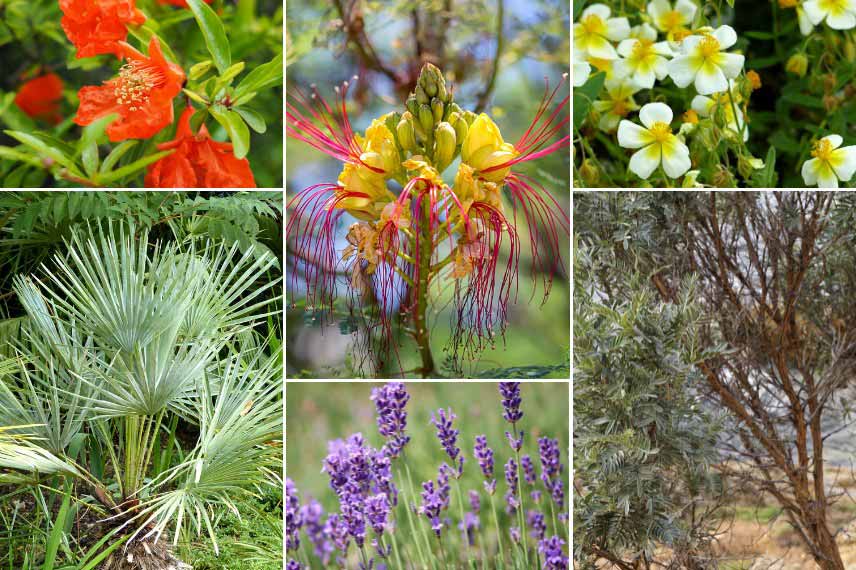
Punica granatum, Caesalpinia gilliesii, Helianthemum ‘Elfenbeinglanz’, Chamaerops humilis ‘Cerifera’, Lavender and Anthyllis barba-jovis
Read also
How to create a dry exotic garden?In a dry and mineral garden
Caesalpinia gilliesii is a hardy plant that can withstand dry and arid conditions. Take the opportunity to create a dry exotic garden by pairing it with cacti, succulents, and other plants with narrow leaves. Indeed, plants that thrive in arid environments have reduced their leaf surface area (sometimes limited to thorns, as seen in cacti) to minimise evapotranspiration, thus conserving water. Combine Caesalpinia with Opuntias, agaves, dasylirions, and Yuccas. Also, discover the Aloe striatula, hardy down to -12°C, and the Cylindropuntia imbricata, a cactus that tolerates temperatures as low as -15°C! Their mineral and clean appearance will highlight the delicate foliage and explosive flowering of Caesalpinia. You will achieve a particularly graphic and exotic display. Add some blooms in warm tones: enjoy, for example, crocosmias, kniphofias, Anigozanthos flavidus, and Sparaxis tricolor. To enhance the mineral aspect, consider ornamental grasses like Festuca glauca. This will result in a resilient and aesthetically pleasing garden that requires little maintenance.
Discover our inspiration page “Australian Exoticism”
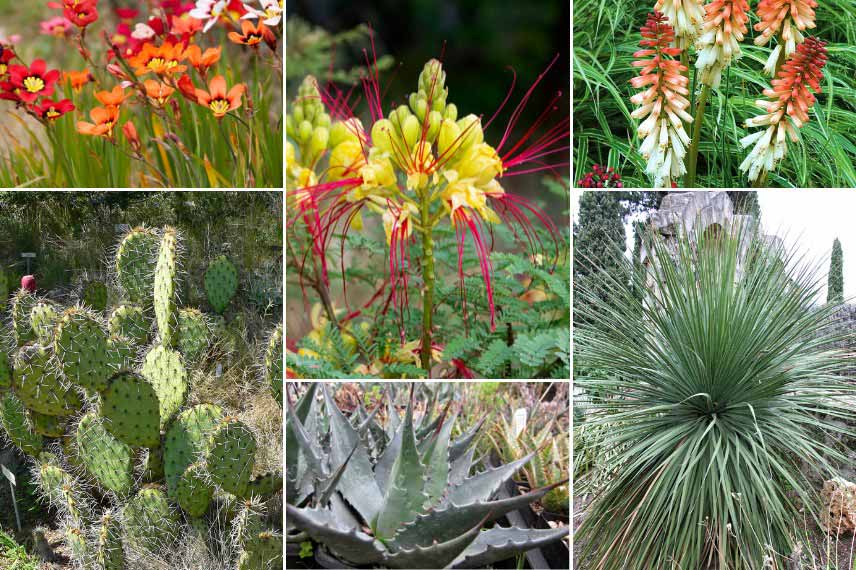
Sparaxis tricolor (photo: copyright Richard Shiell_- GWI – Biosphoto), Caesalpinia gilliesii, Kniphofia ‘Orange Vanilla Popsicle’, Opuntia phaeacantha (photo: Stan Shebs), Agave montana (photo: M. Hansen) and Dasylirion
In a pot on a terrace
If your climate does not allow for its cultivation in open ground, you can grow Caesalpinia in a large pot and bring it indoors for the winter. It will create a very exotic summer decor on your terrace, alongside other plants that need to be overwintered. Pair it, for example, with Strelitzia reginae, whose extremely elegant flowers resemble a bird, as well as Gloriosa superba ‘Rotschildiana’: you will achieve a stunning trio, as these three plants offer exceptional flowers, undoubtedly among the most beautiful that exist. Also integrate some plants with decorative foliage, such as Phormium, Fatsia japonica, or palms. If your terrace has a pergola, you can let Black-eyed Susans, Thunbergia alata climb on it, as well as ipomoeas ‘Cardinal Climber’. Otherwise, plant them against the facade of your house, installing a trellis. Being frost-sensitive, Thunbergia are grown as annuals, but it is also possible to plant them in pots and bring them indoors for the winter to preserve them from one year to the next. The combination of these plants will allow you to enjoy your terrace in a truly exotic atmosphere during the summer!
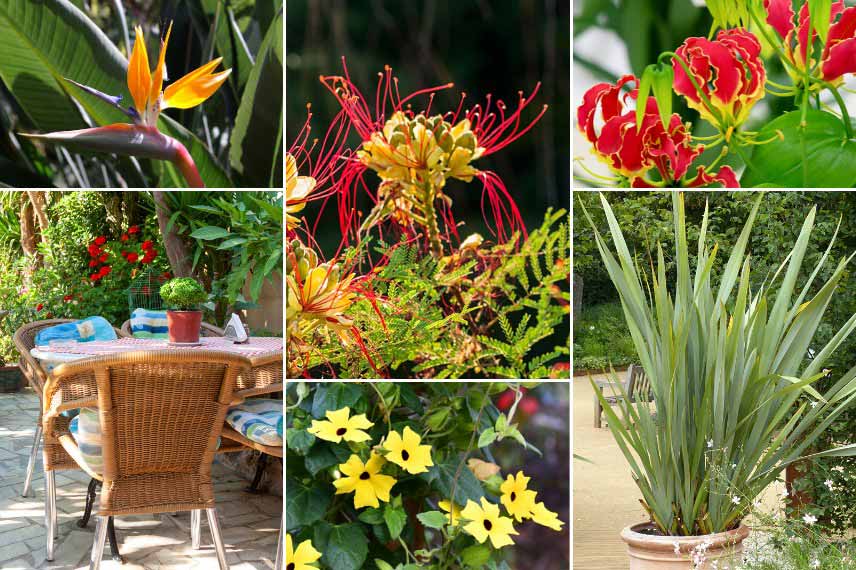
Strelitzia reginae, Caesalpinia gilliesii, Gloriosa superba, Thunbergia alata, and Phormium tenax
To create colour contrasts
Nothing showcases the flowers of Caesalpinia gilliesii quite like pairing them with a radically opposite hue! Play with a contrast of warm and cool colours: the yellow and red flowers of the Caesalpinia will stand out against the blue of a hardy geranium ‘Johnson’s Blue’, an agapanthus ‘Midnight Blue’, and a gentian sage, Salvia patens. Enhance the yellow hue of the Caesalpinia by incorporating verbascums, ‘Little Goldstar’ rudbeckias, and ‘Moonshine’ achilleas. You can also create the same style of contrasting association by opting for purple-mauve instead of blue: consider penstemon ‘Sour Grapes’, nepeta ‘Six Hill Giant’, agapanthus ‘Poppin Purple’, and Salvia guaranitica ‘Amistad’. Your flowerbed is sure to attract attention!
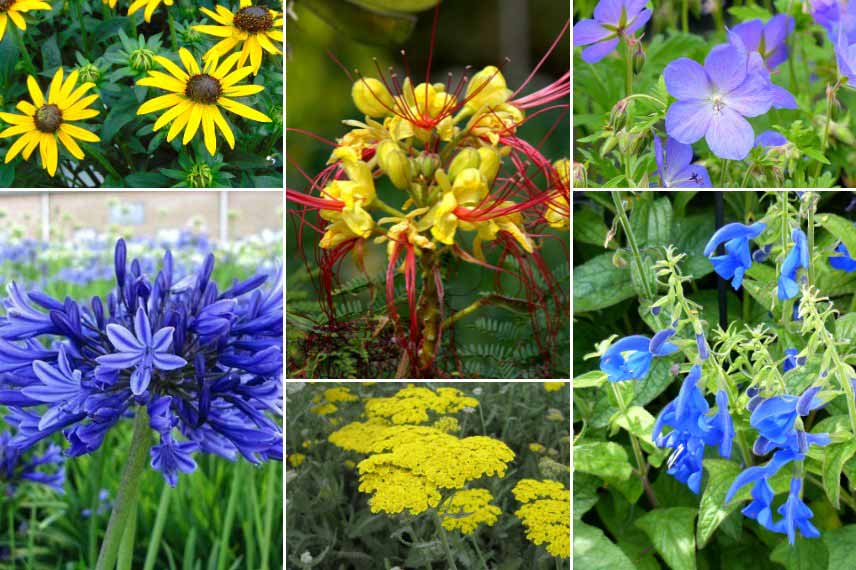
Rudbeckia fulgida ‘Little Goldstar’, Caesalpinia gilliesii (photo: Luk), Geranium ‘Johnson’s Blue’, Agapanthus ‘Midnight Blue’, Achillea ‘Moonshine’, and Salvia patens ‘Royal Blue’
- Subscribe!
- Contents
Comments