





























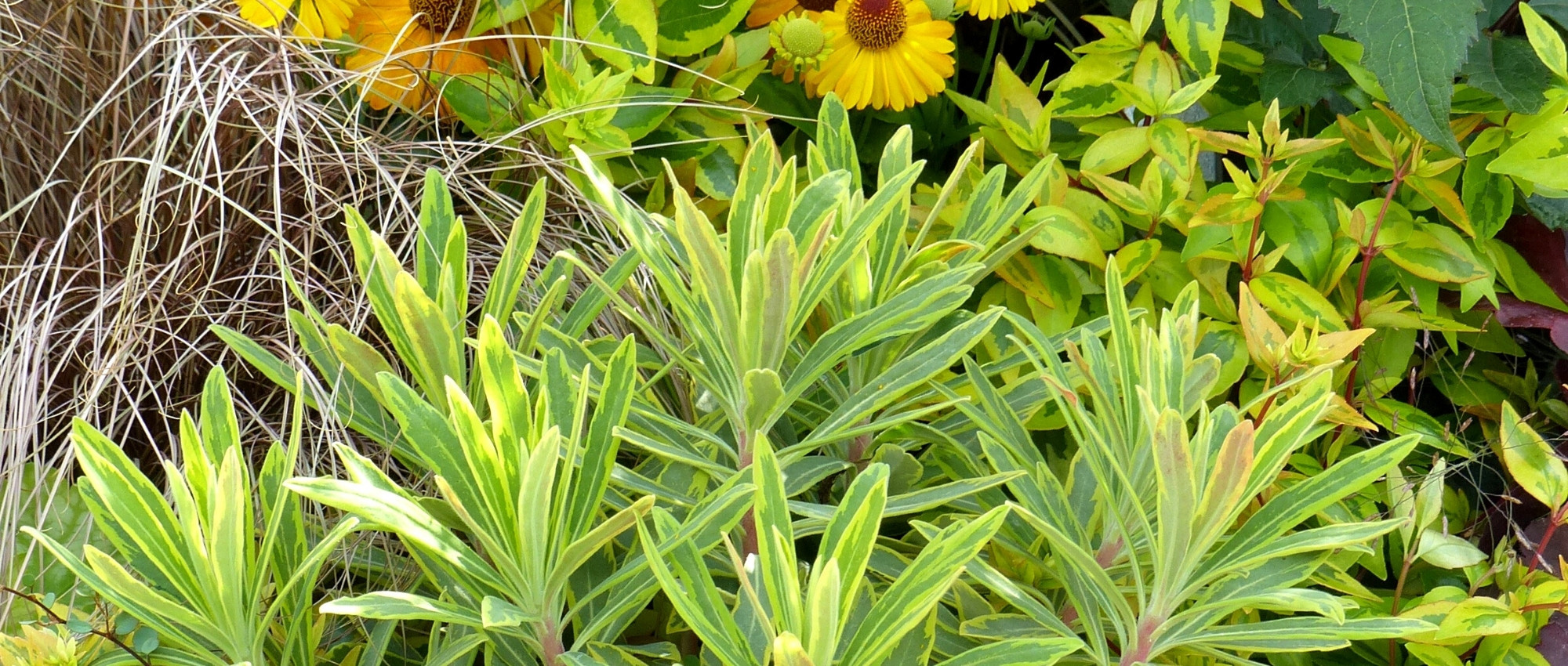
7 Euphorbias for borders
The best varieties
Contents
Euphorbias represent a highly diverse genus, comprising over 2,000 species and countless varieties! They differ in the shape and colour of their foliage, their size which varies greatly among species, their flowering, their hardiness, and more. In the garden, medium to large euphorbias integrate very easily into borders alongside perennials. Discover the 7 most beautiful varieties of euphorbias for borders, along with our tips for growing them and some ideas for successful combinations!
And to learn everything about euphorbias and their cultivation, feel free to check our complete guide “Euphorbias: to plant, to grow, and to maintain”

Euphorbia characias ssp. wulfenii
Originating from the Mediterranean region, the Mediterranean Spurge is an ideal species to incorporate into an exotic-style border. The wulfenii subspecies is distinguished from the type species by its beautiful blue foliage and large inflorescences of an acid green that is almost yellow. It is a highly structural and graphic plant that reaches a height of between 80 and 90 cm. It flowers from March-April until June, offering a very bright, acid green flowering. In the garden, it thrives in full sun, in rather dry, well-drained, even stony soil. For a more striking effect, we recommend planting it in groups rather than in isolation. You might integrate it into a warm-toned border (with yellow, orange, red flowers and bronze, purple foliage…), alongside wallflowers, tulips (for example, the stunning orange tulip ‘Shogun’), cistus, Draba aizoides, Euryops chrysanthemoides… For foliage, consider Phormium ‘Pink Panther’ and Carex ‘Bronze Form’.
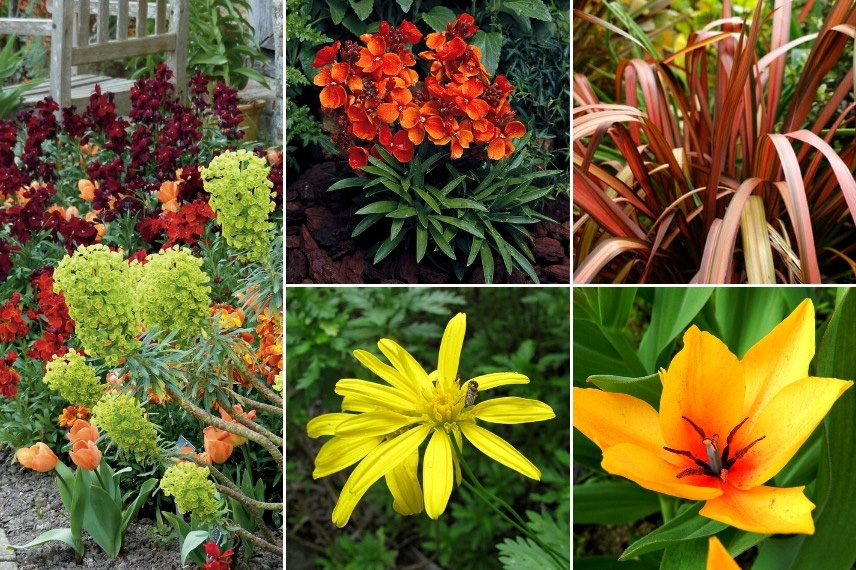
Scene with Euphorbia characias ssp. wulfenii, Wallflowers ‘Bedder Scarlet’ and ‘Bedder Vulcan Brune’ / Wallflower ‘Bedder Scarlet’ / Phormium ‘Pink Panther’ / Euryops chrysanthemoides (photo Leonora Enking) / Tulipa praestans ‘Shogun’
Euphorbia x martinii
Martin’s Spurge is a beautiful perennial with evergreen foliage, growing quickly to reach 60 cm in all directions. It features elongated, grey-green leaves arranged along its upright stems. In spring, Euphorbia x martinii reveals stunning green-yellow flowers, which are very bright and adorned with red nectariferous glands. Plant it in full sun in very well-drained soil, and preferably in partial shade in gardens in the south of France. Its acid green flowering will integrate beautifully into a garden with soft hues: mauve, violet, blue, silver… for a lovely effect that is both romantic and natural! Consider, for example, the beautiful blooms of Ornamental Garlic ‘Violet Beauty’, Sage ‘Raspberry Royal’, and Ceanothus. Bring lightness with the very graphic spikes of the grass Stipa gigantea, and incorporate some silver foliage, such as that of wormwoods or Stachys byzantina.
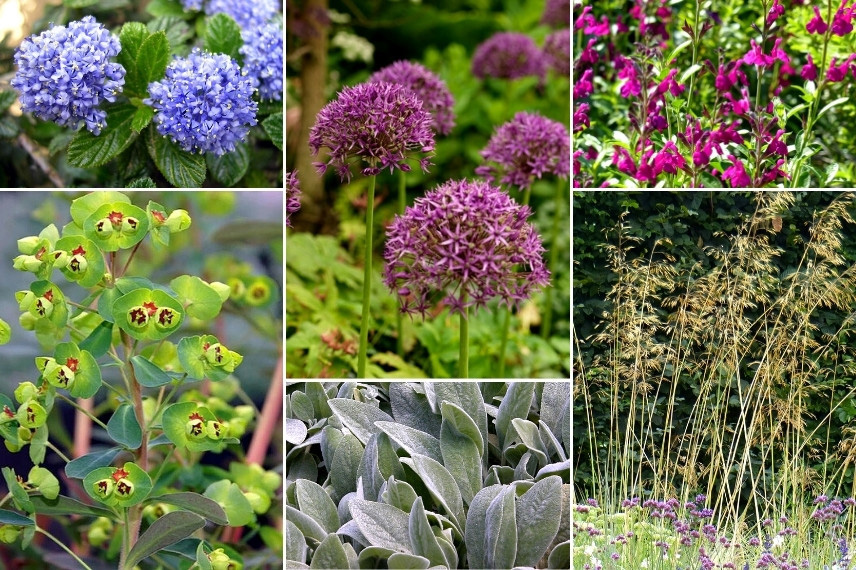
Ceanothus thyrsiflorus ‘Repens’ (photo Kousvet) / Allium stipitatum ‘Violet Beauty’ (photo J.M. van Berkel) / Salvia jamensis ‘Raspberry Royal’ / Euphorbia x martinii (photo David J. Stang) / Stachys byzantina (photo Carl Lewis) / Stipa gigantea
Discover other Evergreen perennials
View all →
Available in 0 sizes
Available in 0 sizes
Available in 0 sizes
Available in 0 sizes
Available in 0 sizes
Available in 1 sizes
Available in 1 sizes
Available in 1 sizes
Available in 1 sizes
Available in 1 sizes
Euphorbia griffithii 'Dixter'
Euphorbia griffithii ‘Dixter’ is a unique and vibrant variety! Tall in stature, it forms a dense, rounded clump reaching 1 metre in height. Its foliage changes colour with the seasons: initially purple in spring, it then turns dark green with a slight copper hue, before becoming orange in autumn. From May to June, large bright orange inflorescences emerge above the foliage, adorned with yellow nectariferous glands. Depending on the climate, its leaves are deciduous to semi-evergreen. Plant it in full sun or partial shade, in cool, humus-bearing soil, without excessive lime. This spurge is perfect for creating a border with warm tones, for example by pairing it with the flowering of Baptisia ‘Carolina Moonlight’, avens, bushy sages, and the beautiful botanical daylily Hemerocallis fulva.
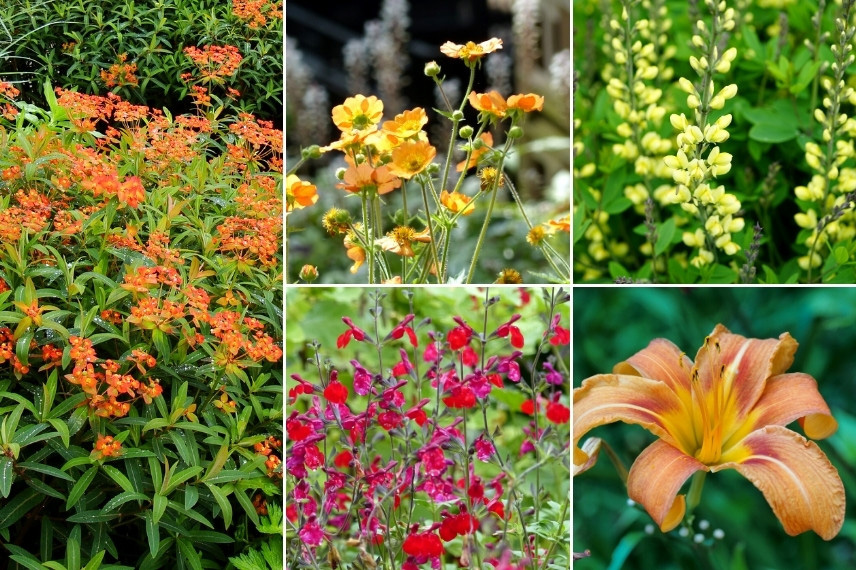
Euphorbia griffithii ‘Dixter’ (photo Christopher) / Geum ‘Totally Tangerine’ / Baptisia ‘Carolina Moonlight’ (photo Adobe Stock) / Salvia jamensis ‘Reve Rouge’ / Hemerocallis fulva
Read also
Euphorbias: 7 successful pairing ideasEuphorbia 'Ascot Rainbow'
Like the euphorbia ‘Dixter’, the variety Euphorbia martinii ‘Ascot Rainbow’ is also very colourful! It features variegated foliage in bluish-green edged with yellow, supported by reddish stems, and it produces young red shoots at the end of summer… creating a truly multicoloured effect! From April to June, it also boasts a beautiful yellow-green flowering, adorned with red nectariferous glands. This euphorbia reaches 60 cm in all directions and has evergreen foliage, which remains decorative even in winter! In the garden, plant it in full sun (or partial shade in the south of France), in very well-drained soil that does not retain water in winter. Pair it with other decorative and colourful foliage, such as that of heucheras (with their wide range of colours!), Carex, and Muehlenbeckia axillaris. Also integrate some yellow flowers (like that of Anthemis ‘Golden Butterfly’), which will echo the yellow variegation of the euphorbia.
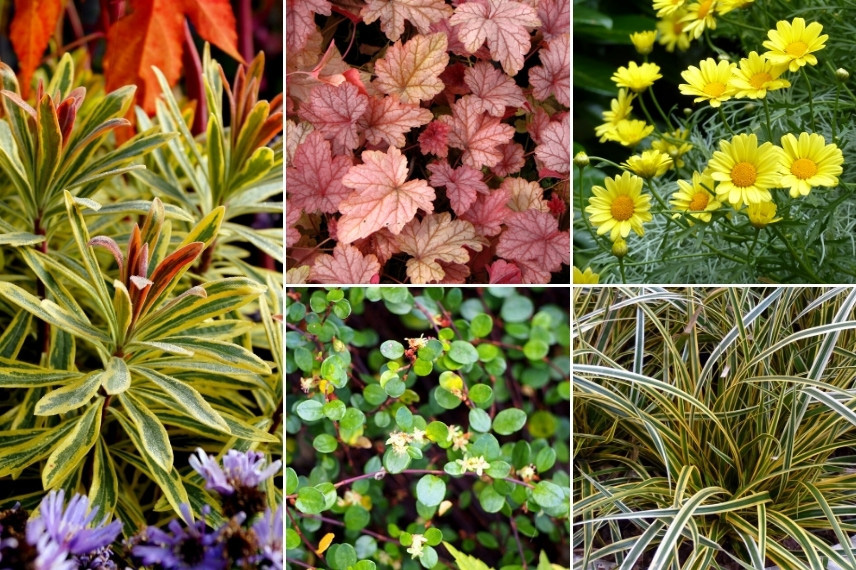
Euphorbia ‘Ascot Rainbow’ (photo Adobe Stock) / Heuchera ‘Vienna’ / Anthemis ‘Golden Butterfly’ / Muehlenbeckia axillaris (photo Agnieszka Kwiecień) / Carex ‘Everglow’
Euphorbia schillingii
Euphorbia schillingii is a giant variety with a very natural style! It forms upright, unbranched stems that bear lanceolate, light green leaves with a white vein running through the centre. At the top of the stems, beautiful small yellow flower clusters appear in mid-summer. It thrives in fresh, humus-bearing soils, even heavy and clayey ones, and enjoys full sun or light shade. It is ideal for creating a naturalistic border. Pair it with perennials that offer a light and airy flowering, such as cosmos, sanguisorbas, penstemon, and grasses. Also consider the beautiful flowering of achilleas!
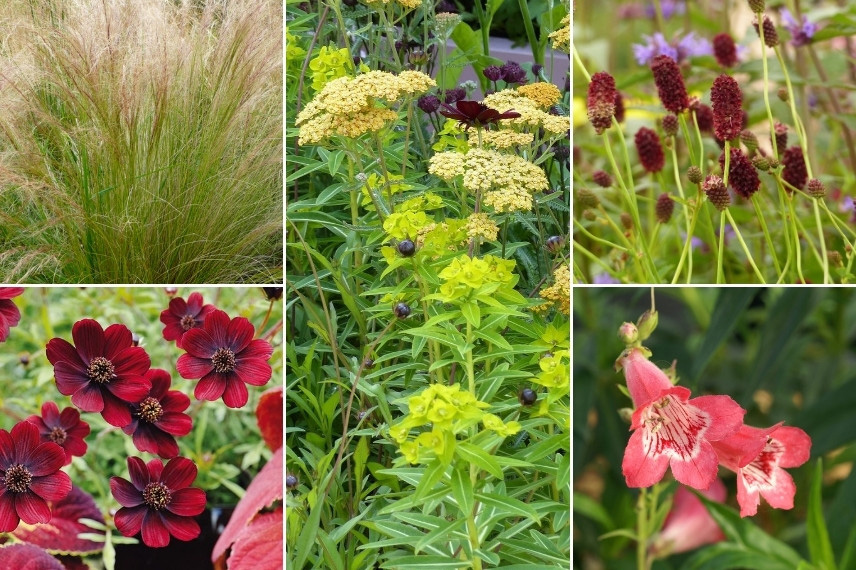
Stipa tenuifolia / Cosmos atrosanguineus ‘Chocamocha’ / scene with Euphorbia schillingii, Achillea ‘Terracotta’ and Cosmos atrosanguineus / Sanguisorba ‘Red Thunder’ / Penstemon ‘Souvenir d’Adrien Regnier’
Euphorbia palustris 'Walenburg's Glory'
Marsh spurge ‘Walenburg’s Glory’ is also a large perennial ideal for naturalistic gardens. It forms tall, upright stems that can reach up to 1 metre high. These are adorned with fine, elongated leaves, similar to those of willows. Green in spring and summer, they take on beautiful reddish-orange hues in autumn before falling. Its foliage is denser than that of the typical species. In spring, it produces beautiful yellow inflorescences at the top of its stems. Unlike most spurges, it adapts very well to heavy, moist soils. In the garden, you can place it on the banks of a pond or in a border with other plants that prefer cool soil. It will pair beautifully with the elegant blue flowering of Iris sibirica and Camassia leichtlinii ‘Caerulea’. Bring more freshness and lightness to your border by incorporating some white flowers, such as those of the poet’s daffodil, ‘Spring Green’ tulip, and the candelabra primrose Primula japonica ‘Alba’.
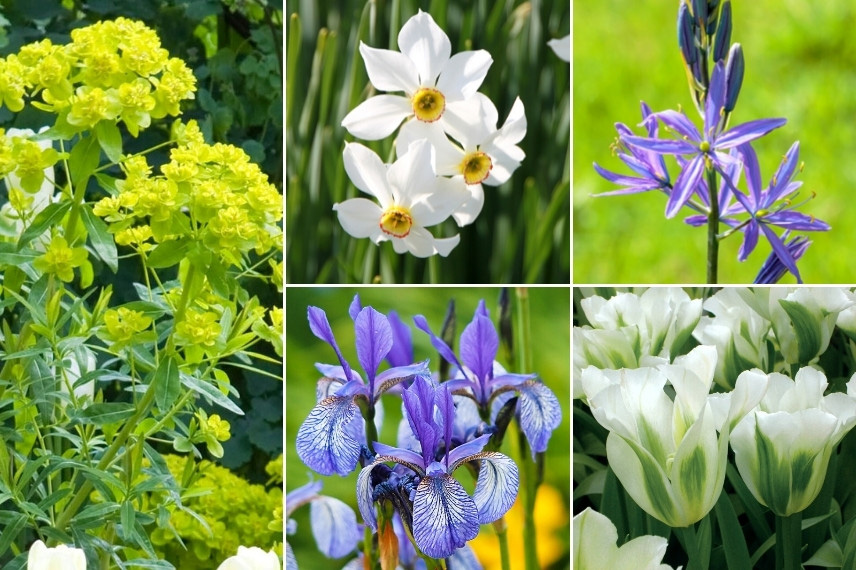
Euphorbia palustris ‘Walenburg’s Glory’ / Narcissus poeticus ‘Recurvus’ / Camassia leichtlinii ‘Caerulea’ (photo Dominicus Johannes Bergsma) / Iris sibirica / Tulip ‘Spring Green’
Euphorbia amygdaloides 'Purpurea'
Euphorbia amygdaloides ‘Purpurea’ stands out for its very dark, purplish foliage. It has a beautiful rounded, cushion-like shape and reaches a height of 50 to 60 cm at ripeness. In spring, in April-May, it brightens up with a lovely acid yellow flowering. This is the ideal variety to bring contrast to a flowerbed! It thrives in full sun or partial shade in fresh, well-draining soil. You can create a very original flowerbed by pairing it with the purplish foliage of Cotinus ‘Grace’, Heuchera ‘Black Pearl’, Ophiopogon planiscapus ‘Nigrescens’, and the almost black flowers of the ‘Black Parrot’ tulip. Add contrast by integrating among them acid green foliage, almost yellow: for example, that of Hakonechloa macra ‘Aureola’, Lysimachia nummularia ‘Aurea’, Heuchera ‘Lime Rickey’, and Hydrangea ‘Little Honey’. You will achieve a successful flowerbed that surely attracts the eye with its play of colours and its modern, graphic style.
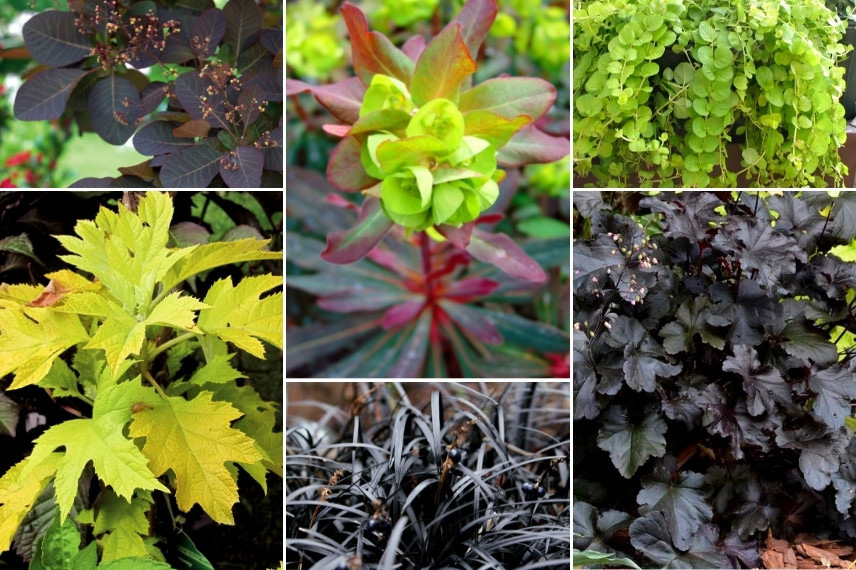
Cotinus ‘Grace’ / Euphorbia amygdaloides ‘Purpurea’ / Lysimachia nummularia ‘Aurea’ (photo David J. Stang), Hydrangea quercifolia ‘Little Honey’ / Ophiopogon planiscapus ‘Nigrescens’ (photo brewbooks) / Heuchera ‘Black Pearl’
- Subscribe!
- Contents

Comments