


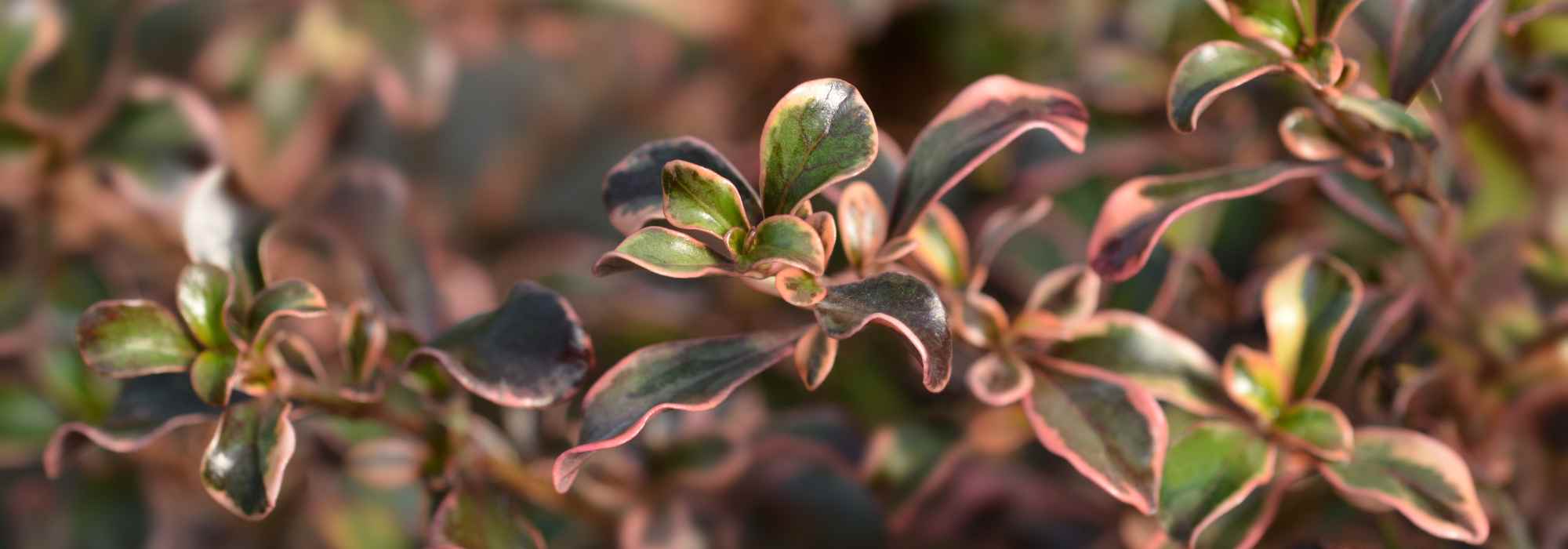
7 evergreen shrubs with colourful foliage
Our selection of evergreen and colourful shrubs to enhance your garden
Contents
Evergreen shrubs are indispensable companions in a garden, providing structure and bulk all year round. Chosen with colourful foliage, often variegated, sometimes purplish, blue or gold, they have no equal in adding an irresistible splash of colour to the garden or a terrace. These colourful evergreen shrubs attract us mainly for their foliage, but some are also endowed with a delightful flowering. Those we feature here display colourful foliage all year round, not just in autumn or spring. Give them a prime spot in the garden!

Fatsia 'Spider Web'
Widely loved by many Fatsia enthusiasts, the cultivar ‘Spider Web’ is now readily available in garden centres and nurseries. It is loved for its completely distinctive, foliage splashed with white. It becomes a striking shade-loving shrub with this feature added to its exotic appeal. The Fatsia japonica ‘Spider Web’ has the same large leaves as the type species, tough and palmately lobed in several irregular lobes, but variegated white to cream. When it is happy (in moist, well-drained soil), the Fatsia japonica ‘Spider Web’ grows to 2–3 m tall with a similar spread. It is frost-hardy down to -15°C, which allows planting in many regions. The shrub produces flowers around September, similar to ivy flowers (they belong to the same Aralia family), which attract numerous pollinators.
Slow-growing, give it time to establish well to enjoy its distinctive appearance in a shaded border, where you’ll be spoilt for choice to accompany it: hostas, ferns, Hakonechloa macra…
N.B.: Another variety, Fatsia japonica ‘Variegata’, also offers attractive variegated foliage.
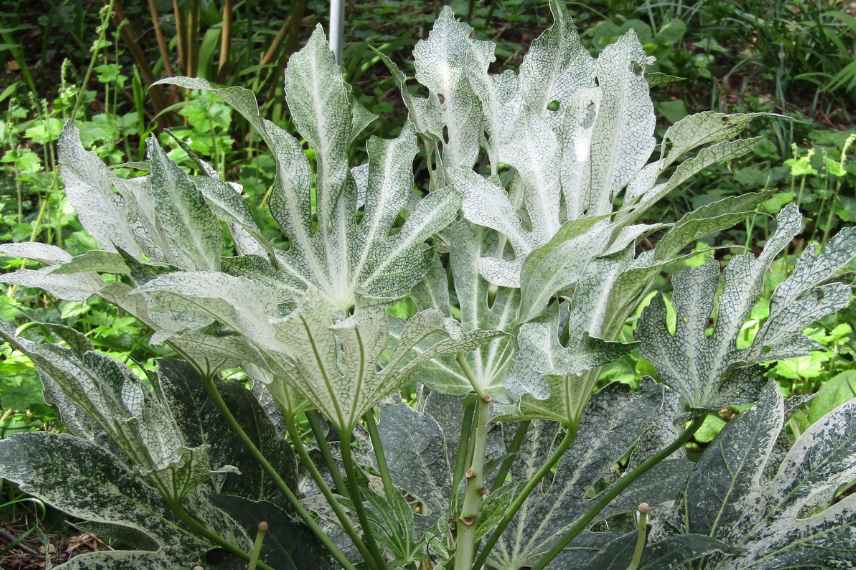
Fatsia japonica ‘Spider Web’ (© Leonora Enking)
Read also
10 hardy evergreen shrubsAcacia baileyana 'Purpurea'
Acacia baileyana ‘Purpurea’, a variety derived from the type species native to Australia, is a sublime shrub, which features evergreen, bipinnate and very fine foliage of acacias, but in a purple version on its new growth in spring. It retains these tones which will mingle with the rest of the bluish-grey foliage. Sumptuous!
Another advantage is that it flowers in summer in its natural habitat, which translates here as a flowering in mid-winter, between January and February, of a multitude of small bright yellow flowers, typical of acacias.
Capable of reaching well over 5 m in height, it will eventually spread to 3–4 m, and proves fairly drought-tolerant once established. The only drawback for this southern beauty is that it tolerates only transient frosts, and will suffer below -6°C. Therefore, we recommend it for so-called ‘mild’ regions (Brittany–Cotentin, the Atlantic coast and the Mediterranean fringe).
Sublime as a stand-alone plant, it will also look stunning trained on a stem, alongside exotic plants with greyed, purple, or contrasting foliage, and Mediterranean plants such as Melianthus major, Aeonium, and pale mauve flowers in summer, for example Tulbaghias or Tradescantias.
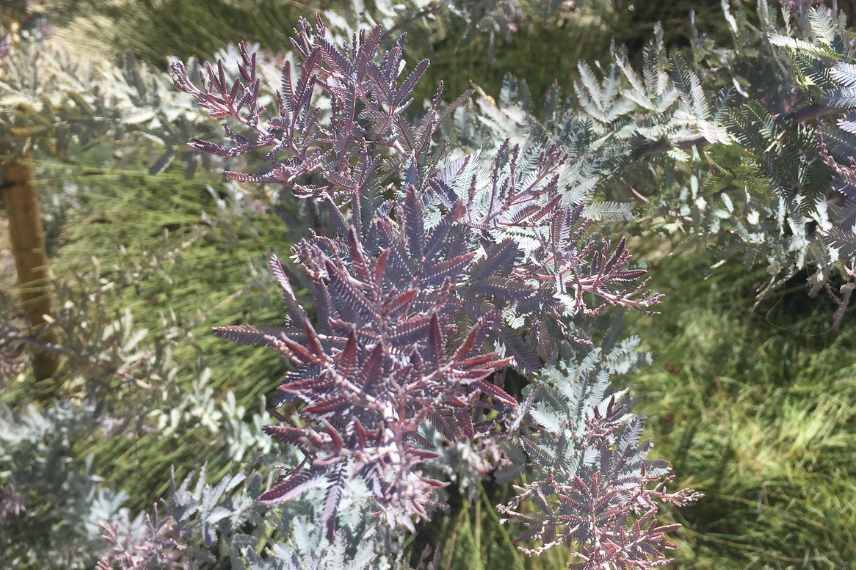
Acacia baileyana ‘Purpurea’ (© Megan Hansen)
Pseudowintera colorata
Here is another evergreen shrub, very colourful, of oceanic origin, more precisely from New Zealand. Close to Drimys colorata (they belong to the same family), this small shrub remains compact, reaching at maturity (it grows slowly) between 1 m and 1.5 m in height. The foliage of Pseudowintera colorata is superb in all seasons, displaying several colours, red, shrimp-pink, golden, pale green, more or less marginate depending on the seasons. In terms of flowering, the shrub produces tiny cream-white flowers, which turn into dark red berries.
Hardiness to -10°C, and it prefers cool, even moist and well-drained soil, with exposure to partial shade ideally or sun that is not scorching. The Pseudowintera colorata has the advantage of withstanding wind and sea spray well. It is therefore the ideal subject for a coastal garden, with mild winters.
Create a spectacular Australasian scene by its foliage, planting around it other shrubs from the same region, of varying heights, with ornamental leaves: Pittosporum tenuifolium at the head, but also a Drimys aromatica (Tasmanian pepper), a Phormium tenax, veronicas shrubs and a few Carex.
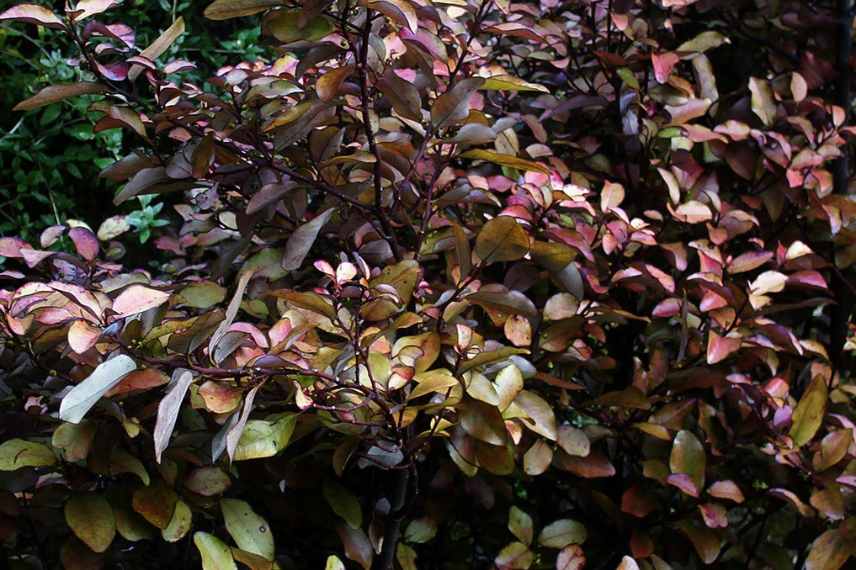
Pseudowintera colorata ©Peganum
Read also
10 evergreen shrubs for coastal gardensEuonymus japonicus 'Emerald 'n' Gold'
It’s hard to overlook spindle shrubs when talking about evergreen shrubs with coloured foliage. There are many of them, of all sizes and in a range of colours.
Euonymus fortunei ‘Emerald ‘n Gold’ is a dwarf spindle with green leaves broadly edged with a bright yellow. It reaches 50–60 cm in height with a spread usually double, retaining a semi-spreading habit. Very hardy, it tolerates temperatures down to -20°C. It prefers well-drained soil and a position in full sun or partial shade.
Its silhouette, a densely bright mattress-like shape, suits rockeries among rocks, or planted on a small wall as a groundcover where it can be paired with boxwood and perhaps a small Japanese maple.
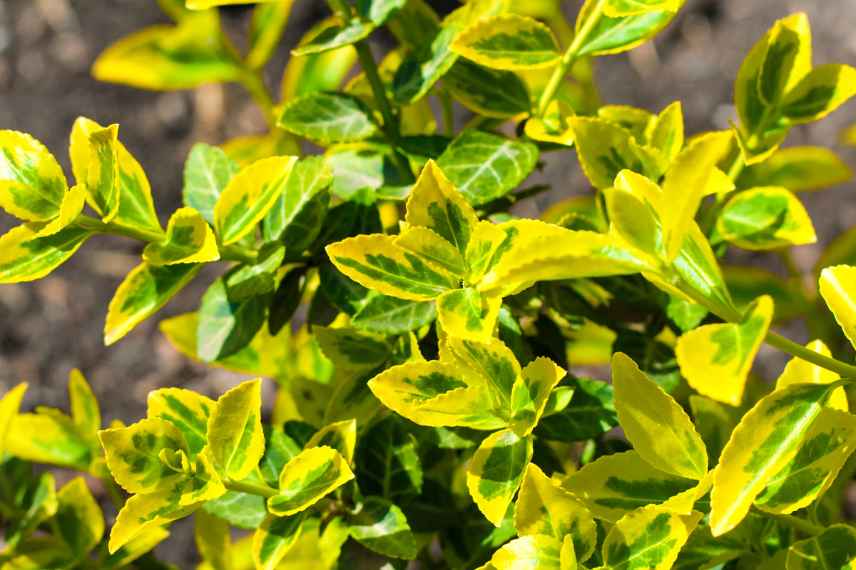 Euonymus fortunei ‘Emerald’n Gold’
Osmanthus heterophyllus 'Tricolor'
Originating in Taiwan, the Osmanthus heterophyllus make wonderful evergreen shrubs with very fragrant flowers. The oblong, green and spiny leaves of the type species are displayed on the variety ‘Tricolor’ (also called ‘Goshiki’) with an ivory-to-yellow variegation, reddening in autumn. In spring, new shoots are also coloured, with a pretty coppery pink this time, adding to the shrub’s appeal. It benefits from being relatively forgiving of soil, provided it is well-drained, and tolerates both sun and partial shade.
Like all Osmanthus, it produces very fragrant flowers in spring, another of its many virtues. The Osmanthus ‘Goshiki’ reaches about 1.5 m in height and remains similarly sized after several years, the shrub being slow-growing. Hardy to -15°C, it has its place in many gardens.
It can be planted in a border with a wide variety of shrubs and perennials: roses, Pieris, flowering currant, hardy geraniums, etc.
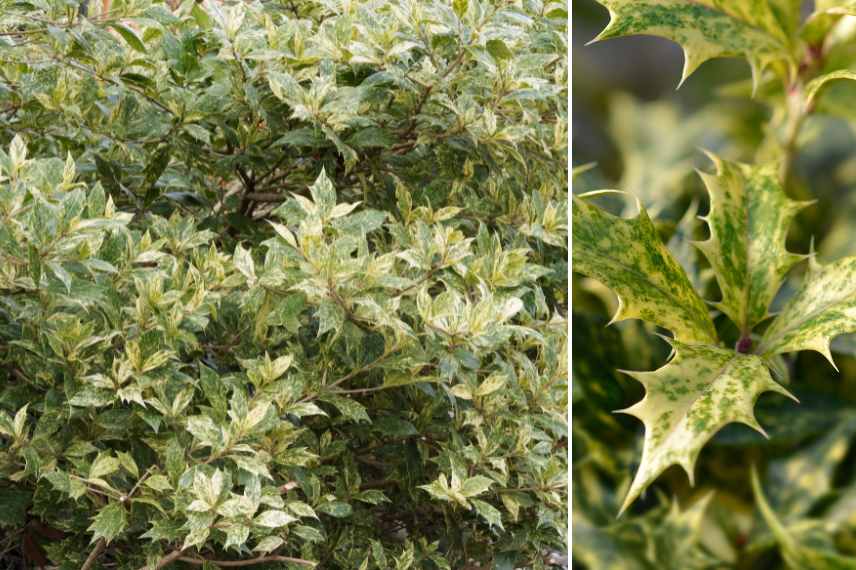
Osmanthus heterophyllus ‘Tricolor’
Juniperus squamata 'Blue Star'
Bluish evergreen foliage is magical for adding colour and contrast to the garden. If some Eucalyptus, such as ‘Baby Blue’, can be grown as shrubs in the garden, owing to their small size, junipers are certainly the most remarkable for their diversity.
Among the various cultivars of interest, the Juniperus squamata ‘Blue Star’ offers stunning blue-silver foliage. This scaly juniper has foliage in tiny sharp scales. It slowly forms a dense, flattened ball, 50 cm high by 40 cm wide at ten years, and will continue to spread to a 1 m reach. Very hardy, it tolerates temperatures down to -25°C. It prefers well-drained soil and full sun but will tolerate partial shade.
This creeping juniper is charming planted as a solitary specimen, emphasising a rock garden, or in a winter garden to bring a contrasting colour, and even suited to a Japanese garden. It can also be planted beside other taller conifers and heathers, for example.
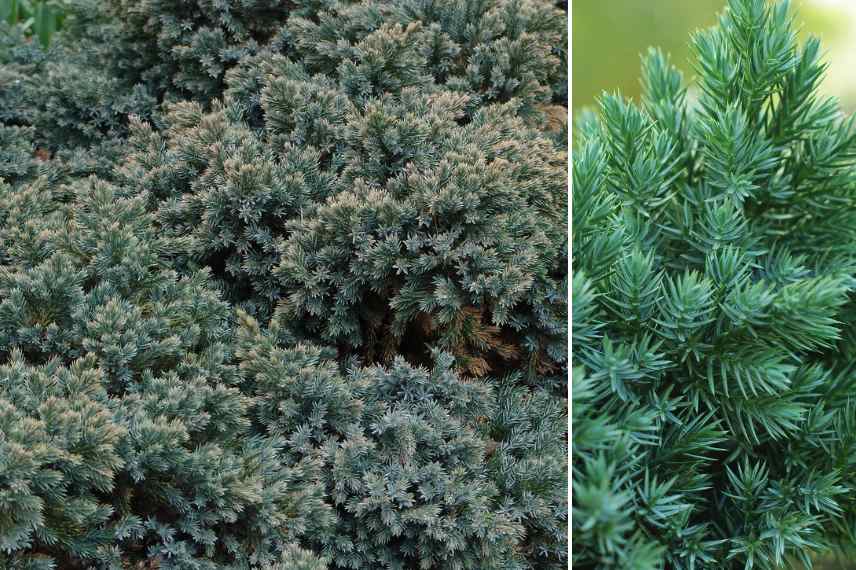
Juniperus squamata ‘Blue Star’ (©Drew Avery)
Pittosporum tenuifolium 'Purpureum'
There are many small-leaved pittosporums with variegated foliage, such as the Pittosporum tenuifolium ‘Variegatum’ or ‘Irene Patterson’, or even ‘Tom Thumb’, compact and purple-tinted.
Pittosporum tenuifolium ‘Purpureum’ itself displays a rich, dark colour, an essential addition to the garden. Leaves with undulate margins are olive-green at bud burst and gradually become purple. A little smaller than the other small-leaved pittosporums, it can still reach up to 3 m in height in maturity, with a more compact spread, the shrub retaining a handsome oval shape, which is particularly well suited to pot culture. It is a relatively fast-growing shrub compared with other evergreen shrubs in this selection. The tiny, fragrant flowers appear in May.
Hardy to -5°C, this purple Pittosporum will therefore be grown in regions with mild winters; it is particularly splendid in coastal gardens. It likes well-drained soil and full sun, and above all a site sheltered from cold winds.
In terms of combinations, enhance its purple hue by planting beside it a Tibetan cherry with reddened bark, and other evergreen foliage for a perennial border: creeping rosemaries, rockroses, purple hellebores and a few yellow narcissi to accompany it in spring.
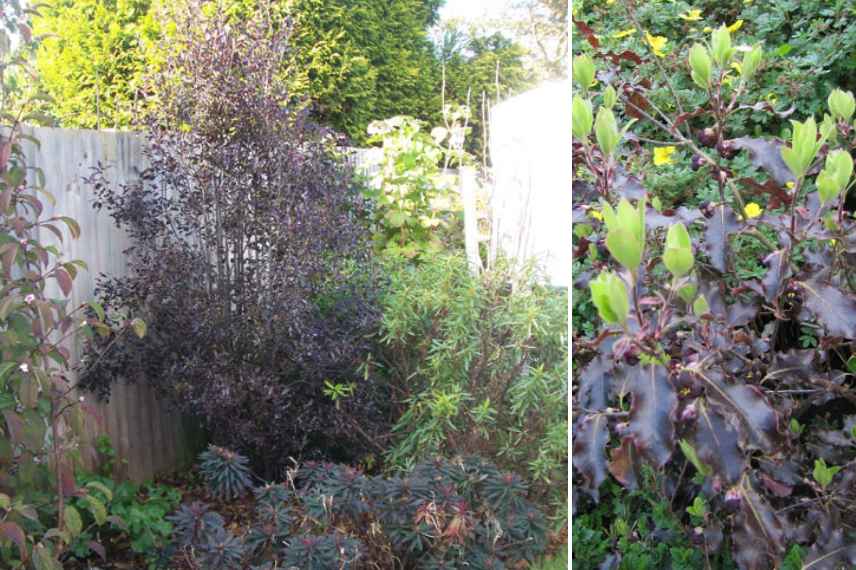 Pittosporum tenuifolium ‘Purpureum’ (© Leonora Enking)
And also...
The selection above is not exhaustive, as many evergreen shrubs display remarkable coloured foliage.
One can cite, in no particular order: the Cistus ‘Little Miss Sunshine’ all-golden, the Loropetalum and the Leucothoe for shaded conditions, some Skimmias and Daphnes marginated with cream such as the Skimmia japonica ‘Magic Marlot’ and the Daphne odorata‘Aureomarginata’, many Eleagnus (or oleasters) with silvery leaves or heavily marked with yellow. Not forgetting numerous Phormiums and Cordylines, Coprosmas and purple Dodonea for regions with mild winters (along the Atlantic coast and the Mediterranean rim), the Camellia japonica ‘Kerguelen‘ subtly cream-margined, some Yuccas such as ‘Golden Sword’, the Photinias and aucubas, and, regarded as a shrub given its size, the Eucalyptus ‘Baby Blue‘, all dressed in blue…
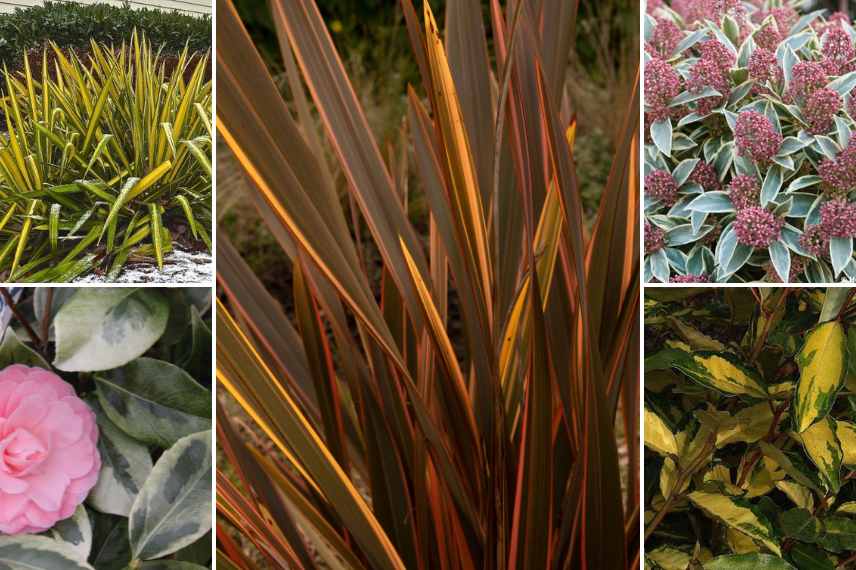
Yucca filamentosa ‘Golden Sword’, Camellia ‘Kerguelen’, Phormium tenax, Skimmia japonica ‘Magic Marlot’, and Eleagnus ebbingei ‘Eleador’
- Subscribe!
- Contents

Comments