





























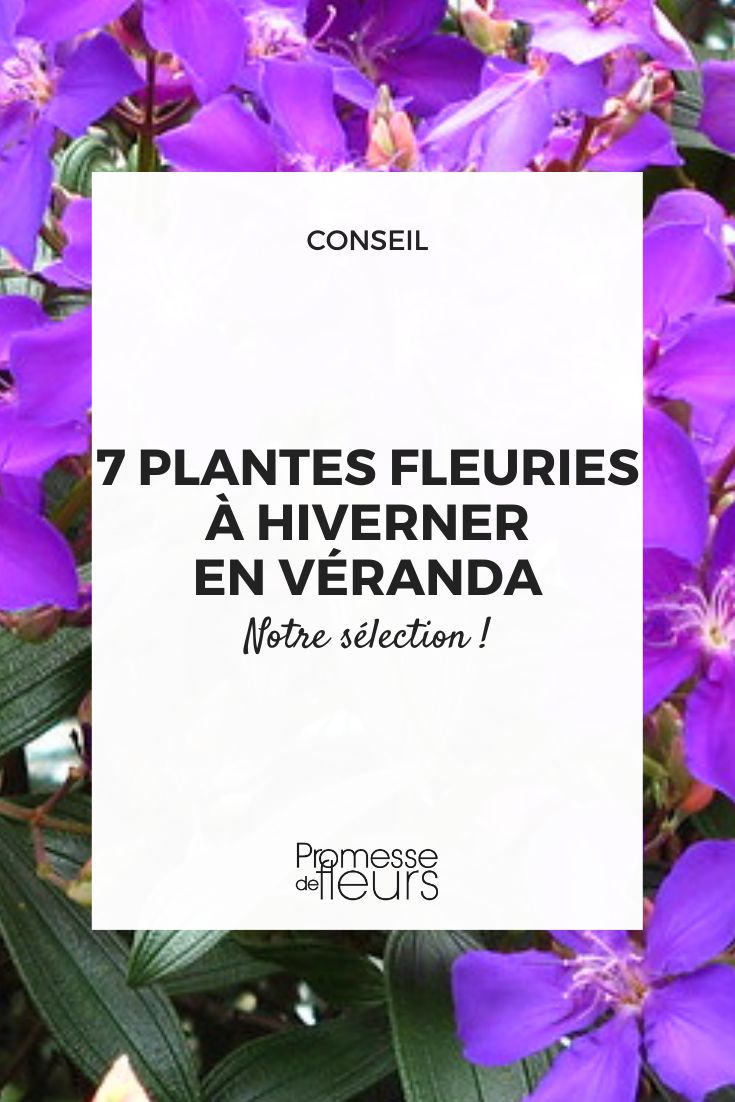
7 flowering plants to winter in a conservatory
Selection of ideal plants to gow in an unheated conservatory
Contents
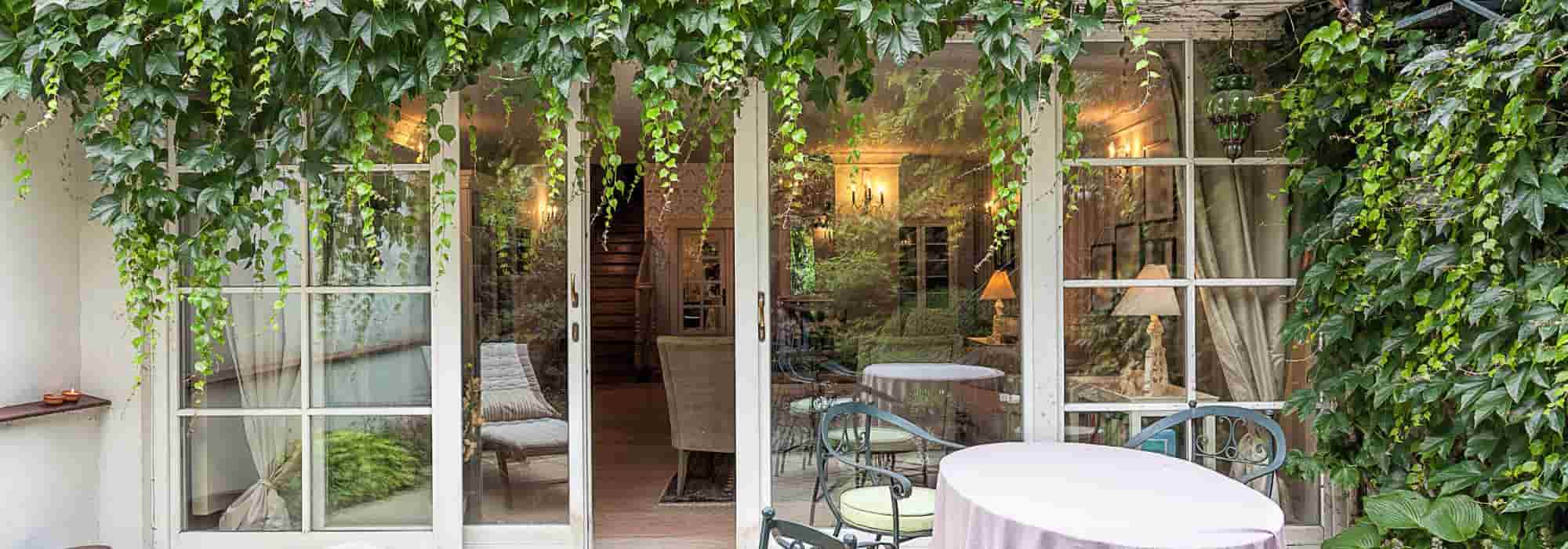
As an extension of the home, the conservatory is a living space that establishes a close connection between the interior and the garden. If it has efficient heating and good thermal insulation, the conservatory quickly becomes a light-filled living area. Other unheated conservatories serve as perfect places to winter slightly tender plants, often of Mediterranean, tropical, or subtropical origin. A conservatory indeed benefits from two significant advantages that are highly sought after by plants: exceptional light and protection from the cold, allowing them to enjoy their winter dormancy period in complete peace. Thus, a conservatory can easily become a lush winter garden where plants reign supreme! And, in summer, they will relish the joy of the outdoors in your garden or on your terrace.
We offer you a selection of 7 flowering plants that enjoy spending winter in a conservatory, to add a splash of colour to this bright space.

Jasmine for its highly fragrant flowering
Originating from China, the jasmine (Jasminum) is a shrub whose habit can vary from one species to another. However, most are considered climbing plants, boasting a multitude of alluring features. Starting with its highly fragrant flowering, which some may describe as overwhelming while others find it enchanting. Nevertheless, these terminal or axillary cymes of star-shaped flowers with a broadly opened corolla above a long narrow tube exude strong scents between December and July, depending on the species.
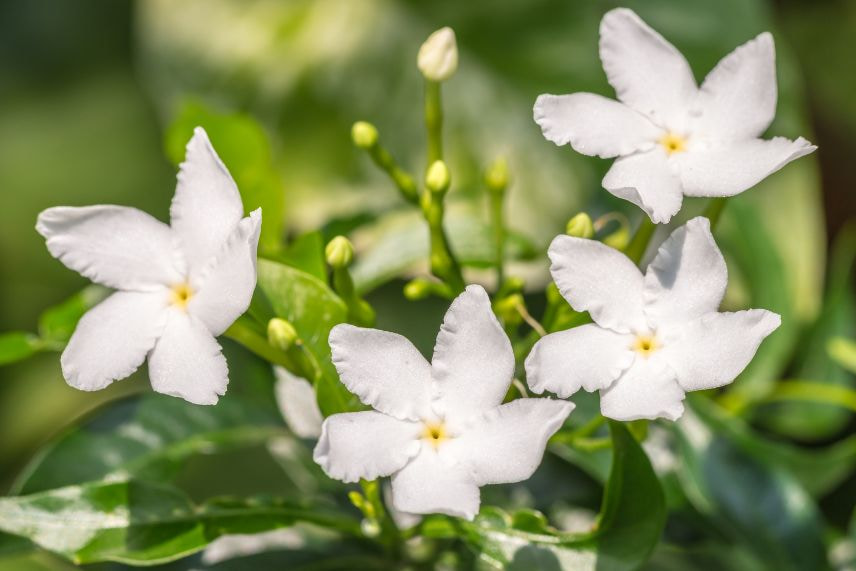
The jasmine
With hardiness limited to -5 to -7 °C depending on the species, jasmine is only grown outdoors in regions with a mild climate. Only the winter jasmine (Jasminum nudiflorum) and the Italian jasmine (Jasminum humile), both with yellow flowers, can be grown outdoors throughout France due to their hardiness down to -12 to -15 °C.
On the other hand, it is perfectly suited for pot cultivation. It will be just as vigorous in a pot as in the ground. Therefore, it will need a support for its angular or cylindrical stems, which are particularly voluble, to climb around.
How to grow it in a pot? Jasmine should be planted in a pot or container of at least 50 cm in diameter filled with a special Mediterranean plant compost. Don’t forget the layer of clay pebbles for drainage. In winter, the veranda should not exceed 15 °C.
For further reading:
Read also
6 Mediterranean perennialsBougainvillea for a profusion of flowers
Very sensitive to cold, the bougainvillea(Bougainvillea) loves warmth and sunshine. This means that in open ground, it only grows around the Mediterranean. However, it thrives wonderfully in pots. In summer, it will flood your garden with its colourful blooms, and in winter, it will enjoy the tranquillity of a bright conservatory, ideally with a temperature between 10 and 15 °C. This is because the bougainvillea is particularly frost-sensitive (from 0 °C).
The bougainvillea is a climbing plant with opulent flowering in vibrant colours ranging from pink, red, orange, to purple. Fast-growing, its shoots can reach between 2 to 8 m (significantly less if grown in a pot). They bear bright green foliage and small flowers, surrounded by bracts with a velvety and crinkled texture. Flowering occurs from May to September depending on the variety.
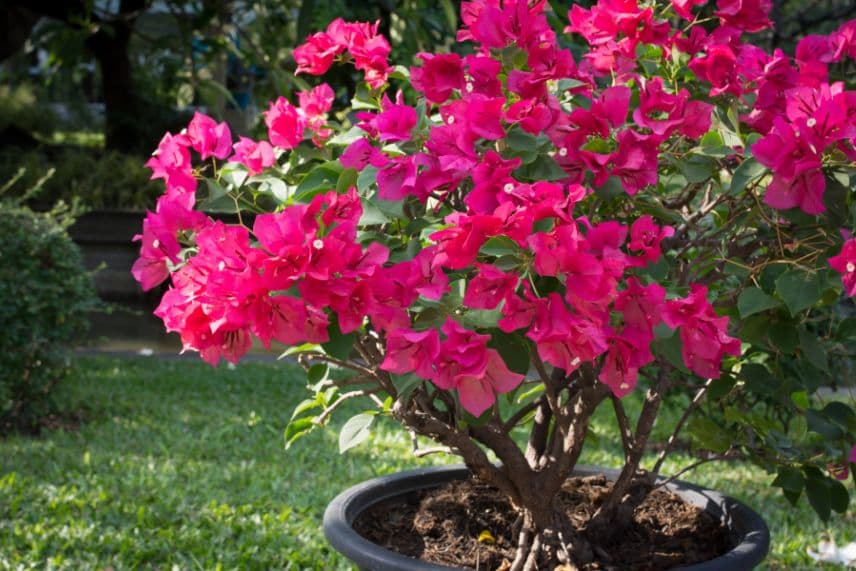
The bougainvillea
How to grow bougainvillea in pots? The bougainvillea needs a wide and deep pot, complemented by a support or trellis for its voluble stems. It should be planted in a mixture of garden soil and potting soil rich in blonde peat, or simply in special potting soil for Mediterranean plants, on a layer of clay balls for drainage.
For further reading:
Tibouchina for the originality of its purple flowers
Native to the south of Brazil, the tibouchina (Tibouchina), also known as spider flower, is a large, sparsely branched plant that naturally grows in tropical forests. In our latitudes, it can only be grown in a container or pot to be wintered in a conservatory with temperatures between 12 and 15 °C. The tibouchina will thrive there with its lovely deep purple flowers, approximately 12 cm in diameter, which bloom from August to November, either solitary or in bouquets on the young shoots of the year. At maturity, this flowering plant reaches a height of 2 to 3 m with a spread of 1 to 2 m. The foliage is dark green, wrinkled on the top, and adorned with beautiful longitudinal veins.
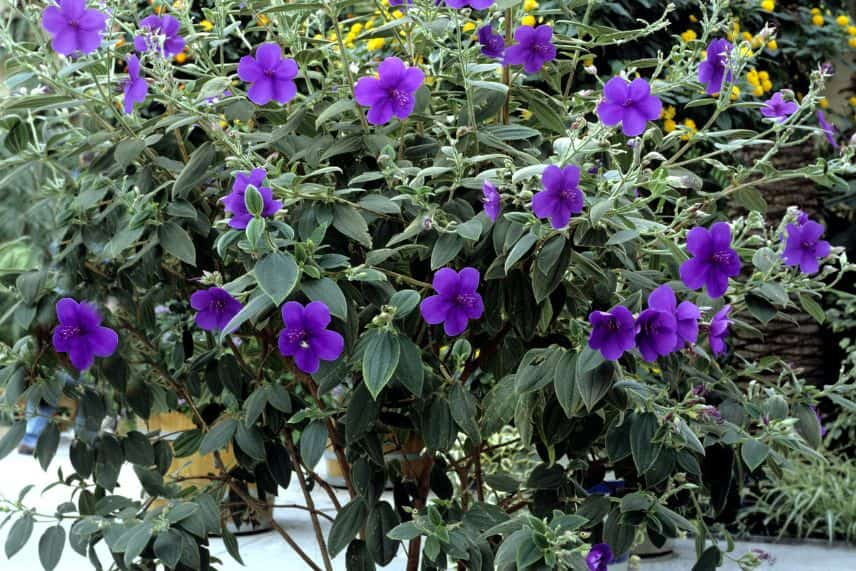
The Tibouchina
How to grow tibouchina in a pot? The tibouchina should be planted in a large pot, lined with a layer of clay balls or gravel for drainage, in a substrate formed of potting soil, compost, and heather soil. In summer, it should be placed in a cool spot, sheltered from direct sunlight.
For further reading:
- Growing Tibouchina in a pot
- Tibouchina: planting, cultivation, maintenance
Read also
Wintering plants in a conservatoryStrelitzia for its bird-shaped flowers
If you mention birds of paradise, you immediately think of the Strelitzia, this splendid exotic plant of South African origin, which is only grown in pots or containers, in greenhouses, conservatories, or winter gardens in our latitudes. Due to its hardiness down to -4 °C, the Strelitzia can be grown in the ground around the Mediterranean in a sheltered location.
The Strelitzia reginæ is the most well-known, with its orange and blue flowers, measuring 15 cm long, which emerge from a green boat-shaped spathe edged in red or purple. These flowers resemble the shape of a bird’s head with a slender beak and a colourful crest. The foliage is evergreen, elongated, and leathery, with long petioles. However, there are 4 other species, including Strelitzia nicolai and Strelitzia augusta ‘alba’ with white flowers. In pots, the Strelitzia rarely exceeds 2 m in height.
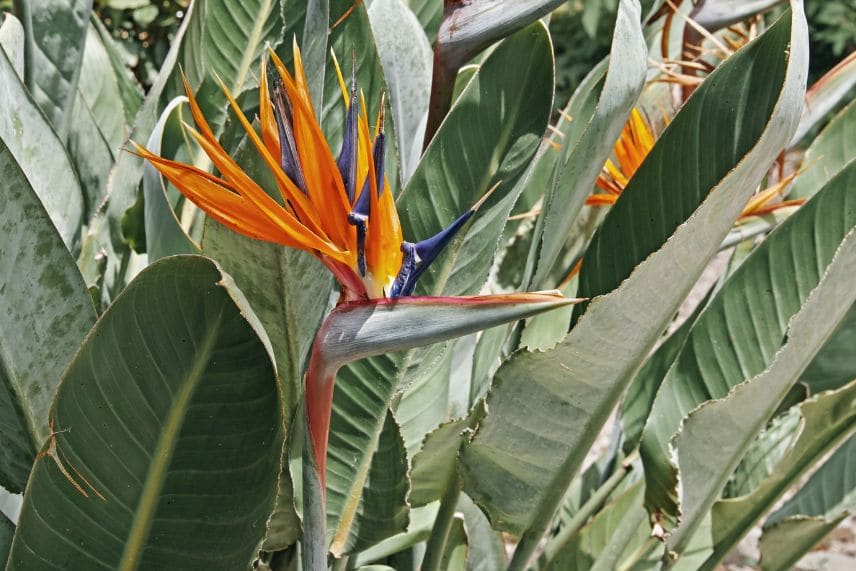
The Strelitzia
How to grow Strelitzia in a pot? In summer, the Strelitzia should be placed in a sunny spot, and in winter, a rather cool conservatory (10 to 12 °C) is ideal. It should be planted in a wide and deep pot, in a substrate formed of potting soil and compost, on a layer of clay pebbles or gravel.
To go further:
Lantana for its multicoloured flowering
If the lantana is called “thousand flowers,” it’s not by chance. Indeed, this tropical bush, grown exclusively in open ground on the Côte d’Azur, is particularly floriferous over time. It blooms from spring until the first frosts in a rainbow of colours. The small, fine, tubular flowers change hues as they open, transitioning from yellow or pink to orange, lilac, purple, or scarlet.
Sensitive to cold, lantana is often grown as an annual in pots. It will then be easy to winter it in a conservatory at a temperature between 10 and 15 °C, before allowing it to return to the garden once the risk of frost has passed. It can reach a height of 30 cm to 1 m.
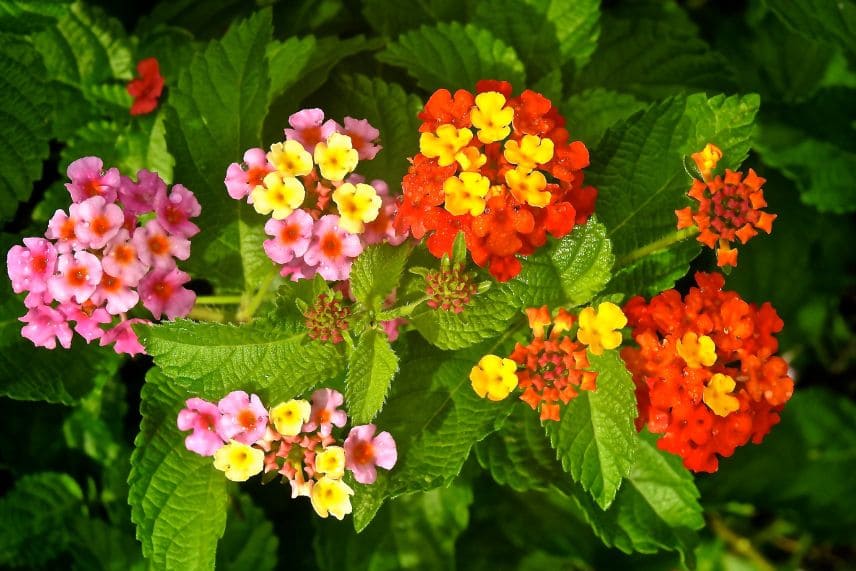
The lovely multicoloured flowers of the lantana
How to grow lantana in a pot? Lantana should be planted in a pot of at least 30 cm in diameter, filled with a substrate made of special geranium compost and sand, on a layer of clay pebbles.
For further reading:
Abutilon for its unusual flowers resembling Chinese lanterns
Shrubby or climbing plant, native to tropical or subtropical regions, the abutilon only survives in the ground in areas with a Mediterranean climate. Elsewhere, it thrives when grown in a pot, enjoying summer in the garden and winter in a conservatory, benefiting from temperatures above 10-12 °C. While its foliage is simple, lanceolate, ovate to rounded, and coloured in various shades of green depending on the varieties, its flowers are truly remarkable. From May to October, it indeed produces stunning flowers shaped like round bells or Chinese lanterns, with a calyx coloured in white, pink, red, yellow, orange, or even mauve blue.
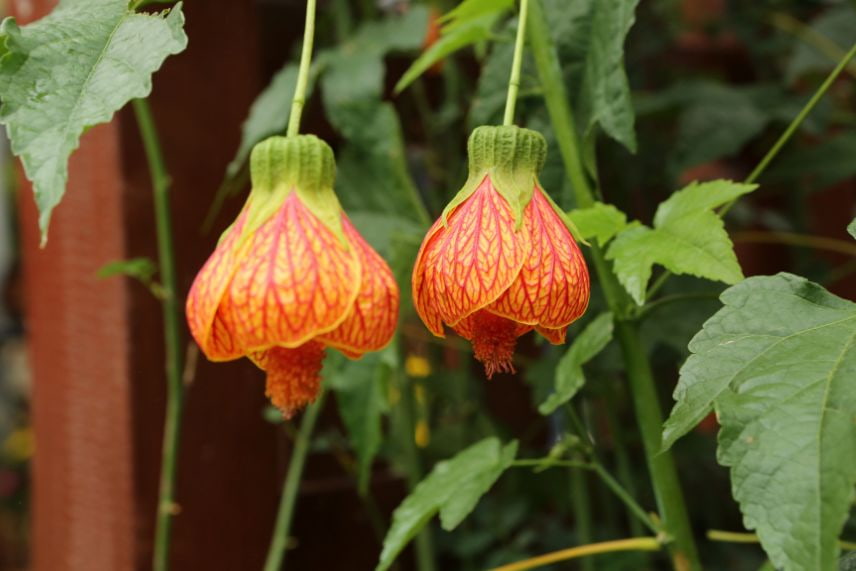
The astonishing flowers of abutilon
How to grow abutilon in a pot? Abutilon should be planted in a large pot 40 to 70 cm in diameter, filled with a substrate formed of garden soil, potting mix, and compost, on a bed of clay pebbles.
For further reading:
Passionflower for the complexity of its flowers
The passionflower (Passiflora) captivates primarily with its very distinctive summer flowering. It is a climbing plant whose flowers’ corollas resemble the crown of thorns of Christ, hence its vernacular name, passion flower. Highly decorative, these flowers, formed of five identical petals and five sepals, a pistil divided into three stigmas, and five stamens, bloom persistently from June to October on glossy, usually lobed foliage. The stigmas and stamens are surrounded by a crown of filaments, which adds to the charm and uniqueness of these delicately scented flowers. At the end of summer, they are followed by small, oval fruits that are yellow or orange.
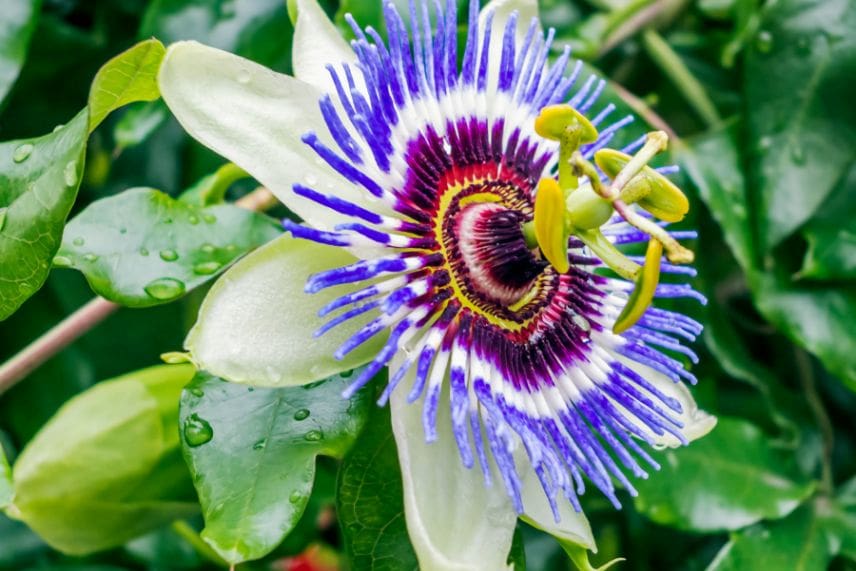
The atypical yet splendid flower of the passionflower
How to grow passionflower in a pot? The passionflower should be planted in a pot at least 30 to 50 cm wide, with a good layer of clay balls. The substrate will be formed of garden soil, compost, and sand.
For further reading:
- Subscribe!
- Contents
Comments