





























7 perennials with remarkable foliage
to enjoy them all year round or almost
Contents
Observe, if you haven’t already, the foliage of the plants around you. We are often distracted by the fleeting flowering, which is part of their charm, but the foliage is present for a large part of the year, if not all year round. Appreciate the foliage of perennials, whether in various shades of green, blue, grey, black, bronze, or purple. Enjoy its shape: full or dissected, the size of the leaves, giant or tiny. Appreciate its texture, appearance, thickness…
There is much to admire in the foliage of perennials, and moreover, there are particularly remarkable foliages, due to their size, colour, shape, or appearance. Let’s discover together 7 perennials with exceptional looks, thanks, not to their flowers, but to their leaves.

Acanthus 'Whitewater'
Let’s start with a plant whose foliage is inseparable from its flowering, as both are remarkable. Yet, the foliage alone is worth the visit. The Acanthus is a Mediterranean perennial with lush, leathery leaves, which we typically associate with woodland and moist-soil perennials. The Acanthus ‘Whitewater’ has a very architectural appearance, enhanced by its contrasting white foliage, which is very contemporary. Its spreading clump of semi-evergreen foliage consists of large, ovate, dentate leaves that are opposite and deeply lobed. Their colour is a randomly variegated dark green with cream-white. The plant reaches 1.2 m in height and 1 m in spread at ripeness. Let’s mention its exceptional summer flowering, featuring cream flowers with pink hues on large rose-purple spikes.
This variegated variety thrives in partial shade or full shade, inviting associations with white perennials like Epilobium angustifolium ‘Album’ or Veronicastrum virginicum ‘Album’, in front of dark evergreens. You can also pair it with pink or ochre foliage and flowers for a softer, less contemporary result.
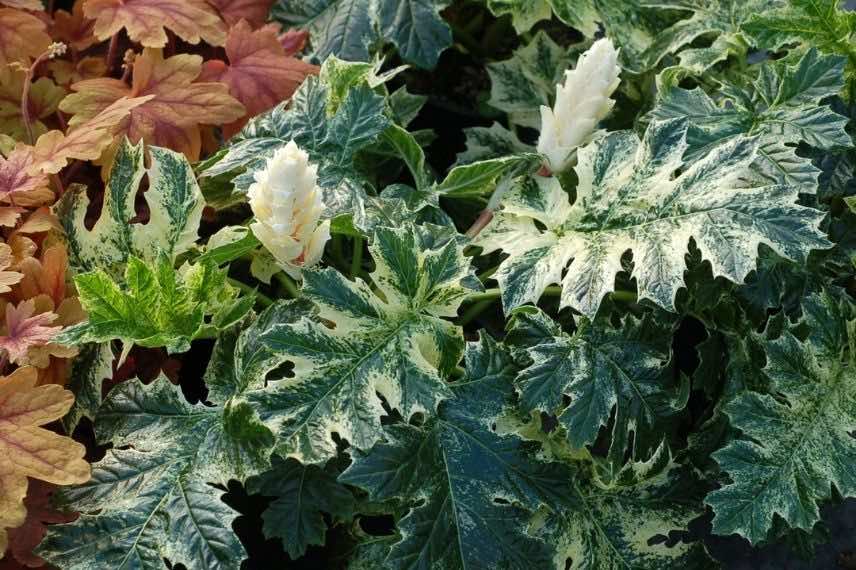
Acanthus mollis ‘Whitewater’
Read also
12 perennials for heavy, wet soilHosta abiqua 'Drinking Gourde'
Here is a remarkable Hosta for several reasons: the Hosta abiqua ‘Drinking Gourde’ boasts one of the bluest foliage in its family. Its round, well-wrinkled, cup-shaped leaves, resembling water receptacles as its name suggests, shine with a beautiful blue-grey hue. The upright petioles hold the leaves horizontally, giving the plant an astonishing, tall, and generous overall shape. Heart-shaped, its foliage is heavily veined and quite thick. It blooms in summer with lavender then white bell-shaped flowers. This is a reliable and robust Hosta.
One can imagine it in a contemporary garden, in cool soil, alongside several Hostas and Astilbes, as well as golden foliage that highlights the brilliance of its blue, such as Hakonechloas or large Carex in cool soil.
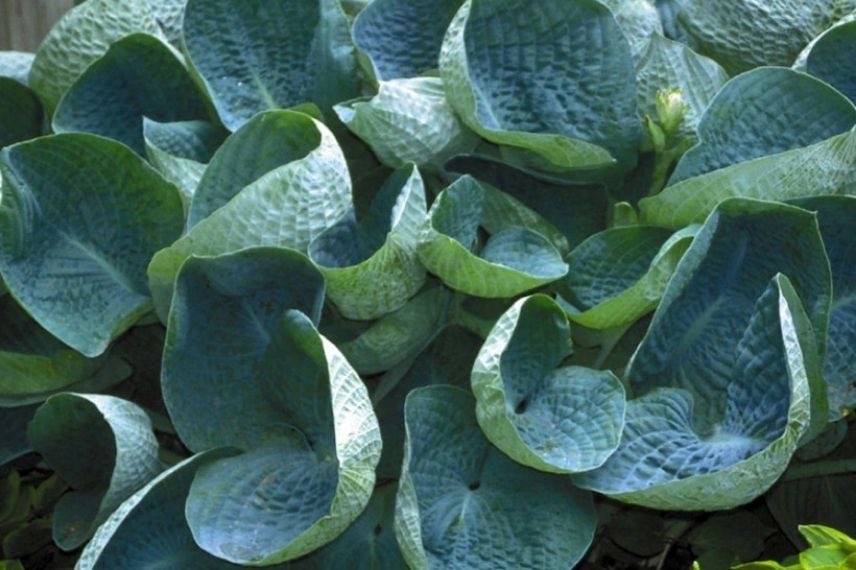
Hosta abiqua ‘Drinking Gourde’
Discover other Coloured foliage perennials
View all →
Available in 1 sizes
Available in 1 sizes
Available in 1 sizes
Available in 2 sizes
Available in 1 sizes
Available in 1 sizes
Available in 1 sizes
Available in 1 sizes
Available in 1 sizes
Available in 1 sizes
Farfugium japonicum
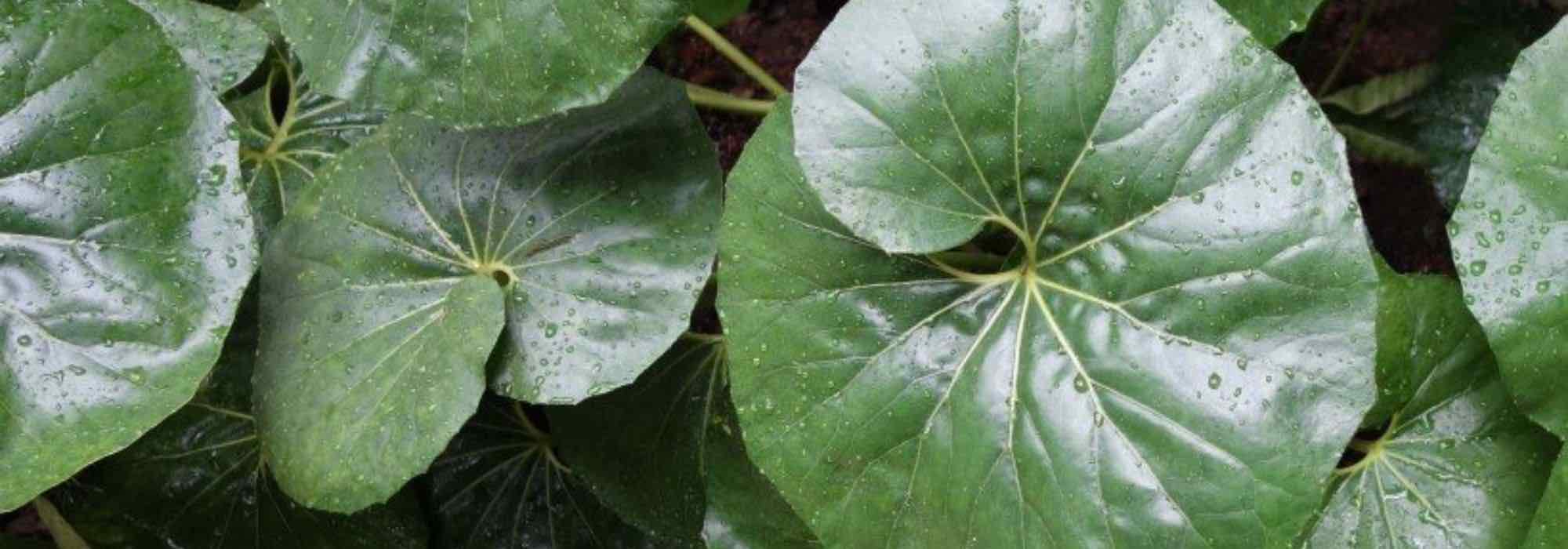
Asian perennial of humid undergrowth, the Farfugium japonicum embodies the essence of ornamental foliage. As a fine representative of perennials for cool soil, it offers opulent, thick, and glossy foliage. At the end of a thick, long petiole, leathery and shiny leaves unfold, measuring up to 30 cm in diameter. The variety ‘Gigantea’ boasts leaves that can grow up to 45 cm wide. Well-veined, the leaves are rounded or more precisely reniform, reminiscent of those of water lilies. Farfugium japonicum forms wide and somewhat loose clumps, about 60 cm in height and width. A bit tender, Farfugiums are hardy down to -10° C. They evoke exotic and cool gardens, in shade or partial shade.
Several varieties have their own distinct personality, such as the bright and very original Farfugium japonicum ‘Aureomaculatum’ with its yellow-spotted leaves, aptly named Panther Plant. The Farfugium japonicum ‘Crispata’ features very wavy edges on grey-green leaves. Even more intensely undulated, the Farfugium japonicum ‘Wavy Gravy’ forms a compact and intensely frizzy clump.
Farfugiums bloom in autumn with yellow daisies well above the foliage. Plant them in cool shade in woodlands or along banks alongside ferns and Polygonatums. Pair the variety ‘Aureomaculatum’ with a Kirengeshoma palmata to echo the yellow spots of its foliage.
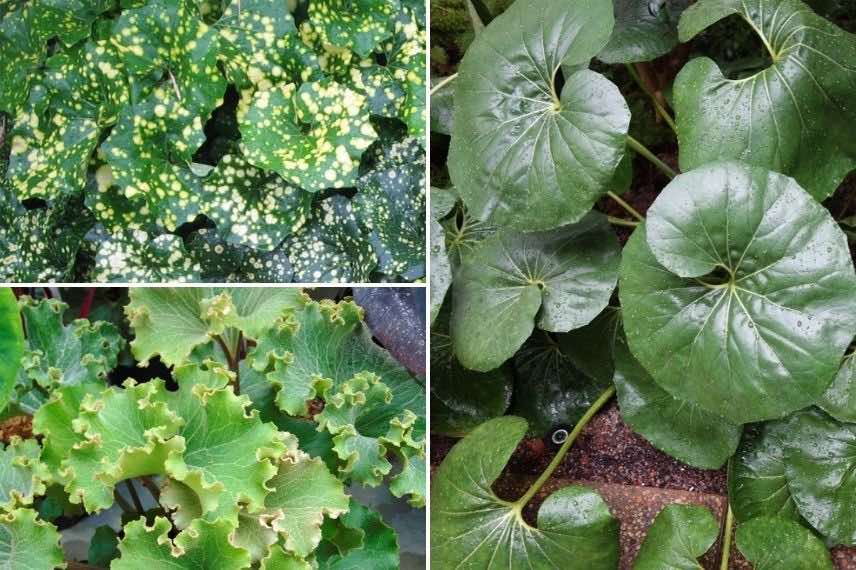
Farfugium japonicum ‘Aureomaculatum’, ‘Gigantea’ and ‘Crispata’
Leptinella squalida 'Platt's Black'
After giant leaves, miniature leaves: a close-up at ground level with Leptinella squalida ‘Platt’s Black’, a particularly ornamental variety of Leptinella, this small perennial groundcover thrives in shade or partial shade. Observe these lovely, finely dissected leaves with an unusual coppery bronze hue tinged with violet, highlighted by a touch of acid green. A delight of precision and delicacy!
In well-drained, cool soil, in shade or partial shade, it makes an excellent groundcover, even an alternative to small patches of lawn. Growing to a height of 5 cm, it produces small, rather insignificant yellow flower heads in summer. Plant it in crevices, in shady rockeries, alongside a fern Athyrium niponicum ‘Pictum’ as a complement, a Brunnera ‘Looking Glass’ with Myosotis-like flowers, and a Milium effusum ‘Aureum’ with golden foliage.
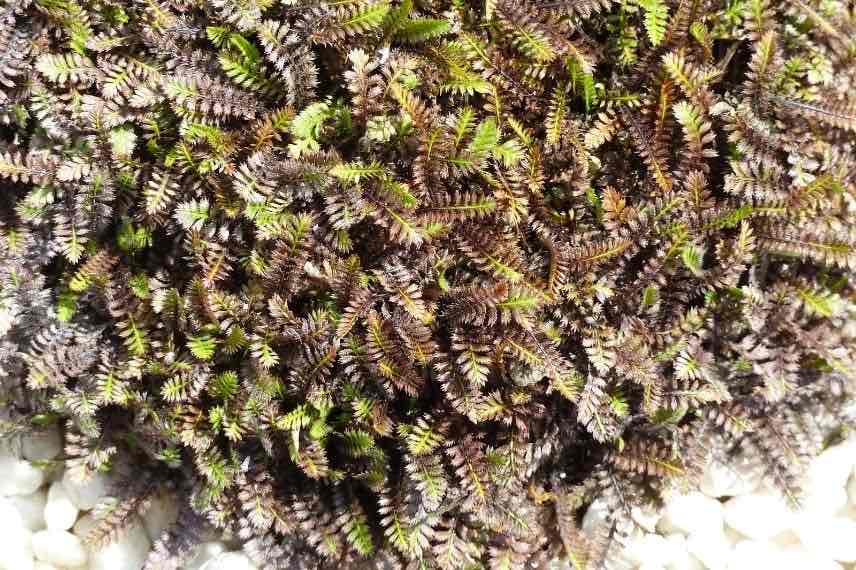
Leptinella squalida ‘Platt’s Black’
Saxifraga stolonifera 'Cuscutiformis'
Let’s stay close to the ground with Saxifraga stolonifera ‘Cuscutiformis’, a Saxifrage that brightens up light shade with its refined presence. Its evergreen foliage is adorned with silver patterns on olive green and brown leaves. Quite hardy, it is a slightly easier Saxifrage to grow than Saxifraga fortunei. It spreads through its stolons, and if it likes the spot—preferably in cool, dappled shade or light shade—it pleasantly extends into rosettes of 15 to 20 cm in diameter for the largest leaves, decorating the chosen location all year round. Let’s also mention its flowering, which produces a misty haze of tiny white flowers maculate with red, held high on their stems, gracefully lasting for several weeks.
Plant it at the edge or in a rockery alongside small Hostas, Tiarellas, and Hakonechloas.
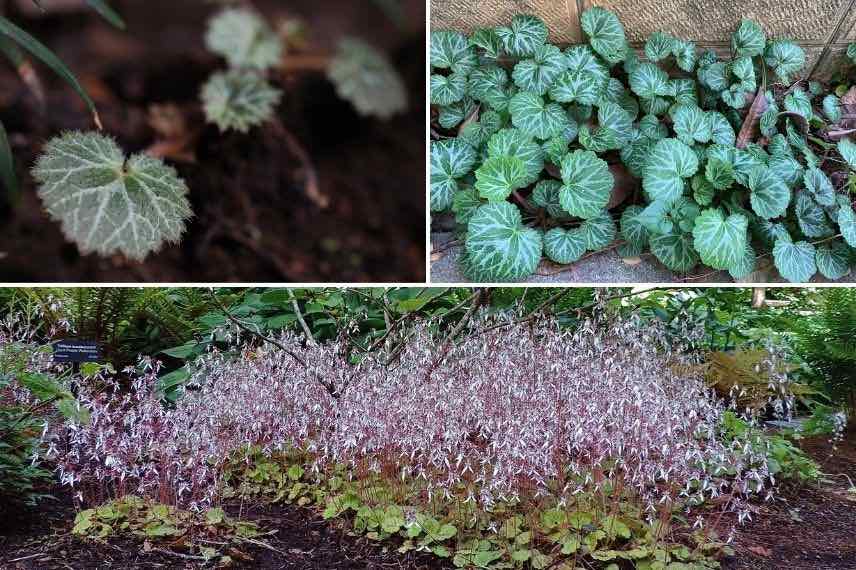
Saxifraga stolonifera and a glimpse of its flowering (photos ©Yuya Tamai, ©Forest and Kim Starr, ©Peter Stevens)
Colocasia
Very exotic, the Colocasia is both in nature and appearance. Native to the humid tropical regions of East Asia, it is grown in France as an outdoor plant where it is hardy down to -10°C; its stump is then mulched to protect it in winter. However, it is also well-known among houseplant enthusiasts, where you can place it in a pot with very good light. It is truly a foliage plant, as it rarely flowers here. It boasts very large heart-shaped and sagittate leaves measuring 60 to 80 cm long and 50 to 60 cm wide, often with pronounced veins. Thick, slightly undulate, and sometimes plicate, they are inclined towards the ground. The thick petiole can measure up to 1 m long. Depending on the varieties, the leaves declinate a wide palette of green: very bright yellow-green, soft green, dark bluish-green, but they can also be purplish and almost black.
Accompany it in an exotic scene of moist soil with a tree fern, Dicksonia antarctica, a Gunnera, if you have the space! Or more modestly, with Phormiums, Crocosmias, and Arums.
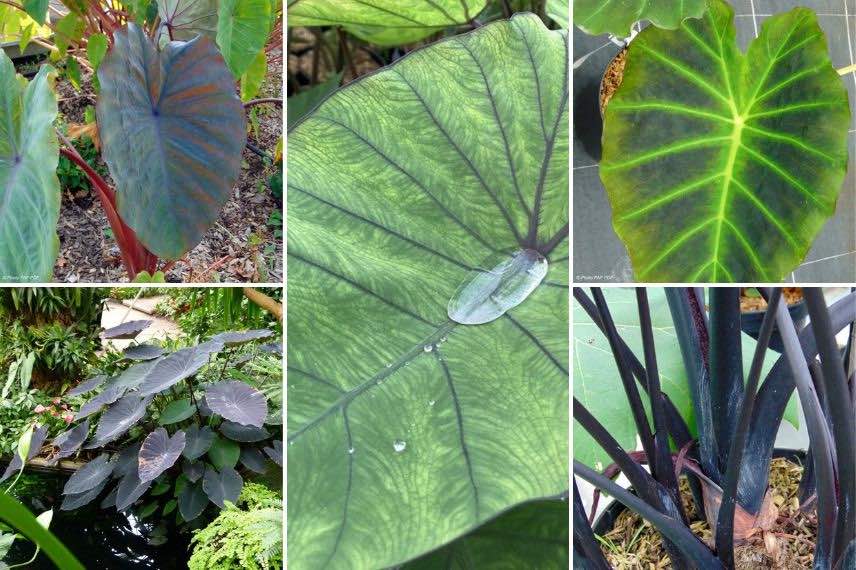
Colocasia ‘Sangria’, ‘Blue Hawaï’, ‘Imperial Gigante’, the black stems of Colocasia ‘Black Stem’ and Colocasia ‘Black Magic’
Podophyllum
Here is a captivating plant in every way! The Podophyllum is a rhizomatous perennial of the understory native to North America or, for other species, to mountainous regions in Asia. It displays umbrella-shaped foliage, more or less lobed, and for some varieties, marked with irregular brown or purple spots. Its leaves measure 15 to 35 cm in diameter. In Podophyllum peltatum, the umbrella-like leaves are deeply lobed, glossy, bronze-green to light green. In Podophyllum ‘Spotty Dotty’, the leaf is star-shaped, a chartreuse green speckled with dark chocolate green. Finally, Podophyllum hexandrum features well-dentate foliage, a glossy green marked with brown spots. The Podophyllum produce small white or red flowers, followed by egg-shaped fruits. Although very curious, Podophyllum are still hardy plants, tolerating temperatures down to -15 or -20 °C; however, patience is required to see them settle in.
Plant them in dense or light shade, alongside understory plants such as Ferns, Corydalis, Polygonatum, and variegated Hostas for the light they provide.
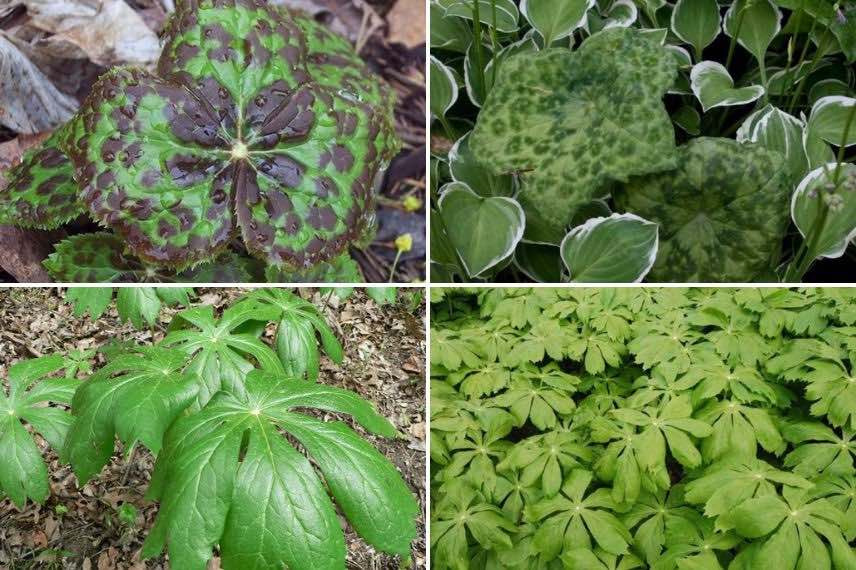
Podophyllum hexandrum, Podophyllum ‘Spotty Dotty’, and below Podophyllum peltatum
- Subscribe!
- Contents
Comments