





























7 Rare Trees
Stunning collection subjects to discover
Contents
Living fossils that were thought to be lost forever and have been saved by the wonders of plant technology, rare specimens in cultivation and the only representatives of their genus, or subjects as exceptional in their natural habitat as in the collections of nurserymen: some trees are true rarities, which it is rewarding to discover and, why not, to grow in your garden, provided you can offer them the optimal growing conditions.
Discover these originals, these unique trees, both for your curiosity and to consider adopting one at home: here is our selection of 7 rare and collector trees.

Quercus myrsinifolia: a wonderful Myrsine-leaved Oak
Resembling the camphor tree, the Myrsine-leaved Oak Quercus myrsinifolia is a rare small tree native to Japan and China. Its common name, which is sometimes also “Bamboo-leaved Oak,” comes from the shape of its leaves, which are elegant, lanceolate, and prominently veined, measuring about 13 cm in length and 4 cm in width. This delicately structured tree has a pyramidal habit in its youth, eventually forming a rounded crown over the years. While in its native range it slowly develops into a small tree reaching 15 m in height, in our climates, it will not exceed 5 m in height and 3 m in spread.
Preferring mild conditions, it thrives in fresh, neutral to acidic soil in full sun: give it a prime spot in your garden, or consider it for a seaside garden, as it tolerates salt spray very well! It can also wonderfully contribute to the design of a Japanese garden.
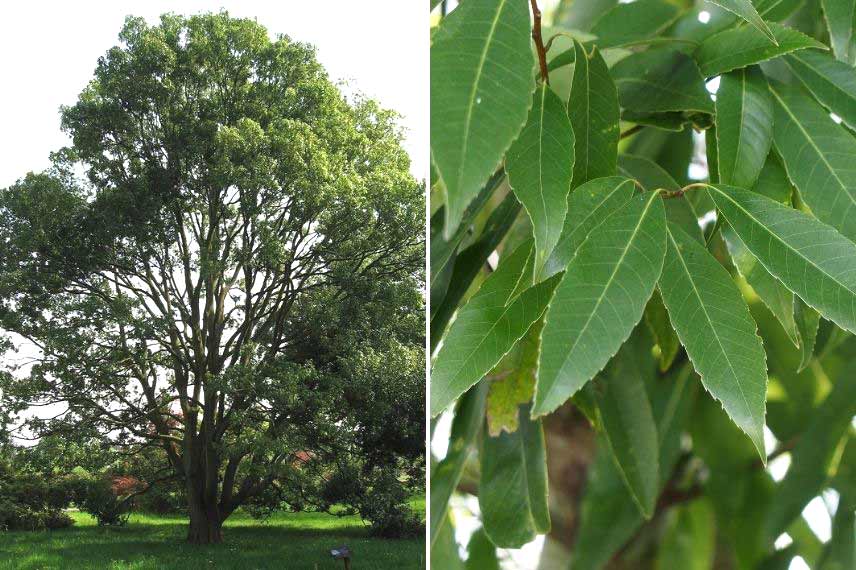
Quercus myrsinifolia
Wollemia nobilis: an Australian Pine thought to be extinct
Représentant de la famille des Araucariaceae, qui est l’une des plus anciennes du point de vue botanique, le Wollemi Pine Wollemia nobilis est un cousin des Araucarias, derniers représentants d’un groupe de plantes qui proliférait au Jurassique. Cette espèce est la seule représentante actuelle du genre. On le croyait disparu, jusqu’à ce qu’il soit redécouvert en 1994, dans le fond d’une petite vallée tenue secrète, en Australie. Les botanistes ont depuis pu le multiplier, ce qui permet non seulement de le préserver, mais aussi de le proposer aux jardiniers.
Il arbore la silhouette d’un grand sapin élancé à la ramure très particulière en double couronne : les branches basses sont pourvues d’un feuillage en grandes aiguilles souples et aplaties vert clair, disposées horizontalement, qui rappellent les frondes des fougères, et la couronne terminale prend une forme de cône. Son écorce boursouflée a une belle couleur chocolat. Cet arbre, faisant partie des plus rares au monde, préfère les sols humifères, acides et frais, et redoute les fortes gelées (il serait rustique jusqu’à -12 °C) : on peut tenter sa culture sous un climat de type océanique doux. Les quelques Wollemia nobilis adultes atteignent 35 m de hauteur et présentent un port globalement étroit et pyramidal.
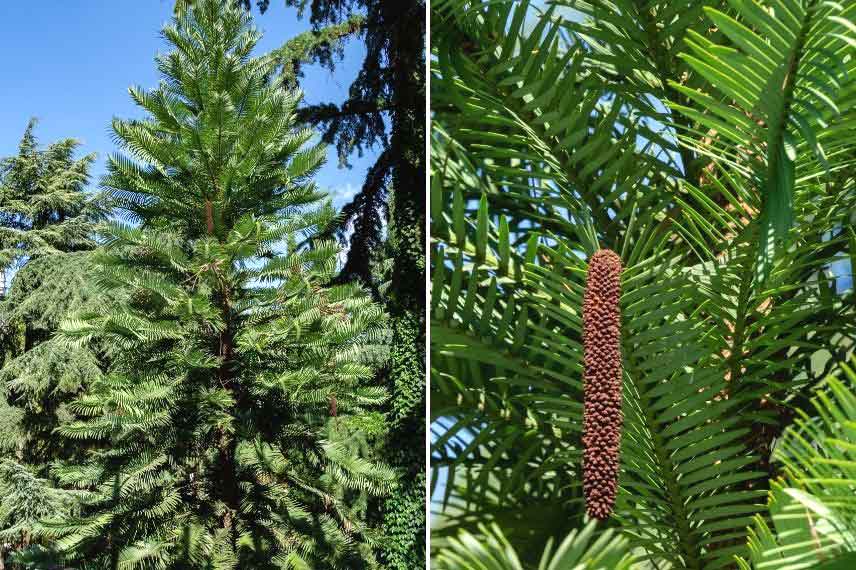
Wollemi Pine
Discover other Trees and large shrubs
View all →
Available in 1 sizes
Available in 1 sizes
Available in 1 sizes
Available in 1 sizes
Available in 1 sizes
Available in 1 sizes
Available in 1 sizes
Available in 1 sizes
Available in 1 sizes
Available in 1 sizes
Tetracentron sinense: a rarity from Asia
Originally, the Tetracentron sinense is found at the forest edge and in the steep valleys of Asia. This small deciduous tree is the sole representative of the genus Tetracentron. The name comes from the Greek “tetra” meaning “four” and “kentron” referring to a prickle, in reference to the four appendices shaped like spines that adorn its fruits. In its native regions, where it is unfortunately endangered, this tree can reach 30 m in height, but it will reach about 12 m in height with a spread of 6 m when planted in our climates.
Very graceful, the Tetracentron sinense boasts a generally upright and rounded silhouette, with young heart-shaped red foliage that turns soft green, taking on beautiful shimmering tones again in autumn. Its spring and summer flowering takes the form of long, original pendulous aments, followed by decorative fruiting. Hardy (down to -18°C), it prefers a bright or partially shaded location in neutral to acidic soil.
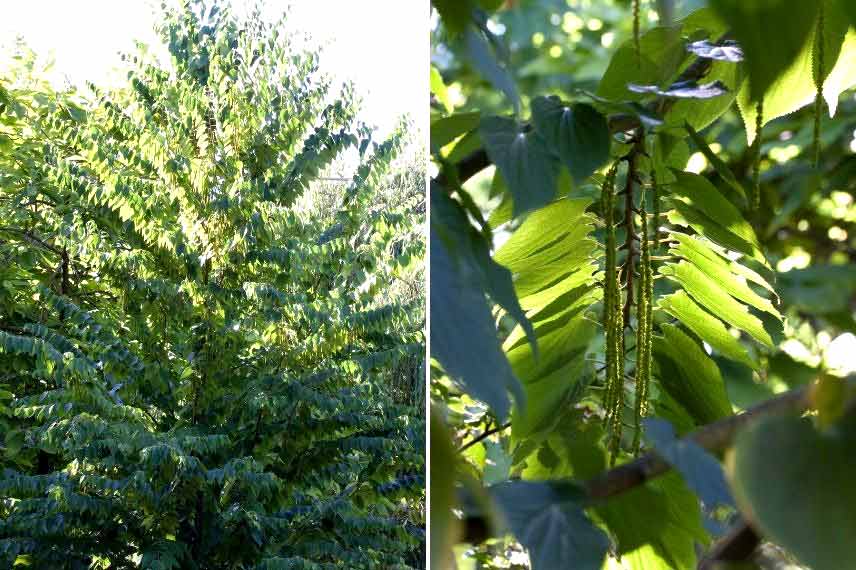
Tetracentron sinense
Emmenopterys henryi: a rare flowering
Protected species native to southern China, the Emmenopterys henryi can, in its native range, reach heights of 45 m and live for several centuries. Its rare flowering, on an equally rare specimen, is stunning but unpredictable, delighting enthusiasts. It comprises intensely fragrant cream-white tubular flowers, appearing on the upper branches from June to August. This magnificent tree, with its spreading habit, features lovely dark, glossy foliage, with young shoots that are bronze-red, as well as grey, cracked bark.
The Emmenopterys henryi thrives when planted in deep, rich, humus-bearing, cool, well-drained soil, in sunny or partially shaded locations, sheltered from cold or drying winds. Quite hardy, it withstands temperatures down to -15 °C.
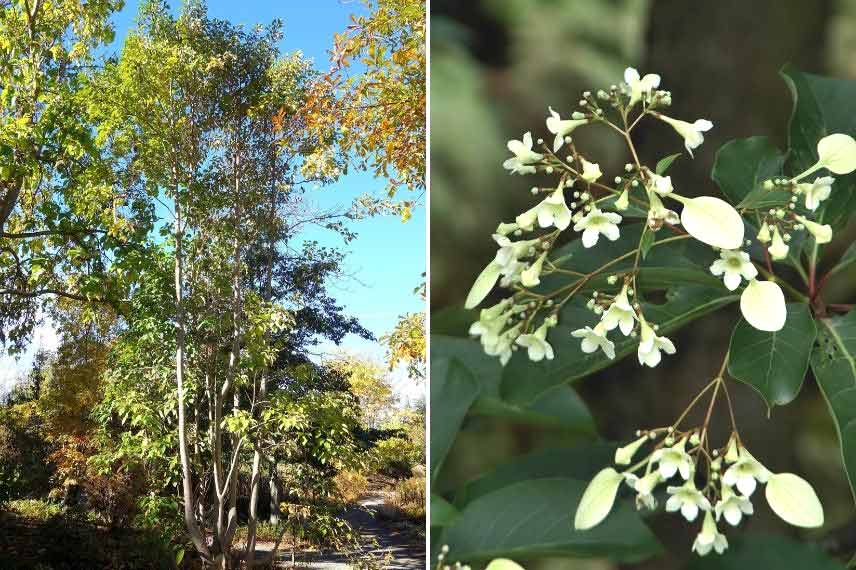
Emmenopterys henryi (Wikimedia)
Delavay Magnolia: a collection Magnolia
This variety of magnolia provides a grand spectacle in summer with its countless large, delicately scented cream flowers. Quite hardy (down to -12 °C), the Magnolia delavayi, also known as Chinese Magnolia, is an extremely rare species, a true collector’s tree. From July to September, it adorns itself with large cream flowers that gradually turn to purplish pink, measuring 10 to 20 cm in diameter, ephemeral and solitary, with a cone at their centre. After flowering, the cone remains on the tree until ripening. Its evergreen foliage is formed of large, leathery, glossy ovate leaves, in an elegant green.
It is a small evergreen tree with a rounded habit, reaching 10 to 12 m in height and 8 m in spread, perfect for confined spaces, where it will be the focal point in rich, cool, even moist but well-drained, non-calcareous soil. Protect it from prevailing winds and place it in full sun or partial shade to see this beautiful rarity thrive!
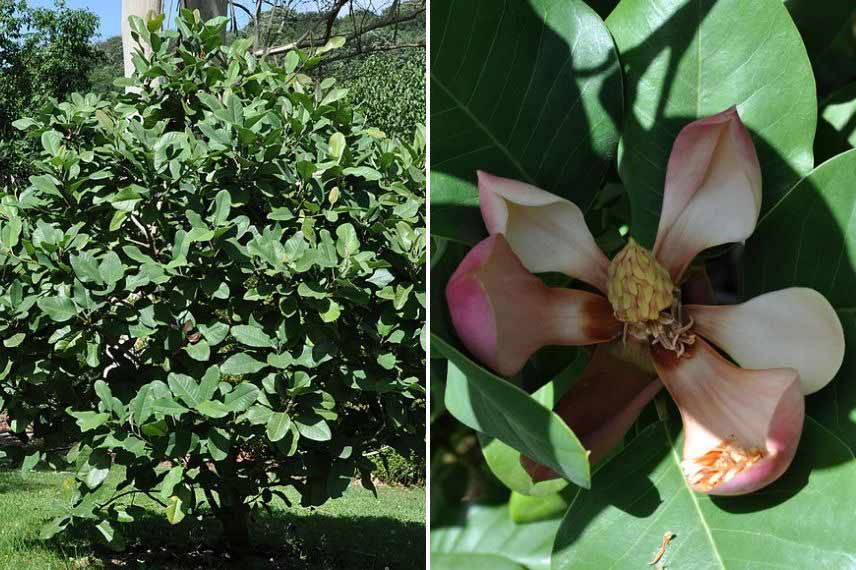
Magnolia delavayi (Citron – Wikimedia)
Davidia involucrata 'Lady Sunshine': a variegated Handkerchief Tree to discover
The common name of this deciduous tree, the Dove Tree, perfectly evokes the shape of its flowers, surrounded by large, very original pendulous bracts. This abundant white flowering blooms from early May to the end of June, giving it a unique appeal. The branches of the Dove Tree spread rapidly, reaching heights of up to 12 m and a span of 10 m.
Speaking of rarities, let’s mention the Davidia involucrata ‘Lady Sunshine‘, a very rare form of the Dove Tree, featuring stunning heart-shaped variegated foliage, green with broad cream-yellow edges. This variety flowers from a young age, unlike the type that flowers after many years. With excellent hardiness (down to -15 °C, or even beyond), this collector’s tree thrives in full sun or partial shade, in deep, fertile, light, and moist soil.
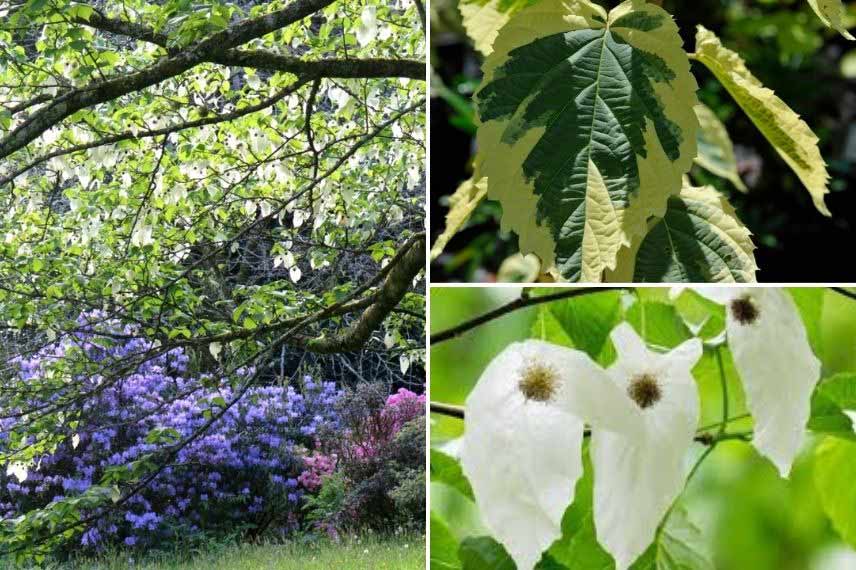
Davidia involucrata ‘Lady Sunshine’
Eucryphia moorei: delightful Rosewood
Generously flowering for almost two months in summer, Eucryphia moorei, also known as Rosewood, is a collection subject to discover! A tree with a fastigiate habit reaching 25 m in height in its humid and temperate native environment of south-eastern Australia, it takes on the appearance of a beautiful small evergreen tree under our latitudes, not exceeding 8 m in height and 4 m in spread, adorned with graceful white cup-shaped flowers in July and August.
This lovely tree, with its dazzling summer flowering that is highly melliferous, will find its place in partial shade in oceanic climate gardens, either in shrub borders or as a specimen. It prefers cool, acidic to neutral, well-drained soils and will not tolerate excessive heat or drought. Frost-sensitive, Eucryphia moorei will withstand temperatures dropping occasionally to -5 °C once well established, but its foliage will suffer from -2 °C.
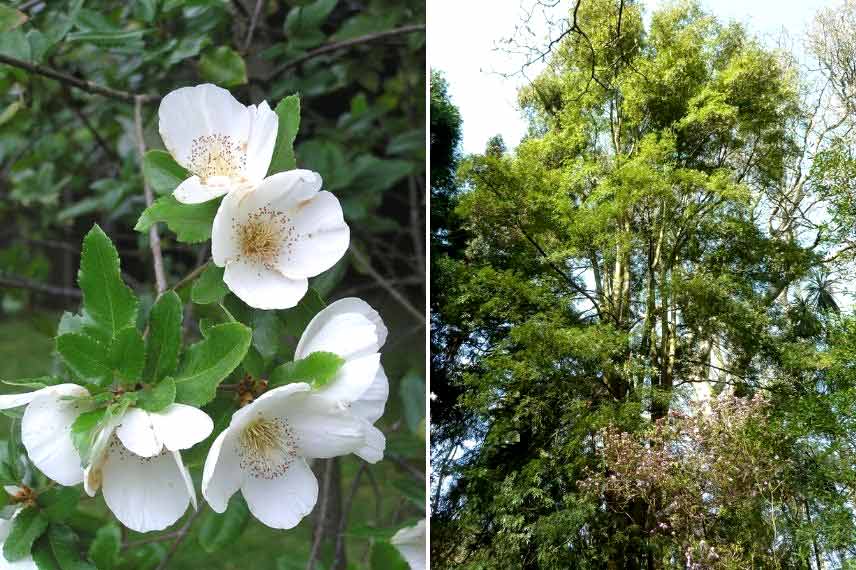
Eucryphia moorei

- Subscribe!
- Contents
Comments