





























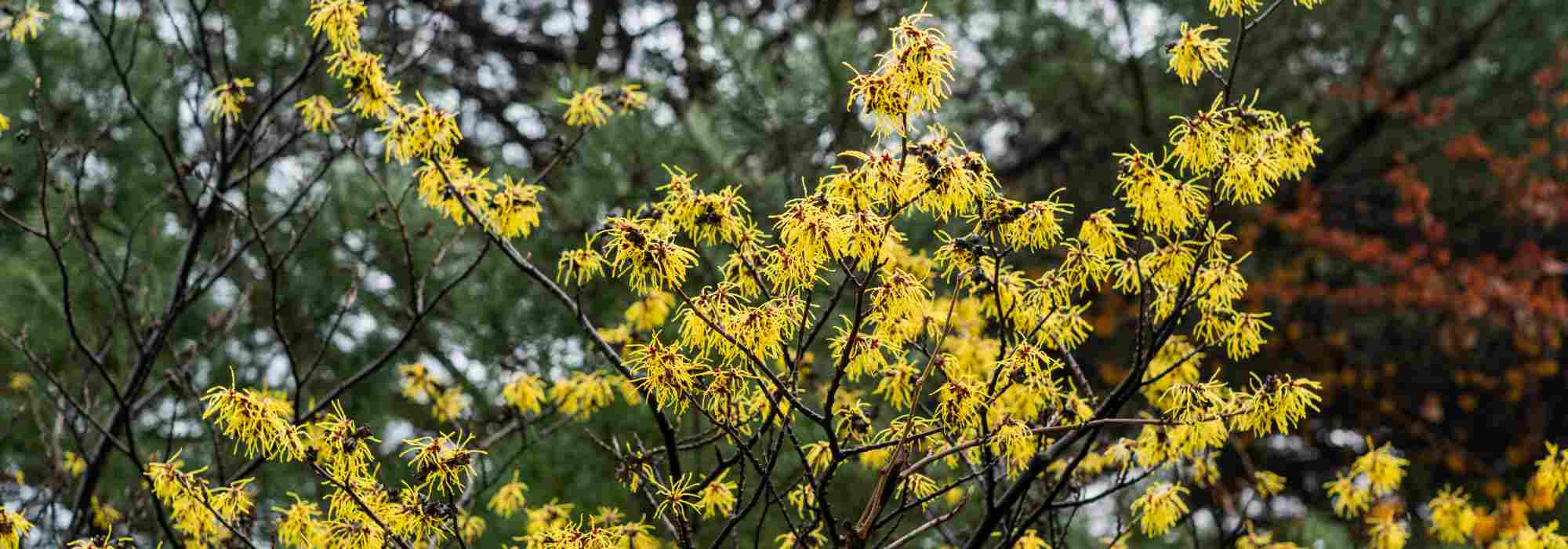
7 Witch hazels with yellow flowers for a blooming winter
Our selection of the most beautiful yellow varieties
Contents
Witch Hazel is one of the few shrubs that flowers in the heart of winter. Elegant and mysterious, long known as the “witch’s hazel,” it boasts a delicately fragrant flowering resembling spiders that bloom on its naked branches. These curious flowers, which are fragrant, emerge in warm hues. While it brings a touch of light and fragrance to the heart of winter, its hazel-like foliage continues the enchantment as it takes on fiery colours in autumn before falling. It is a must-have in a four-season garden. Hardy down to -20 to -30 °C and easy to maintain, it thrives in full sun or partial shade in heather soil that is non-calcareous, humus-bearing, and cool. Its slow growth and well-balanced habit make it an excellent centrepiece for a winter garden (Winter garden). It can be planted in borders, in a free-standing hedge, or under large trees, as a specimen, or even in a pot near the house to enjoy its intoxicating fragrance. Discover our selection of 7 yellow-flowered witch hazels to brighten up the still-sleeping garden!

Hamamelis (x) intermedia 'Arnold Promise'
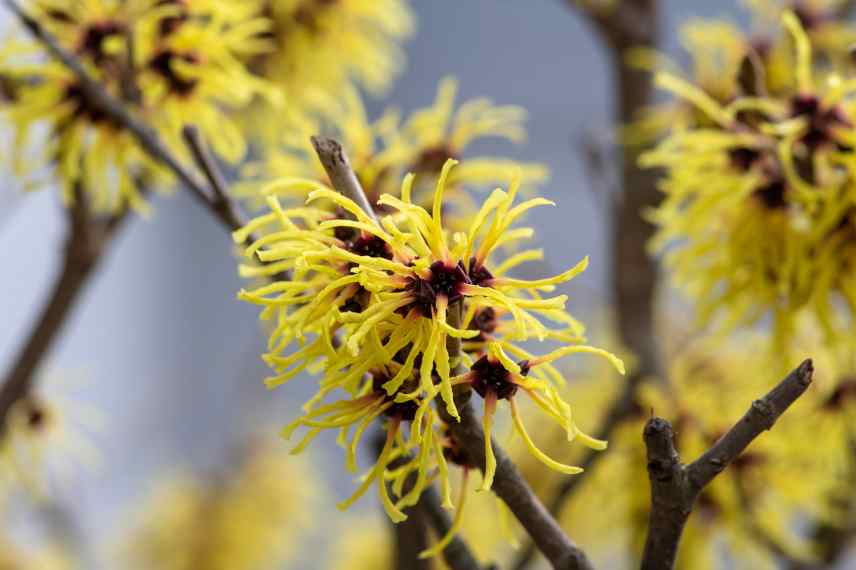
The flowers of Hamamelis ‘Arnold Promise’, a bright yellow, appear in the heart of winter, typically between January and March, bringing a bright touch to the garden when most other plants are still in dormancy. They consist of narrow, ribbon-like petals that are slightly undulate, emitting a delicate fragrance reminiscent of honey and spices. They develop in tight clusters along the naked branches and bloom abundantly despite the winter chill.
After flowering, ‘Arnold Promise’ produces dense, decorative foliage resembling that of the hazel. Its deciduous leaves are ovate, measuring between 8 and 15 cm long, with undulating and slightly dentate edges. A light green, they display vibrant shades of bright yellow tinged with red along the margins as the days shorten, offering a second period of ornamental interest. It has a spreading and upright habit, typically reaching between 3 and 4 metres in height at ripeness, with a similar spread.
Pair Hamamelis ‘Arnold Promise’ with hellebores, these winter-flowering perennials will form a lush carpet at its feet, creating an elegant duo that is frost-resistant.
Read also
Choosing a witch hazelHamamelis virginiana
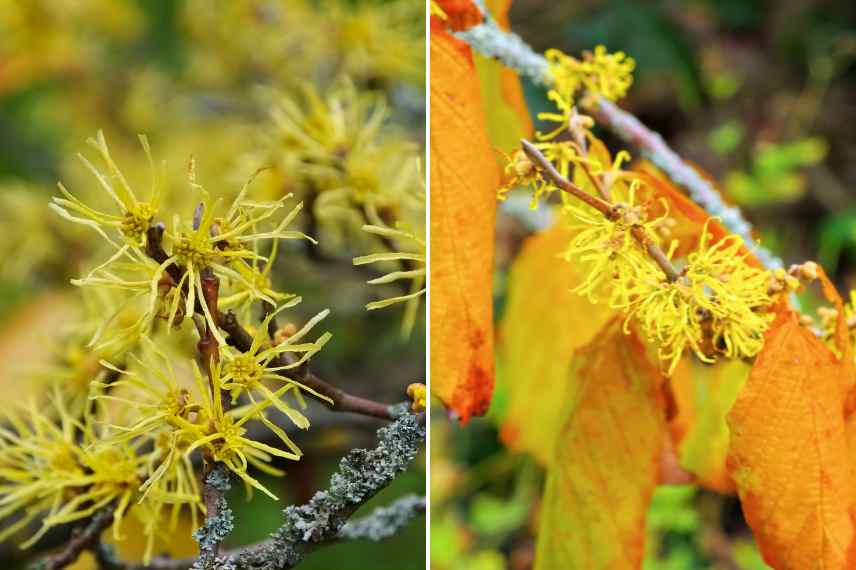
Hamamelis virginiana or Virginia Witch Hazel is distinguished by its early flowering. Unlike most other witch hazels that bloom in winter, this one unfolds its flowers from late September to November. Its small, bright yellow flowers, with their thin, ribbon-like petals, appear on the naked branches or among the last falling leaves. Each flower consists of four elongated petals, measuring about 2 cm long, curiously crumpled and almost claw-like, resembling witch’s fingers, which gives the bush an intriguing appearance. The bright yellow flowers gather in small clusters along the branches. Their fragrance of hyacinth, daffodil, lemon, and honey attracts the last bees of the season, still in search of nectar before winter arrives. After flowering, it produces fruit capsules that are also yellow. These fruits often persist on the bush until the following spring, adding a lasting golden touch.
The foliage is equally interesting. As autumn approaches, it turns golden and orange-yellow before falling to make way for the flowering, marking the transition from summer to winter in a striking manner. Its growth is relatively slow, but over the years it forms a bushy shrub with an elegant and airy habit of about 4 m in height and 3.5 m in spread.
Hamamelis virginiana reveals its golden flowering at the time when maples and dogwoods display their purple and orange hues. Pair it with a Japanese Maple ‘Brown Sugar’ with autumnal red and orange tones, with dogwoods (Cornus mas, Cornus officinalis, Flowering Dogwoods), or with Persian Ironwood. Together, they will create a fantastic and colourful autumn scene until the first frosts.
Hamamelis (x) intermedia ‘Barmstedt Gold’
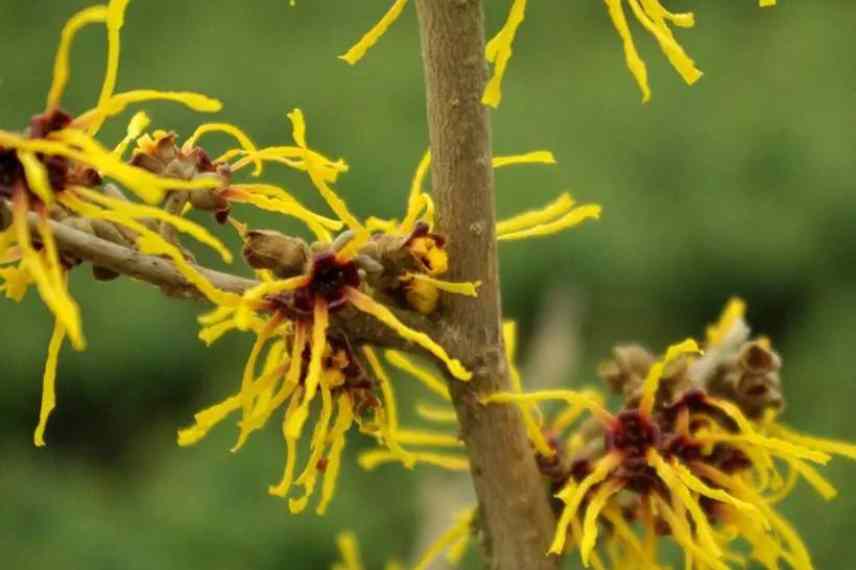
Another remarkable variety that has been awarded by the Royal Horticultural Society of England. The Hamamelis (x) intermedia ‘Barmstedt Gold’ stands out for its abundant flowering in a golden yellow that is much brighter than the usual sulphur yellow of many other varieties of witch hazel. The centre of each flower is enhanced with orange. Flowering begins as early as January and continues through February, or even from December to March depending on the climate. The flowers, about 2 cm in diameter, are composed of thin filaments that give them the appearance of small spiders or sea urchins clinging to the bare branches. They are so densely grouped on the branches that they form a true golden cloak. They emit a honeyed fragrance that emerges in the heart of winter, bringing a comforting note to this often dreary time.
After the winter flowering, the bush is covered with dense and decorative foliage. Its leaves are ovate and dentate, measuring 8 to 15 cm long. During the summer season, they adopt a dark green colour. As autumn approaches, the foliage turns yellow before falling.
Its natural and graceful silhouette, as well as its size (it will reach 1.5 m after 10 years of planting and 3 m in all directions at maturity), makes it a choice element to brighten up a flowerbed. Pair it with Viburnum bodnantense ‘Dawn’, which also blooms in the heart of winter, delivering bouquets of highly fragrant pink flowers and purple-red autumn foliage, or with a Forsythia, which will take over the floral display in the garden.
Hamamelis x intermedia 'Yamina'
With its spectacular flowering and changing foliage, Hamamelis x intermedia ‘Yamina’ is sure to catch the eye and bring a touch of magic to the still-sleepy garden. Between January and March, this bush is adorned with a constellation of spider-like flowers approximately 2 cm long, remarkable for their abundance on its naked branches and their enchanting fragrance. They are composed of numerous sulphur-yellow petals that bloom around a burgundy calyx.
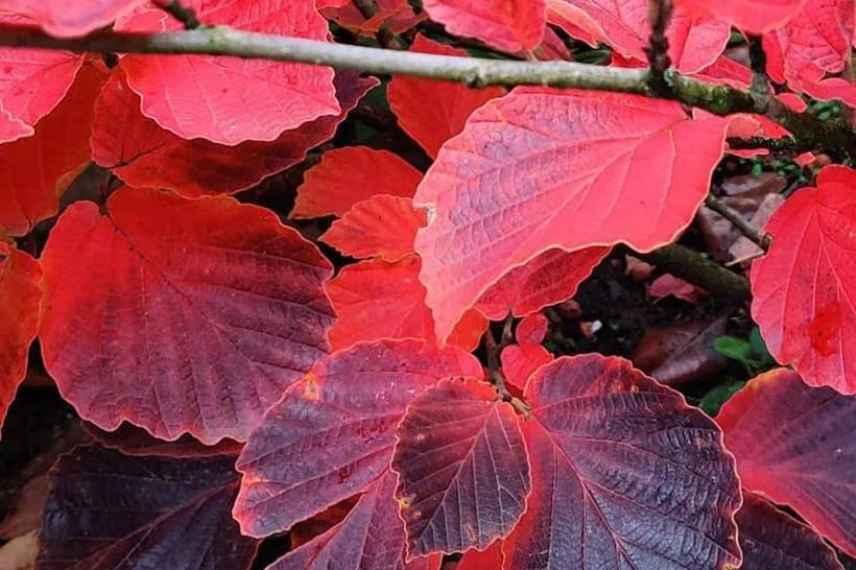
As the season progresses, its hazel-like foliage, which appears after flowering, also puts on a show. If the bush receives sufficient sunlight, its green leaves begin to take on shades of purple-brown and bronze by late summer. Then, in autumn, they present a true festival of colours, transitioning successively from violet to butter-yellow, then to blood-red. Before falling, they fill the garden with warm and vibrant hues, extending the ornamental interest of the bush well beyond its flowering period.
This witch hazel typically reaches a height of 2 to 3 metres, making it an ideal shrub for small gardens or for use at the edge of woodlands, beneath large trees, or in the background of a border. To highlight Hamamelis ‘Yamina’, pair it with winter-flowering shrubs such as dwarf Rhododendrons, Sarcococca, or Daphnes, as well as ericaceous plants with evergreen foliage.
Hamamelis x intermedia 'Westerstede'
Hamamelis x intermedia ‘Westerstede’ stands out for its late flowering. This variety is one of the last to bloom among witch hazels. Its bright, vivid yellow flowers generously unfold on the naked branches, offering a dazzling display at the end of winter, in February-March. Although less fragrant compared to other varieties of witch hazel, they impress with their abundance. The elongated, curiously dishevelled petals add a whimsical touch to this time of year when the garden slowly awakens. Then, the bush dons its leafy attire. As summer settles in, the foliage transitions from dark green to dark yellow, bronze, and orange before falling.
This cultivar also distinguishes itself from other hybrid witch hazels by its unique spreading habit. At maturity, it takes on the shape of a large cup, with branches that spread harmoniously, forming a graceful and airy silhouette. This bush can reach a height of 3 to 4 metres, sometimes spreading up to 3 metres in width. Its open habit and architectural structure are perfect for adding whimsy to the garden, preferably not far from the house to enjoy the fragrance and beauty of the flowers at the end of winter with every pass.
To highlight it, pair it with companion plants that enhance its winter flowering. At its base, plant winter heathers and heucheras to add texture and contrasting colours. Also, install Edgeworthia chrysantha beside it, which offers a most original flowering of golden blooms in late winter on the bare wood.
Hamamelis x intermedia 'Aurora'
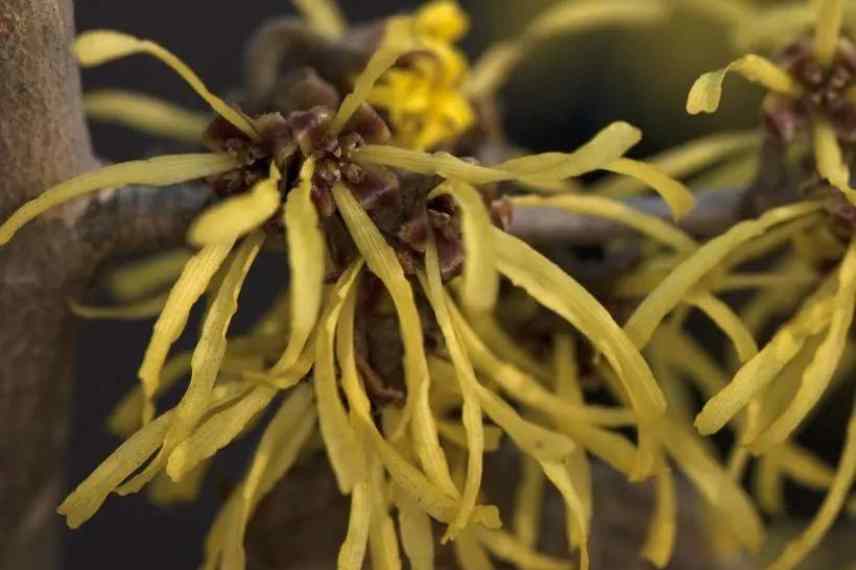
The Hamamelis x intermedia ‘Aurora’ stands out for its exceptionally large flowers, probably the most impressive among the Hamamelis intermedia. Its lightly scented flowers, with a diameter of up to 4 cm, bloom quite late, in February, before the leaves appear, on the naked branches. They take on the species’ characteristic spider-like shape, composed of fine, delicate filaments. Their pale yellow colour, subtly tinged with orange at the base, adds a touch of luminous softness to the winter garden. In a similar style, theHamamelis ‘Cyrille’ is a selection that is also characterised by a bicoloured flowering, straw yellow and rust.
In autumn, the foliage dons warm colours, transitioning through shades of yellow, orange, and sometimes scarlet red, providing a striking final touch before falling. Once mature, this bush will reach 3 m to 3.5 m in all directions.
To accompany its winter flowering, plant nearby a Sarcococca hookeriana ‘Digyna’, a small bush with evergreen foliage and delicately scented winter flowers or pair it with a Mahonia with acid yellow flowers.
Hamamelis japonica 'Pendula'
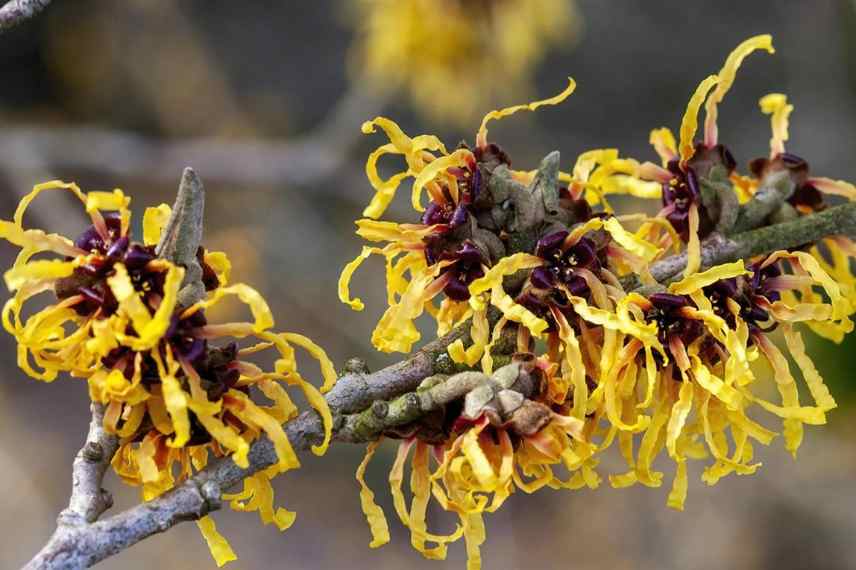
The Hamamelis japonica ‘Pendula’ has a unique pendulous habit among witch hazels. At maturity, the bush reaches about 2.5 metres in height. Its drooping branches form a compact and curiously dense mass, giving it a unique silhouette, even when in leaf. It rewards us with a delicate winter flowering that is more subtle than in other varieties. Its lightly fragrant flowers appear in February-March, directly on the bark of the branches. They consist of fine, elongated petals in a subtle pale yellow, delicately punctuated with dark pink at the base. This combination of colours gives the flowers a refined appearance, while their unruly shape evokes the “spider” characteristic of witch hazels. Although less showy than other varieties, these flowers add a special charm to the bush during the coldest months.
A Chimonanthus praecox will be an excellent companion, with its fragrant winter flowering. To provide a lovely contrast to the pendulous habit of the witch hazel, add a Japanese grass such as Hakonechloa macra with its fresh green fountain-like foliage that turns coppery orange in autumn.
- Subscribe!
- Contents

Comments