





























A resplendent summer garden: our design tips
A successful summer garden in a few simple steps
Contents
A lush, green lawn, thriving borders and generous flowering… You often dream of an opulent garden, blanketed with flowers, unfazed by the scorching rays of the sun? Summer is the season when gardens dress themselves in their most vibrant colours and reveal all their splendour. Long, sunny days and mild temperatures are conducive to the flowering of plants. However, scorching sun, the mercury rising, or going on holiday can sometimes complicate the gardener’s task!So how can you design your garden to stay looking fresh all summer? Which plants and tips are essential to ensure a small flowering paradise that will delight everyone during the summer months? Here are our tips for creating a beautiful summer garden that you’ll enjoy admiring!

What makes a garden look beautiful in summer?
Beauty is subjective! Nevertheless, when designing a garden, we want it to remain attractive in all seasons, and perhaps more particularly in summer, when we can spend more time there. A garden that is beautiful in summer would thus showcase pleasing plant displays. And if it can, on top of that, avoid excessive maintenance or water waste, we reach the pinnacle. The garden would then strut proudly and ostentatiously like a peacock. And the plants would flourish there with grace and elegance. This does not mean, however, that we are designing a meticulously managed garden, ruled by pruning to strict straight lines, a hunt for dandelions, or frantic mowing. It simply rests on the ability to surround oneself with plants that can flourish serenely, whether in full sun or shade, and create a lovely atmosphere until the first frosts. With abundant flowering, sometimes even fragrant, and evergreen foliage, it is designed to offer abundant colour, texture and scents, while being resilient (or at least well adapted) to summer climate conditions. For this reason, The more the selected plants prove themselves unfazed by the scorching sun, the more your garden will remain attractive and harmonious throughout the summer, even amid sometimes challenging weather. High temperatures, intense sun, dry winds and scarce rainfall can affect the health and appearance of the plants and the lawn. To create a garden that looks its best in summer, it is therefore essential to tailor the layout and maintenance to local climate conditions. The plant selection places emphasis on summer flowering that is heat- and drought-tolerant, but also easy to grow and low-maintenance!
Read also
6 climbing plants that flower all summerGet ready for summer!
When summer is in full swing, it’s the gardener’s rest period; we put our feet up, take it easy, and perhaps even admire our laurels, provided we’ve planned ahead! Summer is often synonymous with drought periods, more or less long, which can jeopardise the health and beauty of your plants. To avoid this inconvenience and preserve the sparkle of your garden, it’s important to prepare your garden to face the season.
- Choose the right location for your plants: to avoid disappointments, respect the specific needs of your plants (water, light exposure, soil type).
- Select drought-tolerant plants: given the recurrence of heatwaves, it becomes essential to select plants able to withstand heat and water scarcity (and there are many!), under penalty of witnessing a desolate spectacle mid-season: lavenders, rockroses, rosemaries, thymes, hardy geraniums, to name but a few among the drought-tolerant perennials, as well as the bushy sages, strawberry tree, Cercis, Buddleia, Lagerstroemia, Grevillea, Caryopteris, on the drought-tolerant trees and shrubs side.
- Acclimate your containerised plants gradually: if you have pot plants or indoor plants, it’s important to acclimate them gradually to the outdoors and to the sun, to avoid thermal shocks and burns. To do this, you can move them outside, first exposing them to shade, then gradually increasing their sun exposure.
- Mulching: a good mineral mulch (slate, pozzolana) or vegetal mulch (woody bark, fallen leaves or natural wood chips…) as and when needed, laid at the base of your plantings from spring, helps limit water evaporation, keep the soil cooler and more humid, reduce watering needs and the weeding chore. Very decorative, it is used in flower beds or in shrub borders, or even to decorate paths, giving them a neat appearance.
- Prune: to prepare your plants for summer and encourage their growth and flowering, it is important to prune them regularly. Pruning also helps maintain a harmonious and neat habit. Some perennials or shrubs will flower all summer, provided you prune them in late winter. In late March, perform a severe prune of your perennials to ground level. You can also pinch back perennials such as the Santolines to densify them. Prune all shrubs that flower in summer. Prune to flower better, that’s the motto! The more you prune them, the more floriferous and vigorous they become. Evergreen-leaved shrubs can, for example, benefit from a light pruning in summer. However, avoid pruning your plants in full bloom! And, discover the Chelsea chop, a green pruning practice for perennials so that they are more vigorous and have a longer flowering period.
- Inspect your plants: to prepare your plants for the summer and guarantee their health and beauty, it’s important to protect them from pests and diseases. Implement regular monitoring of their condition to detect and treat any problems promptly.

The installation of mulch at the base of the plants helps keep the soil cooler for longer. In addition, it gives a neat appearance to the flower borders and paths.
Planting palette
Discover our tips to select long-lasting summer-blooming plants, mix perennials, bulbs and annuals, and plant groundcovers such as hardy geraniums (for example hardy geranium Rozanne), which require little maintenance and curb the growth of weeds while offering beautiful flowering. Perennials will faithfully return every year, becoming more floriferous over time. They will form the backbone of your borders and ensure the lasting vitality of your garden. Choose those known for their low maintenance and robustness. Slightly less enduring, but also more voracious and water-hungry, the annuals will bring colour and variety and allow you to renew your borders easily each year according to your wishes and fashion.
Another factor to consider, as we have just seen, opt for water-efficient, sober and easy-care plants, which often require no watering in most regions. Among the champions of floriferousness are:
– perennials: Gauras, Echinaces, Penstemons, Gaillardia, Achilles, Agastaches, Erigeron, Iberis, Sage, Lavenders, Dahlias, Phlox, Perovskia, generally requiring little maintenance, they bloom relentlessly for some all summer and often until the first frosts. Not forgetting ornamental grasses with delicately flowering heads that can blend naturally with a multitude of plants.
– self-seeding flowers in the wind: Lychnis, Aquilegia, Esсhscholzia, Nigella, Verbena bonariensis…
– melliferous flowers will inevitably feature in your enchanting decor, a precious resource for pollinators: Centaurea, Borage, Thistles, Gaillardes, Scabiosa, Knautia, Nepeta, Sedum, Sage, Verbenas, Asters, Astrance, Rudbeckia…
– long-lasting summer-blooming annuals: Cosmos, Calendula, Lunaria annua, Pelargoniums, Poppy, Petunias, or Nasturtiums are safe bets, relentless from May to the frosts.
– summer-flowering bulbs: the summer-blooming bulbs are destined to colour your borders, rockeries or pots until autumn. Crocosmia, Gladioli, Allium, Lilies, Agapanthus, Dahlias, Cannas or Alstroemeria, embody the splendour of summer with abundant and cheerful blooms.
– Roses: whether shrubs, bush roses, ground-cover roses or climbers, trained against a wall, most roses are exceptionally floriferous, hardy and easy to live with. Prefer repeat-flowering roses, which bloom several times a year. Some varieties flower from May–June to October, offering long-lasting coloured borders, such as the variety Paul Neyron which blooms almost continuously from summer to autumn.
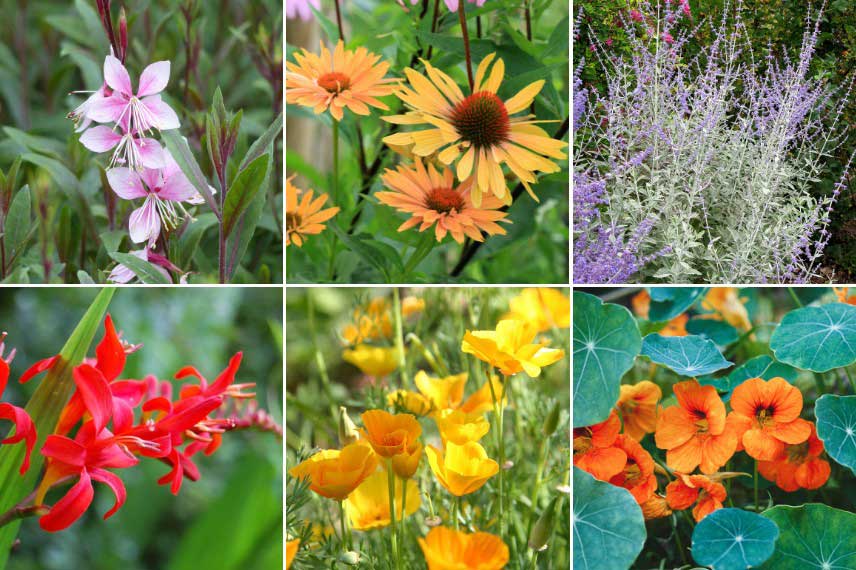
Gaura ‘Cherry Brandy’, Echinacea, Perovskia ‘Silvery Blue’, Crocosmia ‘Lucifer’, Eschscholzia californica (California poppy) and nasturtium
-
- –
summer-flowering shrubs
-
- have no equal for enlivening and colouring gardens in summer. It is a must for those wishing to have a beautiful and colourful garden during the warmest months. There is a wide variety of shrubs in summer bloom; the choice will depend on climate and taste. Among them, we love the exotic
-
- with its long flowering, and
-
- , whose flowers attract many butterflies for long months, as well as
-
- ,
-
- ,
-
- ,
Lagerstroemia
-
- with sometimes remontant flowering,
-
- , Abelia,
-
- ,
-
- or
-
- as shade trees, Potentillas, and
-
- , in mild climates.
-
- –
The blooms of South African beauties are also generous and spectacular under the summer sun.
-
- Think of the very exotic yet tender
Strelitzia reginae (Bird of Paradise)
-
- ,
-
- ,
Anisodontea capensis ‘El Rayo’
-
- and
-
- , which are among the hardiest.
-
- –
Climbers
-
- are ideal for creating cascades of greenery and abundant blooms, such as the
Eyeconic® Meipouzmoi climbing rose
-
- in bloom from May to frosts, the
Wisteria frutescens ‘Amethyst Falls’
-
- a wisteria that blooms from spring to autumn, and the
bignones
- .
→ Our tip: remove faded flowers. First for aesthetics, which is important in an ornamental garden, but also to prevent your plants from tiring themselves unnecessarily. Removing faded blooms daily stimulates the rise of new flowering.
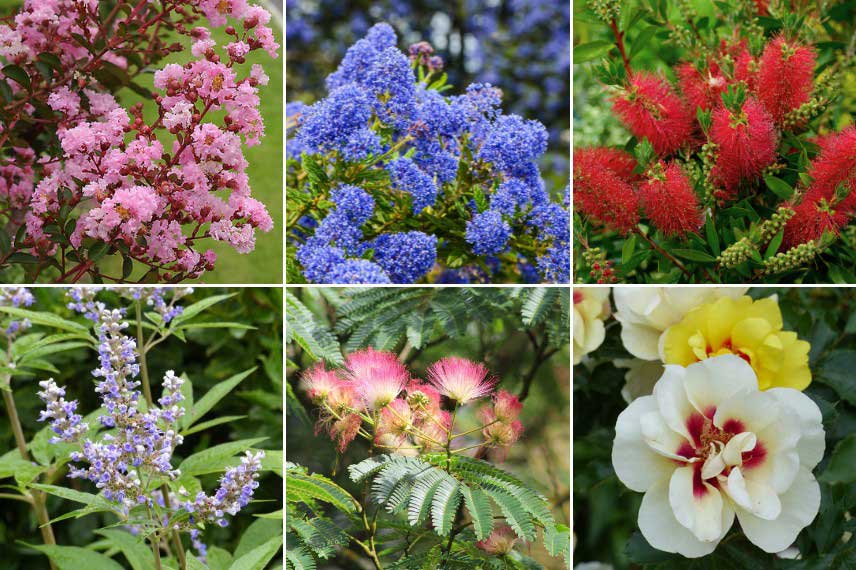 Lagerstroemia indica, Ceanothus, Callistemon laevis, Vitex agnus-castus ‘Latifolia’, Albizia julibrissin and climbing rose ‘Eyeconic Meipouzmoi’
Read also
7 flowering plants all summer longNeither lawn nor lawn
A lawn doesn’t necessarily make a beautiful garden in summer! Especially when it turns into a dry, waterless mat under drought conditions. We all dream of a lush, green lawn even in summer. But the lawn can be particularly vulnerable to hot, dry summer conditions. That is why, from now on, heatwaves and repeated summer water restrictions push us to ditch the English lawn, and to reduce lawned areas in favour of:
- flowering meadows which will provide a long-lasting flowering area with little maintenance (ideal for avoiding mowing) and a reservoir of biodiversity.
- mixed-border borders comprising plants that will take turns blooming throughout the summer.
- perennial ground-cover options as alternatives to lawn, these “green carpets” require little to no mowing, watering or maintenance and typically become covered with pretty little flowers all summer.
→ Also see our tips on lawn alternatives: 10 groundcovers to replace the lawn, Replacing a lawn: ideas and solutions.
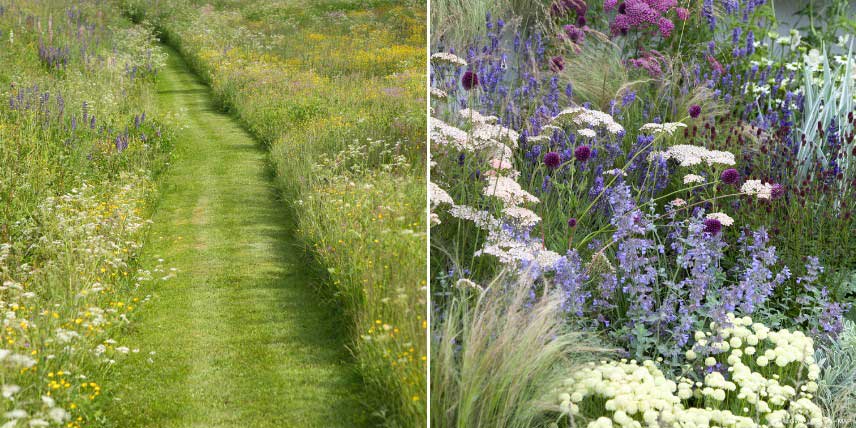
Avoid lawn areas; favour flowering meadows and broad flower borders in the mixed-border style
Go for groundcover plants
To create a garden that stays beautiful in summer and is easy to maintain, it is important not to neglect groundcover plants. These plants, which have the ability to spread quickly and form a dense carpet, are particularly useful for covering the soil, showcasing the taller plants, smothering weeds and keeping the soil cool and moist. In addition to being ornamental, once well established in beds or borders, they generally look after themselves, they are low-maintenance and you’ll be able to create an aesthetically pleasing summer garden with little effort. Among the groundcover plants to favour, one can mention the Sedums, the Euphorbias, the Ivies (evergreen!), the Achillea or the hardy geraniums, or the summer heathers, the Rosmarinus officinalis ‘Prostratus’ and Cotoneasters, which are part of these beautiful groundcover shrubs flowering in summer. Other plants with a notably dense groundcover effect, such as ferns in shade or the Pratia in dry areas are another interesting choice.
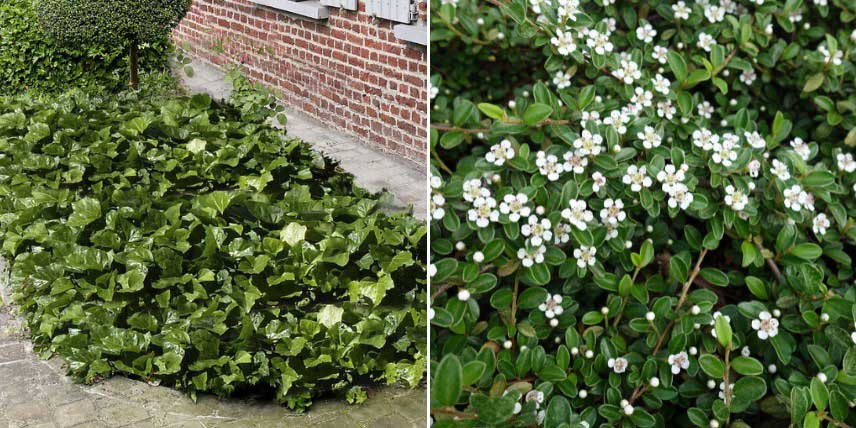
Groundcover plants: ivy and Cotoneaster horizontalis
Plant evergreen foliage
Relying on evergreen foliage is another good way to make life easier by ensuring a beautiful backdrop all year round. Trees or evergreen, semi-evergreen or marcescent shrubs structure the garden, filter the wind and sun, and guarantee a degree of privacy year-round. They retain their leaves in every season, including summer. This means your garden will never be short of colour or structure, even when deciduous plants shed their leaves. And dead leaves won’t litter your beds during the height of summer. In summer, temperatures can rise and make the garden uncomfortable. Evergreen foliage will provide welcome shade and create cooler zones in your garden. They can also serve as windbreaks and privacy screens, such as Phyllostachys bamboos for example. This can be particularly useful in summer when you want to shield yourself from prying eyes with a beautiful screen of foliage.
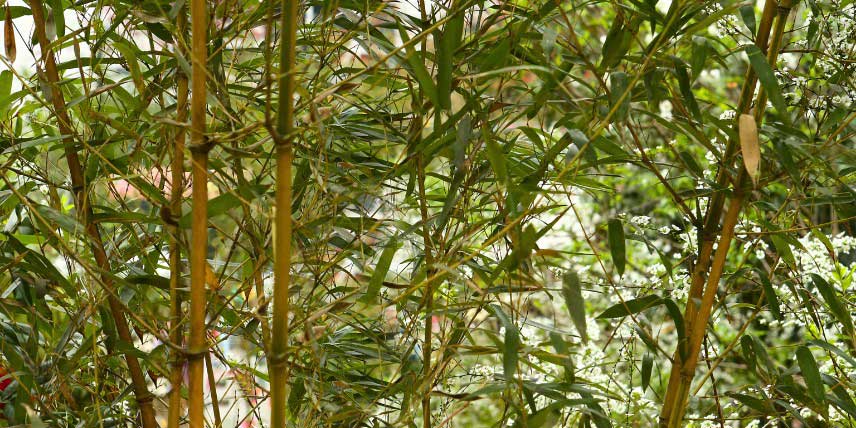
Bamboos help create a beautiful, effective all-year privacy screen. Here, Phyllostachys aureosulcata ‘Spectabilis’
Provide shade
To create a magnificent summer garden, whether in towns or the countryside, you need to fashion shaded, refreshing corners where you can retreat and recharge when the sun is at its zenith. You can install various structures, which will later be planted with climbers, such as arbours or pergolas. Climbing plants are one of the loveliest options for creating shade and bringing a touch of coolness in summer. Annuals or perennials, it doesn’t matter, provided they rapidly cover their support. Bougainvillea, morning glories, jasmines, Virginia creeper, hops or trumpet creepers will quickly climb to form a leafy parasol, when the parasol trees (umbrella pine, albizia or catalpa) prove highly effective at keeping us cool and shielding from the heat. Large perennials such as acanthus, astilbes, cimicifugas, Dryopteris or Thalictrum form a lush display and also filter light, inducing pleasant dappled shade.
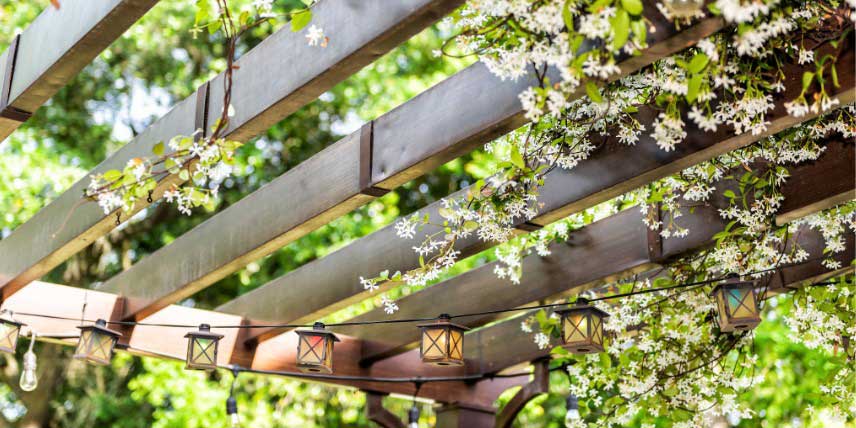
Install a pergola for climbing plants to grow there, and they will provide ample shade in summer
Spruce up the decor
Beauty isn’t a theme… more of a personal, emotional perspective. A well-kept garden is often perceived as more beautiful, because it reflects the care and attention given to every detail. Cleanliness and good circulation also play an important part in a garden’s aesthetics. Here are a few aspects to consider to keep a neat garden:
- Prune bushes and hedges regularly to maintain a harmonious shape. Remove spent flowers and dead leaves to promote healthy growth and prevent the accumulation of debris.
- Sweep leaves and debris from paths and patios. A clean space is immediately more inviting and pleasant to the eye.
- Clean garden furniture to prevent dust and stains.
- Avoid leaving unnecessary items lying around. Use storage containers or garden sheds to store your gear.
- Weed borders and flower beds regularly to prevent weeds from taking over. Use mulch to suppress their growth, preserve soil moisture and add a decorative touch!
- Create pathways with natural stone flagstones, gravel or stepping stones to structure your garden and ease movement.
- Install string lights, lanterns to create a magical atmosphere and highlight the key areas of your garden after dark. You can also use candles or tealights for a romantic touch.
- Define a relaxing area (sun loungers, deck chairs, hammocks, etc.) so you can lounge there, enjoy the sun and the surrounding nature. Choose cushions, throws and accessories in harmonious, neutral tones.
- Prefer natural materials such as wood, stone, terracotta or rattan in your décor, which pair well with plants, bringing an authentic touch.
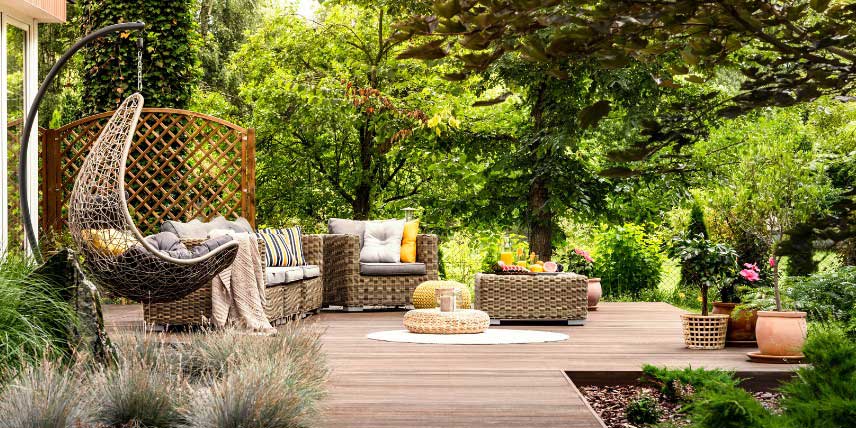
Feel free to create a relaxing zone, with sofas, armchairs, hammocks… preferably in natural materials and colours.
- Subscribe!
- Contents
Comments