





























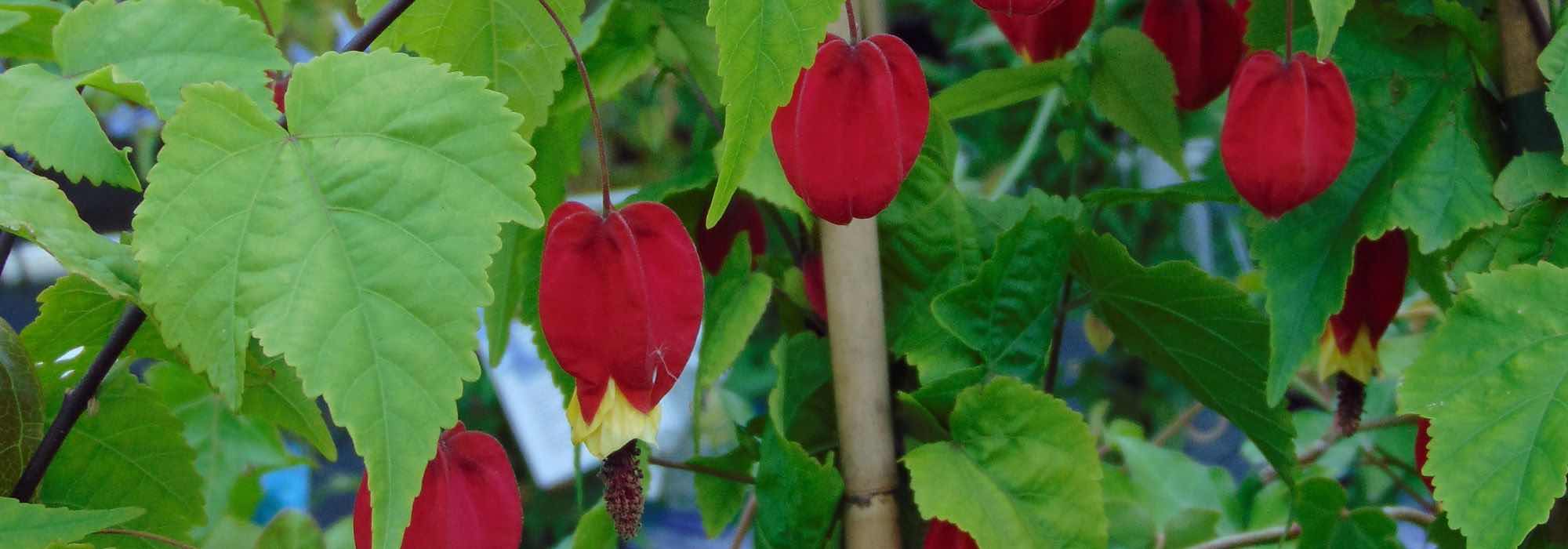
Abutilon: How to choose the ideal variety for your garden or patio?
Our tips to make the right choice
Contents
Abutilon is a popular ornamental plant for its bell-shaped flowers and exotic-looking foliage. Its delicate flowers, like tiny Chinese lanterns, and its sometimes variegated leaves add a touch of exotic elegance to gardens, terraces, and balconies. Whether you’re after an imposing bush, a climbing plant or a compact variety for your balcony, abutilon adapts to a multitude of configurations.
Browse through our criteria such as the colour of the flowers or foliage, the mature size, the intended use (border, hedge, terrace) or hardiness to make the right choice. In this guide, discover how to select the perfect abutilon according to your needs and the specifics of your space.

According to its height
Mature size of Abutilon is a consideration when incorporating it into your garden or on your terrace. This bush can take on different habits, ranging from bushy and erect to trailing or climbing, and its height at maturity can vary from one metre to over three metres.
The botanical species Abutilon vitifolium stands out for its large size. It can reach up to 3.50 metres in height, with a spread nearly equal, which makes it an excellent choice as a bush on a lawn or at the back of a border. Vigorous and imposing, it lends structure to the space while offering generous flowering.
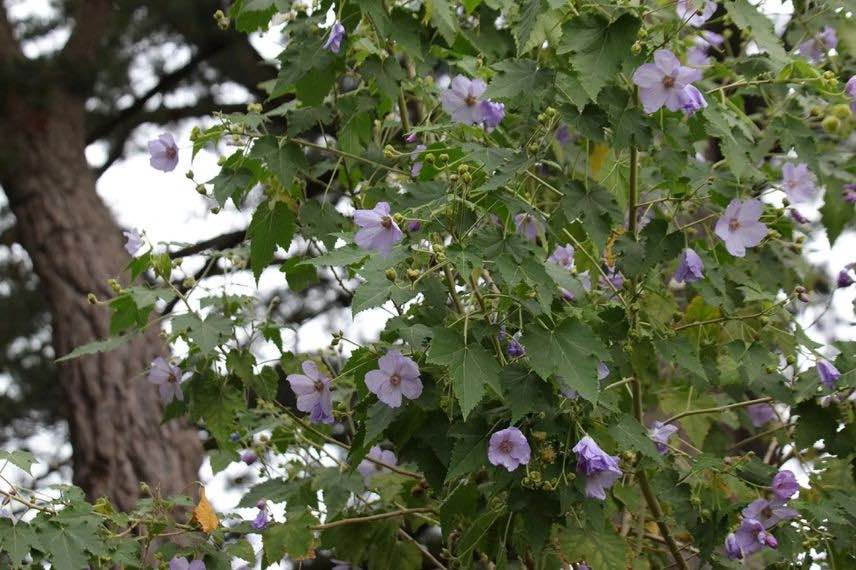
Abutilon vitifolium
Other abutilons, of smaller size, are better suited to a variety of uses, particularly in smaller gardens. Medium-sized varieties, growing between one and two metres tall, are particularly versatile, adapting well to both in-ground planting and pot culture. For the more modest examples, consider the Abutilon megapotamicum ‘Pink Charm’ and the ‘Ines’, whose mature size is about 1.20–1.50 m in all directions.
If you would like a mid-sized variety, you can choose the Abutilon striatum ‘Redvein’ or the Abutilon hybrid ‘Cannington Peter’, which reach approximately 2 metres in height and 1 metre in spread.
Read also
Abutilon : planting, pruning, careDepending on flower colour.
Abutilon is particularly valued for its abundant and colourful flowering, which generally lasts from spring until the first frosts. The flowers, often pendulous bell-shaped, offer a varied colour palette, allowing a range of atmospheres in the garden or on the terrace. Long, bell-shaped, lantern-shaped or open-cup-shaped flowers appear in abundance from May to the first frosts. The flowers range from 4 to 8 cm in diameter, with petals often accompanied by a coloured calyx.
Red-flowered varieties:
- Abutilon ‘Nabob’: it produces bright flowers in a deep red, almost burgundy, ideal for creating a striking contrast with dark green foliage.
- Abutilon hybrid ‘Cannington Peter’: it bears satin mahogany-red flowers.
Orange-flowered varieties:
- Abutilon pictum ‘Thompsonii’: with its soft orange flowers veined with red, this variety enlivens spaces.
- Abutilon ‘Savitzii’: it offers flowers in an almost apricot orange, for a warm and soothing ambience.
Pink-flowered varieties:
- Abutilon ‘Pink Charm’: its soft pink flowers bring a romantic and delicate note, ideal for cottage-style gardens.
- Abutilon ‘Cerise Queen’: this variety bears cherry-red flowers that are almost pink and catch the eye.
Purple-flowered varieties:
- Abutilon vitifolium: a botanical species with flowers ranging from Chinese blue to mauve.
- Abutilon ‘Suntense’: the flowers are mauve to violet, covering this particularly bright hybrid.
Bi-coloured varieties:
- Abutilon megapotamicum: it features yellow and red bi-colour flowers for an original and exotic touch.
- Abutilon megapotamicum ‘Ines’: its flowers, which appear in pale yellow and copper-orange, make it a particularly decorative plant.
- Abutilon striatum ‘Redvein’: the corolla of its cup-shaped flowers is orange, striate with dark red.
When choosing the colour of your Abutilon flowers, consider harmony with other plants in your garden, as well as the desired effect: striking contrast, softness of pastel tones, or exoticism of vivid colours. Abutilons offer a multitude of possibilities to personalise your space according to your preferences.
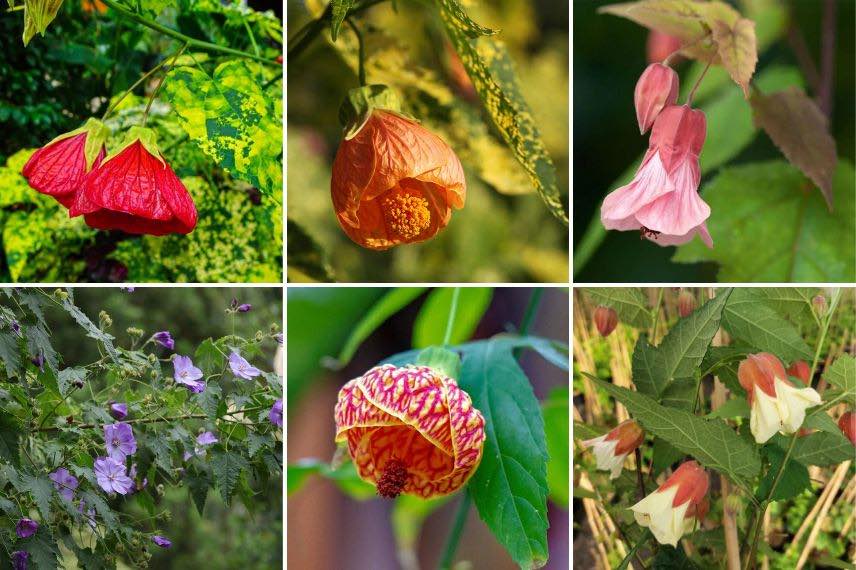
The varieties ‘Cannington Peter’, ‘Thompsonii’, ‘Pink Charm’, Abutilon vitifolium, ‘Redvein’ and ‘Ines’
According to foliage colour
The Abutilon foliage plays an essential role in the plant’s overall aesthetics. It is evergreen to semi-evergreen in mild climates. Depending on species and varieties, the leaves can take on a variety of shapes and colours, offering a diversity of visual displays to enrich your garden or terrace. These characteristics influence the plant’s harmony with its surroundings and can be used to create contrasts or visual continuity in your landscape displays.
Most Abutilons have lobed leaves, with some varieties featuring different shapes, from 3 to 7 lobes. For example, Abutilon vitifolium has foliage reminiscent of grape leaves, with broader and slightly velvety leaves, adding an interesting texture to the garden.
Classic green foliage:
Many varieties of abutilon feature bright green, light green, greenish-gray or dark green foliage, bringing a touch of freshness and simplicity. These leaves, often lobed into 3 to 7 lobes, recall the leaves of the maple, hence the nickname “salon maple”, which is somewhat of a misnomer since Abutilon is an outdoor plant. For example, the Abutilon ‘Nabob’ has dark green foliage that highlights its deep red flowers.
Variegated or decorative foliage:
Some varieties are distinguished by variegated foliage that adds an extra dimension to their appeal. Abutilon pictum ‘Thompsonii’ is an excellent example, with its green leaves speckled with yellow, creating a bright and contrasted effect, just like Abutilon ‘Cannington Peter’. Similarly, the award-winning ‘Souvenir de Bonn’ offers leaves that are cut and cream-edged for an elegant and refined result. We should also mention Abutilon ‘Savitzii’, also award-winning, with pale yellow margins.
Note that in the species Abutilon pictum and Abutilon striatum, the yellow speckled variegation is produced by mosaic virus, which, incidentally, does not affect the plant.
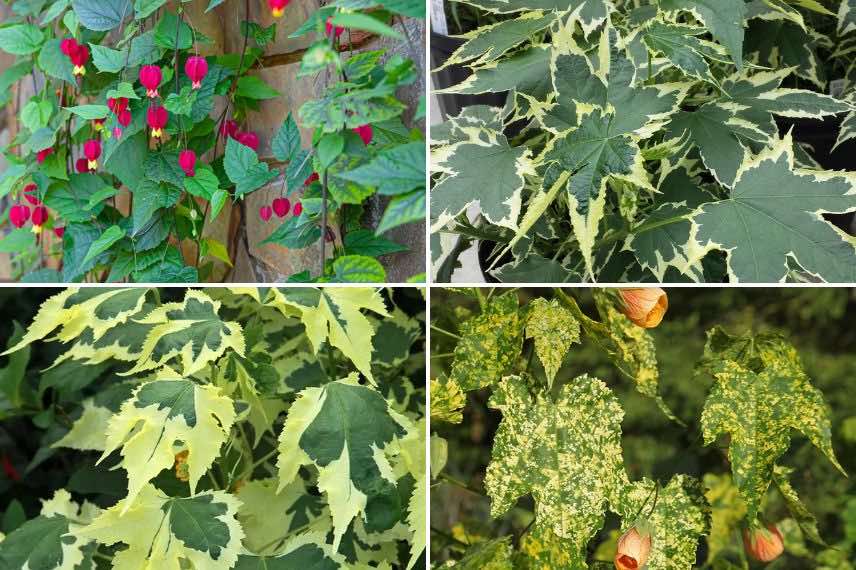
The handsome green foliage of Abutilon megapoticum, variegated with ‘Souvenir de Bonn’, ‘Savitzii’ and ‘Thompsonii’
Read also
Abutilon: how to overwinter it properlyAccording to its hardiness.
Overall, Abutilon is a plant that is only moderately hardy, meaning it is sensitive to temperatures below -5 °C, although some species can tolerate frosts more severe.
Regions with mild climates, such as southern France, the Atlantic coast, or the Mediterranean basin, are ideal for growing Abutilon in open ground. In these areas, it thrives easily with an almost uninterrupted flowering, provided it is planted in rich, cool but well-drained soil. A sunny exposure, but not scorching, or bright partial shade, is ideal to encourage growth while protecting its delicate leaves from overly intense rays.
For regions where winters are harsher, pot growing is preferable. This allows the plant to be brought indoors when temperatures drop significantly, for example by overwintering in a conservatory or a bright unheated room. A good choice for these climates is Abutilon megapotamicum, which is the hardiest species, or its cultivar ‘Ines’, both able to withstand frosts down to -10 °C, especially if the plant is placed in a sheltered location. Even in difficult conditions, this species has the ability to regenerate from the stump in spring.
According to its habit and use
Abutilon is a versatile plant that can adapt to many uses in the garden or on the terrace. The plant’s growth habit influences its use.
When planted in open ground, abutilons with an erect or bushy habit, such as Abutilon ‘Suntense’ or Abutilon vitifolium, pair well with other shrubs that flower in summer, such as hibiscus or fuchsias, to create an elegant and colourful hedge.
These hardy varieties are also well suited to being planted as a specimen, where they can become a focal point in the garden. They are also highly valued as a backdrop to borders where they bring structure and colour.
However, the trailing or climbing species, such as Abutilon megapotamicum, reveal their full potential when trained against a wall or a trellis. Their ability to climb, combined with continuous flowering, makes them ideal for adding an exotic touch to vertical structures. Trellised with care, they create a romantic and elegant atmosphere, while offering a refuge for pollinating insects.
Their flexible growth habit also allows them to be grown in hanging baskets, where they form stunning flowering cascades. Abutilon megapotamicum can also be grown as a decorative groundcover, which layers easily. It sits well at the base of shrub borders and brings greenery and colour to the base of taller shrubs. Its ability to occupy space is particularly useful for limiting adventive species.
For small spaces, compact or trailing varieties are particularly well suited. Cultivated in pots, they fit easily on a terrace or balcony, where their abundant flowering immediately catches the eye.
Whatever way you choose to use Abutilon, it offers great versatility and undeniable aesthetic value.
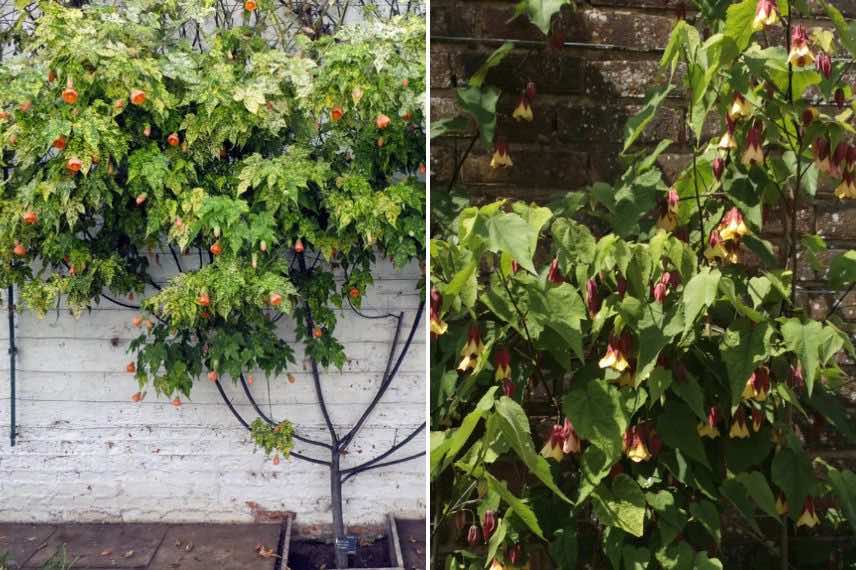
Abutilon pictum ‘Thompsonii’ trellised and Abutilon megapotamicum bushy
- Subscribe!
- Contents
Comments