





























Pairing ideas with Ceratostigma
6 ideas for garden companions
Contents
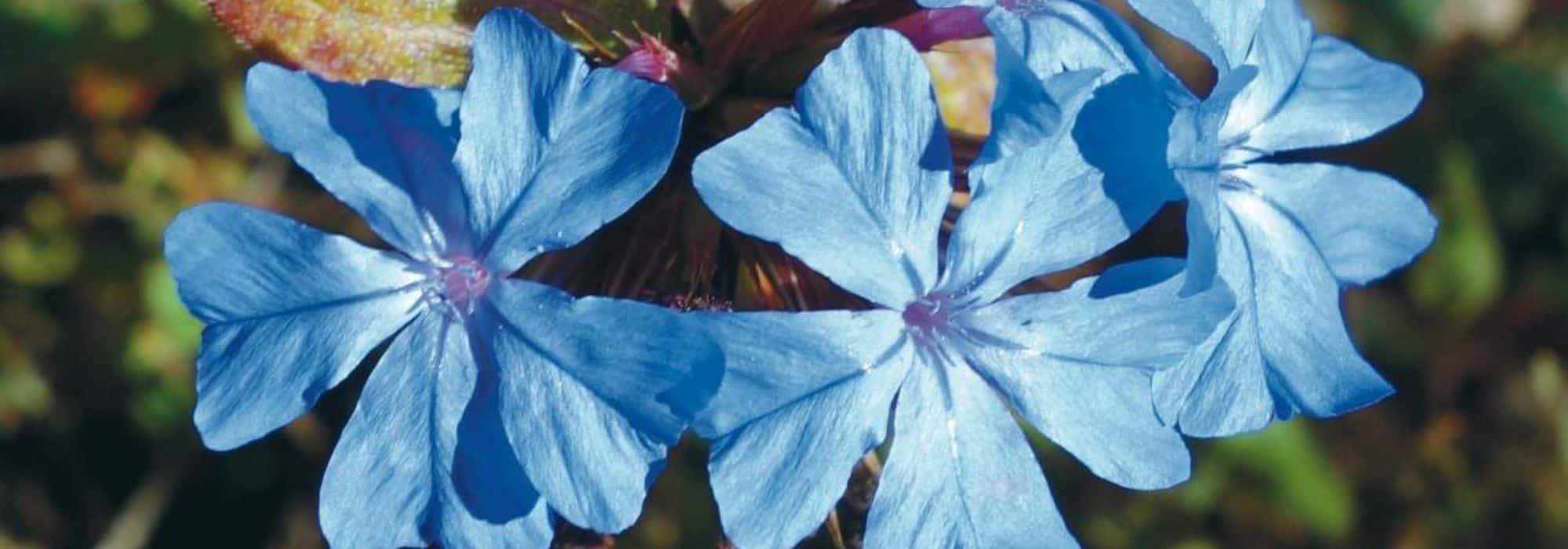
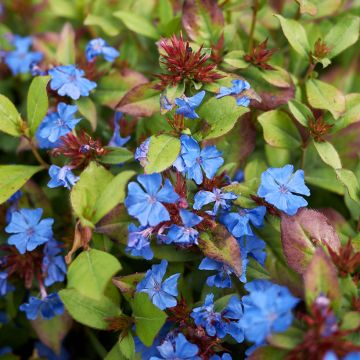
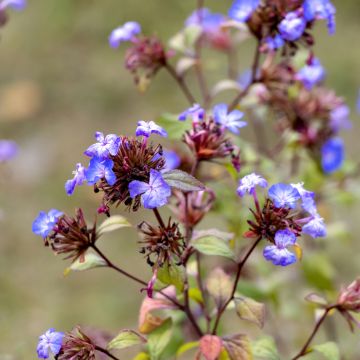
Once known as “Plumbago”, the Ceratostigmas are plants that offer a stunning flowering of intense blue from late summer to autumn. Their beautiful dark green foliage is rather semi-evergreen, or even deciduous depending on the region. It takes on magnificent bronze to purple hues with the arrival of autumn’s chill. This undershrub with running rootstock is often considered a perennial due to its small size, ranging from 30 cm to 1.20 m depending on the variety. Also known as “Leadwort”, the Ceratostigma enjoys warmth and sunlight. It is perfectly suited for a bank, at the foot of bushes, in borders, or as a low hedge, in stony and dry soil.
Discover 6 ideas for pairing Ceratostigmas in the garden.

At the foot of trees and bushes
Peu exigeant et peu gourmand en eau, Ceratostigma is not afraid of root competition, making it an ideal groundcover at the base of trees, shrubs, or even a climbing plant. Be sure to consider the exposure when choosing the most suitable variety of bush. For example, for a semi-shaded area, Ceratostigma plumbaginoïdes is recommended for its small size (less than 30 cm in height) and its ability to spread easily, even in areas where nothing else grows.
It will provide some shade at the base of a Banks Rose ‘Rosea’ or a Clematis terniflora, two climbing plants suitable for dry soils in summer, once well established. To add a splash of colour throughout the year, plant some bulbs of botanical daffodils, colchicums, and crocuses amidst the carpet of bushes.
On the shrub side, the abundant blue flowering of a Ceanothus ‘Impressus’ will echo that of the bush and will also provide beautiful evergreen foliage, glossy dark green in colour, which is very decorative. Also consider the Cotinus coggygria ‘Smokey Joe’, which will offer dazzling flowering in feathery panicles of a bright pink hue. Don’t forget the Oleander, the quintessential Mediterranean shrub, which also enjoys warmth and tolerates drought.
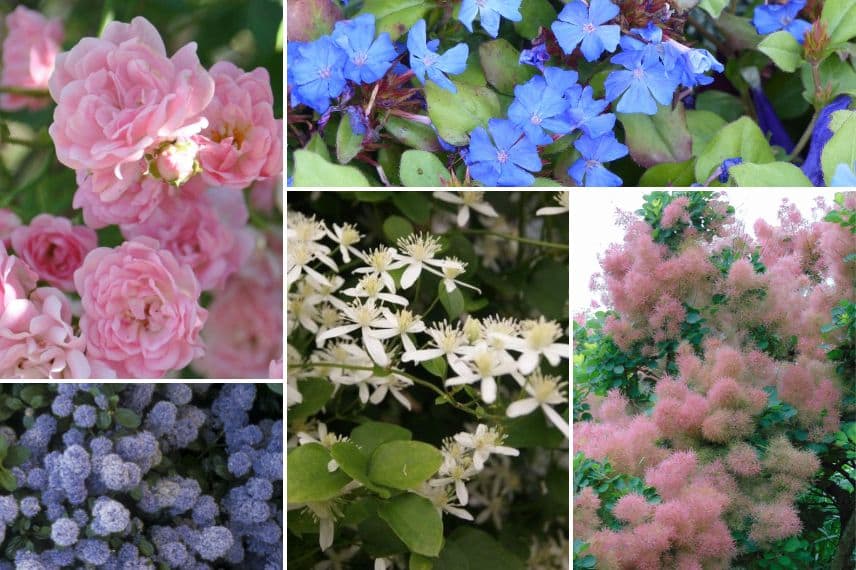
Banks Rose ‘Rosea’, Ceanothus ‘Impressus’, Ceratostigma plumbaginoïdes, Clematis terniflora, Cotinus coggygria ‘Smokey Joe’
Read also
Pairing ideas with PlumbagoIn a bush mass
Easy to grow, the Bush will be perfect for a sunny shrub border. Choose a Ceratostigma according to your preferences: for groundcover, opt for the Ceratostigma willmottianum ‘Forest Blue’ or the Bush ‘Griffithii’, which is slightly taller at the edge of the border.
They can be paired with fuchsia, orange, or red bush salvias, echoing the vibrant stems of the bush. We will also appreciate the Potentilla fruticosa ‘Red Lady’ for its very long bright red flowering from May to September. A Perovskia will add a touch of lightness to the scene, with its airy stems composed of blue flowers and silver foliage. Placed in the middle of the border, a Caryopteris ‘Grand Bleu’ will bloom at the same time as the Bush, bringing clusters of small dark blue flowers and fragrant foliage. Rosemary, cistus, and summer spireas will also find their place, just like the autumn Aster for its spectacular late mauve flowering.
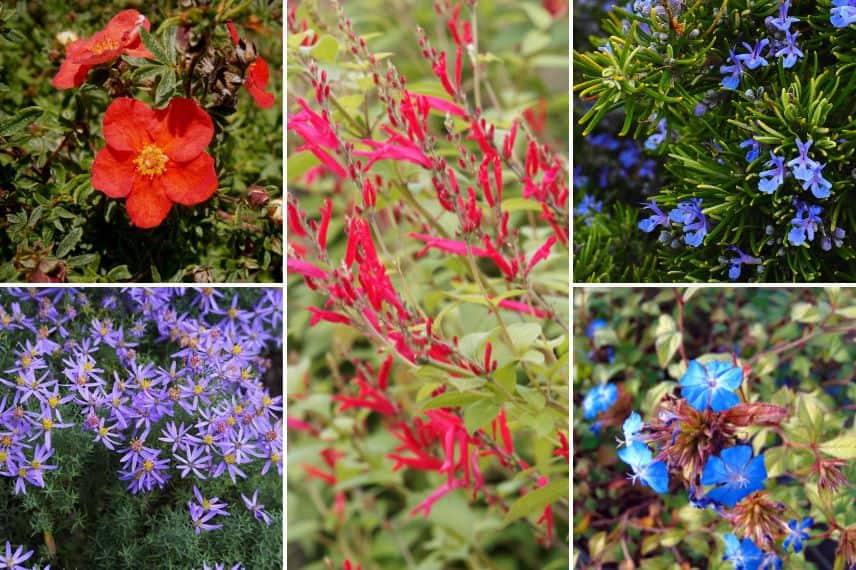
Potentilla fruticosa ‘Red Lady’, Aster, Pineapple Sage, Rosemary, and Cerastostigma
Discover other Ceratostigma
View all →
Available in 2 sizes
Available in 2 sizes
Available in 2 sizes

Available in 2 sizes

Available in 1 sizes
In a low hedge
With its small size, rarely exceeding 1.20 m and its spreading habit, Ceratostigma willmottianum will provide a lovely gentian blue flowering in late summer and autumn, when flowers start to become scarce in this season. Its bronze-green foliage will then turn to autumnal red hues, creating a vibrant colour combination. It will thus make a statement in a low hedge, with a rather free habit, alongside bushes of similar size, such as Caryopteris for its blue (or pink!) flowering and aromatic foliage. Still in shades of blue, it can also be paired with a Perovskia for its graceful and light flowering stems. It should be planted alongside other shrubs that enjoy warmth and dryness, such as Spiraea, Rosemary, or Cistus for its magnificent crumpled flowers like silk.
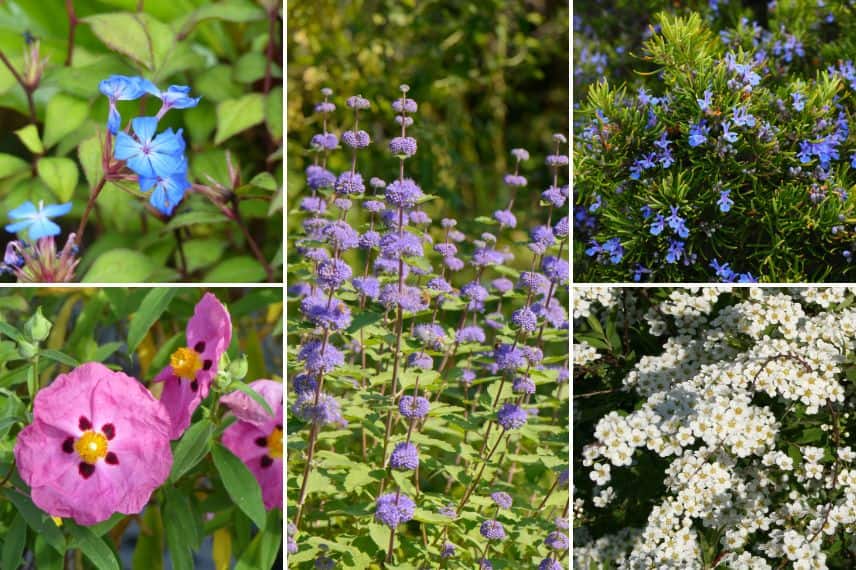
Ceratostigma willmottianum, Cistus, Caryopteris, Rosemary, Spiraea arguta
In a pot
With its small size and late flowering, the Dentate will be perfect for enhancing pots and containers on a terrace or balcony. Preferably choose compact varieties, such as Ceratostigma plumbaginoides or willmottianum ‘Forest Blue’. Additionally, pot cultivation will allow this plant to be wintered in regions with harsh winters. You can also pair it with other tender plants, such as an Agapanthus or a Papyrus (Cyperus alternifolius) for its exotic foliage.
Create a stunning autumn display by pairing it with the reddening foliage of a Nandina ‘Fire Power’ or the flashy flowering of an autumn Aster. Also consider sages with blue flowers and the silver foliage of an Artemisia or a Santolina. Add a touch of lightness with a small grass, swaying in the slightest breeze. If you prefer long flowering periods, opt for a Coreopsis in a soft colour to bring a bit of gentleness.
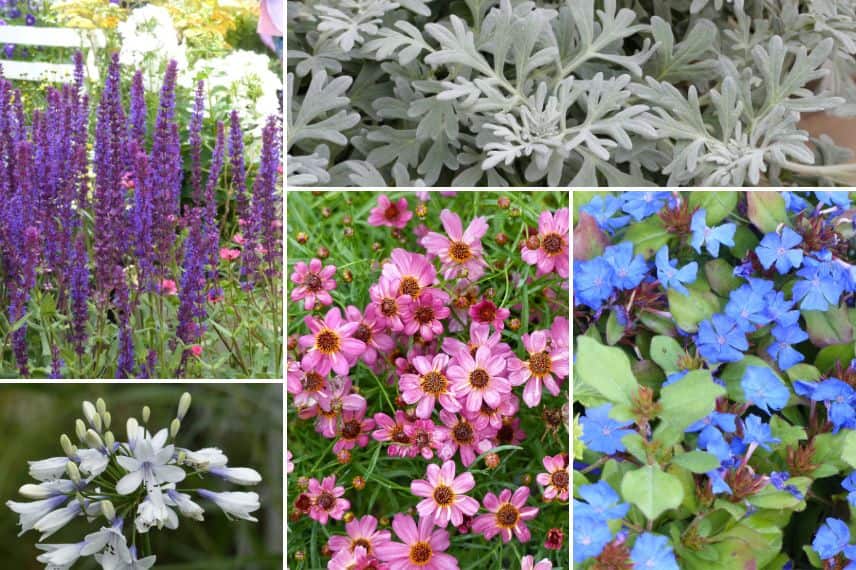
Wood sage, Agapanthus, Artemisia, Coreopsis, Ceratostigma
In a rockery
Not fearing heat or drought, Ceratostigma is an excellent rock garden plant that will colonise thanks to its running rootstock. It pairs well with other plants suited to poor soils, such as Euphorbia myrsinites with its chartreuse and golden flowers. Opuncias, or prickly pears, are making a comeback to add height and volume to dry gardens. A Achillea taygetea with its cloud-like flowering will bring brightness with its beautiful lemon-yellow flowers. For a constantly flowering rock garden, plant bulbs of Sternbergia lutea, botanical daffodils, colchicums, or crocuses in your rock garden and even at the heart of the carpet of Mouse Ears. Some Mouse Ears (Cerastium tomentosum ‘Yo Yo’) will provide lovely touches of grey, along with a profusion of white flowers from May to July. For a perfect scene, also add beautiful grasses, such as Stipa tenuifolia and Elymus magellanicus.
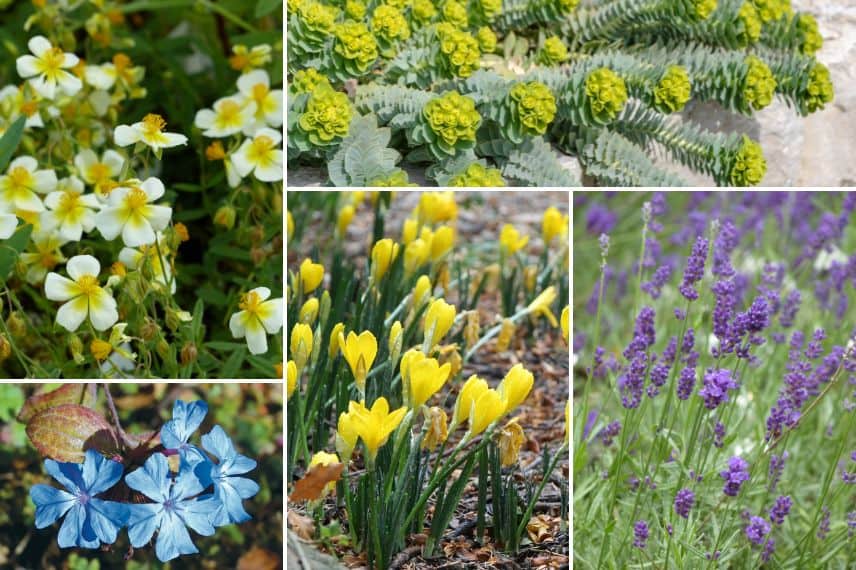
Helianthemum Elfenbeinglanz, Ceratostigma, Euphorbia myrsinites, Sternbergia lutea, lavender
On a bank
Creeping and groundcover, the Plumbago easily dresses a bank, without needing help from the gardener. Moreover, drought and poor soils do not scare it! While all varieties will create a lovely effect, the Ceratostigma willmottianum ‘Forest Blue’ will impress you with its cloud of cobalt blue stars, almost covering the entire foliage in summer.
It can be paired with other drought- and heat-tolerant perennial groundcovers, such as Cistus from the Mediterranean, known for their evergreen foliage, which will start flowering before the Plumbago, from April to July. If you prefer very low perennials, adopt its little cousin the Helianthemum, particularly the cultivar ‘Elfenbeinglanz’ for its charming little white flowers with a bright golden centre.
The Plumbago will take over from the magnificent and long flowering of a creeping California Lilac: the Ceanothus griseus var. horizontalis‘Yankee Point’. In a not too poor soil, you can install some beautiful groundcover roses, such as the variety Mareva or Emera. Not to mention the stars of dry banks: lavender and St. John’s Wort.
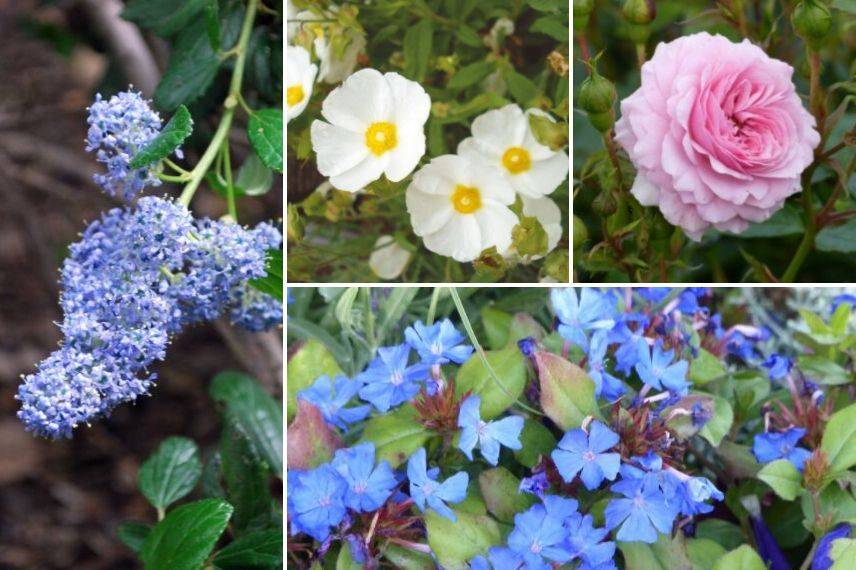
An idea for association on a bank: Ceanothus griseus var. horizontalis ‘Yankee Point’, Cistus monspelliensis, Larissa Rose and Ceratostigma plumbaginoides
For further reading
- Discover our varieties of Ceratostigma.
- To learn more, browse our complete sheet on Ceratostigma and Chinese Plumbago: planting, pruning, and maintaining.
- Subscribe!
- Contents
Comments