





























Pairing ideas with Grindelia
7 successful pairing ideas
Contents
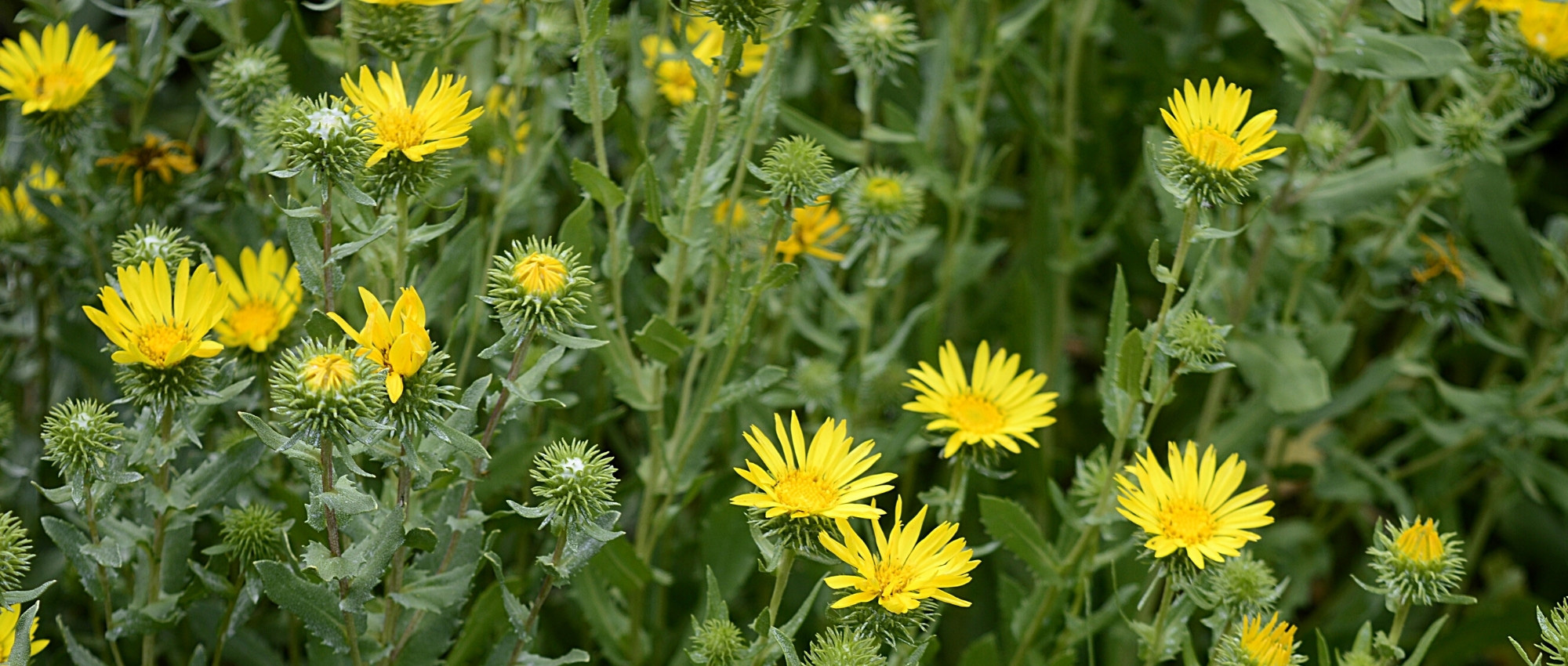
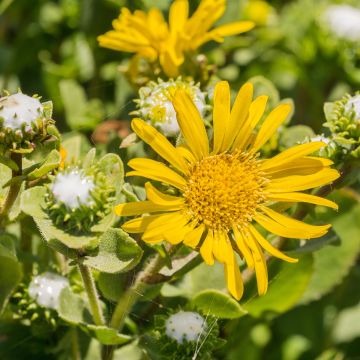
Grindelias are beautiful ornamental plants native to America, producing golden yellow heads in the shape of daisies from mid-summer to early autumn. These flowers are characterised by their spiny bracts, giving them a unique and uncommon style. They are melliferous, attracting pollinators such as bees, butterflies, and hoverflies. Grindelias thrive in full sun, in well-drained soil, dry and poor. Although they enjoy warmth, they are notably hardy (-15 to -20 °C). They integrate easily into rockeries, dry gardens, and naturalistic borders, allowing for beautiful colour combinations with summer-flowering perennials. Discover our finest ideas and inspirations for pairing them in the garden!
For everything you need to know about their cultivation, feel free to consult our complete guide “Grindelia: Planting, Cultivation, Maintenance”

In a sunny rockery or a scree garden
Grindelia thrives in well-drained, rather stony soils that do not retain moisture. Thus, it will be perfect for integrating into a rockery or a scree garden, alongside other dry medium plants. You can plant it, for example, next to small spreading plants like houseleeks, sedums, and Corsican spurge (Euphorbia myrsinites). Add small touches of colour with the flowering of helianthemums, pinks, Geranium sanguineum, and acaules silenes, small perennials that also have a low, spreading habit and will easily find their place at the front of a border or rockery. Behind them, you can install centranthuses, verbascums, and eryngiums. Don’t hesitate to also incorporate Erigeron karvinskianus, which offers lovely small flowers with a very natural style! Bring a bit of lightness and graphic appeal with small tufts of grasses, such as Stipa tenuifolia or blue fescue.
Discover our advice sheets: “Creating a rockery: our tips for success” and “15 plants for a sunny rockery”
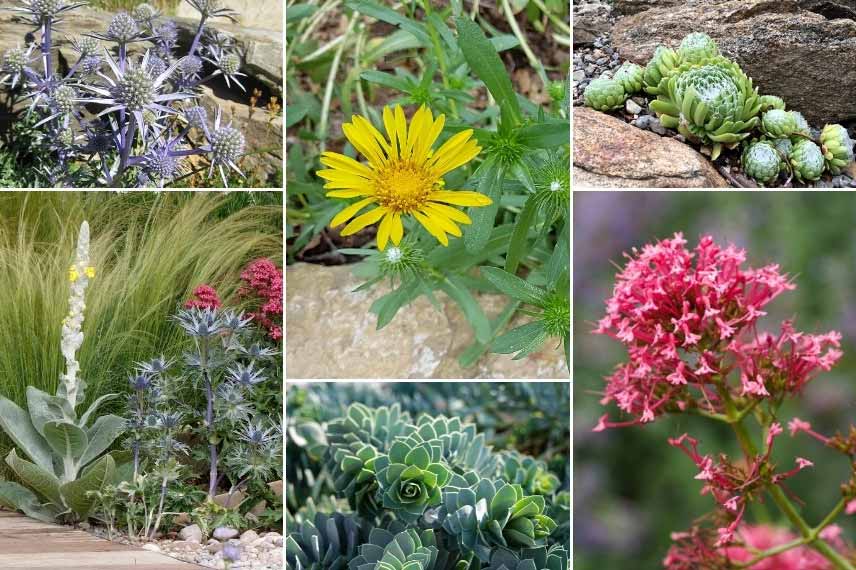
Eryngium bourgatii (photo Carmona Rodriguez), Grindelia robusta, Sempervivum arachnoideum (photo Kristine Paulus), scene with Verbascum ‘Polarsommer’, Eryngium oliverianum, Centranthus ruber, and Stipa tenuifolia (photo AC – Nathalie Pasquel – MAP – Landscape designer: Robert Myers), Euphorbia characias (photo Guilhem Vellut) and Centranthus ruber
Read also
Grindelia: planting, growing, and careIn a seaside garden, Mediterranean style
Even though they originate from America rather than the Mediterranean region, Grindelias will easily fit into the composition of a seaside garden in a Mediterranean style, especially as they love sun and warmth! Pair them with shrubs such as oleanders, which are appreciated for their vibrant flowering, as well as olives, figs, and strawberry trees. Consider the palm Chamaerops humilis, endemic to the Mediterranean region, whose beautiful fan-shaped foliage will bring a touch of exoticism to the garden. For perennials, think of Armeria maritima, agapanthus, eryngiums, Lithodora diffusa, as well as aromatic plants such as lavenders and helichrysums. Don’t hesitate to grow some climbing plants like bougainvillea or bignonia, which you can train to climb on a pergola or against the house facade.
Feel free to check out our selection of perennial plants and shrubs for seaside gardens.
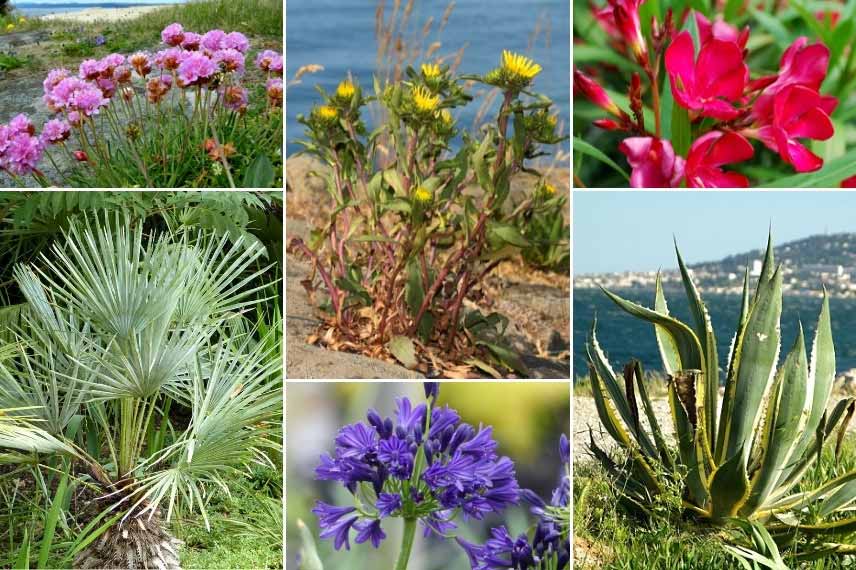
Armeria maritima (photo Arnstein Rønning), Grindelia integrifolia (photo Walter Siegmund), Nerium oleander, Chamaerops humilis ‘Cerifera’, Agapanthus ‘Royal Velvet’ and Agave americana ‘Variegata’
Discover other Grindelia
View all →
Available in 1 sizes
Available in 1 sizes
In a dry garden with warm tones
You can enjoy Grindelia to create a dry and exotic garden, formed of succulent plants, cacti, and other plants with narrow leaves and a very reduced lamina. Indeed, plants that thrive in hot and dry environments like deserts reduce their foliar surface to withstand heat and limit water loss. The golden flowers and spiny bracts of Grindelia will pair beautifully with the prickly style of opuntias, agaves, dasylirions, and Yucca rostrata. With their upright and well-defined silhouette, these exotic plants will provide incredible graphic appeal to the garden. Your garden will evoke the landscapes of Arizona, with its sun-scorched red earth, cacti, and succulent plants. As for flowering, focus on warm hues and the originality of Sparaxis tricolor, as well as the exotic flowers of kniphofias, crocosmias, California poppies, and Delospermas. You can incorporate some grasses, for example, Carex comans ‘Bronze Form’, with fine bronze-orange leaves.
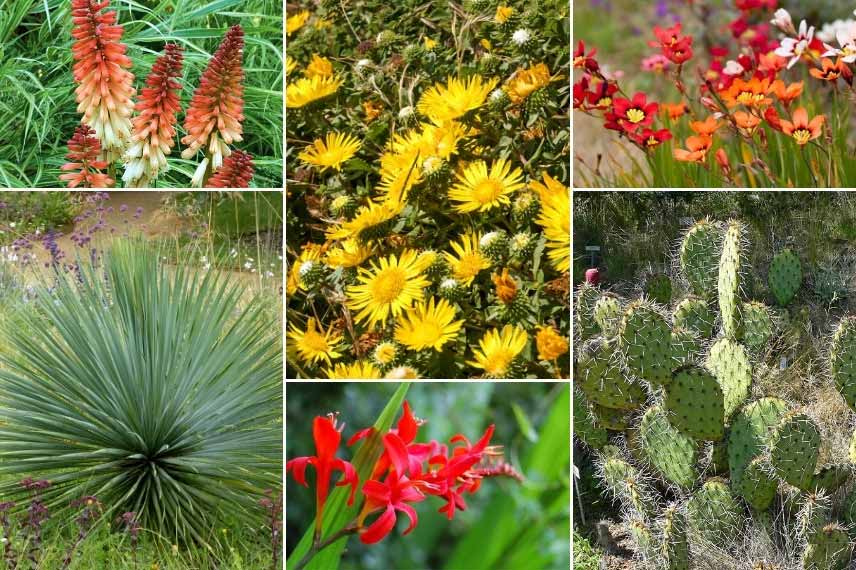
Kniphofia ‘Orange Vanilla Popsicle’, Grindelia camporum, Sparaxis tricolor (photo Richard Shiell – GWI – Biosphoto), Yucca rostrata, Crocosmia ‘Lucifer’ (photo Vicky Brock) and Opuntia phaeacantha (photo Stan Shebs)
In a naturalistic garden
With its very airy habit, formed of ramified and disorderly stems bearing yellow capitula, Grindelia has a true wild plant appearance. Thus, it seems destined for naturalistic and meadow gardens. Plant it alongside other perennials with a free and flexible habit, such as Gaura lindheimeri, whose flowers resemble small white or pink butterflies, as well as knauties, Buenos Aires vervains, and penstemons. Discover Cephalaria gigantea, a giant scabious that can reach 2 m in height, bearing beautiful cream-yellow flowers that are very bright. Also integrate clumps of grasses, essential in this style of garden to create a natural meadow effect! You might choose Pennisetum orientale, Stipa tenuifolia, Calamagrostis, or Molinies.
Discover our inspiration page “Naturalistic Garden” and our advice sheet “10 Emblematic Perennial Plants for Naturalistic Gardens”
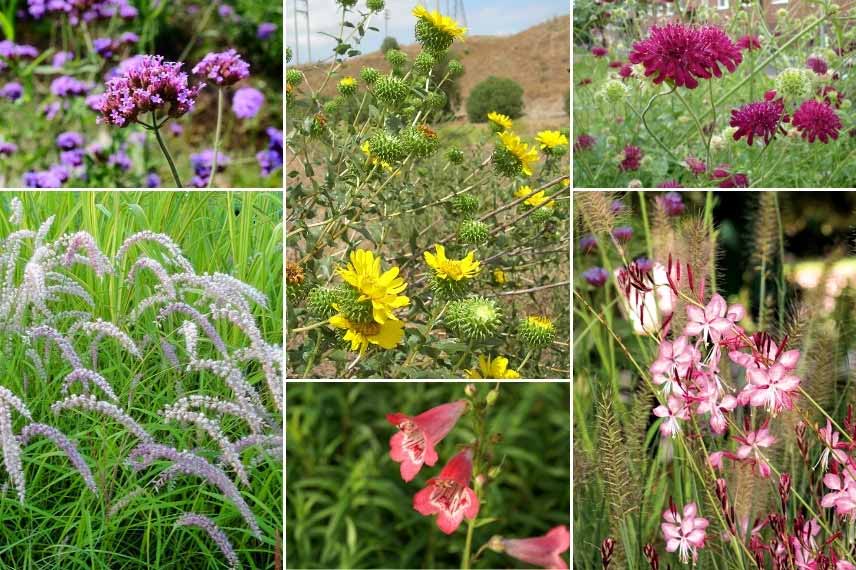
Verbena bonariensis, Grindelia camporum (photo Joe Decruyenaere), Knautia macedonica (photo Epibase), Pennisetum orientale ‘Tall Tails’, Penstemon ‘Souvenir d’Adrien Régnier’ and Gaura ‘Rosy Jane’
To play with complementary colours
One of the best ways to combine colours in the garden is to play with complementary colours: shades that are opposite each other on the colour wheel and, when placed together, enhance each other, creating a sense of depth and contrast. This is the case, for example, with yellow and purple. Thus, you can highlight the yellow shade of Grindelia by planting it alongside rudbeckias, such as the variety ‘Little Goldstar’, as well as Achillea ‘Moonshine’, Bidens ‘Lemon Moon’, and agrimony. In contrast, pair them with the purple shade of Salvia guaranitica ‘Amistad’, Penstemon ‘Sour Grapes’, Nepeta ‘Six Hills Giant’, and Agapanthus ‘Poppin Purple’. You will create a very original flowerbed that catches the eye and leaves no one indifferent!
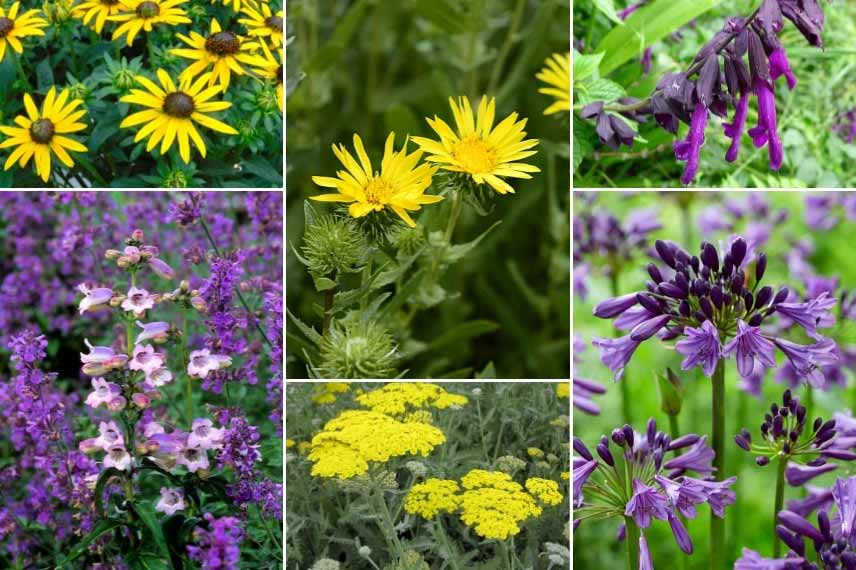
Rudbeckia fulgida ‘Little Goldstar’, Grindelia squarrosa, Salvia guaranitica ‘Amistad’ (photo gailhampshire), Penstemon ‘Sour Grapes’ and Nepeta ‘Six Hills Giant’ (photo Andrew Lawson – Flora Press), Achillea ‘Moonshine’ and Agapanthus ‘Poppin Purple’
To bring brightness to the garden
You can easily highlight Grindélia flowers by pairing them with dark foliage, such as purple or dark brown. This contrast will truly enhance their flowering and make them appear even more vibrant. Consider, for example, Heuchera ‘Obsidian’, Physocarpus ‘All Black’, Cotinus ‘Royal Purple’, and Ophiopogon planiscapus ‘Nigrescens’. To echo the flowers of Grindélia, introduce other touches of brightness into the bed with the golden foliage of Thyme ‘Bertram Anderson’, Sage ‘Icterina’, and Pennisetum ‘Hameln Gold’. Also consider the yellow flowers of Anthemis tinctoria, Centaurea orientalis, and Coreopsis verticillata ‘Moonbeam’. This will give you a stunning yellow and purple bed!
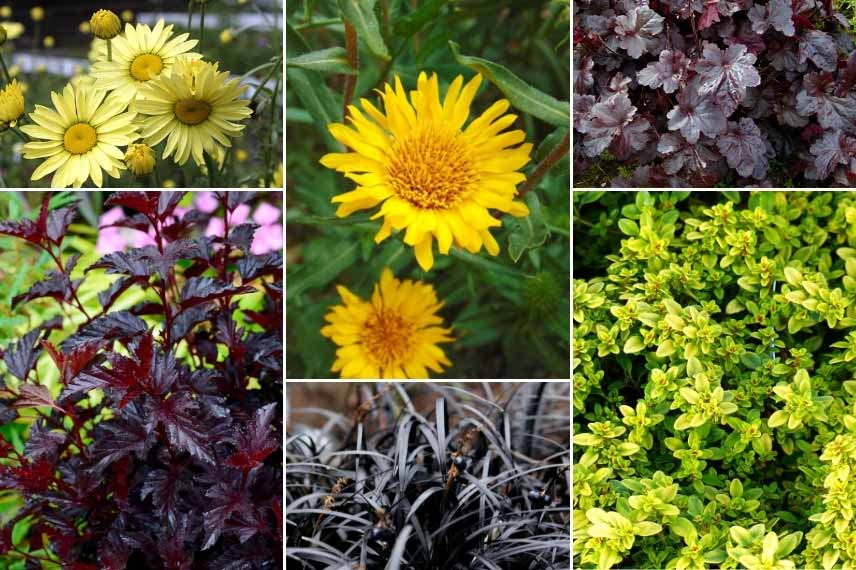
Anthemis tinctoria ‘Wargrave Variety’ (photo Ben Rushbrooke), Grindelia robusta, Heuchera ‘Obsidian’, Physocarpus opulifolius ‘All Black’, Ophiopogon planiscapus ‘Nigrescens’ (photo Brewbooks), and Thyme ‘Bertram Anderson’
For a beautiful late summer to early autumn scene
Grindelia offers a beautiful flowering display that lasts until September-October: take the opportunity to celebrate the arrival of autumn by pairing it with late-flowering perennials, grasses, and shrubs with vibrant foliage! For example, create a lovely late summer to early autumn border by planting Grindelia alongside eupatoriums, perovskias, asters, and ‘Herbstfreude’ sedums. For the colour palette, favour shades of pink-purple, red-orange, and golden yellow, which will create a very soft and warm atmosphere. Consider the beautiful bright flowers of dahlias and echinaceas! You can also incorporate the stunning grass Calamagrostis brachytricha, charmingly nicknamed “Diamond Grass”, whose feathery flower spikes shine under the sun’s rays.
Discover our inspiration page “Autumn Atmosphere”
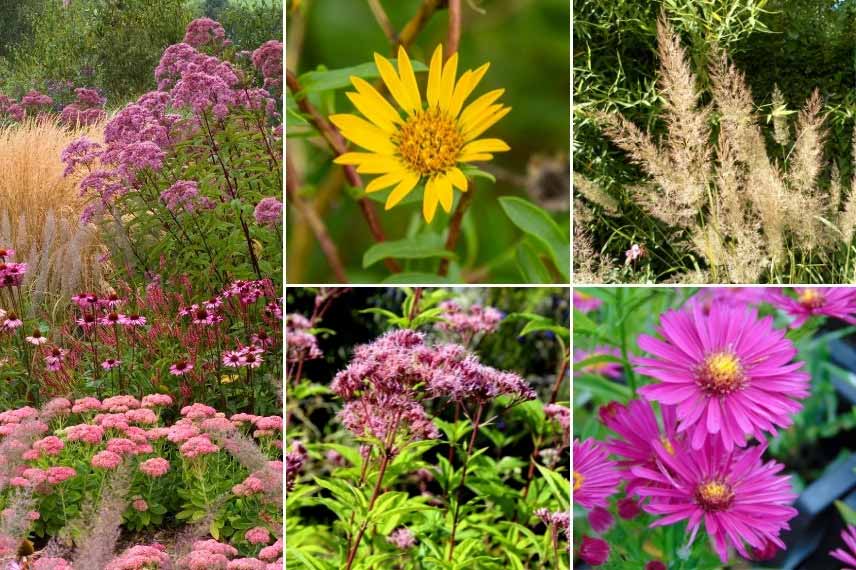
Scene featuring Sedum ‘Herbstfreude’, Echinacea purpurea ‘Rubinstern’, Eupatorium purpureum, Perovskia ‘Blue Spire’ (photo Clive N. – Designer Judy Pearce), Grindelia stricta, Calamagrostis brachytricha, Eupatorium purpureum (photo Manuel M.V.) and Aster dumosus ‘Jenny’
- Subscribe!
- Contents
![[plant1]Grindelia[/plant1] with respiratory well-being, [plant2]Grindelia[/plant2] is a must-have in your herbal garden.](https://en.promessedefleurs.eu/blogwp/wp-content/uploads/2022/08/associer-le-grindelia.jpg "associate grindelia")
Comments