





























Pairing ideas with Fremontodendron
Discover our 6 pairing ideas
Contents
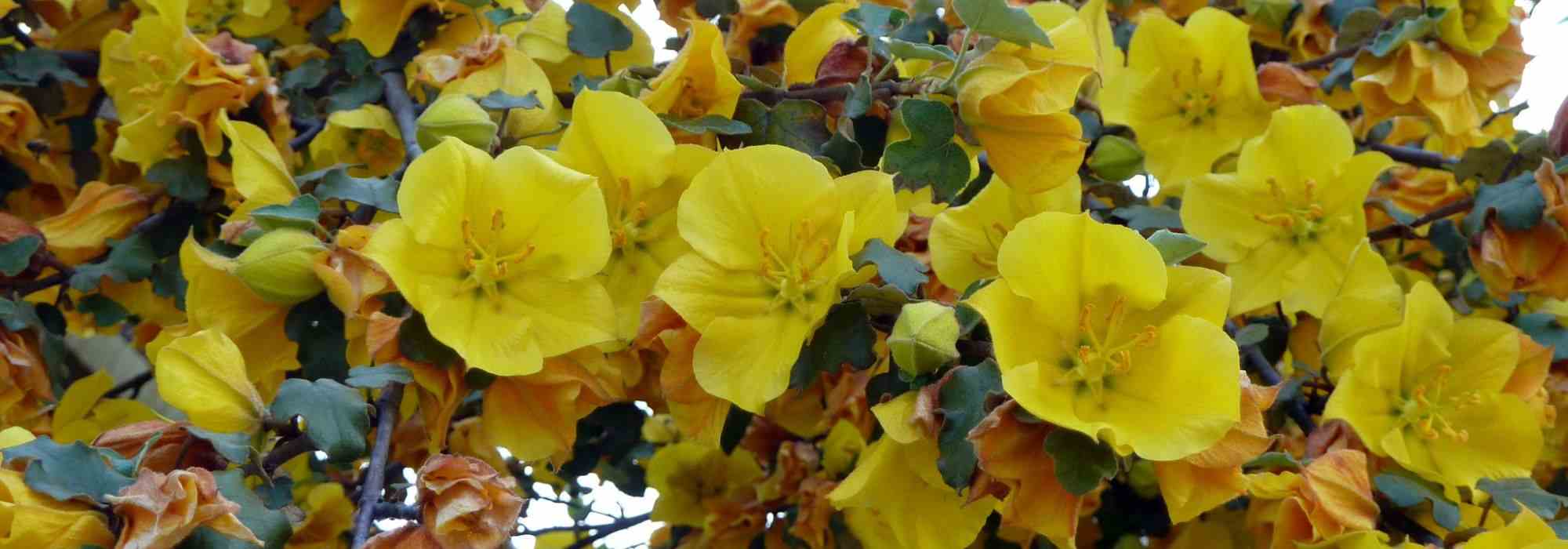
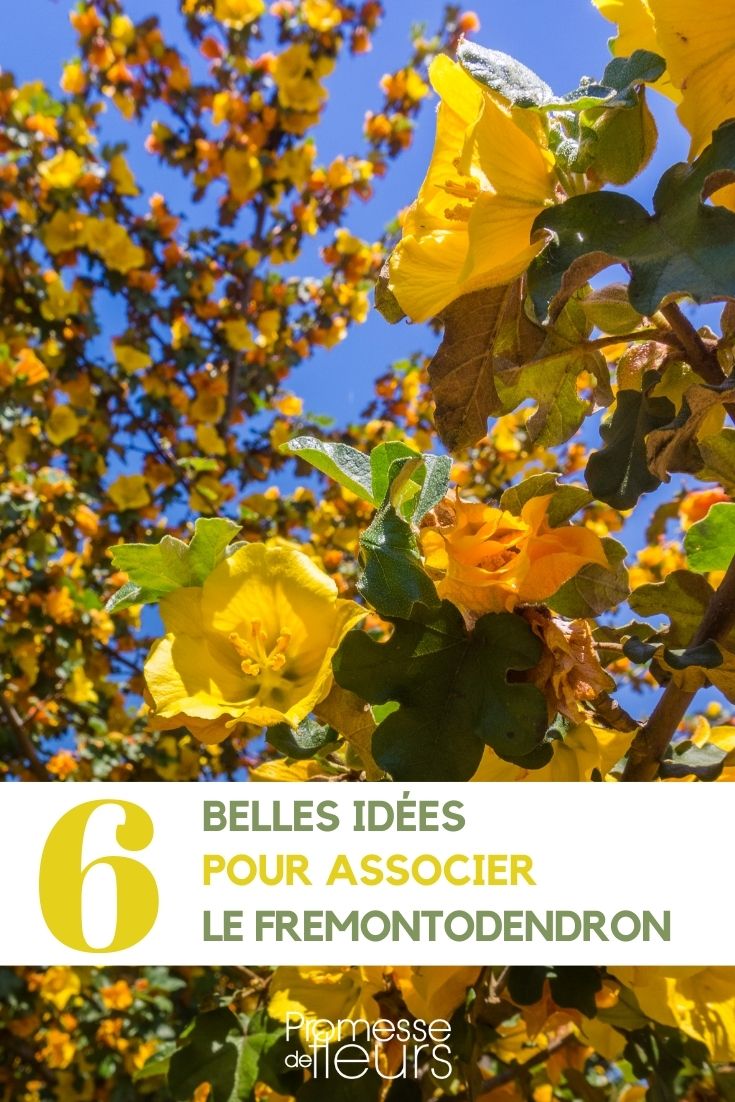
The Fremontodendron californicum is native to the wooded areas at the foot of the Sierra Nevada in the South-West of the United States. Also known as California Frémontia, this beautiful bush with a bushy to climbing habit can reach heights of 6 m, and even up to 9 m if the climate is suitable and it receives maximum sunlight. In spring, it is covered with a generous flowering of large golden-yellow flowers that reflect the light.
Quite hardy (down to -12 °C), it can be planted in most gardens as a hedge, in a border, or as a specimen where its crown of flowers will brighten up a dark corner. On a terrace or balcony, it should be protected from cold winds and rain. A low-maintenance plant that thrives in well-drained soil and tolerates lime, ideal for a garden with little upkeep.
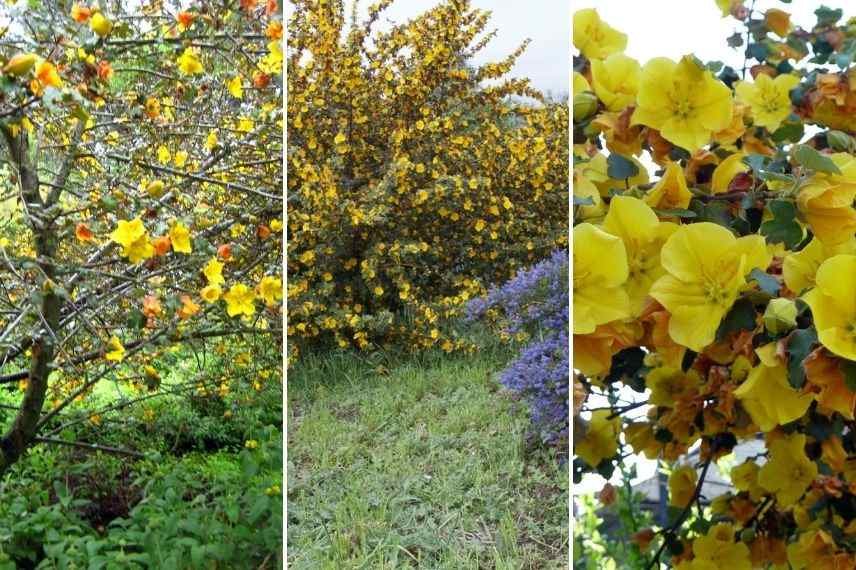
The Fremontodendron californicum brightens and enlarges the space with its generous luminous flowering
To avoid any failure, we recommend planting appropriately, using our web application Plantfit.

In a mixed hedge
The Fremontodendron californicum captivates with its free and tousled appearance. It integrates effortlessly into a mixed hedge alongside Viburnum dentatum ‘Blue Muffin’ for its natural character and its foliage that changes with the seasons, featuring light and bright colours. At its base, place the Mahonia (x) wagneri ‘Pinnacle’ with its broad and dense habit and glossy foliage resembling that of holly. Its bright yellow flowering is particularly abundant in winter. The Cotinus coggygria ‘Golden Lady’, a recent variety of smoke tree with extremely decorative foliage, will bring light and attract attention just as much as the Fremontodendron. In summer, it takes on golden yellow hues before donning orange in autumn.
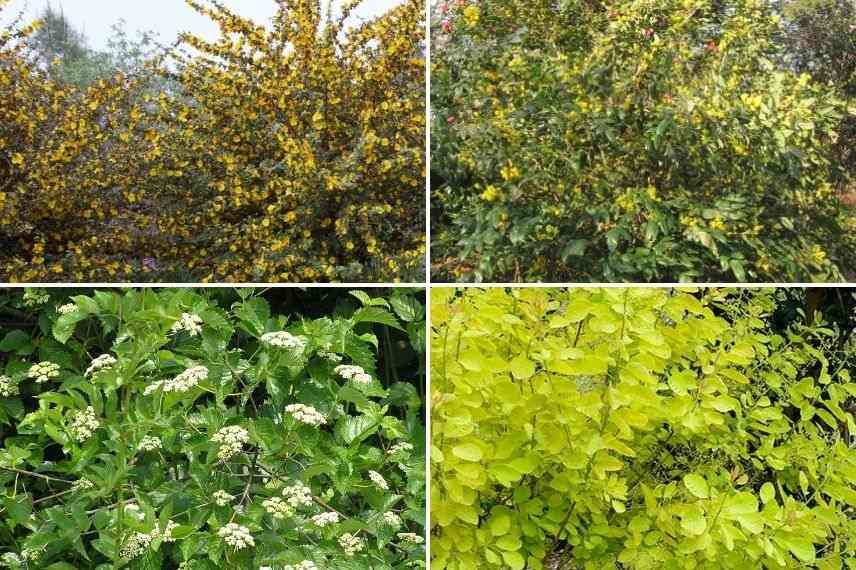
Above, the yellow flowering of the Fremontodendron follows that of Mahonia wagneri ‘Pinnacle’ with its sweet fragrance. Its evergreen foliage changes colour from glossy green to bronze red. Below left, Viburnum dentatum ‘Blue Muffin’ with its beautifully cut foliage highlights the surprising yellow foliage of Cotinus coggygria ‘Golden Lady’
Read also
Moderate yellow flowers in the gardenTrellised against a wall
The fremontodendron needs sunlight and warmth to flower. You can plant it along a wall facing south or west, ensuring good drainage at its base. Pair its evergreen leaves, which are matte green on top and golden-grey underneath, with the decorative light green foliage of the Ampelopsis aconitifolia, which takes on a yellow hue reminiscent of the fremontodendron’s flowers by summer.
As the fremontia quickly becomes bare at the base, the trick is to plant an evergreen bush that can be pruned into a high ball shape of about 1.20-1.50 m. This bush will effectively protect the base of your fremontodendron from frost during a harsh winter. Thus, the lovely variegated yellow foliage of Pittosporum tenuifolium ‘Abbotsbury Gold’ is perfectly suited for this purpose. It will bring light to this scene throughout the year.
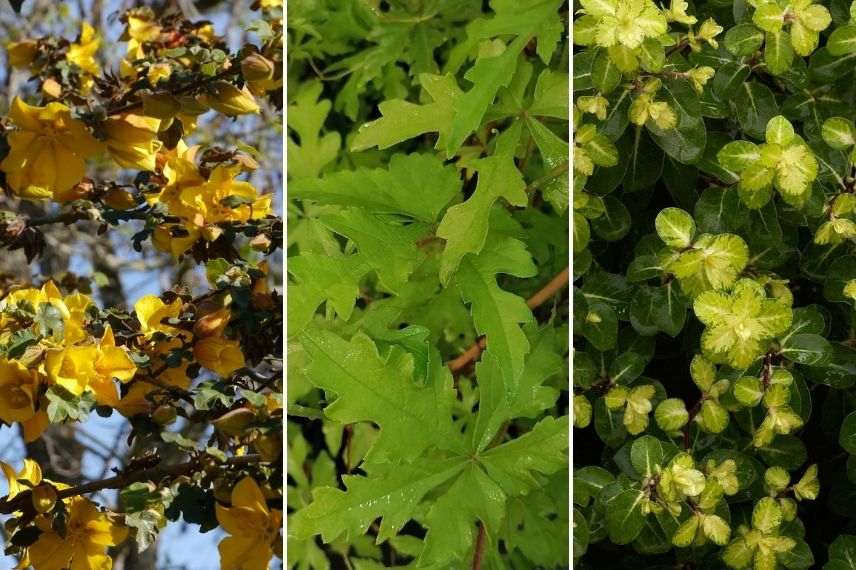
The fremontodendron californicum lends itself well to training alongside the Ampelopsis aconitifolia with its fresh green foliage and the variegated leaves of Pittosporum tenuifolium ‘Abbotsbury Gold’
→ Eric’s tip: The bright golden-yellow flowering of the fremontodendron will be twice as successful if you train it against a wall of red bricks or a vibrant colour, which will highlight its large golden-yellow blooms.
In a monochrome yellow bed
The yellow colour brightens and enlarges space in the garden, especially during the transitional seasons when the low light is diffracted. The elegance of this scene relies on the balance between the flowerings and the foliage. The beautiful contrast between the tender green of California lilac Ceanothus pallidus ‘Marie Blue’; the variegated yellow-green of common sage Salvia officinalis ‘Icterina’ and the dark green foliage of the Fremontodendron, which balance throughout the year, serve as a backdrop to highlight the yellows. In summer, the flowerings of the tender yellow flowering stems of Phlomis russeliana join the trailing golden yellow branches of the Fremontodendron. The whole is punctuated by the magenta pink of Achillea millefolium ‘Apfelblüte’ and softened by the blue haze of the Ceanothus.
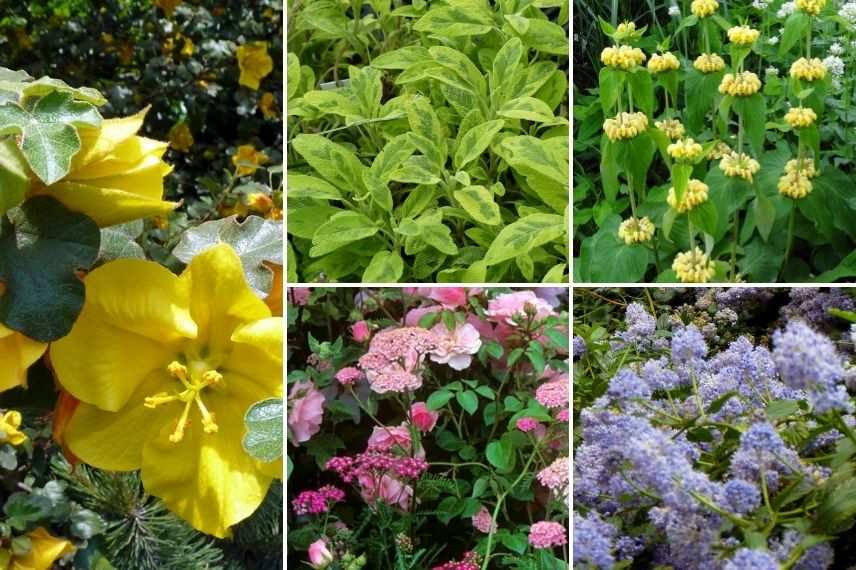
The long yellow flowering of the Fremontodendron balances with the blue of the Ceanothus near the pink of the Achillea below. Above, the yellow-green foliage of Salvia officinalis ‘Icterina’ provides a sumptuous frame for the yellow-flowering Phlomis russeliana.
In isolation
Fremontia is a low-growing tree that does not exceed 6 to 9 metres. It is an ideal choice for small gardens. However, ensure it is provided with well-drained soil and a sunny, sheltered position to guarantee its exceptional golden-yellow flowering. Its rich green evergreen foliage will be enhanced by the purple foliage of the Berberis ottawensis ‘Superba’, which is vigorous and remarkably coloured; its spring flowering of golden-yellow bells will herald that of your fremontodendron.
For a more contemporary garden, accompany your fremontodendron with large clumps of Miscanthus nepalensis. This elegant Miscanthus is ideal for small gardens. Its soft, graceful habit, formed of trailing light green leaves and a flowering of pearly white plumes, beautifully captures the light during the interseasons. Enhance this graphic spirit with the ‘Eryngium x zabelii ‘Big Blue®’ , which will create a modern focal point with its steel-blue stars contrasting with the golden-yellow flowering of the fremontodendron.
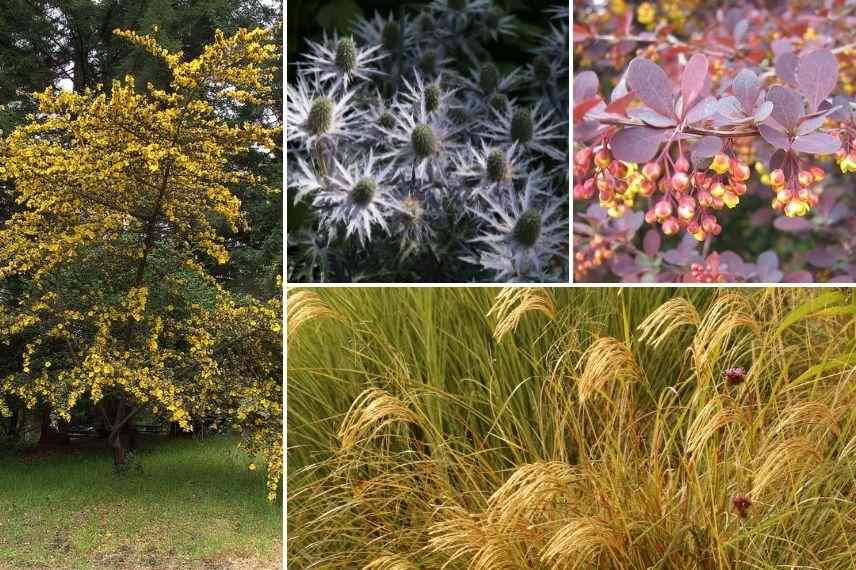
The Fremontodendron californicum attracts all eyes, adorned with its generous golden-yellow flowering in summer. It pairs well with Berberis ottawensis ‘Superba’, with its bronze-red foliage and bright yellow flowers, or in a more modern arrangement with the Nepalese miscanthus and the graphic Eryngium in cool, metallic colours.
→ Eric’s advice: Choose a sunny location for your fremontodendron, away from any automatic watering, which it cannot tolerate.
In a dry garden
Ideal for seaside gardens where the soil can be dry, Fremontia tolerates poor, sandy soils and even salt spray. Pair it with Coronilla glauca for its lightness with its grey evergreen foliage and long, fragrant lemon-yellow flowering. The fremontodendron tends to become bare at the base. Place large patches of perennials that dance with the wind and light. Choose Mullein or Verbascum bombyciferum ‘Polarsommer’, which produces tall spikes of yellow flowers resembling the golden cups of the fremontodendron. Add the Stipa calamagrostis, a graceful medium-sized grass, perfect for dry, poor, or calcareous soil, whose silver-white panicles in summer later take on a lovely golden-beige hue. Leaves and inflorescences remain evergreen in winter. In spring, the large fluffy rosettes of silver sage Salvia argentea bring softness with their fabulous foliage, all dressed in silver.
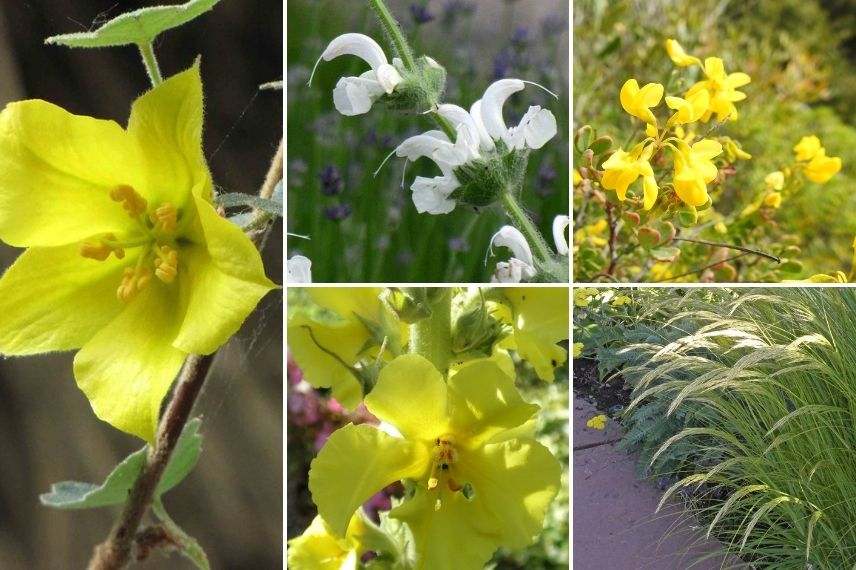
On the left, the large single flower of the fremontodendron dominates this scene, to which the coronilla adds the headed fragrance of its generous golden-yellow flowering at the top right. To its left, the silver sage punctuates the moving mass of Stipa calamagrostis with its white flowers and soft grey foliage. The flower of the tall mullein Verbascum bombyciferum ‘Polarsommer’ closely resembles that of the fremontodendron.
In a large container on a terrace
The fremontodendron is placed on a terrace in a large deep container filled with a draining mix. Expose it to the south or west, sheltered by a wall to avoid cold or overly humid winds. Remember to keep it away from pathways and wear gloves when pruning its foliage. It is covered in a bloom that can be irritating.
At its base, place the hardy Sedum ‘Sunkissed’, to bring the light of its large cream-yellow flowers borne on stout stems, accompanied by the irresistible fuzzy grey foliage of Bear’s Ears Stachys byzantina that also plays with the light. This light effect is enhanced with the Caryopteris (x) clandonensis‘Hint of Gold’ whose bright vivid light yellow foliage in spring turns acid green in summer, contrasting with its lovely lavender-blue flowers. It exudes a surprising scent of anise mixed with lavender.
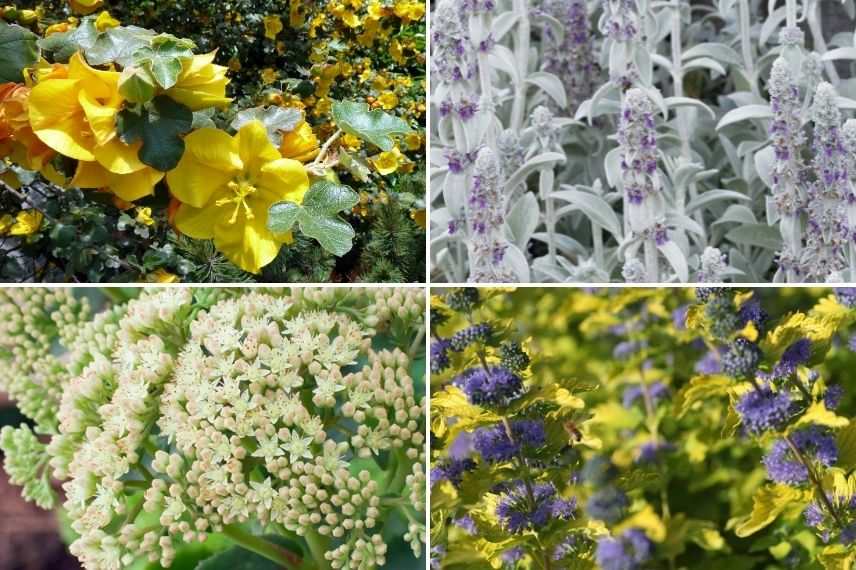
A sunny terrace with, at the base of the fremontodendron, the softness of Stachys byzantina for a touch of gentleness. The shades of sunny yellow are highlighted here by the fragrant foliage of Caryopteris clandonensis ‘Hint of Gold’ in the bottom right and that of Sedum ‘Sunkissed’.
For further reading
Discover all our yellow-flowering bushes.
- Subscribe!
- Contents
Comments