





























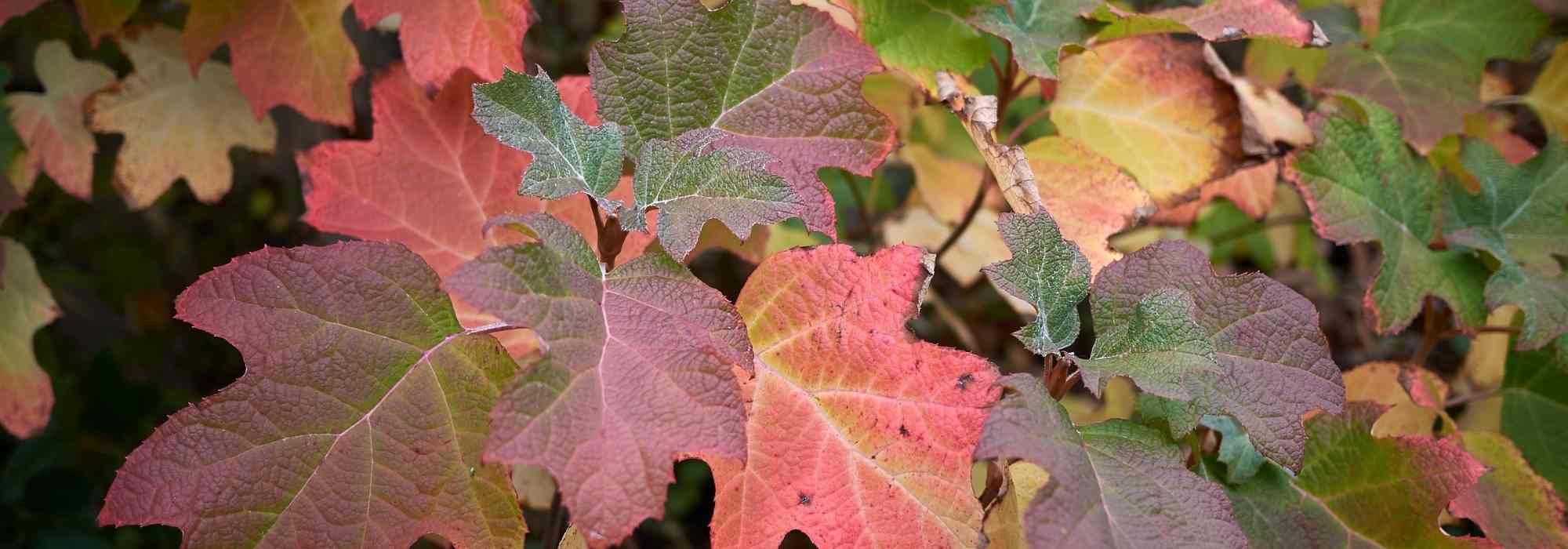
Hydrangeas with stunning autumn colours
The best Hydrangeas changing leaf colour in autumn
Contents
Hydrangeas are magical for blooming in the garden all summer long, for many weeks, with a wide variety of species in different colours and flower shapes.
While many cultivars see their flowers transform from green to pink, even red, it is sometimes forgotten that the foliage of certain varieties is not without interest, subtly changing colour as autumn approaches. The cold causes them to take on orange to reddish, crimson, coppery, or purple hues… they become admirable focal points and join more classic bushes in their autumn attire.
What are the most beautiful hydrangeas whose foliage takes on autumn colours? We reveal them to you in this advice sheet, by species.
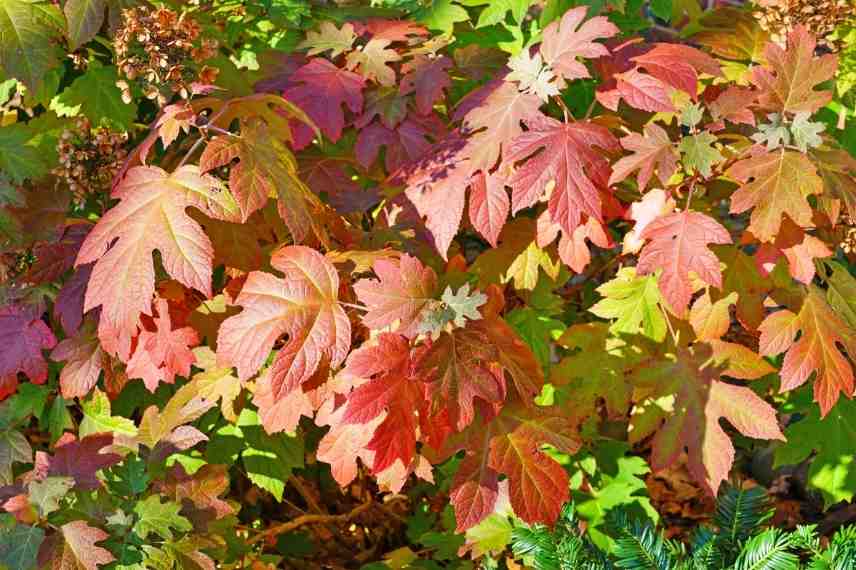
Hydrangea quercifolia are the most noted for their reddening foliage in autumn, even more colourful when they have received sunlight

Hydrangea quercifolia
Hydrangea enthusiasts will certainly first remember the stunning colours displayed by oak-leaved hydrangeas in early autumn. In addition to the uniqueness of their lobed foliage resembling that of oaks, they are known and appreciated for their characteristic of turning orange and then red. Their flowering occurs in upright or trailing panicles, always white and cream, often blushing at the end of summer.
The typical species, Hydrangea quercifolia, takes on a wider than tall habit with age, reaching heights of 1.80 to 2 m. It is characterised by long, loose panicles (about 10 cm), and shows excellent resistance to cold and drought once established.
♥ Among the noteworthy cultivars:
- The Hydrangea quercifolia ‘Ice Crystal’: Compact, with pink flowers at the end of summer, the almond green leaves turn purplish in autumn;
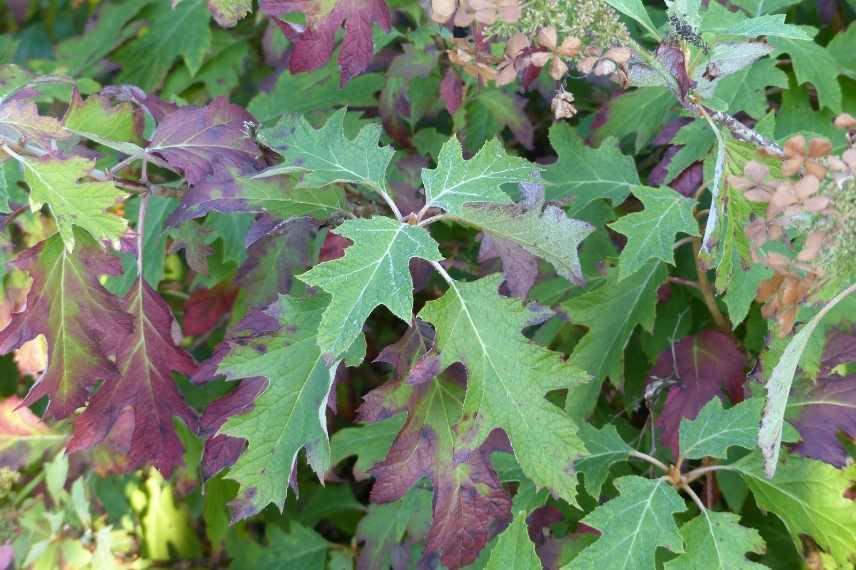
Hydrangea quercifolia ‘Ice Crystal’ (© Virginie Douce)
- The Hydrangea quercifolia ‘Alice’: Tall (between 2 m and 2.50 m), the leaves gradually and quite late turn a caramel orange and copper to purple. They have the particularity, like ‘Burgundy’, of remaining on the bush for a long time in winter.
- The Hydrangea quercifolia ‘Snow Queen’: A beautiful variety distinguished by its upright flowers and its superb orange to reddish-brown colouration at the end of summer.
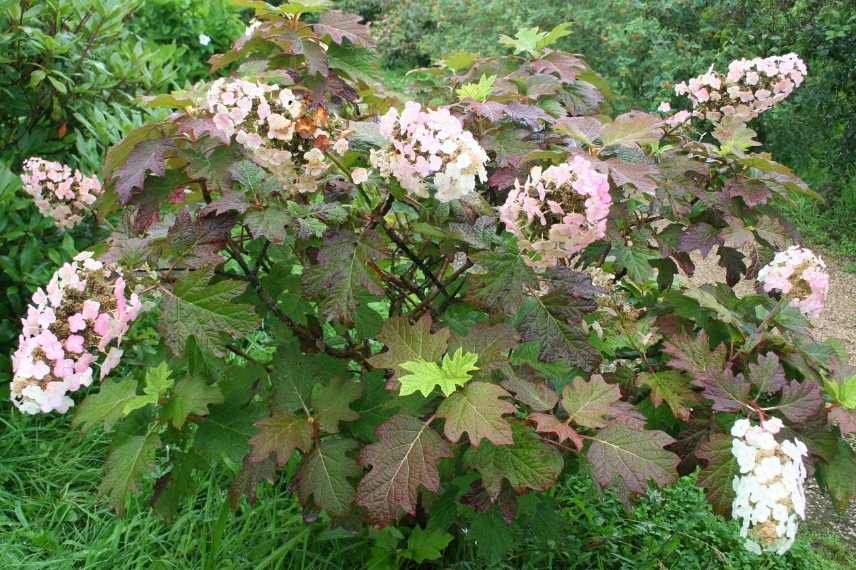
Hydrangea quercifolia ‘Snow Queen’ (©Eva Deuffic)
- The Hydrangea quercifolia ‘Burgundy’: Medium-sized (about 1.60 m), its foliage turns reddish-purple, almost black in winter.
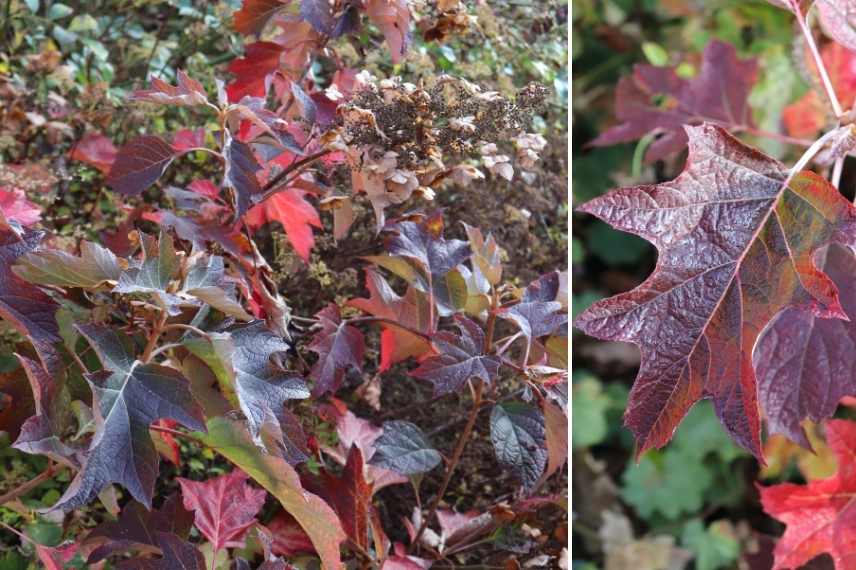
Hydrangea quercifolia ‘Burgundy’ (© Virginie Douce)
Read also
Hydrangeas: planting, pruning and careHydrangea serrata
Hydrangea serrata, also known as lacecap hydrangeas, are characterised by a light and delicate flowering, often flattened and repeat flowering at the end of summer, and early in June. They have particularly fine foliage. They are also very hardy. These are often small and compact hydrangeas (usually between 1 m and 1.40 m).
Less renowned than Hydrangea quercifolia for the beauty of their autumn foliage, many Hydrangea serrata are nonetheless remarkable for their autumn leaves. They should not be overlooked in the composition of borders, as they display stunning colours, often red with blue pigmentation.
♥ Among the noteworthy cultivars:
- Hydrangea serrata ‘Cap Sizun’: Flowers of a beautiful blue or pink depending on the soil pH. The foliage takes on a wine-red colour from September. It is stunning due to its repeat flowering at a time when the new blooms are enhanced against the foliage;
- Hydrangea serrata ‘Tiara’: Known for its floribundity, it is magnificent with its leaves turning a flamboyant purple-red in late summer;
- Hydrangea serrata ‘Grayswood’: The flower sepals evolve from pure white to pink and then wine-red, and the light green foliage takes on beautiful burgundy shades in late summer. One of the largest among the “serrata”;
- Hydrangea serrata ‘Graciosa’: The pink and mauve flowers contrast from summer with foliage gradually turning brown and purple;
- Hydrangea serrata ‘Santiago’: The entire bush ignites in autumn: the semi-double flowers change from pink to red. They beautifully accompany the foliage, which colours from a violet-blue to gradually turn to carmine burgundy;
- The Hydrangea serrata ‘Blueberry Cheesecake’: A bicolour flowering early in the season, well repeat flowering, and foliage ablaze in autumn are the undeniable assets of this new star of the shade;
- Hydrangea serrata ‘Precioza’: Its flowers are bright pink then purple, with slightly purple foliage and stems. Beautiful rounded habit.
- Hydrangea serrata ‘Oamacha’: Notable for its red to purple leaves from August (it flowers from May to July). This is the variety of the famous Buddha tea!
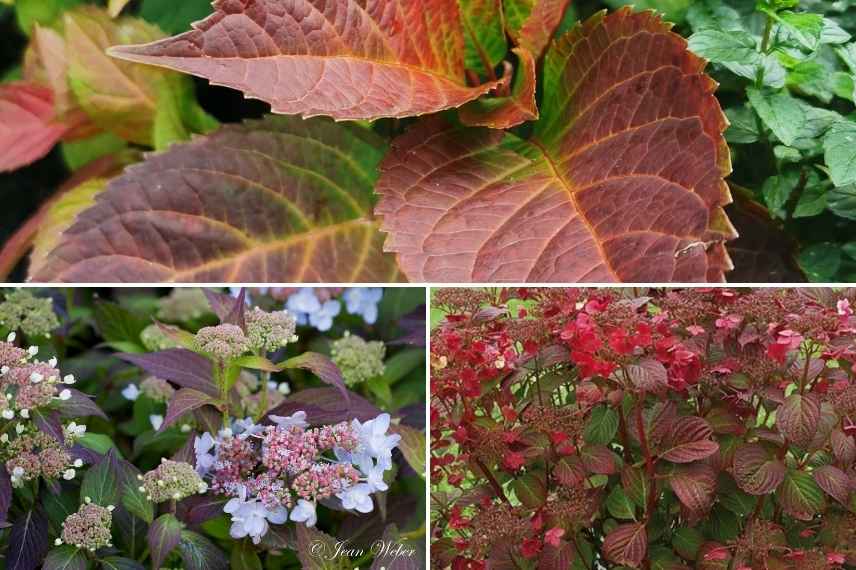
Above, Hydrangea serrata ‘Precioza’ (© Virginie Douce). Below left, Hydrangea serrata ‘Tiara’ (© Jean Weber), and on the right ‘Santiago’
Discover other Spring bulbs A to Z
View all →
Available in 2 sizes
Available in 1 sizes
Available in 2 sizes
Available in 1 sizes
Available in 1 sizes
Available in 1 sizes
Available in 1 sizes
Available in 2 sizes
Available in 1 sizes
Available in 1 sizes
Hydrangea macrophylla
Hydrangea macrophylla, the classic hydrangeas with large, colourful flower heads, are prized for the extraordinary variety available on the market. These hydrangeas have large ovate leaves, which is reflected in their Latin name, and often deeply lobed, highly veined leaves. They thrive in shade or partial shade.
Some cultivars, whether old or newly introduced, surprise us with their evolving autumn foliage:
- The Hydrangea macrophylla ‘Merveille Sanguine’: an old variety boasting one of the brightest reds in its flowers, and a beautiful glossy foliage that shines when planted in sufficient sunlight, turning to a burgundy in autumn;
- The Hydrangea macrophylla ‘Julisa’: a creation from Angers with a stunning variety featuring purple foliage that greens in summer, turning red with the first chills. Its flower heads are a carmine red;
- The Hydrangea ‘Daredevil’: this is actually a Hydrangea serratophylla (a hybrid between H. macrophylla and H. serrata): the leaves evolve to an almost black purple, while the flowers change from pink to red;
- The Hydrangea macrophylla ‘Sandra’: its foliage takes on stunning orange hues in autumn, and its flowers are bicoloured, white edged with pink, turning red later in the season.
Read also
Hydrangeas: how to choose them?Hydrangea paniculata
It is not for the autumn foliage that one chooses a Hydrangea paniculata, these beautiful hydrangeas with large conical flowers, which have been very trendy in recent years, as they are not only ornamental but also drought-resistant and sun-loving, allowing for a new use of hydrangeas in the garden. Their leaves are small and ovate, quite different from other hydrangeas.
However, some Hydrangea paniculata turn a beautiful golden yellow hue at the end of the season like ‘Wim’s Red’, or orange-red as seen in ‘Perle d’Automne’ and in the Hydrangea paniculata ‘Diamant Rouge’, which takes on very beautiful claret colours, standing out at the end of summer with its reddest flowers for a “paniculata“.
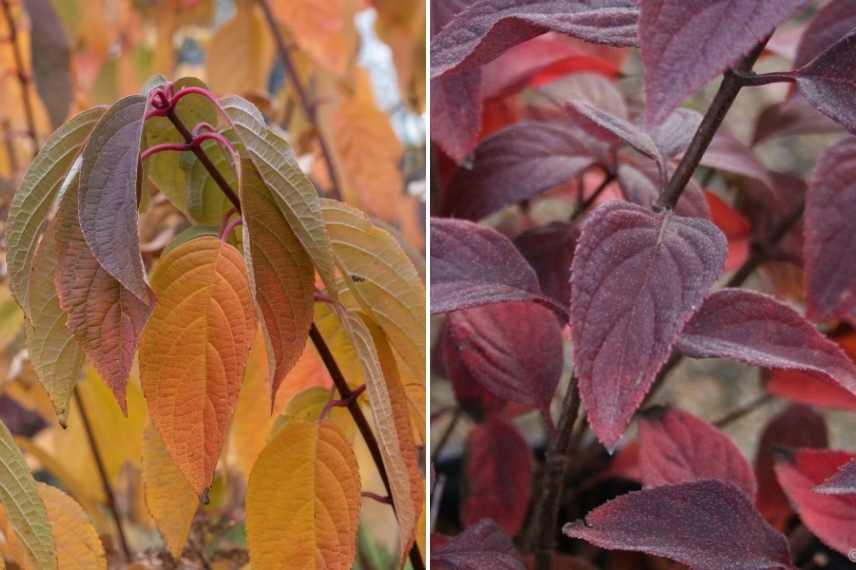
Hydrangea paniculata ‘Wim’s Red’ on the left, and on the right the variety ‘Diamant Rouge’
And some others...
Hydrangea heteromalla ‘Bretschneideri’: a large-growing hydrangea, with light, frothy cream flowers, and leaves that turn orange to purple in autumn.
Hydrangea anomala ‘Winter Surprise’: this climbing hydrangea, native to the Himalayas, has small semi-evergreen to evergreen leaves that turn red in mid-winter.
Hydrangea heteromalla ‘Snowcap’: of medium size (2 to 3 m tall), it turns dark purple with violet highlights in autumn.
Important note about these changes colours
The intensity of the foliage colouration of hydrangea will depend on several factors: the sun exposure that enhances the vibrancy, the weather and heat during summer, but especially the differences between daytime and nighttime temperatures in autumn. This results in sometimes notable differences between the same young plant planted on the coastal shoreline and in a more continental climate.
- Subscribe!
- Contents
![[plant id="1234" color="autumn"]](https://en.promessedefleurs.eu/blogwp/wp-content/uploads/2022/09/hortensia-couleur-automne.jpg "[plant id=\"hortensia\" color=\"autumn\"]")
Comments