





























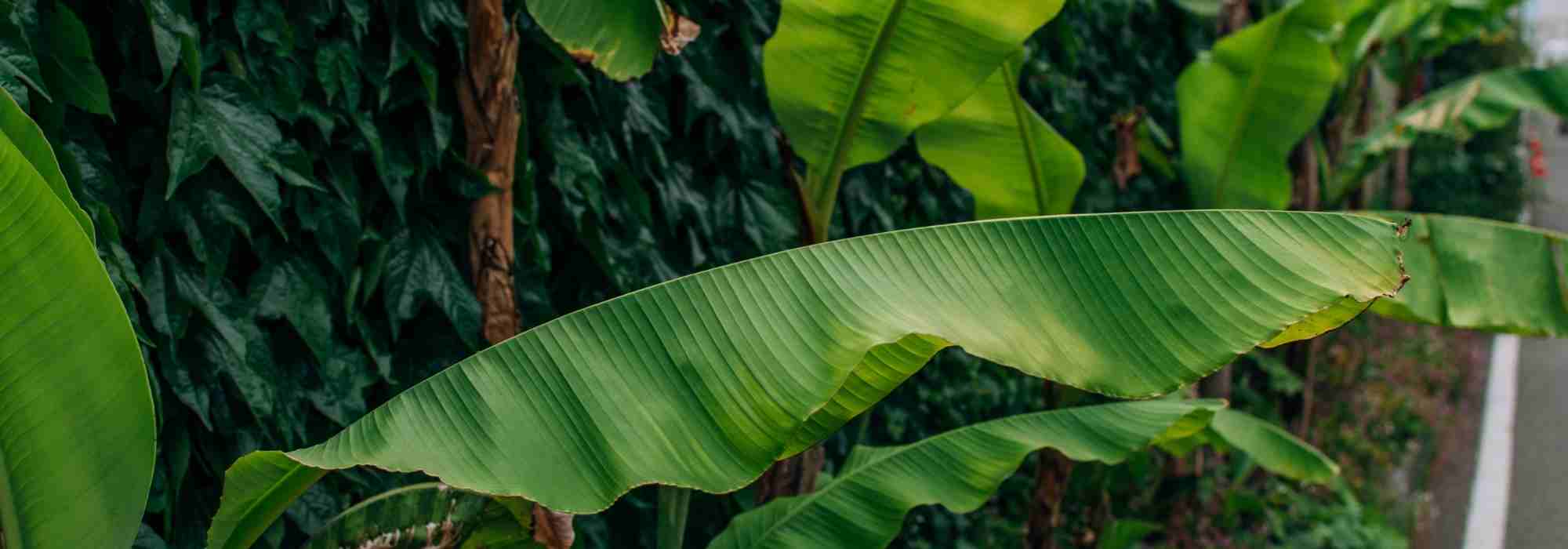
Banana plant: 10 questions and answers
Everything you’ve always wanted to know about the banana plant but never dared to ask
Contents
To add an exotic touch to your garden, nothing beats the broad, majestic and luxuriant foliage of the banana plant! Grown in the ground in regions with warm to temperate climates, the banana plant adapts very well to indoor pot culture. Under its apparent majestic tree-like appearance that can still reach up to 5 m in height, the banana plant is in fact an herbaceous plant with an arborescent habit and a pseudo-trunk called a stipe, which is the result of a stacking of petioles. Banana plants are especially notable for their summer flowering of great originality: the small yellow or pale cream flowers (the females at the top, the males at the bottom) are covered by large brownish or red bracts.
The banana plant, which belongs to the genus Musa and which comprises several different species including Ensete and Musella, hides curiosities in terms of planting or cultivation. Discover with us the answers to the questions we most often ask about banana plants.
Further reading: Banana plant: planting, growing and care, in pots or in the garden

What is the best place to plant a banana plant?
Remember that the banana plant is an exotic plant, so it loves warmth. That is why, to grow it in open ground outdoors, you must live in a region with a warm or temperate climate. Provided you select the hardiest species and varieties,, as with the Japanese banana plant (Musa basjoo), the most common in gardens, hardy to -12°C. In smaller gardens, it is possible to plant dwarf banana plants Musella lasiocarpa or Musa acuminata ‘Dwarf Cavendish’, hardy to -10°C.
Even the hardiest banana plants need a cozy haven to thrive. They require a sunny spot (at least eight hours of sunlight per day) and protection from drafts and cold winds. Not to mention that wind tends to shred their foliage, leaving it in tatters. Planting them at the foot of a south-facing wall is ideal. They also prefer to be planted in isolation, away from the shade of neighboring plants. However, avoid placing them too close to the wall—banana plants grow quickly! A spot near a pool also suits them rather well.
Gwenaëlle shares all her tips in: A banana tree in a small garden?d Our ideas for integration.
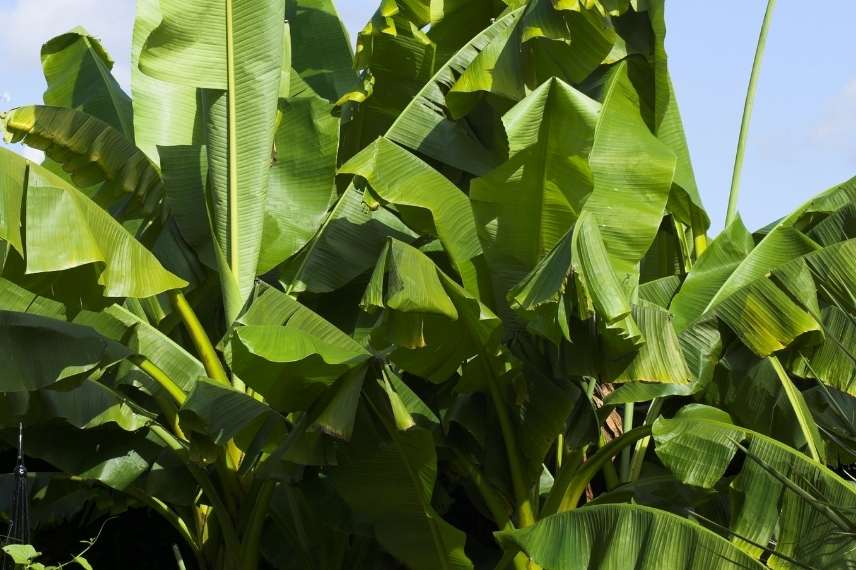
The Japanese banana plant (Musa basjoo)
In terms of soil, provide soil rich in organic matter (compost or manure well decomposed) and fertile, moist and perfectly drained. It dislikes damp or waterlogged soils. When planting, adding coarse sand is necessary to ensure drainage.
If you live in a region where winters are a little harsh, container planting is recommended. Again, you will need to choose varieties of modest dimensions, as your banana plant will have to stay warm over winter, ideally in a conservatory, a winter garden or a heated greenhouse, and outdoors in summer. So, think about moving the pot! You can even keep it indoors all year round, provided it does not have to endure direct sun.
Read also
Potted Banana tree: planting and careWhen is the best time to plant a banana plant?
It is best to plant the banana plant in the ground outdoors in spring, when the risk of frosts has definitively passed. Similarly, it will appreciate being planted in well-warmed soil. It is therefore recommended to wait until mid-May to plant the banana plant.
By contrast, banana plants grown in pots indoors can be planted all year round.
Can I put my banana plant in a pot outside?
Are you growing an Abyssinian banana tree (Ensete venticosum) or a pink-flowered banana tree (Musa velutina), not very hardy, in a pot indoors, either in your conservatory, in a heated greenhouse, or in a winter garden? And you’re wondering whether it can go outdoors, into your garden, on a balcony or a terrace? The answer is yes, but only from mid-May to September.
Indeed, your banana plant will enjoy spending the summer outdoors, but you must find a suitable, warm and bright location for it. It should be placed in a spot sheltered from winds, preferably sunny. It can tolerate partial shade, provided the light is adequate.
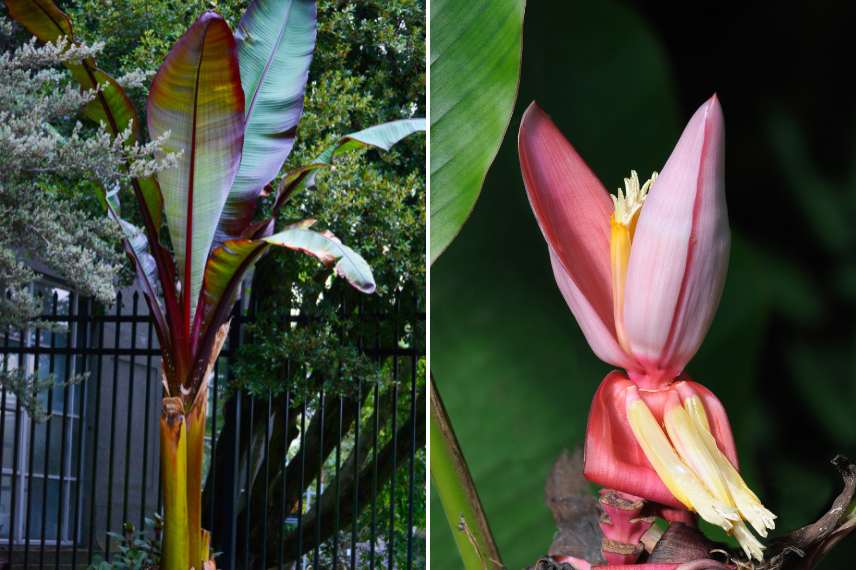
The Abyssinian banana tree and the pink-flowered banana tree
Read also
5 cold hardy banana treesHow to look after a banana plant outdoors?
Outdoors, the banana plant needs warmth. But to achieve healthy growth, it also requires some care to develop well. Because the banana plant is greedy. Both in water and in nutrients.
To begin with, the banana plant requires frequent and generous watering. However, its roots must not sit in water. That is why it is essential to let the soil dry between two waterings, which will take place once a week in spring and summer. And every ten days in autumn and winter. To space out these waterings and maintain a minimum level of moisture, mulching at the base is ideal. In periods of intense summer heat or drought, watering will be increased.
Fertilisation is also essential. Well-decomposed compost or manure additions are necessary in spring. If your banana plant is grown in a pot, you should apply a nitrogen-rich liquid fertiliser every fortnight. However, fertiliser is unnecessary in autumn and winter.
Does the banana plant grow quickly?
Banana plants are known for their very rapid growth. Depending on species and varieties, they can grow from 40 cm to 1 m during the growing season, i.e. in spring and summer. Some varieties thus reach ripeness in a single season. And some banana plants still reach up to 3 m!
Can a banana plant bear fruit in France?
In France, it is impossible to eat bananas that have grown on a banana plant. Indeed, for the fruits to reach ripeness, they require a great deal of warmth over a long period. And our summers, however hot they may be on the French Riviera, are not enough. By contrast, the fruits can form without ripening if climatic conditions are truly optimal. Sometimes, very exceptionally, a few bananas can reach ripeness on older plants. But they will be of little flavour. So don’t expect to grow a banana plant to avoid going to the greengrocer!
Moreover, in France, most banana plant varieties are grown for their ornamental value rather than for fruiting. This appeal rests on their foliage and unusual flowering. Thus, some varieties such as the Abyssinian red banana plant (Ensete ventricosum ‘Maurelii’) or the Sikkim banana plant (Musa sikkimensis ‘Red Tiger’) lean into colour with their foliage. As for the Chinese banana plant (Musella lasiocarpa), it is remarkable for its large yellow flower that lasts for many months.
→ Read also our article: How to get a banana plant that bears bananas in France?
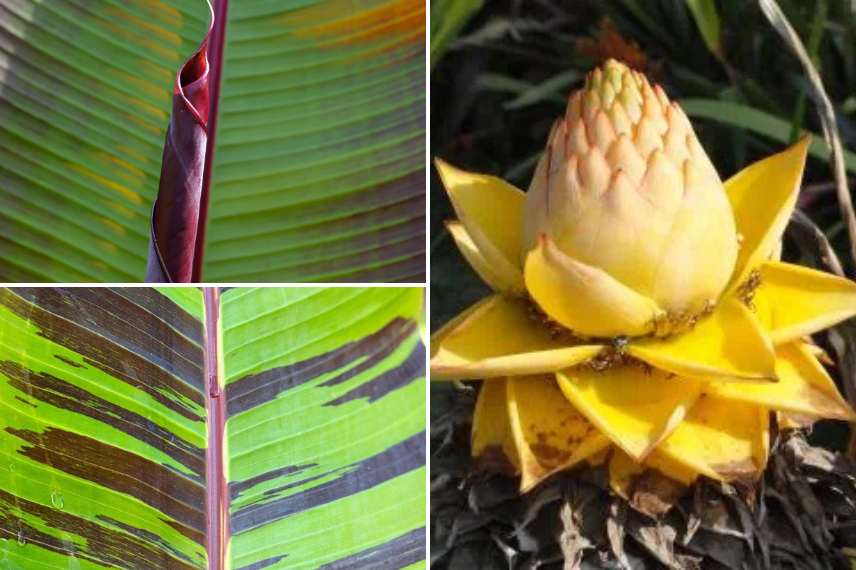
Some banana plant species and varieties possess undeniable ornamental qualities
Can I grow a banana young plant by planting a banana?
At the risk of disappointing you again, there’s no point in planting your bananas to grow a banana plant. Indeed, fruits bought commercially are sterile, that is to say they contain no viable seeds. They have been selected for ease of cultivation and flavour. To grow a banana plant, you need seeds. Promesse de fleurs also offers seeds for a few varieties that are fairly easy to grow: the seeds of Musa velutina will produce a banana plant with pink flowers. The Abyssinian banana plant is also available in the form of seeds.
By contrast, you can always try burying banana peels at the base of your tomato plants, as they are reputed to be rich in calcium, potassium and phosphorus. They also make an excellent fertiliser and a good compost activator.
Further reading:
How to propagate a banana plant?
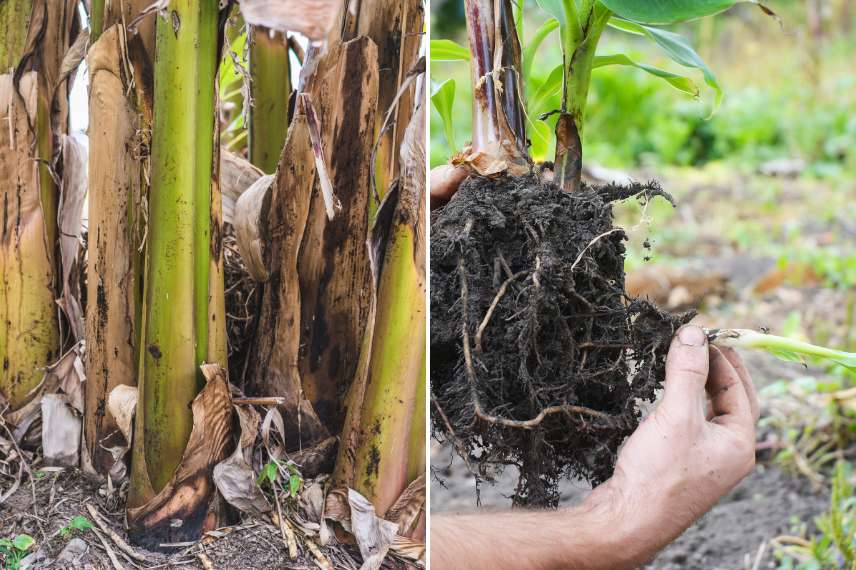
There are two ways to multiply a banana plant: sowing purchased seeds, or taking a sucker from the base of a banana plant:
- Before sowing, the seeds should be lightly scarified and soaked in lukewarm water for 24 hours. They are sown in a mix of potting compost and sand. The pot should be kept at a temperature of 25–30°C. The growing medium must remain moist. Germination can take place after two weeks, but more likely after several months if the temperature is not high enough.
- If you wish to propagate the banana plant, I invite you to consult our two articles: How to propagate banana plants? and Dividing banana plants: how to separate the suckers?
Can a banana plant tolerate the cold?
Some banana species such as Musa basjoo tolerate cold down to -10 to -12 °C. However, in regions where the banana may be at the edge of hardiness, it’s best to protect it from the cold in winter. No one is immune to a late frost that could prove fatal to the banana plant! A winter cover can prove effective, but it’s preferable to surround the pseudostem with a cone-shaped protection made from wire mesh filled with straw or dead leaves.
Banana plants grown in pots should simply be overwintered in warmth.
What is the lifespan of a banana plant?
In its natural environment, a banana plant can live for 10 to 15 years, or up to 20 years if conditions are optimal. In our climate, its longevity will be shorter, especially if grown in the ground, where its root system will expand. Indeed, it will regularly produce suckers that help ensure its ongoing longevity.
By contrast, a banana plant grown in a pot will have a shorter lifespan. To extend its life, it should be repotted regularly to provide renewed nutrients, and, above all, receive proper care.
- Subscribe!
- Contents
Comments