





























Choose autumn-biennials for a flowering garden as soon as warm days arrive
They are planted in autumn to bloom in late winter
Contents
Daisies, forget-me-nots, wallflowers, pansies, foxgloves, ranunculus, primroses… Autumn-biennials are plants that begin flowering as early as spring and can be grown in the garden as well as in pots on a balcony. Planted in autumn, they establish their roots and thicken their growth in the first year to bloom abundantly in the second year from the end of winter. Biennials are thus named because their life cycle spans two years. Ephemeral, they live longer than annuals and shorter than perennials. We also classify in this category frost-tender perennials, which are grown as biennials due to their low hardiness. The appeal of autumn-biennials? They offer a wide range of shapes and colours from which to draw inspiration to bloom generously in your garden or on your balcony as the warmer days arrive. Discover the different criteria you can use to choose autumn-biennials that match your flowering preferences.

Depending on colour
From blue to red, including pink, yellow, orange, white and purple, among the autumn biennials, you have a wide range of colours to brighten and bring your garden into bloom from spring.
Blue biennials
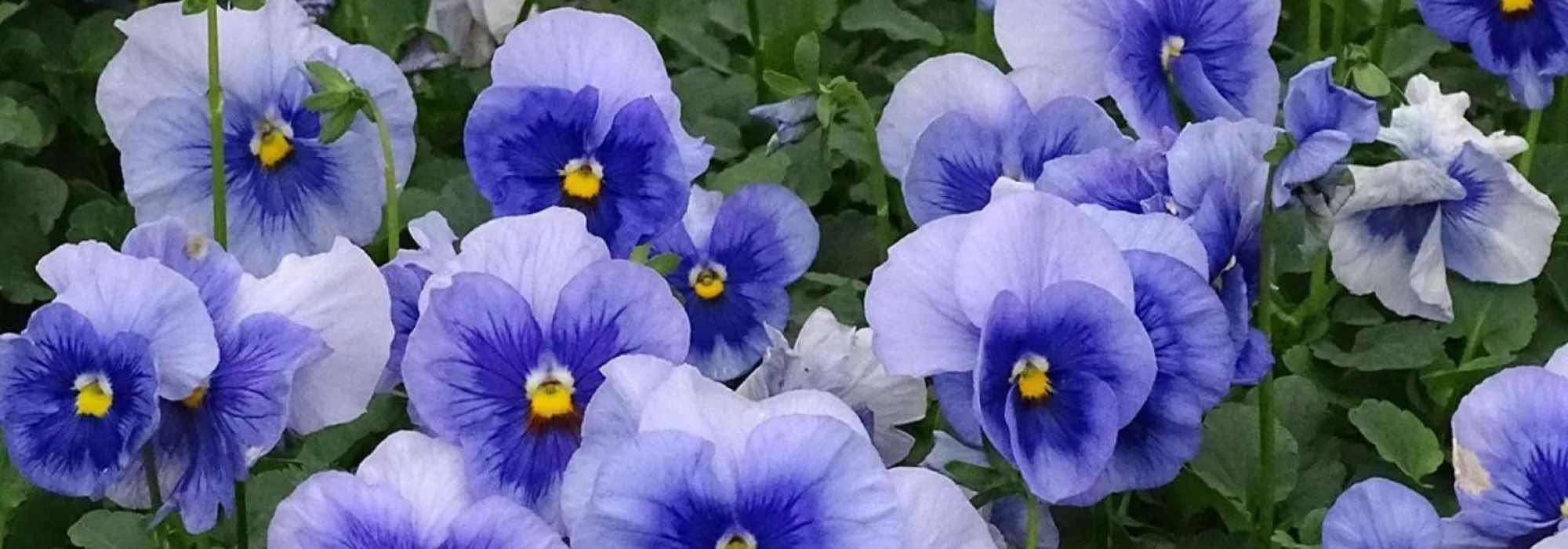
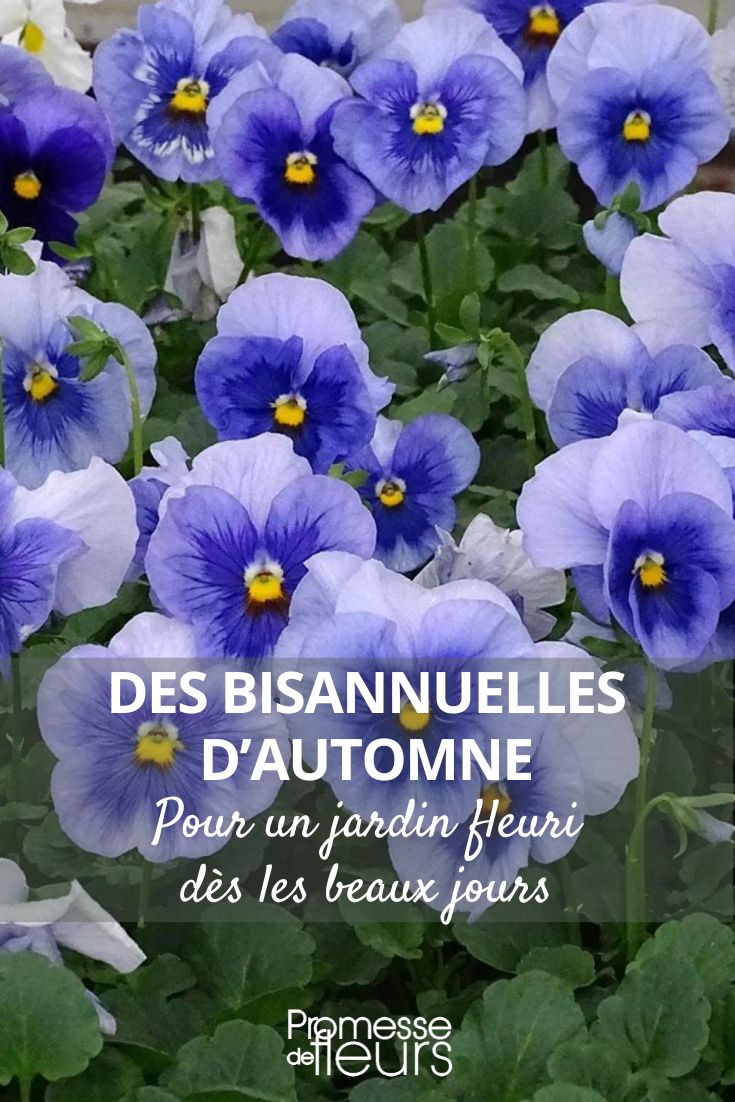
Among blue-flowered biennials, you can opt for pansies, primroses and forget-me-nots. The Pansy ‘Inspire Metallic Blue Blotch’ offers large flowers with a subtle blue gradient and blooms early and for a long time, from January to May. The Double Primula ‘Belarina Cobalt Blue’ – Primula vulgaris produces very double flowers in an intense and striking blue, which makes them glow in partial shade. This plant blooms from January to April. Also consider filling your borders or containers with the Myosotis sylvatica ‘Savoie Blue’, whose small flowers in pure blue open for long months, from January to June and October to December, and serve as a backdrop to other, more imposing flowers such as tulips or wallflowers.
Purple biennials
Wallflowers, money plant, and pansies come in violet or mauve shades. If you like these colours, you can grow for example the Money Plant – Lunaria annua, which flowers from May to July, the Perennial Wallflower – Erysimum ‘Poem Lavender’ which bears mauve-lavender flowers from February to June, or the Trailing Pansy ‘VIOLET WING’ which animates hanging baskets with yellow and purple from October to April.
Pink biennials
If you love the colour pink, opt for the fresh, spring charm of the Daisies ‘Tasso Strawberries & Cream’ – Bellis perennis which produce delicate candy-pink pom-poms from February to May. You can also choose florist’s ranunculus ‘Vortex F1 Hot Pink’ – Ranunculus hybrida, a compact and floriferous ranunculus with flowers in intense, elegant colours appearing from March to May. Another plant with attractive flowering is the Giroflée quarantaine ‘Heritage Pink’ – Matthiola incana which yields pale pink, fresh-coloured, double and very scented flowers. The flowering lasts longer, from April to September. If you want to brighten your garden in winter, plant Primroses Primroses ‘Rambo F1 Appleblossom’ – Primula acaulis which produce large pale pink flowers with a green and raspberry centre from January to February. Fans of tall plants adding verticality, the Digitalis purpurea ‘Camelot Rose’ grow up to 1.2 metres and bear magenta-pink flowers with cream throats speckled with purple-brown, from May to July.
White biennials
White-coloured biennials bring light, freshness and elegance to a border, bed or container. Think of the Campanula carillon with large double flowers – Campanula medium which carry large double, pure white bell-shaped flowers from May to August. Very floriferous and romantic, these campanulas are also nicknamed “cottage garden” and also come in violet and pink. The Maroc daisy ‘Flirt’ – Rhodanthemum hosmariense ‘Flirt’ forms cushions of daisies with fine, silvery, evergreen foliage and flowers from March to June.
Pour garnir un massif, the Cinéraire maritime ‘Silver Dust’ is perfect with its silvery-white, evergreen foliage to showcase flowers of any colour. There are also small white biennials, handy for brightening a flowering composition, such as Viola cornuta ‘Sorbet XP White’, the daisy ‘Tasso White’ – Bellis perennis or the Myosotis ‘Snowsylva’.
Yellow biennials
Yellow biennials also come in yellow to create a radiant, warm garden. In this colour range, you can choose such as the Trailing Pansy ‘Cool Wave’ (Golden Yellow), wallflowers such as Erysimum ‘Winter Light’ – Perennial Wallflower or primroses Garden Primulas Primula ‘Everlast F1’ Primula veris ‘Everlast F1’.
Orange biennials
To stay within the warm colours, bringing dynamism to a garden, orange biennials really make an impact. In this category, we can cite florist’s ranunculus ‘Vortex F1 Orange Pink’ ranunculus – Ranunculus hybrida oscillating between dark and bright orange, hybrid primroses Primroses ‘Charlie Orange F1’ – Primula hybrida with intense colour, or Erysimum ‘Winter Spice’ – Faux-giroflée in coppery-orange to brown.
Red biennials
For fans of bright red in the garden or on a balcony, several autumn biennials sport this colour, such as the Daisy ‘Tasso Rouge’, the Primrose ‘Rosebud F1 Red Shades’ – Primula acaulis which looks like a small red rose, or the florist’s ranunculus ‘Vortex F1 Red’ ranunculus – Ranunculus hybrida.
White or multicoloured biennials
Some rare biennials are black as the horned violet ‘Sorbet Black Delight’ and many others are bi-coloured or even multi-coloured, such as the double Primula ‘ Rubens Antique Rose F1’ – Primula hybrida with yellow and old-rose flowers, or the perennial wallflower – Erysimum ‘Winter Party’ with yellow to violet blooms, including yellow and pink. Pansies are, too, very often bi-coloured, such as the Pansy with Large Flowers ‘Matrix Sangria F1’ – Viola hybrida burgundy red and yellow or the Viola ‘Blue Moon’ delicately tinted with lavender blue, pale yellow and cream.
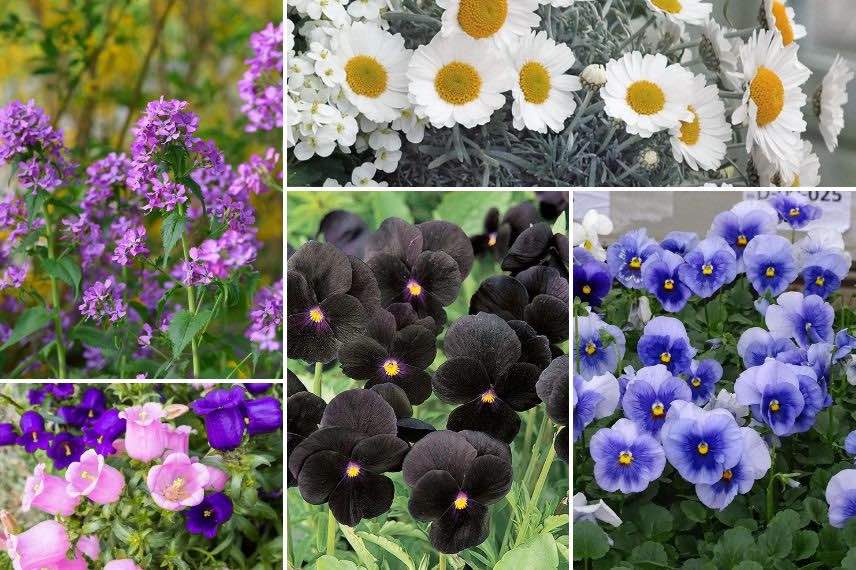
In clockwise order: money plant, Moroccan daisy ‘Flirt’, Pansy Inspire Metallic Blue Blotch, horned violet ‘Sorbet Black Delight’, Campanula carillon with large double flowers
Based on height
There are small biennials between 15 cm and 30 cm in height at ripeness, such as daisies, pansies, primroses and forget-me-nots. Some ranunculus reach up to 20 cm tall. These modest-sized flowers are perfect for filling borders, pots or the front of herbaceous borders.
For a height between 30 cm and 1 metre, think of wallflowers, foxgloves and Persian buttercups.
According to the exhibition
Among autumn biennials, you will find both plants that enjoy sun and those that prefer partial shade.
- Wallflowers grow in full sun and flower from February to June.
- Pansies thrive in full sun or partial shade and also bloom for a long period.
- Forget-me-nots also enjoy sun or partial shade, just as honesty (Lunaria annua), the Daisies and Ranunculus.
- Primroses generally thrive in sun or partial shade and their flowering runs from December through to March–April, at a time when flowers are in short supply in the garden or on the balcony. Some primroses particularly prefer shade or partial shade such as the Double Primrose ‘Rubens Antique Rose F1’ – Primula hybrida or the Double Primrose ‘Belarina Baltic Blue’ – Primula vulgaris.
- Foxgloves prefer partial shade.
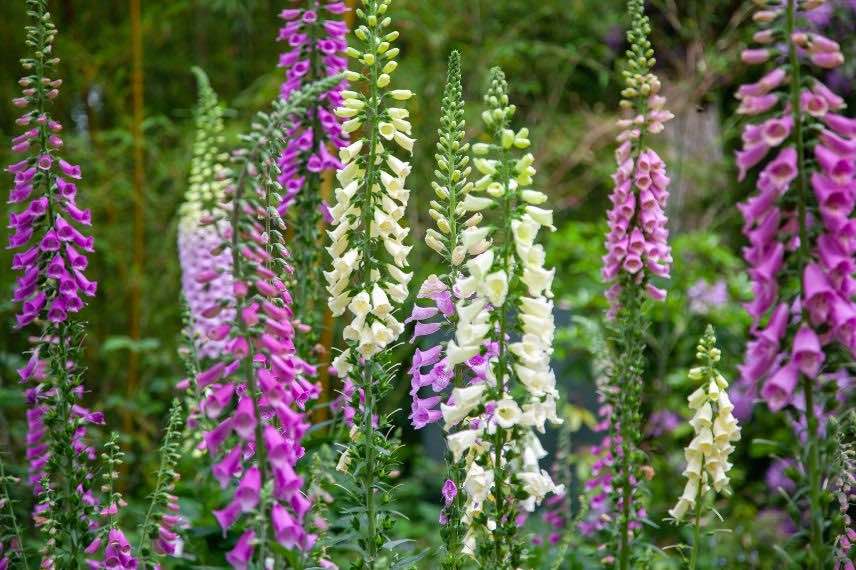
Foxgloves are biennials for partial shade
According to leaf persistence
Many biennials carry evergreen foliage that makes them decorative in every season. This is the case of the Dusty Miller ‘Silver Dust’ whose grey-silvery leaves bring light and a touch of neutrality to the border. Pansies, wallflowers, ox-eye daisies or primroses and Moroccan marguerites also carry evergreen foliage.
The money plant, ranunculus and forget-me-nots, in turn, have deciduous foliage.
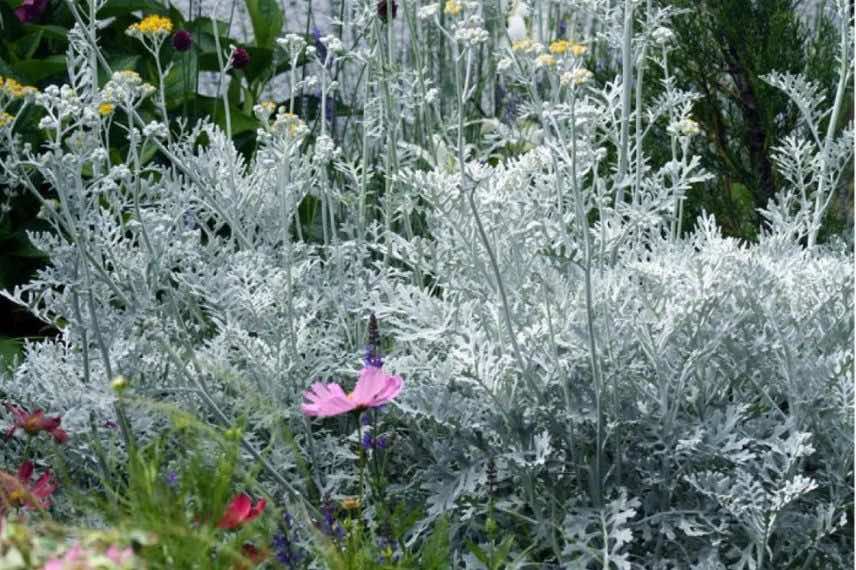
The Dusty Miller ‘Silver Dust’ offers beautiful silvery-white, evergreen foliage
According to the fragrance
If you prefer to plant scented flowers, wallflowers offer a spicy or sweet fragrance, and some primroses have a delicate fragrance such as the Double Primrose ‘Belarina Buttercup Yellow’ – Primula vulgaris.
According to hardiness
Biennials can be very hardy, just like pansies, forget-me-nots, primroses, honesty, daisies and foxgloves. Wallflowers have good hardiness, as does sea thrift. The most tender are Ranunculus and some wallflowers.
According to usage
Biennials lend themselves to a variety of uses. In a garden, autumn biennials can be planted in a border for both the small and the large ones such as Cineraria, pansies, carnations, foxgloves or the money plant. We can fill a border with the smaller ones such as daisies or pansies. Most biennials can also be grown in containers or pots to brighten a balcony or terrace.
For further reading, consult our advice sheet: Biennial plants: everything you’ve always wanted to know!.
- Subscribe!
- Contents
Comments