





























Choose these beautiful grasses all year round!
They retain their beauty in every season
Contents
The ornamental grasses in this selection stand out for their often colourful foliage, which retains its aesthetic qualities all year round. Delicate undulations of the “angel hair” of Stipa tenuifolia, to the bright, compact tufts of Arundo donax ‘Ely’, these plants are far more than mere greenery; they are the beating heart of a poetic and dynamic garden. In this article, we invite you to discover a selection of ornamental grasses which, through their evergreen beauty and ease of cultivation, will become the undisputed stars of your garden beds, ranging from the wildest to the most contemporary style.

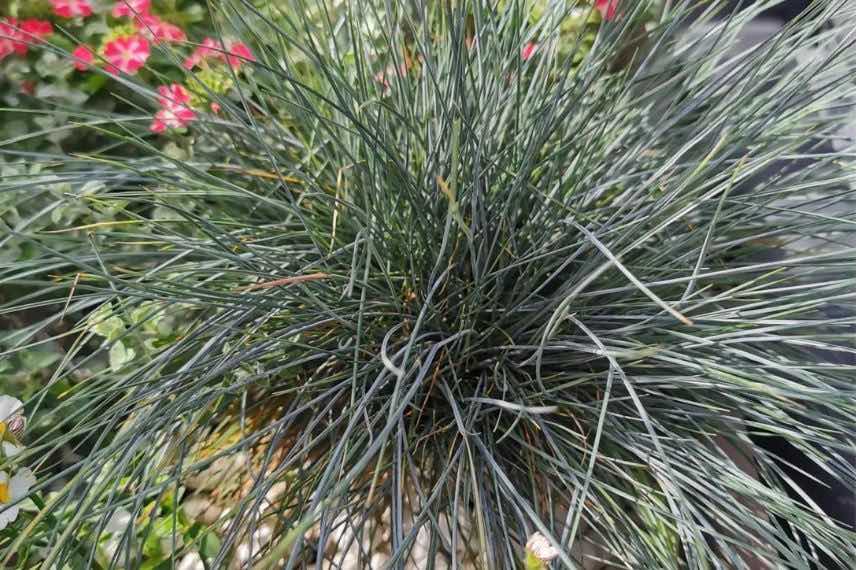
Blue Fescue Festuca glauca 'Elijah Blue'
Fescues are small evergreen grasses with foliage that stays attractive year-round. Most of the time, they are green or blue-grey in colour.
The Festuca ‘Elijah Blue’ enhances the blue fescue palette with its slender foliage and pronounced steel-blue sheen. This evergreen, perennial grass forms tufts with a slightly tousled appearance, from which arise in spring silvery, trailing spikelets, softly illuminating the plant. Its robustness and its ability to thrive in dry soils make it a favourite choice for challenging spaces, lending itself to various uses as groundcover, borders, rockeries, containers or at the front of herbaceous borders.
Originating from Central Europe and the rocky terrains of the western Mediterranean, blue fescue has naturalised in many regions thanks to its hardiness and drought tolerance. It naturally grows on arid, sandy or stony soils in full sun.
This plant forms compact hemispherical and rigid tufts, measuring 25 to 30 cm tall and wide. Its evergreen foliage, a deep bluish-grey, is covered with a fine waxy layer, giving it a metallic appearance and attesting to its adaptation to dry environments. Blue fescue ‘Elijah Blue’ lives for around five to six years in poor, well-drained soil.
‘Elijah Blue’ can be paired with undemanding groundcover plants like itself, in poor, dry soil such as blue eryngo, agastache and lavender.
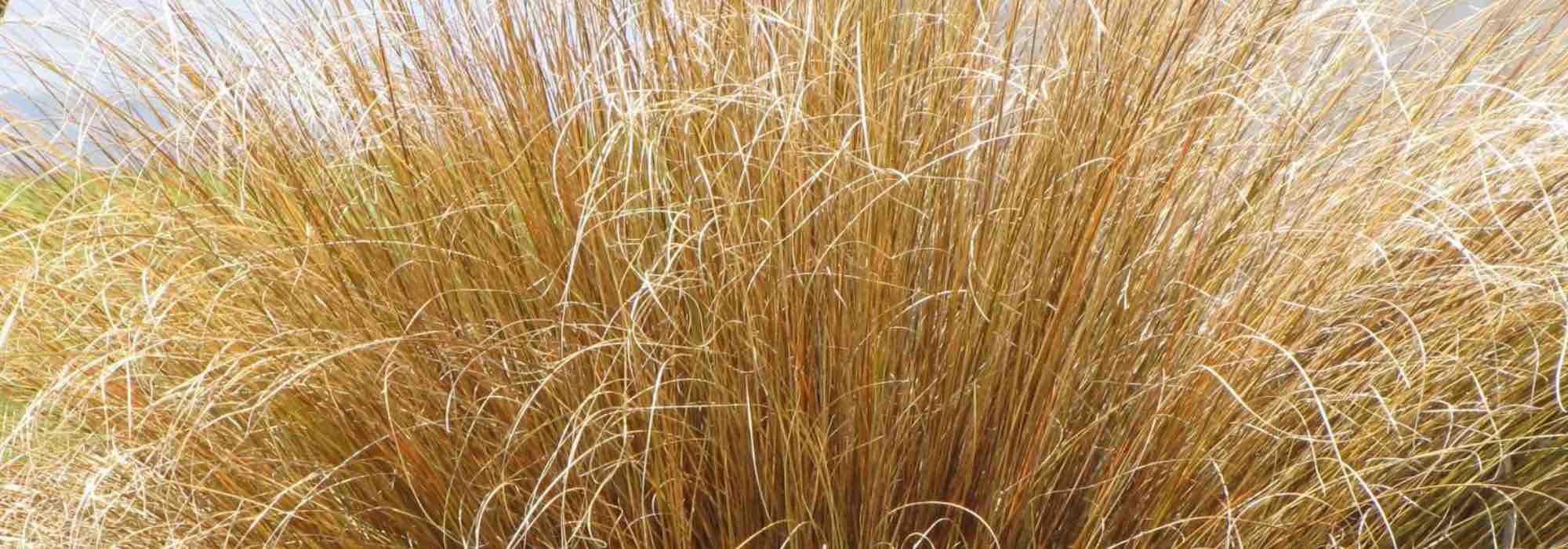
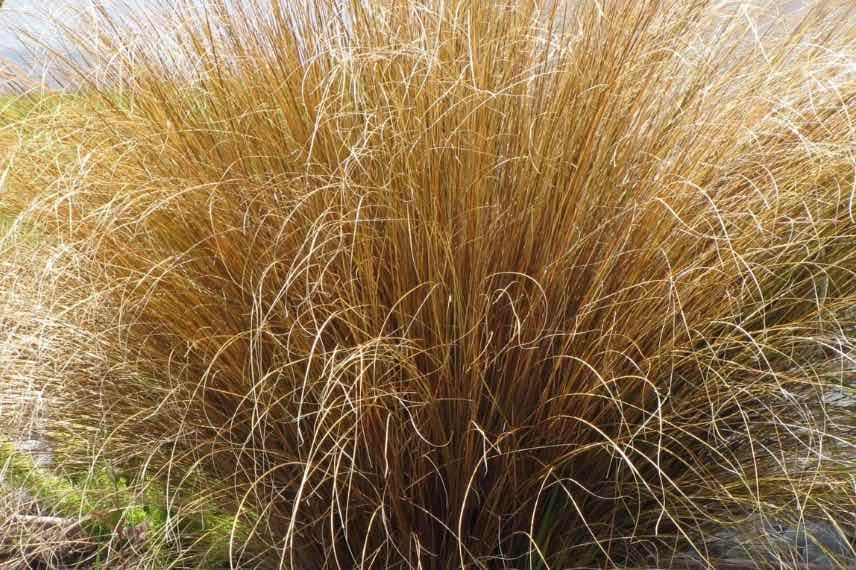
Carex buchananii
Often grouped with grasses due to their distinctly ‘gramineous’ appearance, Carex are not botanically classified among the grasses, but with papyrus.
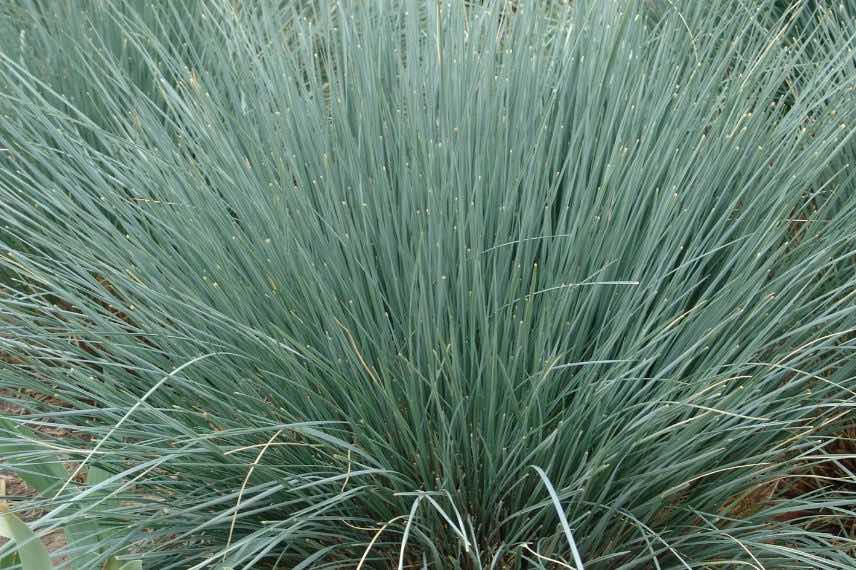
Blue oat grass Helictotrichon sempervirens
Helictotrichon sempervirens, commonly known as blue oat grass, stands out for its refined appearance. This grass forms an upright, spherical clump of long arching leaves with a silver-blue colour and metallic highlights. In summer, it bears soft, trailing panicles, pale straw-yellow, which harmonise with the blue-tinged foliage. Preferring sunny exposures and well-drained soils, it shows excellent drought tolerance and lends itself beautifully to the ornamentation of rockeries or dry gardens.
Originating from the mountains of Central Europe and the southwest, the Helictotrichon sempervirens thrives on calcareous or sandy soils. The flowering period runs from June to August, during which the plant can rise up to 1.20 m, with spikelets that evolve from bronze-green to pale straw-yellow, adorned with purple tints.
Blue oat grass has its place in gravel gardens, rockeries or sunny banks. Its highly architectural form blends harmoniously with the silver foliage of Artemisia and Stachys byzantina, as well as with the blue flowers of eryngiums or perennial flax.
Read also
5 grasses with variegated foliageCarex oshimensis 'Everillo'
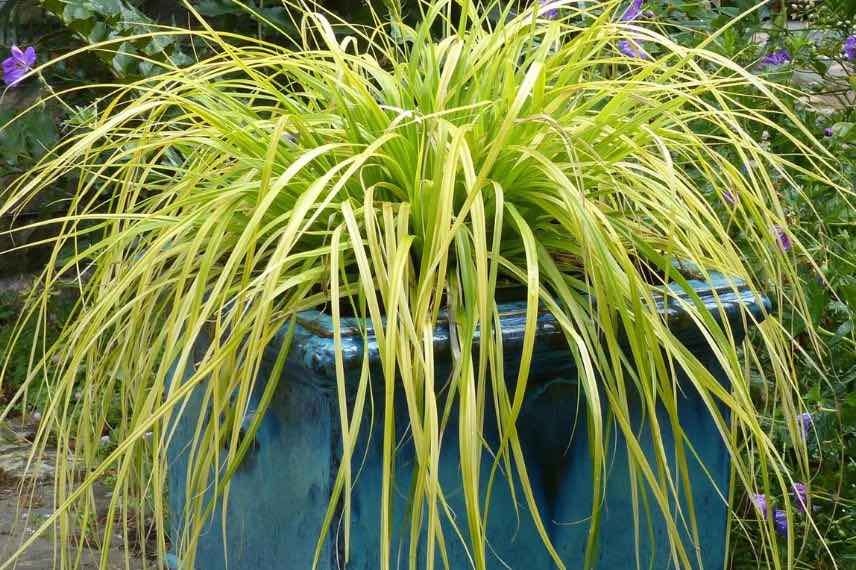
The Carex oshimensis ‘Everillo’ presents itself as an elegant, flexible clump with strap-like leaves in lemon-yellow or bright lime-yellow that catch the light. Although its autumn flowering is modest, with small brown spikes almost black, it is its bright foliage that makes it a standout addition in a border or container, in moist, well-drained soil, under partial shade to intensify its acid-yellow hue.
Oshima’s Carex forms a compact clump, with an upright to trailing habit, reaching 50 cm in height and spread. Its evergreen, grass-like leaves have slender-edged margins and trailing tips. The lime-green colour of its foliage is more pronounced in semi-shade, while it shifts to lemon-yellow in full sun.
This grass is notable for its delicate foliage and clean, uncluttered habit, forming a tuft of leaves that unfurls beautifully in a pot. It does not require the company of other plants to shine, but can bring a note of lightness beside the lush foliage of Rodgersias or ferns, and pairs well with Heucheras. Preferring moist, well-drained soils, Carex integrates perfectly into aquatic gardens, banks or along pond margins, helping to stabilise them. In borders or when planted in mass plantings for a wild look, it adapts well to contemporary gardens as well as countryside spaces.
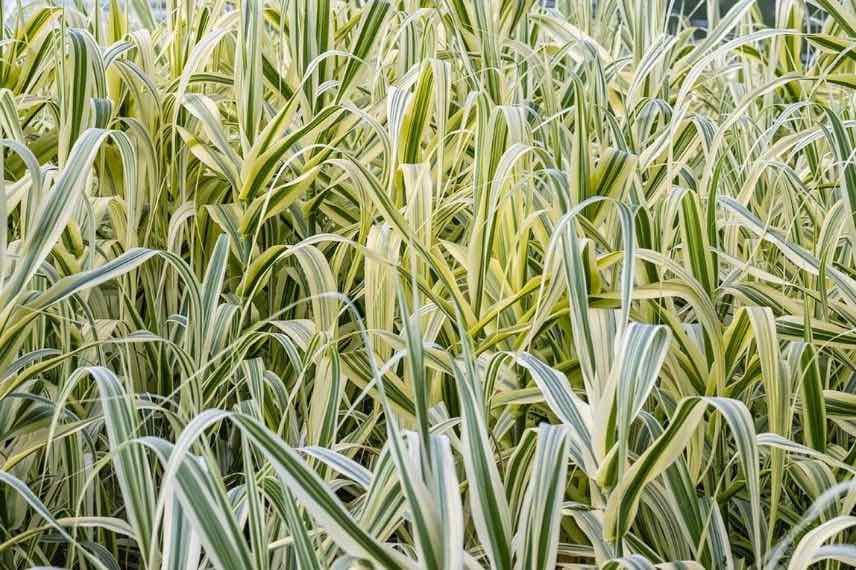
Provence cane Arundo donax 'Variegata'
Arundo donax ‘Ely’ is a compact form of Provence cane that stands out for its spectacular variegated foliage. Leaves, maize-like, are evergreen in mild climates and become deciduous elsewhere. Flowering is rare, but may produce pyramidal greenish panicles in late summer under favourable weather conditions. Perfectly suited to small gardens and contemporary terraces, Arundo donax ‘Ely’, less invasive and more ornamental than its larger counterpart, creates a unique summer backdrop at the back of a border or along a pond edge. Although it can spread and dominate with its strong personality, it pairs harmoniously with purple cannas, hardy banana plants or Colocasia for an exotic landscape.
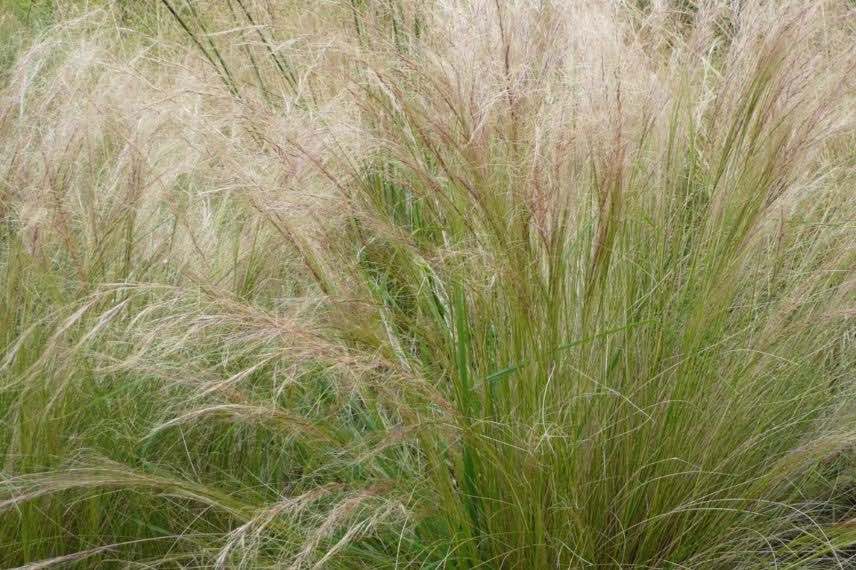
Angel hair grass Stipa tenuifolia
The Stipa tenuifolia is a grass that charms with its simplicity and natural beauty. Starting as a modest tuft of unruly hair-like strands, it grows over two seasons to form a fountain of fresh green, hair-like strands, undulating in the slightest breeze. In summer, it becomes blonde, silky tufts, creating waves in the wind and catching the sunlight in backlight. This hardy perennial, resilient to tough conditions and adaptable to poor, dry soils, blends harmoniously into a range of gardens, from wild to romantic, through to contemporary. It also self-seeds readily, often in the most unexpected places, and is easily grown in pots.
The Stipa tenuifolia is a short-lived herbaceous perennial plant. Forming a small tuft of very fine, cylindrical and linear leaves, it reaches 40–50 cm in height and width at maturity. Its evergreen foliage gives way in summer to long, soft, silky spikes, which range from pale blond to gold and then bronze in autumn.
Resistant down to -15°C in well-drained soil, the Stipa tenuifolia is ideal for dry gardens and poor soils. Its silky texture and decorative appearance make it a prized companion to floriferous and delicate perennials, such as linarias or Penstemons. Planted in mass, it makes a striking impact.
For further reading
Within the range of species cited, there are many very interesting cultivars, notably the Carex sylvatica, ‘Bunny Blue’ and the Luzulas, such as the variety ‘Solar Flare’.
- Subscribe!
- Contents
Comments