





























Choosing a Elderberry: Buying Guide
Discover our finest varieties of elderberry.
Contents
Elder bushes are interesting for more than one reason. They are known for their berries, which are used to make delicious syrups, jams, and other recipes with a floral and tangy taste. They are also increasingly appreciated for their ornamental qualities. Indeed, many varieties have emerged in recent years with stunning foliage; some are finely cut and designed for very graphic appearances, while others are golden or nearly black. They can sometimes form columnar bushes, far from the sprawling elder of the countryside. Their flowering also plays its part, delicate and fragrant, with fine white or pink umbels.
Find your favourite elder, the one you will adopt in your garden, especially since regardless of the varieties, they all retain the ease of cultivation of elder, very accommodating as long as they are given a sunny or semi-shaded exposure. It grows quickly and resembles a mature bush after 5 to 6 years. Deciduous, its leaves are valued in compost because they accelerate decomposition. It is also made into manure, useful in the garden as a repellent for several insects and small mammals. Here are some qualities of a bush that is not lacking in merits.

According to the flowering period
There are essentially two shrubby species of Elder: Sambucus racemosa, the red elder, and Sambucus nigra, the black elder. These vernacular names refer to the colour of their fruits.
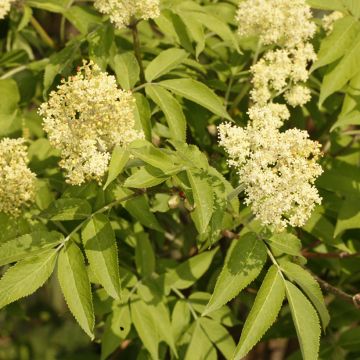
The elder flowers in spring. Red elders, Sambucus racemosa, are the first to bloom, in March and April, with elongated and ramified panicles. This is followed by the flowering of black elders, Sambucus nigra, in May and June, whose flowers are grouped in large fragrant corymbs, inclined towards the ground.
Read also
Elder: planting, growing, pruningAccording to the colour of flowers and fruits
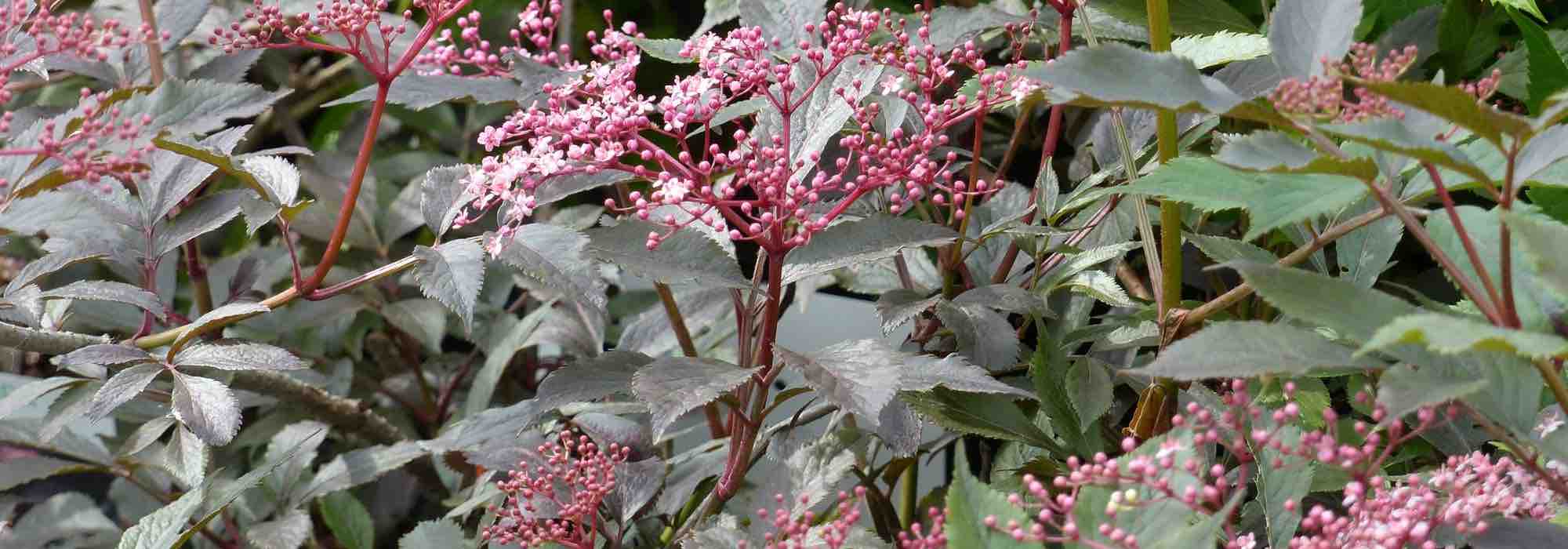
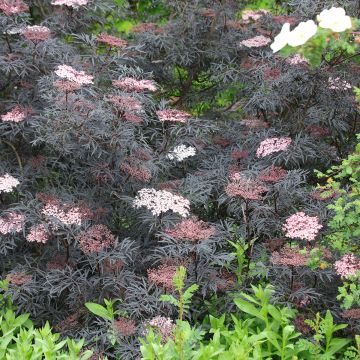
Elderberries bloom in white or pink. Many varieties develop white flowering. Some cultivars of black elderberry, often with purple-black foliage, are adorned with pink flowers that create a beautiful contrast with the very dark foliage in spring. The flowers of black elderberry are slightly fragrant, with a lemony scent. The elderberries with pink flowers include the following:
- The Sambucus nigra ‘Black Beauty’ boasts a generous display of purplish-pink flowers that later fade to white.
- The Sambucus nigra ‘Black Lace’ blooms in delicate light pink umbels that fade to cream white. They are borne on red petioles. Over the days, they lighten almost to white, creating a lovely gradient.
- The Sambucus nigra ‘Thundercloud’ carries large umbels that transition from pink to white and are very long-lasting.
- The Sambucus nigra ‘Straight Laced’ is adorned with large corymbs of pink flowers.
- The Sambucus nigra ‘Black Tower’ features umbels measuring 10 to 20 cm wide with reddish petioles. Their colour transitions from dark pink to pink and then to cream white.
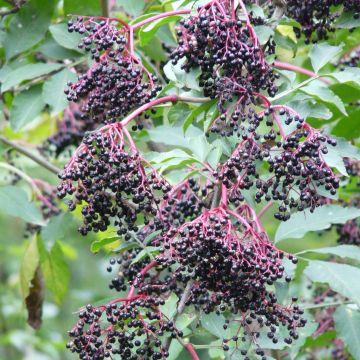
The Sambucus nigra then produces black berries, while the Sambucus racemosa yields bright coral-red berries. They appear in late summer as lovely clusters. The elderberries are sought after by birds and are edible for us, provided they are cooked. There are many recipes using black elderberries, which are the most sought after for their taste. The red elder produces more acidic berries, requiring more sugar to be pleasant when cooked; however, they contain pectin, making them suitable for jam-making. The flowers of elderberries are also edible when dried. If you choose an elderberry for fruit consumption, opt for a productive variety such as the Sambucus nigra ‘Haschberg’ or the Sambucus nigra ‘Korsor’, which produce large sweet fruits.
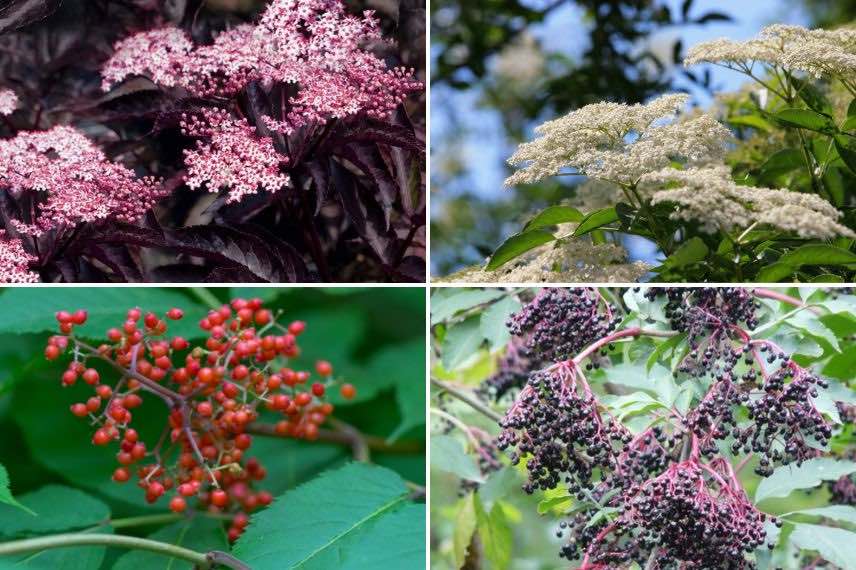
The pink flowers of Sambucus nigra ‘Black Beauty’, the white ones of Sambucus nigra. The red fruits of Sambucus racemosa and the black ones of Sambucus nigra
Discover other Sambucus - Elder tree
View all →
Available in 1 sizes
Available in 2 sizes
Available in 4 sizes
Available in 1 sizes
Available in 1 sizes
Available in 1 sizes
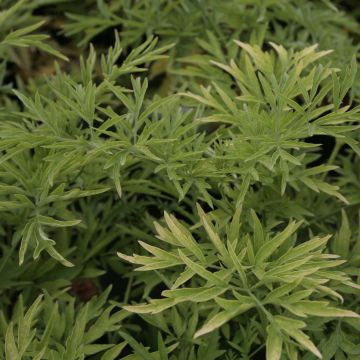
Available in 3 sizes
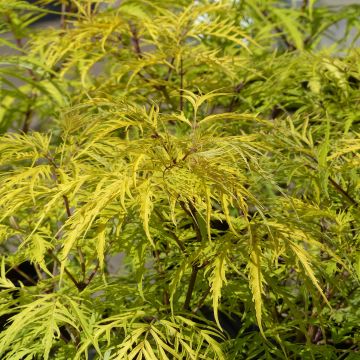
Available in 1 sizes
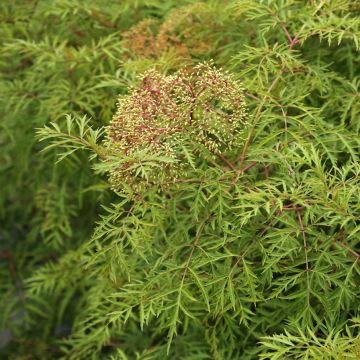
Available in 1 sizes
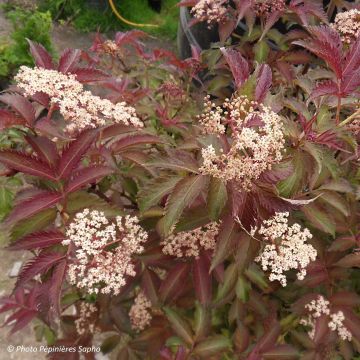
Available in 2 sizes
According to the colour and shape of the foliage
Elderberries, known for their light flowering and fruits that can be picked along country paths in untidy bushes, offer a range of varieties with highly ornamental foliage. Sometimes, they feature very fine, cut, laciniate leaves that resemble Japanese Maples and are used as substitutes when growing conditions are not suitable for planting a Japanese Maple. They also boast vibrant foliage, in shades of gold or black, or in a delightful array of colours, or beautifully variegated. Elderberry leaves are deciduous, opposite, and odd-pinnate (composed of an odd number of leaflets). They are among the first leaves to appear in spring and are sought after by all sorts of insects, particularly moths that feed on the caterpillars.
The Different Leaf Colours of Elderberries
Some varieties of black elderberries (Sambucus nigra) boast magnificent dark, glossy foliage, a very dark purple-brown, almost black. You need to get close to see their shades of purple or sometimes very dark green. From a distance, the foliage appears black. This is the case for the varieties ‘Black Beauty’, ‘Black Lace’, ‘Black Tower’, and ‘Straight Laced’, all competing in beauty with different leaf shapes.
Other black elderberries are adorned with variegated foliage, such as Sambucus nigra ‘Madonna’, ‘Golden Spark’, or ‘Pulverulenta’. The first has dark green leaves with yellow edges; the second also has a striped appearance on a more vibrant green. The third displays light green foliage splashed with pure white, like speckled.
Others, very bright, feature golden foliage. While golden-leaved varieties can be found in both species (Sambucus racemosa and S. nigra), it is certainly among the Sambucus racemosa that the most beautiful golden foliage can be found.
- The Sambucus racemosa ‘Welsh Gold’ has sumptuous foliage that is almost fluorescent, bronze-green to golden yellow.
- The leaves of the Sambucus racemosa ‘Plumosa Aurea’ are orange-red at bud burst, turning pale yellow and remaining so until early summer, then shifting to yellow-green, finishing their season in dark yellow in autumn.
- The Sambucus racemosa ‘Sutherland Gold’ has bronze foliage that then turns golden.
- The Sambucus racemosa ‘Lemony Lace’ has sumptuous bright yellow foliage to chartreuse green.
- As for Sambucus nigra, they are not to be outdone with the varieties ‘Aurea’ and ‘Golden Tower’, both with golden-green foliage.
Finally, some black elderberries have foliage that changes throughout the season: ‘Serenade’ is adorned with leaves of a brown-purple hue at emergence, then bronze to golden yellow, and finally light green in summer. ‘Thundercloud’ has initially dark green foliage that quickly turns to dark purple.
The Different Leaf Shapes of Elderberries
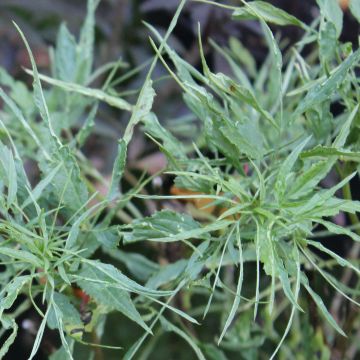
Let’s start with the famous fine, laciniate foliage, so delicate, of some red or black elderberries. The Sambucus nigra ‘Laciniata’ has very finely cut green foliage, reminiscent of parsley leaves. The Sambucus racemosa ‘Welsh Gold’, mentioned earlier for its bronze and golden colour, can boast very laciniate foliage, deeply cut, just like the Sambucus racemosa ‘Lemony Lace’ with finely incised foliage and very supple leaves.
Black elderberries or Sambucus nigra ‘Golden Tower’, ‘Black Lace’, and ‘Straight Laced’ all have laciniate foliage as well. However, it is slightly thicker or less cut than the previous ones, so they have slightly less supple or trailing foliage, a bit less airy. All these varieties with laciniate foliage can replace a Japanese Maple in a Japanese-style scene.
Next, let’s discuss original foliage, a bit thicker, dentate, and architectural, like that of Sambucus racemosa ‘Plumosa Aurea’ or Sambucus nigra ‘Serenade’. They always evoke Japanese Maples a bit, but also ferns. Between the previous ones and these, we can also mention the foliage of Sambucus racemosa ‘Sutherland Gold’, with an exotic appearance, featuring long, finely cut fronds.
Finally, let’s mention the very particular foliage of the Sambucus nigra ‘Linearis’, which is so finely cut it appears shredded. It is also very matte and a light green colour with a slight grey hue.
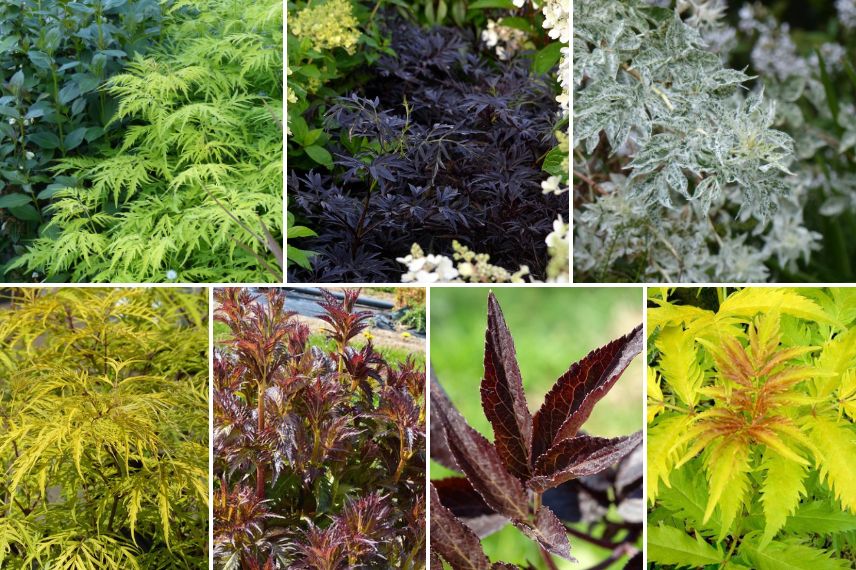
Clockwise: Sambucus racemosa ‘Lemony Lace’, Sambucus nigra ‘Black Lace’, Sambucus nigra ‘Pulverulenta’, Sambucus racemosa ‘Welsh Gold’, Sambucus nigra ‘Serenade’, Sambucus nigra ‘Black Beauty’, Sambucus racemosa ‘Plumosa Aurea’
Read also
Sambucus nigra 'Black Tower'According to its silhouette
Common elderberries have a bushy, irregular habit and are as wide as they are tall. Depending on the varieties, they measure between 1.5 m and 4 m in height and width.
One exception: the fastigiate elderberries, narrow and very vertical, such as the Sambucus nigra ‘Black Tower’ and ‘Golden Tower’. They are remarkably narrow compared to the natural tendency of elderberries to spread. The former reaches 4 m in height with a span of 2 m, while the latter grows to 3 m in height and 1 m in width.
Let’s also mention the blur of the laciniate and soft foliage, the airy, feathery silhouette, and the undefined habit of certain elderberries. For example, those of the Sambucus racemosa ‘Plumosa Aurea’ and the Sambucus racemosa ‘Lemony Lace’.
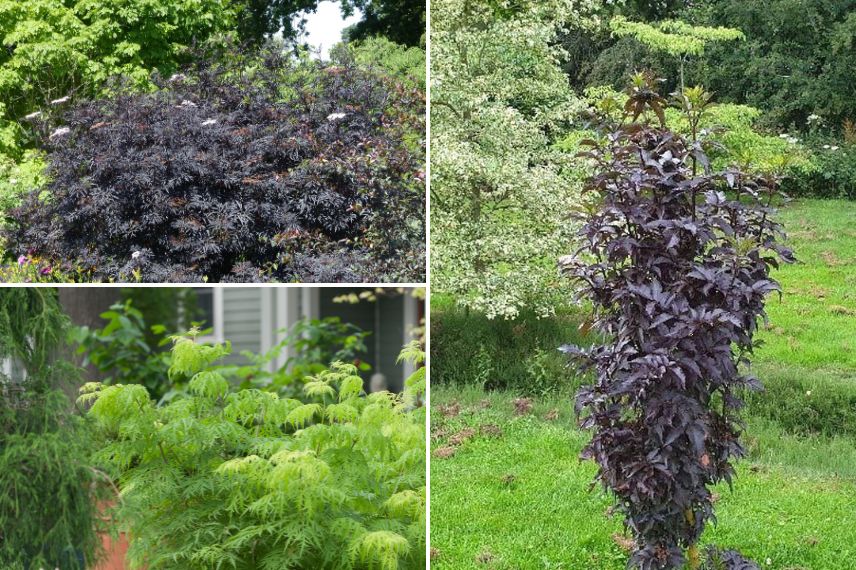
The bushy habit of Sambucus nigra ‘Black Lace’, the fastigiate habit of Sambucus nigra ‘Black Tower’, and the airy silhouette of Sambucus racemosa ‘Lemony Lace’
Depending on the use
- In a wild hedge: this is obviously the primary use of elder. Its size and rapid growth encourage us to use it this way. We enjoy its lovely flowering and fruits, and appreciate its resilient character.
- On the contrary, in a more formal setting, a fastigiate form is perfect: it doesn’t spill over and maintains its narrow dimensions. One might choose a variety such as Sambucus nigra ‘Black Tower’ or ‘Golden Tower’.
- Fastigiate forms are also ideal when space is limited, in a small garden or at the back of a border.
- In a contemporary garden, the Sambucus nigra ‘Black Tower’ impresses with its almost black foliage and verticality. It allows for very contrasting and graphic combinations.
- For a touch of sophistication, opt for a black-foliaged elder such as Sambucus nigra ‘Straight Laced’ or a speckled foliage variety like Sambucus nigra ‘Pulverulenta’.
- For an exotic atmosphere, choose laciniate foliage like that of Sambucus nigra ‘Black Lace’.
- For a Japanese-inspired scene, select a laciniate and coloured elder: golden or black.
- For purely ornamental use, contrasting foliage, play with assembling plants that express themselves through their foliage, such as a golden elder and physocarpus, berberis, heucheras, and carex, to name just a few.
- For the love of it, to make elderflower syrup, with its delicate and floral taste, choose the most productive varieties such as Sambucus nigra ‘Haschberg’ and Sambucus nigra ‘Korsor’.
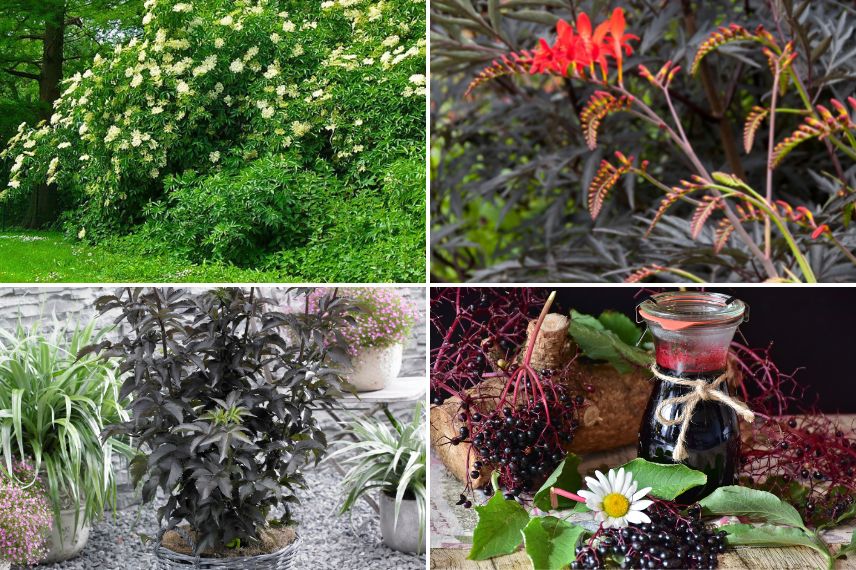
An elder in a border, a purely ornamental use with the contrast of a Sambucus nigra ‘Black Lace’ and a red Crocosmia, the pleasure of elderflower syrup, and a Sambucus nigra ‘Black Tower’ in a pot
- Subscribe!
- Contents
Comments