


Choosing a serviceberry
Discover the many advantages of this charming bush.
Contents
L‘Amelanchier is a bush with numerous ornamental and culinary qualities, and it is also quite agreeable regarding its growing conditions. It produces a beautiful display of white star-like flowers early in spring, before its lovely deciduous foliage takes over and then bursts into a blaze of warm, vibrant colours in autumn. In summer, it generously offers delicious fruits in small berries that are quickly devoured by humans or birds and can be used in various culinary ways. Very hardy, it can be grown almost anywhere, being low-maintenance and accommodating. Its elegant, light, compact habit makes it a friend to both small and large gardens, as well as pots on terraces.
Discover or rediscover this bush, its species and varieties, and the good reasons why you should plant it in your garden, including: its habit and size, its early flowering, its tasty fruits, its colourful autumn foliage, and its desire to simplify your life.

For a small garden
Serviceberry is a great choice for a small garden, especially if you can only plant one tree, given its many advantages throughout the seasons. Its growth is quite slow, and its compact, elegant habit means it doesn’t take up too much space where room is limited. Most species and varieties reach 3 to 6 m in height and 2 to 3 m in width at ripeness. Except for the Lamarck serviceberry, which can continue to grow to eventually measure up to 10 m in height and 12 m in spread.
There are also fastigiate varieties of serviceberry, which develop a very narrow silhouette, making them useful in small spaces. Consider, for example, the Amelanchier alnifolia ‘Smoky’, the smallest, which reaches 2.75 m in height and 2.25 m in width. The Amelanchier canadensis ‘Rainbow Pillar’ grows to 4 m tall and 1.5 m wide, like the Amelanchier alnifolia ‘Obelisk’, which can even reach 5 m but also does not exceed 1.5 m in spread.
The smaller serviceberries or fastigiate serviceberries can also be grown in pots, allowing you to enjoy them on a terrace or balcony.

Fastigiate serviceberries: ‘Obelisk’ and ‘Rainbow Pillar’
Read also
Amelanchier: planting, pruning, growingFor a hedge
The fastigiate varieties mentioned in the previous paragraph make excellent subjects for hedges, whether free-standing, rustic, or fruit-bearing, just like the Amelanchier spicata. In a fruit hedge, plant them, for example, with small red fruit bushes such as currants, blackcurrants, raspberries, but also with black elder, Sambucus nigra. In a rustic hedge, combine them with Japanese quinces, ornamental apples, hawthorns, Prunus, Mock Oranges, Exochorda, or with evergreen bushes like Osmanthus.
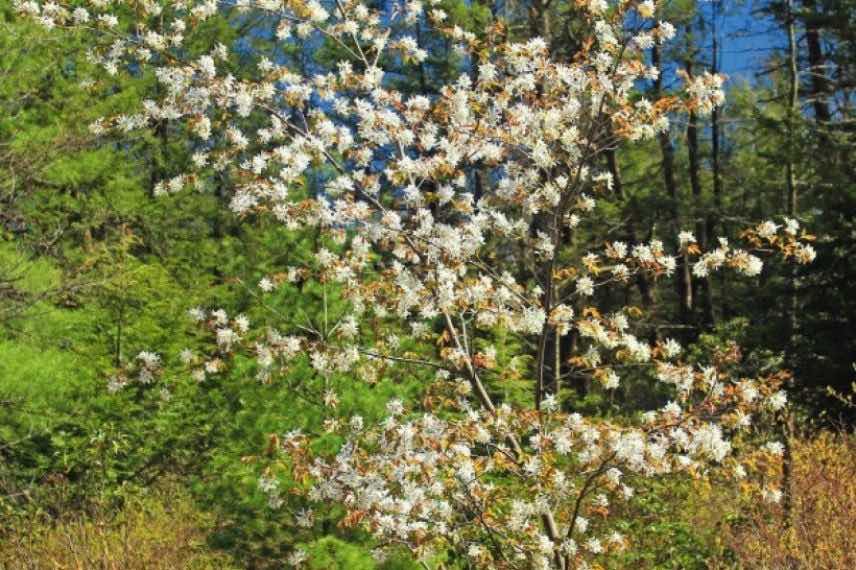
The Amelanchier spicata makes a good hedge subject
Discover other Saskatoon - Juneberry
View all →
Available in 5 sizes
Available in 2 sizes
Available in 1 sizes
Available in 2 sizes
Available in 1 sizes
Available in 1 sizes
Available in 1 sizes
Available in 1 sizes
Available in 1 sizes
Available in 1 sizes
For its early flowering
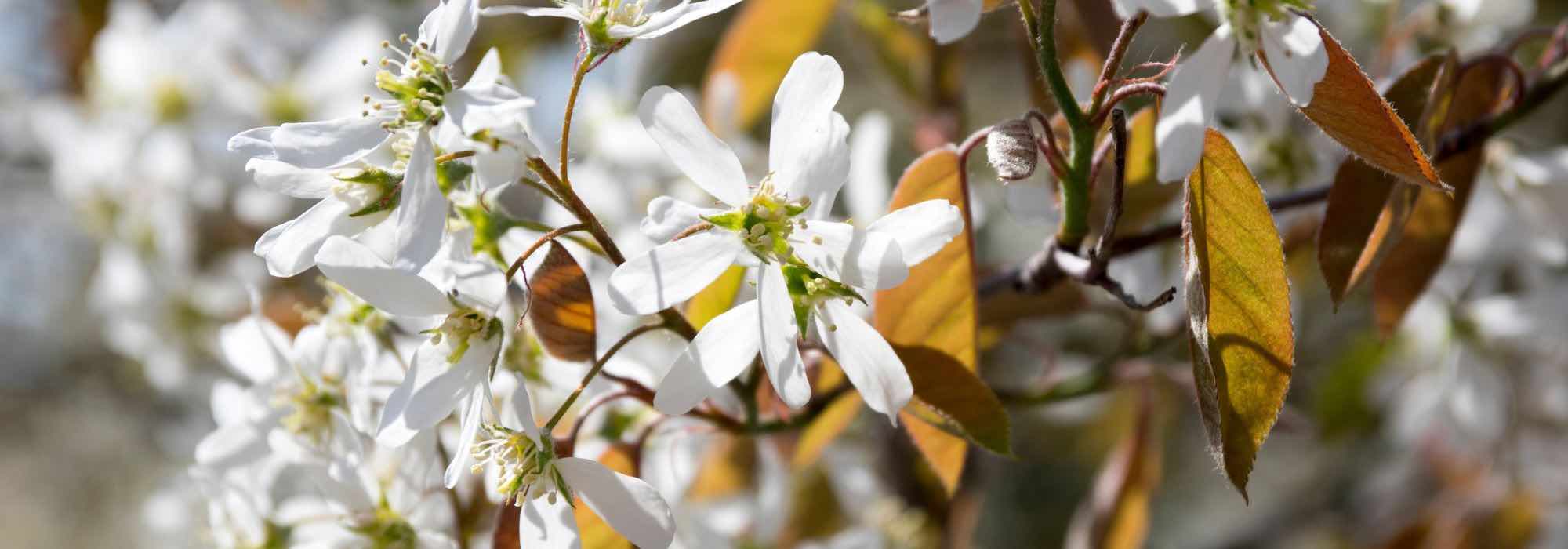
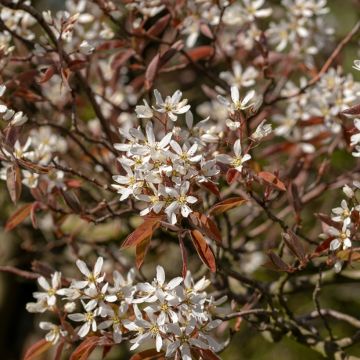
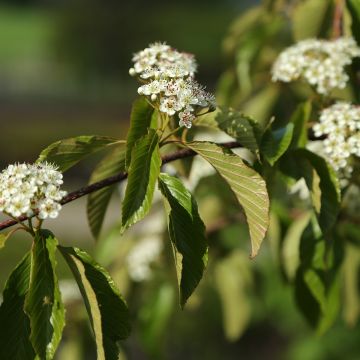
Among the first bushes to bloom in spring, the Amelanchier produces a generous and vibrant flowering on naked branches, just before the first leaves emerge. In small clusters of delicate white stars, it blooms as early as April and does not last long. The pure white flowers, with 5 petals and yellow stamens measuring 2 cm in diameter, are gathered in abundant pendulous clusters 3 to 15 cm long on more or less arching branches. They are melliferous, and some varieties exude a light vanilla fragrance. Its flowering branches, cut when the flower buds are just beginning to open, make lovely long-lasting bouquets in a vase. The Amelanchier spicata is a species that develops its flowering a bit differently, covering itself with white flowers in upright spikes. The Amelanchier grandiflora offers the largest flowers, which are sometimes tinged with pink in bud.
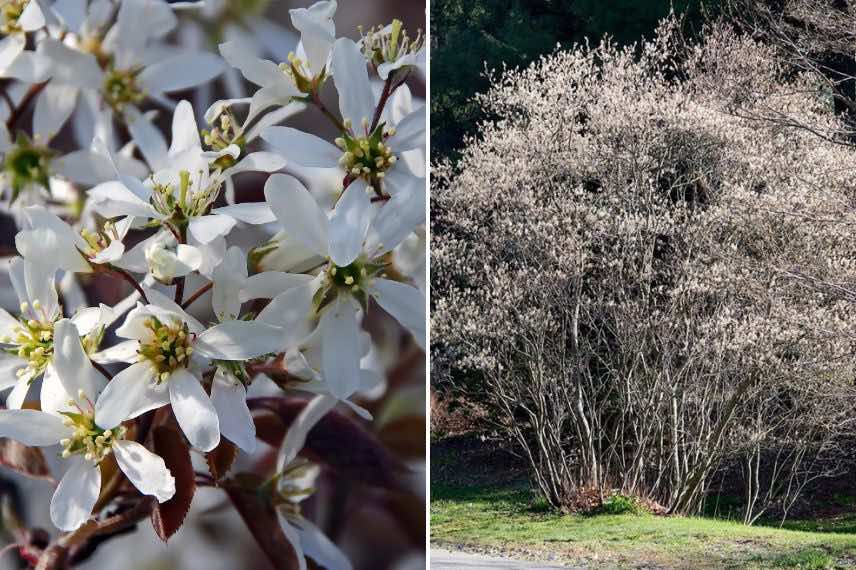
The pure white flowers of the Amelanchier
For the quality of its fruits
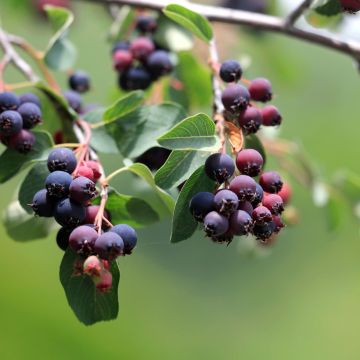
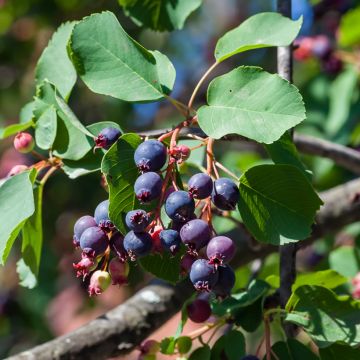
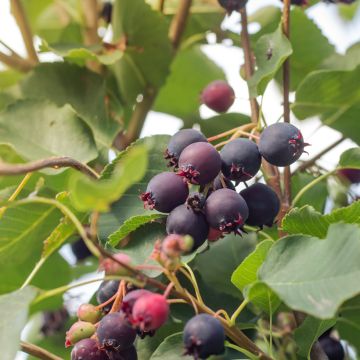
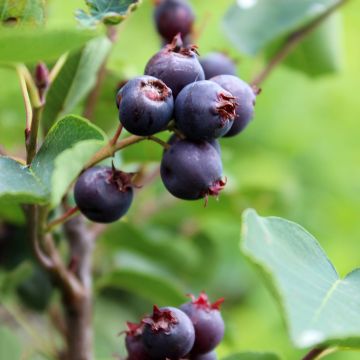
At the beginning of summer, the fruits of the serviceberry take centre stage. Consumed in Canada and Eastern Europe, serviceberries are relatively unknown here, but they deserve more recognition! Indeed, these lovely little round fruits, about the size of a large pea (approximately 1 cm in diameter, sometimes more), are sweet and, depending on the variety, reminiscent of raspberry or grape. The Canadian serviceberry and the Amelanchier lamarckii, are described as finely tangy, somewhere between apple, blueberry, and cherry. The fruits of the productive large-fruited varieties, derived from the species Amelanchier alnifolia, are characterised by different flavours. ‘Thiessen’, for example, offers fruits with a finely tangy taste, while the fruits of ‘Smoky’ are sweeter.
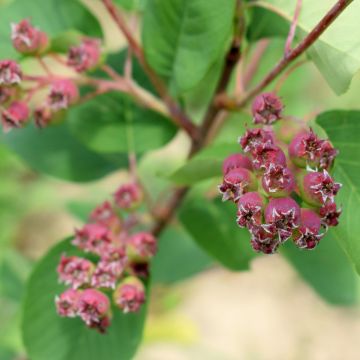
These small, sweet, fleshy berries, initially red, then dark purple or bluish-black when ripe, contain a lighter juicy flesh filled with small seeds. They are harvested in summer, when they are fully black and before they fall, generally from July to August, over a span of about twenty days. The serviceberry is a tree that is a favourite among birds; these berries are a delight for them, so do not delay in harvesting once ripeness is confirmed to enjoy them before sharing.
They can be eaten raw or cooked, in jam or pie, or even as compote or sauce to accompany meats, much like cranberries. They can also be enjoyed dried and can be frozen. They are highly nutritious, rich in vitamins A and C, antioxidants, beta-carotene, as well as minerals: manganese, magnesium, iron, and also calcium and potassium.
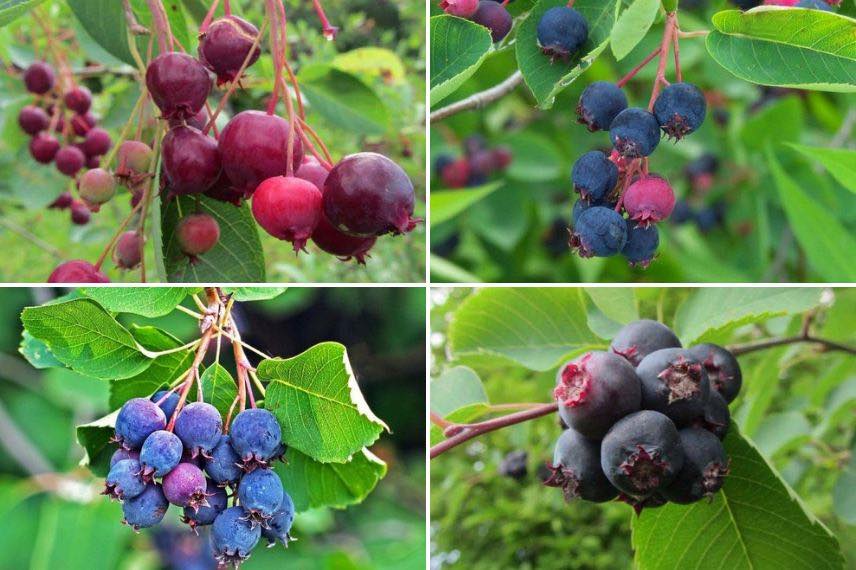
The fruits of the serviceberry: Amelanchier laevis ‘Ballerina’, Amelanchier lamarckii, ‘Amelanchier alnifolia Smoky’ and ‘Saskatoon Berry’
For its beautiful autumn foliage
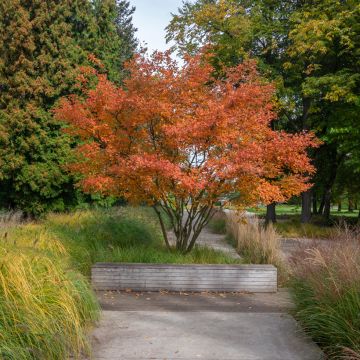
The deciduous foliage of Amelanchier is another of its assets. The leaves are ovate, elliptical to elongated, finely dentate, and measure between 2 and 8 cm long, sometimes covered with a fluffy white down on the underside in spring in certain species. This magnificent foliage from spring to autumn is initially bronze-pink at the emergence of the first leaves, before turning green-yellow or medium green. In autumn, as the first frosts arrive, the leaves take on shades of cinnamon orange, copper red, or deep purple.
For example, in Amelanchier canadensis ‘October Flame’, the autumn foliage is a vibrant light orange-red. The Amelanchier alnifolia ‘Obelisk’ dons a golden yellow hue in autumn.
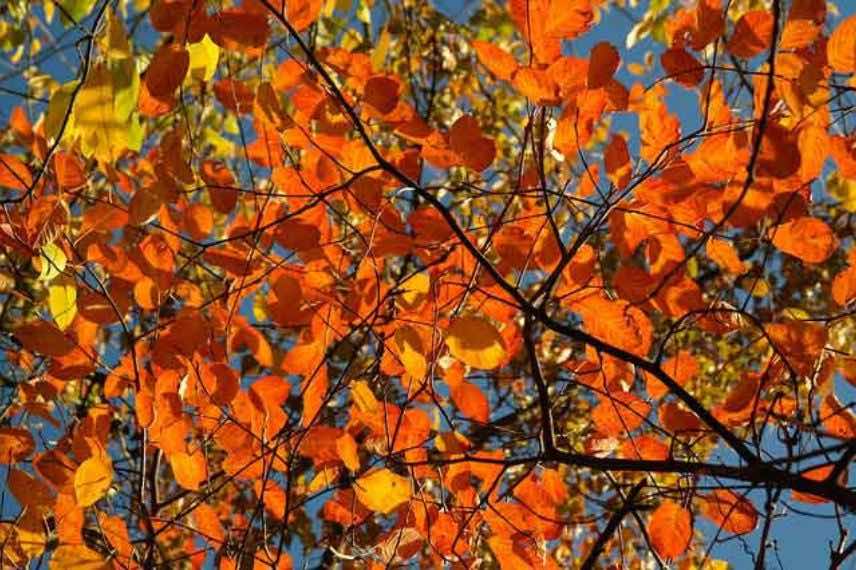
The beautiful autumn colours of Amelanchier
For its ease of cultivation
Very hardy, the Amelanchier thrives in good garden soil that is fresh and well-drained. It enjoys non-burning sunlight. Its hardiness allows it to be planted in all regions of France; however, it should be avoided in Mediterranean climates, which can be too hot and dry in summer. It prefers acidic pH soils but can adapt to neutral or slightly chalky soil, or a good amendment at planting may suffice. The Lamarck Amelanchier accepts chalky and stony soils.
- Subscribe!
- Contents
Comments