





























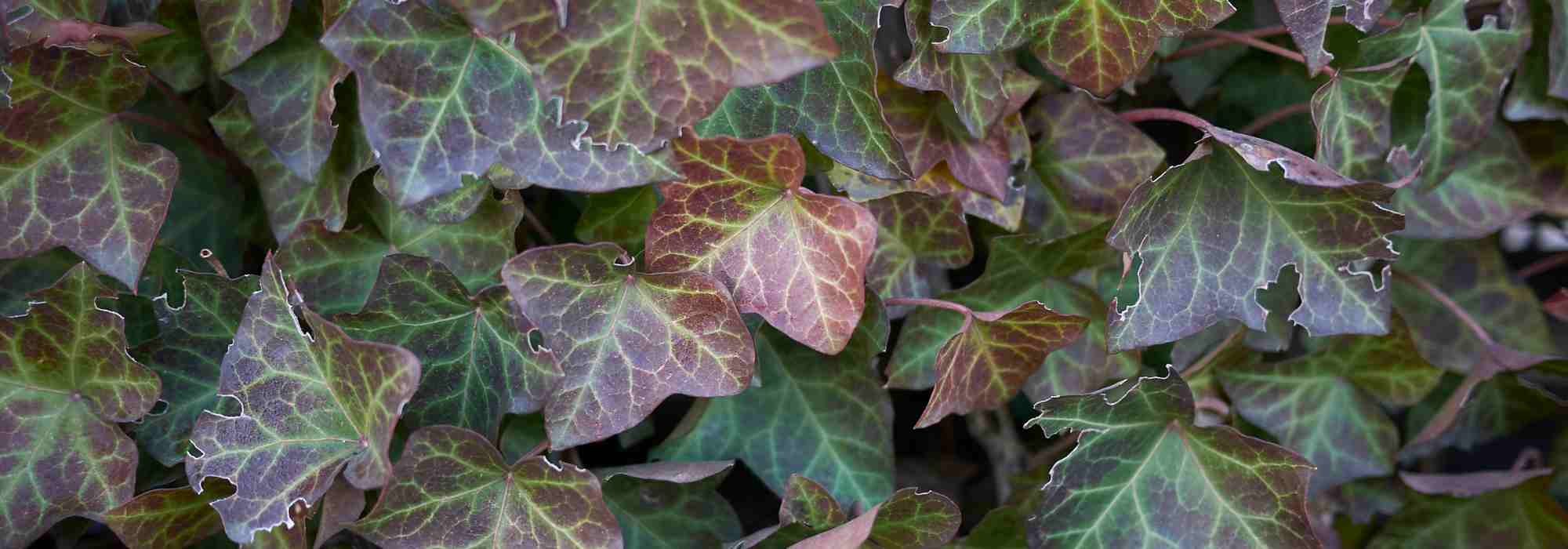
Choosing an ivy
Our buying guide based on the many varieties and uses of ivy
Contents
There is not just one ivy… but many ivies, and when it comes time to choose one for the garden or home, it can be quite challenging to navigate.
Indeed, one might want to plant an ivy! While it has a bad reputation and is subject to many misconceptions, it remains a robust evergreen plant, tolerating all exposures, interesting in its atypical forms, to adorn terraces and pots, or in its climbing or creeping quality to green walls or difficult shady areas. Its melliferous autumn fruiting is another of its assets. When managed properly, as it can become invasive, ivy brings undeniable charm to spaces.
Which ivy should you choose for your garden, facade, or interior? We offer some advice based on their specific characteristics: colours, shapes, and size of the foliage, as well as the different uses one can make of them.
→ See also 5 misconceptions about ivy discussed by Olivier on the Blog and 5 good reasons to plant ivies by Virginie
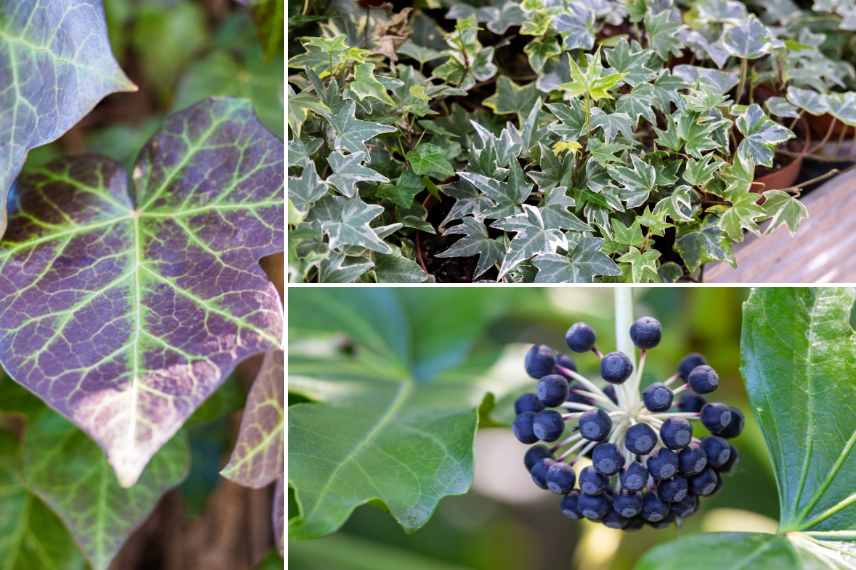
Ivy and its attractions: colour of the foliage, more or less lobed shape, and beautiful, useful fruits in winter!

According to the colour of the foliage
Ivy, or Hedera helix, its Latin name, comprises around fifteen species. Most people have a rather dull image of common ivy, or only envision the one that is a solid green colour. In fact, it comes in various species (Hedera helix, Hedera colchica, Hedera canariensis being the most well-known) and numerous cultivars, including variegated ones, some marbled, and occasionally purplish.
- variegated types: they look beautiful in partial shade: ‘Glacier’ with small grey-green leaves variegated with white, Hedera canariensis ‘Gloire de Marengo’, very popular, Hedera helix ‘Marginata Elegantissima’, with a wide cream margin, Hedera helix ‘Benny Allen’, Hedera helix ‘Kolibri’ variegated with cream
- maculate types: Hedera helix ‘Oro di Bogliasco’ (syn. Hedera helix ‘Goldheart’ spotted yellow in the centre of dark green leaves, ‘Golden Heart’ or Hedera colchica ‘Sulphur Heart’, light green speckled with pale yellow,
- dark green types: Hedera hibernica or Irish ivy, Hedera colchica or Persian ivy, Hedera colchica ‘Arborescens’
- light green types: we love their brightness, as seen in Hedera helix ‘Shamrock’ or Hedera helix ‘Green Ripple’
- yellow types: Hedera helix ‘Jake’, Hedera helix ‘Buttercup’ with young shoots of golden yellow that slowly turn green if not in sunlight,
- marbled or veined types: Hedera helix ‘Helvetica’ subtly marked with white along the veins,
- evolving types: some redden in cold, dry weather, revealing their veins: ‘Atropurpurea’ and ‘Rouge Hivernal’ whose leaves turn purple in winter, Hedera colchica ‘My Heart’ blood red in winter, Hedera helix ‘Smaryll’, Hedera helix ‘Shirayukihime’ with young shoots that are white speckled with green
- colourful types: ‘Tricolor’
- shiny types: Hedera helix ‘Ivalace’, Hedera helix ‘Green Ripple’
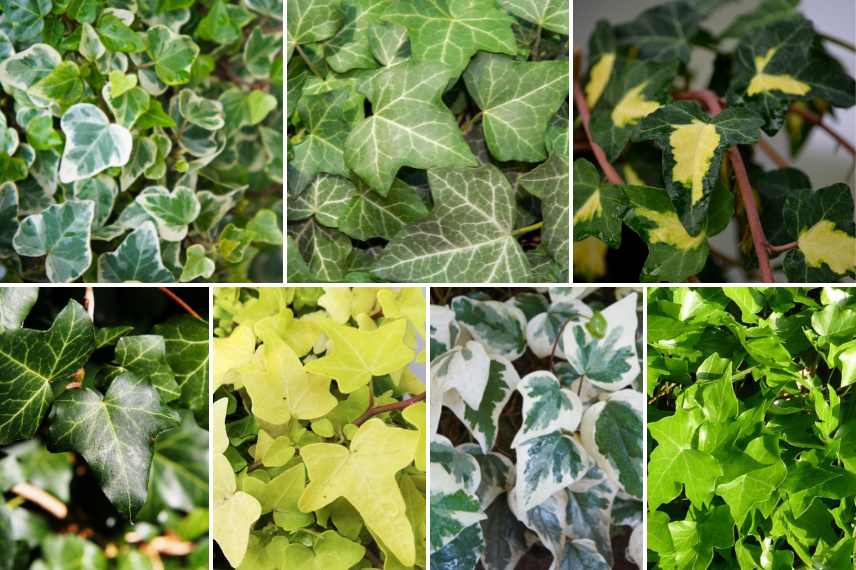
From top left to bottom right: ‘Glacier’, Hedera colchica, ‘Sulphur Heart’, Hedera hibernica, ‘Jake’, ‘Gloire de Marengo’ and ‘Green Ripple’
According to the size of the foliage
Ivy is also surprisingly diverse in the shape and size of its leaves, which can vary in size, with very deeply lobed, more or less lobed and undulate edges. Small-leaved ivies are prized for pot displays, visible from the house, whether indoors or as elegant climbers, while large-leaved ivies are preferred for the garden, as groundcover or on walls.
Most ivies have foliage that is about 4 to 6 cm long and wide. There are also:
- Small-leaved ivies: Hedera helix ‘Discolor’, Hedera helix ‘Goldheart’, Hedera helix ‘Eva’, ‘Kolibri’ and ‘Shamrock’: the leaves measure 2 to 5 cm
- Large-leaved ivies: Hedera canariensis ‘Gloire de Marengo’, Hedera colchica ‘Dentata Variegata’ (lamina 15 to 20 cm marbled with grey-green), Hedera colchica ‘Sulphur Heart’ (lamina up to 16 cm), Hedera colchica ‘Dentata variegata’ with large, slightly soft leaves edged in gold (lamina up to 15 cm).
Discover other Hedera - Ivy
View all →
Available in 1 sizes
Available in 3 sizes
Available in 2 sizes
Available in 1 sizes
Available in 2 sizes
Available in 1 sizes
Available in 1 sizes
Available in 2 sizes
Available in 1 sizes
Available in 1 sizes
According to the shape of the foliage
The genus Hedera features distinct foliage forms, with lobes that are more or less deep, often oval and triangular on adult leaves, but sometimes completely cordate (heart-shaped) or very elongated:
- Round-leaved ivies: Hedera hibernica ‘Deltoidea’, Hedera helix ‘Perkeo’, Hedera colchica ‘My Heart’ cordate
- Curl-leaved ivies: Hedera helix ‘Ivalace’, Hedera helix ‘Melanie’, Hedera helix ‘Parsley Crested’ (syn. Cristata) or Hedera helix ‘Mario’
- Triangular-leaved ivies: Hedera canariensis ‘Gloire de Marengo’, Hedera helix ‘Chester’…
- Sagittate-leaved ivies: these are very beautiful and atypical, with their narrow foliage and a central lobe that is elongated in a leading shoot shape. Among them is the elegant Hedera helix ‘Sagittifolia’, light green, and its variegated version, Hedera helix ‘Sagittifolia Variegata’, cream green, and the Hedera helix ‘Needlepoint’ cut in goosefoot
- Willow-leaved ivies: Hedera helix ‘Gavotte’, with broad lanceolate willow-like leaves, Hedera helix ‘Brokamp’ with entire green leaves that are 1 cm wide and long.
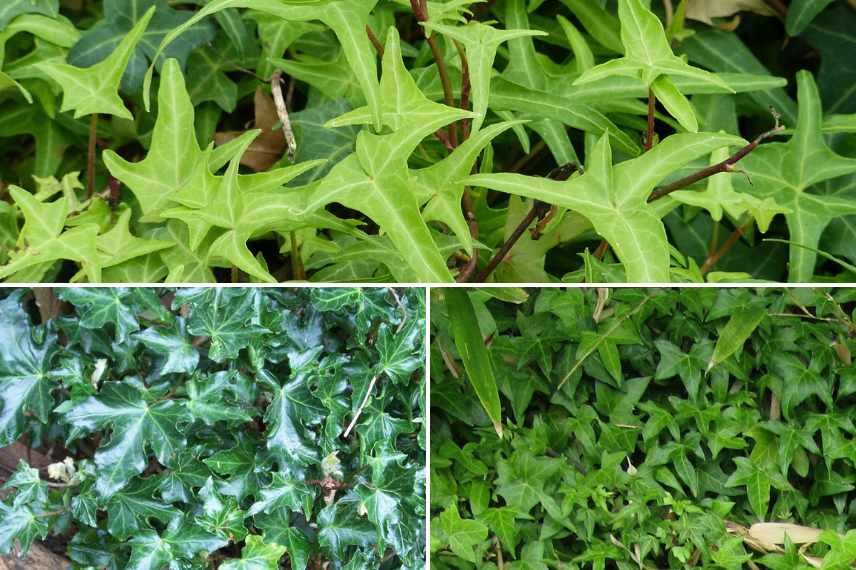
Hedera helix ‘Sagittifolia’, Hedera helix ‘Ivalace’ and Hedera helix ‘Needlepoint’
According to its dimensions and habit
Many ivies are large climbing plants that can easily reach 4 to 5 m high. Some ivies stand out from others due to their smaller size, reduced growth, and upright forms. However, it remains difficult to specify a height for ivy, as it greatly depends on its support.
- Dwarf ivies (30 cm to 1 m)
Some ivies have a naturally modest habit, perfect for window boxes, pots, or small gardens, and even for creating bonsai like Hedera helix ‘Little Diamond’ with its grey-green foliage marbled with pure white (35 cm) or Hedera helix ‘Kolibri’ (60 cm). Hedera helix ‘Shamrock’ features a central lobe that is often curved, while Hedera helix ‘Ivalace’ is vigorous yet compact, climbing up to 1.50 m.
- Medium-growing ivies (1 to 5 m)
Many ivies have medium dimensions, such as Hedera helix ‘Shamrock’ (1 to 2 m), Hedera helix ‘Ivalace’ climbing up to 1.50 m, Hedera helix ‘Goldchild’ (1 to 1.50 m), Hedera helix ‘Buttercup’ (2 m), and the larger Hedera helix ‘Glacier’ (3 to 5 m) or Hedera helix ‘Goldheart’ (3 to 4 m) and Hedera helix ‘Sagittifolia’ (3 to 4 m).
- Large-growing ivies (7-10 m)
We find very vigorous ivies: the common ivy, Hedera helix, which climbs up to 10 m high with a similar spread, the Irish ivy or Hedera hibernica also growing between 7 and 10 m, and Hedera hibernica ‘Hamilton’, with its lovely light green foliage.
- Upright or bushy ivies
A variety of ivy has an upright habit, superb in pots for slightly sophisticated, contemporary, or urban settings. This is Hedera helix ‘Erecta’ (syn Hedera helix ‘Conglomerata’) which tolerates drought and shade well. It forms a bush 60 cm to 1.20 m high with a spread of about 80 cm. This bushy, non-climbing variety features small undulating leaves borne on rigid stems.
A similar ivy is interesting for its candelabra-like upright habit: Hedera helix ‘Congesta’. It is smaller (50 cm) and also very graphic.
There is another bushy ivy variety: Hedera helix ‘Arborescens’ or tree ivy, and its compact version Hedera helix ‘Arbori Compact’ growing to 1 m in height: they form small bushes, spreading with age. Their leaves are unlobed, making them perfect for urban gardens in shade.
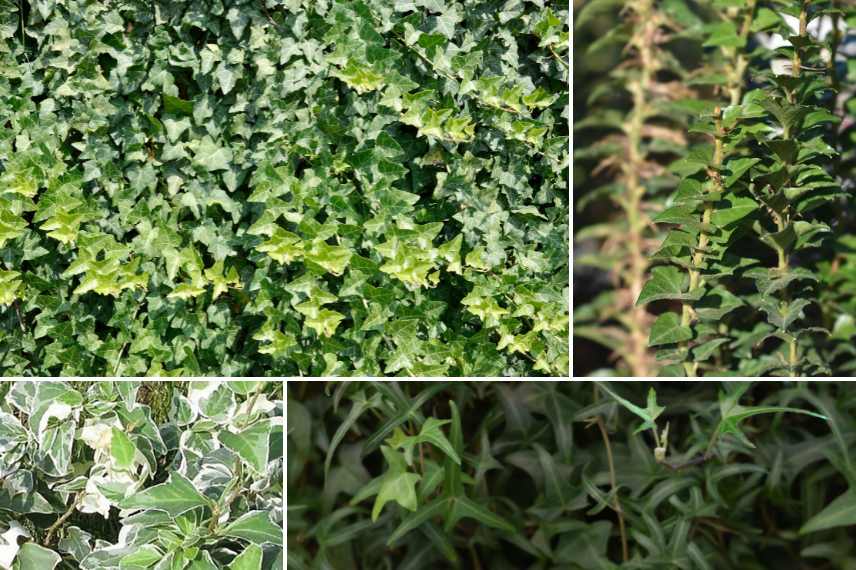
Hedera helix, Hedera helix ‘Erecta’, Hedera helix ‘Little Diamond’ and Hedera helix ‘Sagittifolia’
According to the exposure
Most varieties prefer a shaded position (shade and partial shade). Ivy can tolerate sunlight, but the foliage may suffer or even scorch in some varieties. Be cautious with variegated varieties that may turn greener in the shade, such as the highly ornamental Hedera helix ‘Goldchild’.
Ivy that can tolerate sunlight and enjoys warmth: Hedera colchica ‘Dentata variegata’ prefers sunny, warm exposures, while Hedera canariensis or Canary ivy should be placed in full sun.
According to usage
Polyvalent, ivy has many different uses in the garden or on a terrace:
-
As a climber: to adorn a wall
Hedera comes from the Latin “adhaereo”, meaning “I adhere”. This immediately highlights its strong covering potential. To dress a wall or a large fence, ivy, vigorous in nature, works wonders.
Contrary to popular belief, ivy does not damage raw and healthy walls (its climbing roots attach to rough surfaces), but it is not recommended for walls in poor condition, cracked, painted, or those with traditional joints (lime-sand-earth) or renders that it can damage. It is particularly an interesting alternative for north-facing walls, as it protects them from sudden temperature fluctuations, acting as an insulator.
Like Virginia creeper, it is one of the perfect plants to conceal unsightly concrete walls, but it also adds a lot of character to old stone walls and looks very attractive on brick walls, where it contrasts beautifully. Its covering aspect can also be used to give a touch of green patina to a brand-new garden shed, for example. All sufficiently expansive ivies are suitable for walls or low walls, such as common ivy.
N.B.: Be careful never to let ivy cover roofs or invade gutters and downpipes!
♥ Our favourite ivies as climbers: Hedera helix ‘Glacier’ (Hedera helix), Hedera helix ‘Sagittifolia’, Hedera helix ‘Luzii’, Hedera helix ‘Eva’…
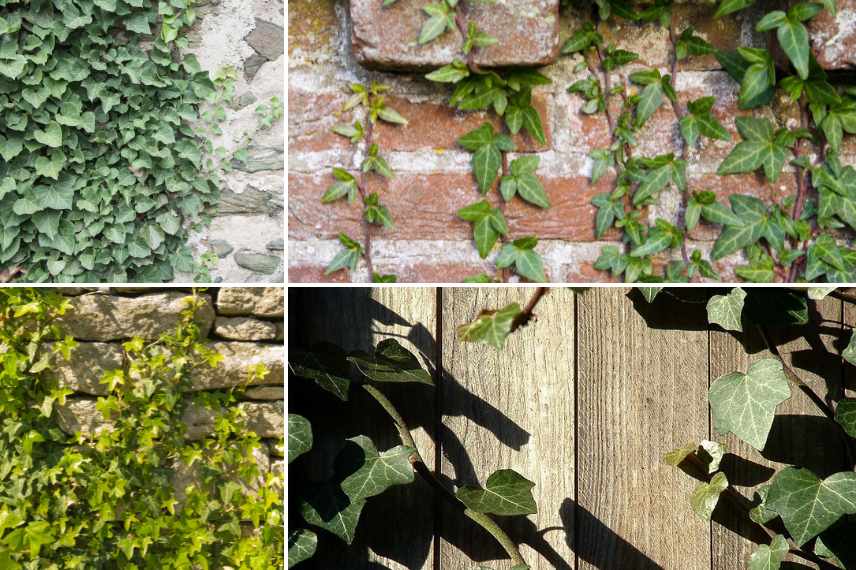
Ivy adds a lot of charm to walls and low walls… as long as it is kept in check
-
As groundcover
Depending on its environment, if it does not find a support to climb, ivy becomes creeping. This is one of its great qualities: it can colonise and carpet poor soils, ungrateful corners, or slopes that are not easily accessible, forming a permanent plant cover, saving maintenance for the gardener. It grows quickly, allowing it to cover large areas in record time.
♥ Here are some of the most vigorous ivies, the best performers as groundcover: Hedera helix ‘Glacier’, superb in shaded areas, Hedera helix ‘Green Ripple’, Hedera hibernica or Irish ivy, Hedera algeriensis ‘Bellecour’ with its beautiful light green foliage, Hedera colchica ‘Dentata’ and its variegated variety Hedera colchica ‘Dentata Variegata’, Hedera helix ‘Cavendishii’, Hedera helix ‘Eva’…
→ Read also The Bellecour ivy: the terror of weeds
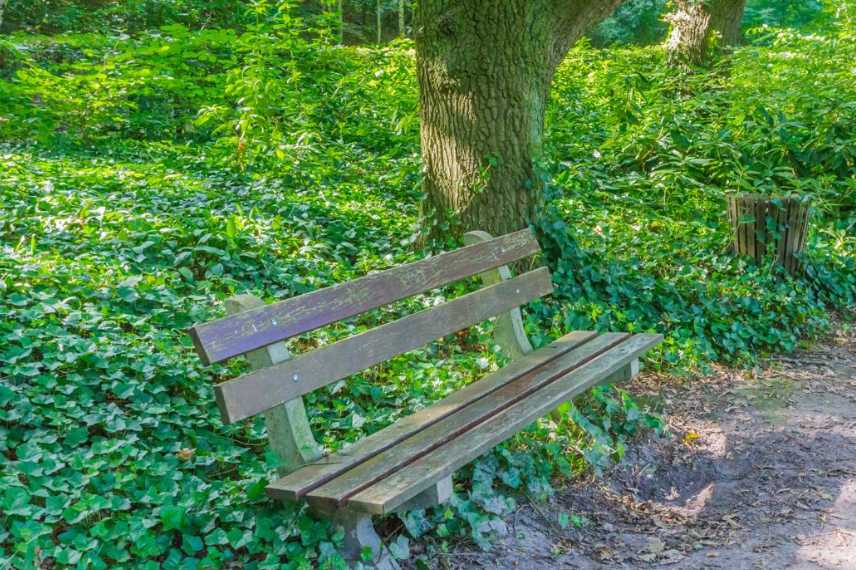 In hard-to-reach undergrowth areas, ivy acts as a perfect groundcover[/caption>
-
-
As a border
-
Ivy forms lovely original borders, replacing boxwood in classic settings, for example. In this context, it is important to prune it well to maintain clean edges and a neat appearance. For this use, medium-growing ivies (1 to 3 m) with medium-sized leaves are the most suitable.
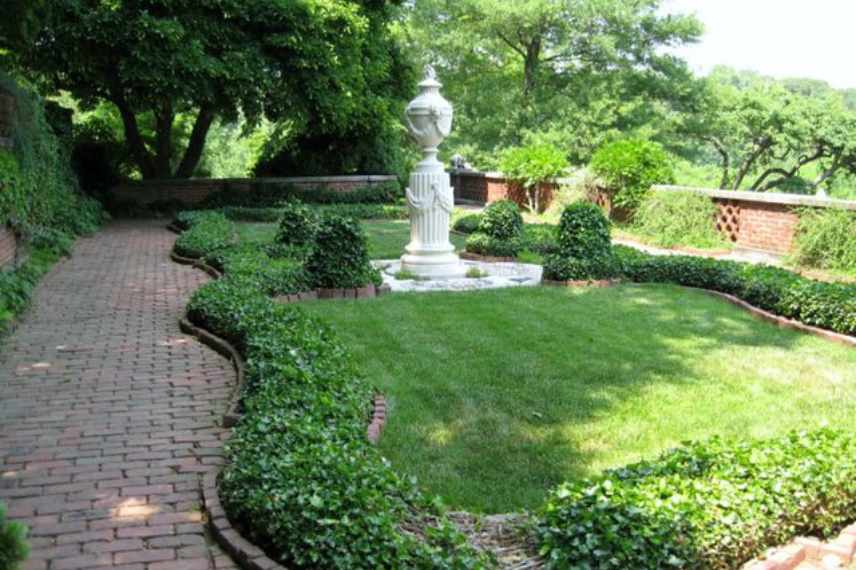
A lovely ivy border in a classic garden (© apium)
-
In pots on the terrace or balcony
Ivy is beautifully showcased when planted in pots. It thrives in urban and contemporary terraces with upright varieties, as well as in English garden and romantic settings, where it is often trained into arches or on a trellis. It is best placed in beautiful natural containers (terracotta, wicker…) or even in fibre cement.
You can either let it take its place alone in a trough or planter, or combine it with some perennials or annuals. Hanging arrangements particularly highlight its lush cascade.
♥ Our favourite ivies for pot cultivation: Hedera helix ‘Kolibri’ with cream variegation for small pots and planters, Hedera helix ‘Ivalace’ with lovely crisped leaves, Hedera helix ‘Erecta’, superb in contemporary terraces, Hedera helix ‘Glacier’ with marbled grey-green silver leaves, Hedera helix ‘Shamrock’ in pots and containers.
→ See also How to grow ivy in a pot? and Ivy in pots: 5 pairing ideas
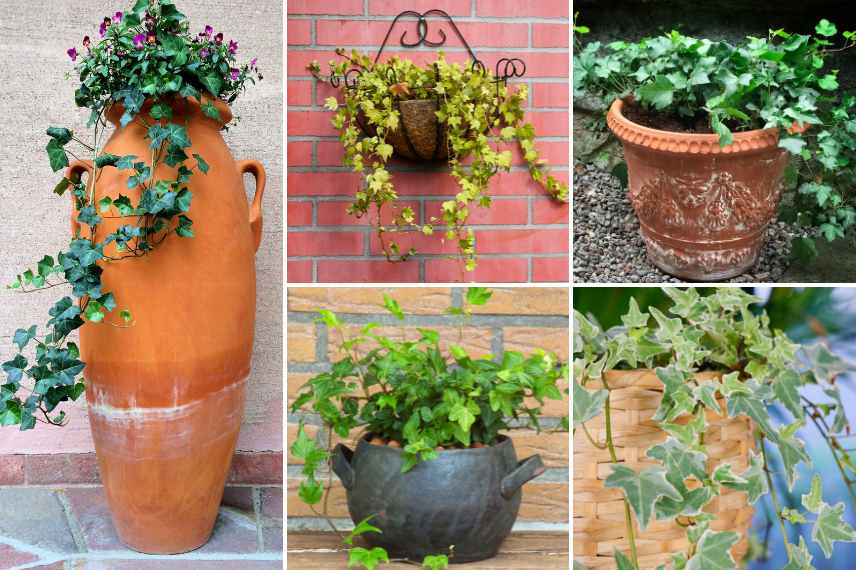 Beautiful in a tall container where it can cascade, but also in hanging arrangements or pots made from beautiful materials[/caption>
-
-
In the form of topiary or arch
-
Ivy is also well-suited for topiary formation. To create beautiful specimens, a rough template made of wire (chicken wire works perfectly) held by a few stakes, can be shaped into any desired form (pyramid, cylinder, cone, ball…). Straight shapes like truncated pyramids are easier to achieve. Once the ivy is planted in the ground or in a large pot, it is covered with its open structure, and all that remains is to wait for the ivy to completely cover it. Pruning is done in spring to maintain a neat shape.
Ivy is also stunning trained over an arch, an entrance portico, or on a pillar in romantic-style gardens.
♥ Our favourite ivies: low-growing ivies like Hedera helix ‘Marginata Elegantissima’ growing between 2 and 3 m or Hedera colchica ‘Sulphur Heart’
[caption id="attachment_185128" align="aligncenter" width="856"]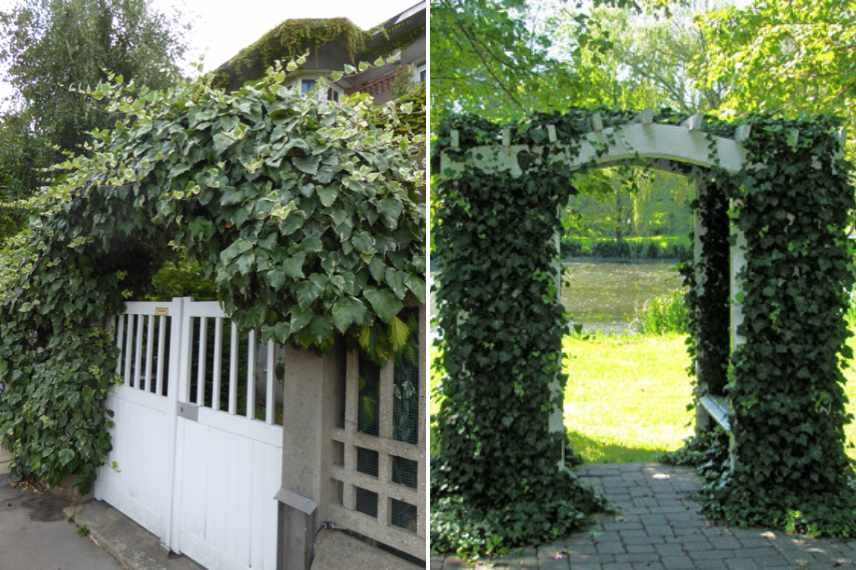 Perfect as a porch (© Gwenaëlle David), ivy gives a romantic air to pergolas or porticos (© Arielle Kristina)
-
Indoors
All ivies make good houseplants, especially as they filter certain pollutants (benzene, formaldehyde, toluene, xylene…). Although they adapt to the warmth of our interiors, they thrive better in cool rooms or unheated conservatories. They warm up minimalist or Scandinavian interiors, and spaces with neutral and muted tones. Indoor ivies should not be exposed to direct sunlight and will need good brightness. They require regular watering, but always allow the substrate to dry out between waterings.
♥ Our favourite ivies for indoors: small-growing ivies with very ornamental small leaves like Hedera helix ‘Eva’, grey-green edged with cream, Hedera helix ‘Goldchild’ edged in yellow growing up to 1.5 m,
[caption id="attachment_184795" align="aligncenter" width="856"]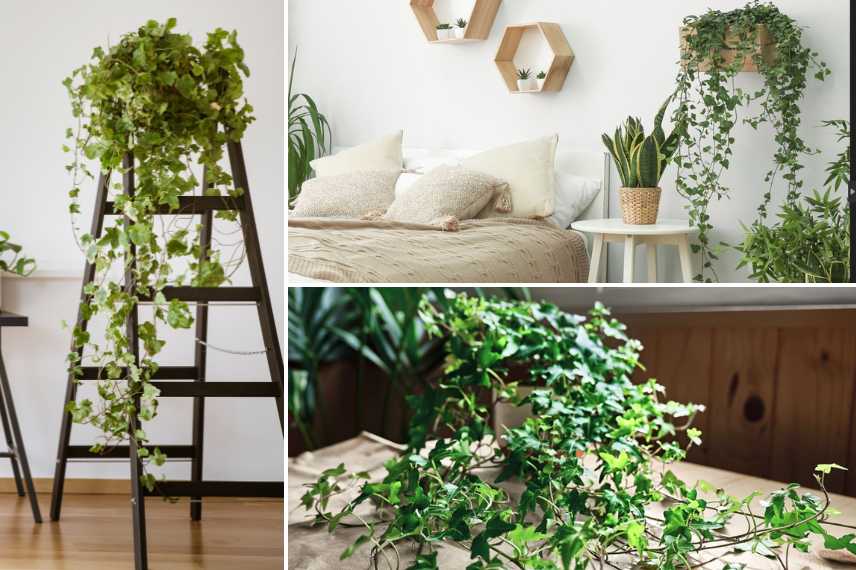 On a ladder, a shelf, or in a conservatory, ivy also makes a beautiful houseplant
According to its hardiness
We imagine ivy to be very hardy, and this is true for the vast majority of varieties. However, we must consider the different species, as some Mediterranean ivies are less resilient. This is the case with Hedera canariensis, which should be reserved for regions with a mild climate or city gardens, as it has a hardiness down to only -7°C. Hedera canariensis ‘Marengo’ is somewhat more resilient, with a hardiness of around -10°C.
- Subscribe!
- Contents
Comments