





























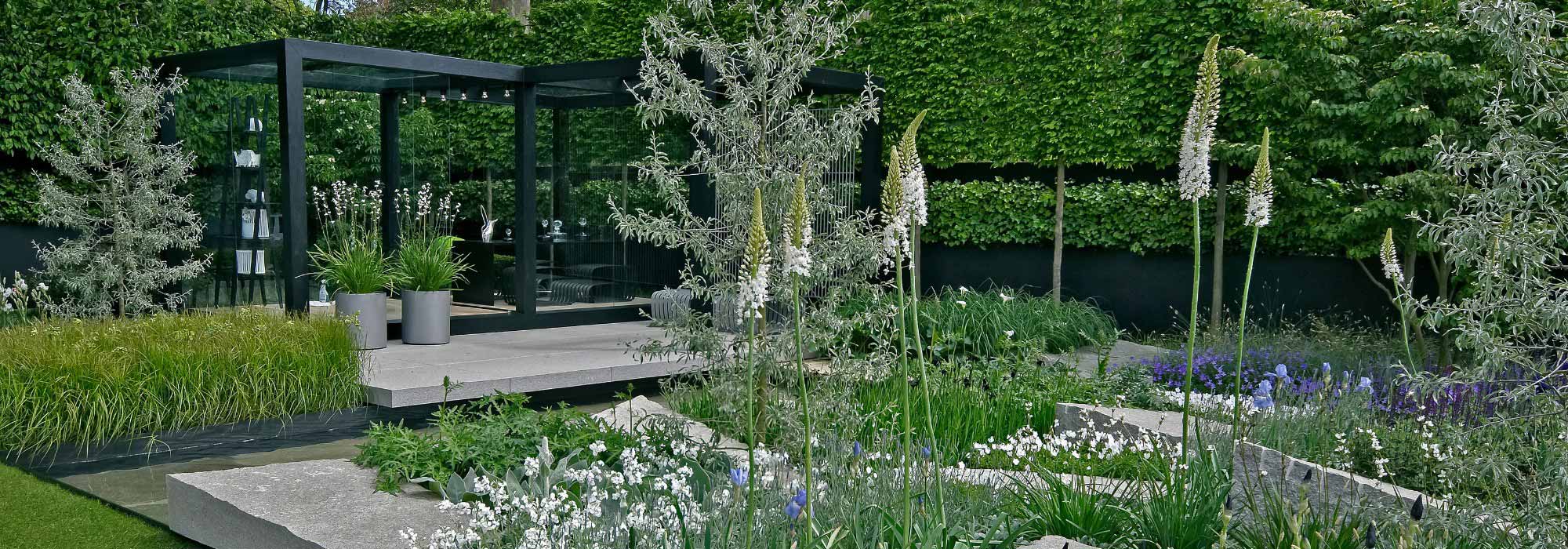
Silvery-white garden: our ideas and tips
A complete guide to successful garden design
Contents
The monochrome garden is all the rage. Its apparent simplicity provides a perfect backdrop to highlight shapes and textures. If the white garden is a timeless classic, the silver-white garden, it adds an extra touch of sophistication. This subtle and elegant tone that combines the purity of white with the metallic reflections of silver creates an atmosphere that is both bright and serene. A combination that highlights metallic foliage, often velvety, and bright white flowers, or slightly pearlescent. Let’s uncover together the secrets of a successful silver-white garden, from the plant palette to display tips!

Silvery white, a lunar shade full of nuances
Silvery-white is an elegant, soft and luminous hue, evoking both the purity of white and the metallic refinement of silver. It conjures moonlight, the sheen of silver, and the coolness of snow. This subtle colour plays with reflections and light, creating soft, subtly lustrous nuances. This combination can appear dazzling in sunlight, while in shaded areas it reveals cooler and more delicate tones. Silvery-white is often used to convey a sense of freshness, lightness and sophistication. Silvery-white foliage plants, such as cinerarias, the Stachys (Lamb’s Ears) or the Artemisia, are particularly useful for catching and drawing in even the faintest light.
In the garden, silvery-white pairs easily with pastel flowers such as pinks and lavenders, but also with deeper colours to play contrasts, such as purples or electric blues (Heuchera ‘Obsidian’,Delphinium ‘Black Knight’, Aster ‘Lady in Black’,Paeonia lactiflora ‘Françoise Ortegat’ or Salvia greggii ‘Arctic Blaze® Purple’).
Silvery-white catches the eye while remaining discreet, allowing other colours to stand out and balancing contrasts in a planting display. This neutral and soothing hue fosters harmony in borders, acting as a binder between vibrant colours or darker tones. It structures plantings while adding a touch of lightness and refinement.
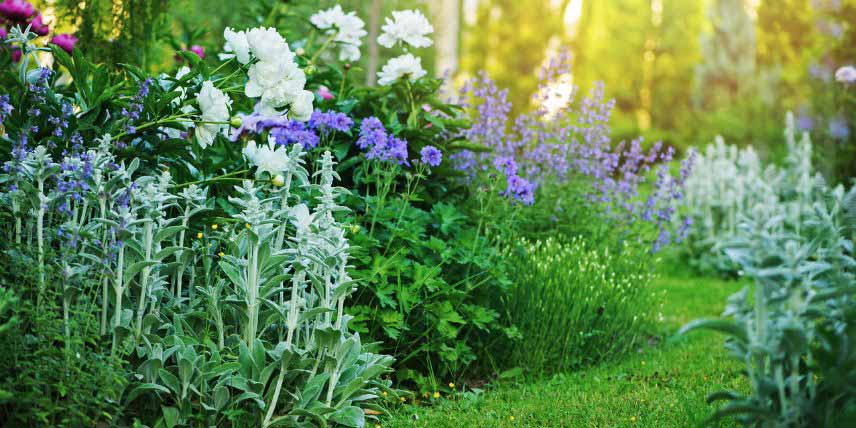
Silvery-white pairs beautifully with pastel colours to create a romantic atmosphere! Here, the silvery tint of Stachys and the white flowers of peonies are perfect to accompany the blue-purple flowers of a hardy geranium and Nepetas
The role of silvery-white in the garden
Incorporating this silvery-white hue into the garden has several advantages:
- Plants with silvery-white foliage bring a distinctive brightness to the garden, especially in shaded areas. Think of silvery Heucheras (Heuchera ‘Mint Frost’) or the Brunnera ‘Jack of Diamonds’, which reflect light, creating a sparkling effect.
- Used in contrast with dark-green foliage plants or colourful flowers, they create texture and colour contrasts.
- Silvery-white plants, due to their ability to reflect light, can give the illusion of a larger space, even in small gardens. Their light, pale colour creates a sense of openness, alleviating the feeling of confinement often experienced in restricted spaces. By incorporating them thoughtfully into garden design, they can help visually widen perspectives.
- Silvery-white plants bring a sense of freshness, which can be particularly pleasant in sunny or arid gardens.
- Silvery-white adds a subtlety and incomparable softness to the garden. This delicate hue does not dominate the landscape but enriches it harmoniously. Leaves that are often downy or finely textured add a soothing tactile dimension.
Which garden style?
White-silver fits harmoniously into many garden styles, thanks to its elegance and its ability to illuminate spaces. This colour finds its place in:
- Mediterranean gardens: Silver foliage is iconic for this type of garden, where plants suited to dry, sunny soils such as Artemisia, lavender or Santolina bring light and texture. These plants withstand heat and drought perfectly. It complements the blue of lavender or the pale green of olive trees with a welcome freshness.
- Coastal gardens: Many plants with silver foliage, such as panic grasses, tolerate sea spray and salty winds well, while adding a bright, natural touch to the coastal landscape.
- Naturalistic gardens: Paired with light grasses such as feather grasses, white-silver foliage enhances the moving, fluid look. They catch the morning or evening light, creating a soft, poetic atmosphere.
- Romantic gardens: The white-silver colour brings a touch of light and elegance. Silver foliage plants, such as Stachys (Lamb’s Ears), Cinerarias or Artemisia, soften the contrasts between pastel blooms, such as roses, peonies or foxgloves. Their silky or velvety appearance enhances the delicate character. This bright foliage attracts the eye and creates soft focal points without ever overloading the compositions.
- Contemporary gardens: The white-silver colour embodies elegance and restraint. It integrates easily into minimalist compositions where geometric lines and contemporary materials dominate. These light tones add a refined touch while reinforcing a palette of neutral colours, often preferred. White-silver also harmonises with airy grasses or with plants of sculptural forms such as agaves.
- Shaded gardens: It is a precious colour for brightening dark areas and creating subtle contrasts. Foliage reflects the available light, without breaking the natural harmony. White-silver acts as a unifying thread, bringing together the greens.
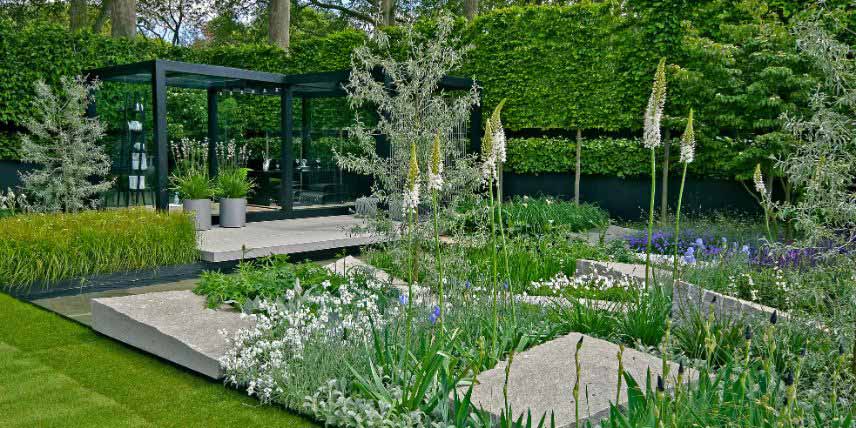
The white-silver colour is ideal for contemporary gardens, enhancing their sober, pared-back and elegant style
Read also
7 ideas for white garden bedsHow to use silvery-white in the garden?
The silvery-white is a versatile colour that can brighten dark areas, bring lightness or structure a planting bed. Overloading the planting with silvery foliage and silvery blooms without sufficient contrast can create an overly blended or monotonous effect. Conversely, introducing colours that are too vivid, such as red or orange, breaks the harmony sought. Silvery-white needs to be enhanced with dense colour touches, such as black, navy blue or violet.
In a border bed, use it as a linking element between vibrant colours or to soften darker tones. For example, it creates a lovely contrast with purples, blues and pinks while enhancing pastels.
Place silvery foliage plants in strategic spots. In borders, they draw the eye and highlight the paths. In shaded areas, they reflect light, brightening spaces that are often dull. In full sun, they tolerate it well and enhance the light effect thanks to their leaves often downy or waxy.
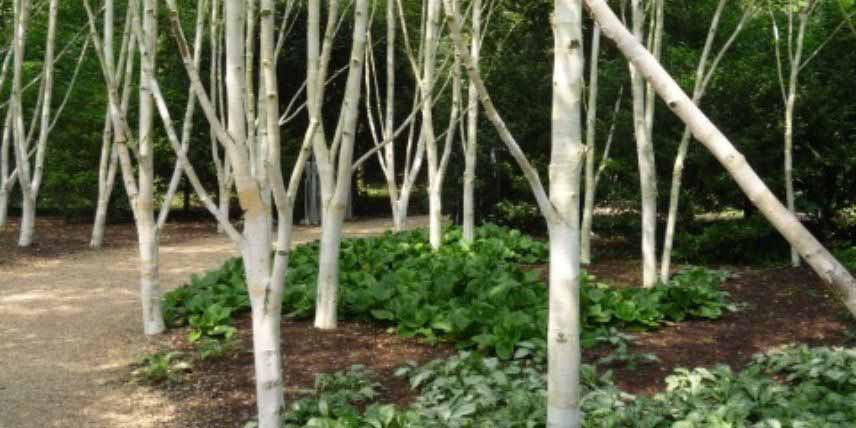
The silvery-white bark of birches helps illuminate a shaded corner
Pair silvery foliage with varied textures. It is essential to introduce variations in the foliage, playing with matte and glossy silvery tones, or soft and smooth textures, to create depth and relief.
Pair the soft, velvety foliage (that of Stachys byzantina for example) with more supple foliage for light and flowing effects, or with fleshy foliage such as those of sedums. The shapes of the leaves themselves also add interest: fine and delicate foliage, such as gypsophila, finely cut like that of a Athyrium nipponicum var. Pictum (silver fern) or light grasses, can nicely contrast with broad, rounded foliage, such as that of Stachys.
A common mistake is failing to take natural light into account. Silvery plants, in particular, reveal their full beauty under bright or soft light, but they can lose their sheen in shade. So be sure to choose varieties suited to your garden’s exposure, as many silvery-leaved species prefer sun and well-drained soils.
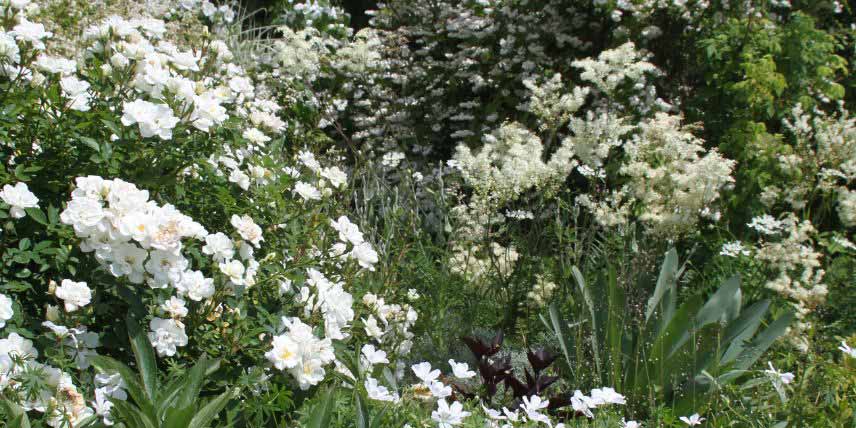
A romantically natural silvery-white garden, with roses and meadowsweet
Plant palette
The plant palette for a silvery-white garden rests primarily on luminous foliage and delicate flowering. Go wild with foliage! Silvery-white leaves must remain the main feature. Silvery-foliage plants form the essential base of this type of garden. They reflect light, create subtle contrasts and provide a backdrop that harmonises the overall look. Plant trees or bushes with silvery or grey foliage, such as the olive tree or the silver willow, to create interesting focal points and add height to your garden. It is difficult to find flowers that are naturally silver. Therefore, the choice will be white-flowering plants, some varieties may appear slightly silvery under particular light.
Plants with silvery-white foliage : Artemisia ludoviciana ssp. Latiloba and Artemisia mauiensis ‘Makana Silver’®Athyrium ‘Ghost’, Cynara cardunculus, Achillea kellereri, Lychnis coronaria, Senecio ‘Angel Wings’ or ‘Silver Dust’, Stachys byzantina, Santolines, Lavanders, Sage argentée, Chrysocephalum apiculatum ‘Korma’ (Australian everlasting), Brunnera ‘Looking Glass’, Agaves, Verbascum bombyciferum ‘Silver Lining‘, Convolvulus cneorum.
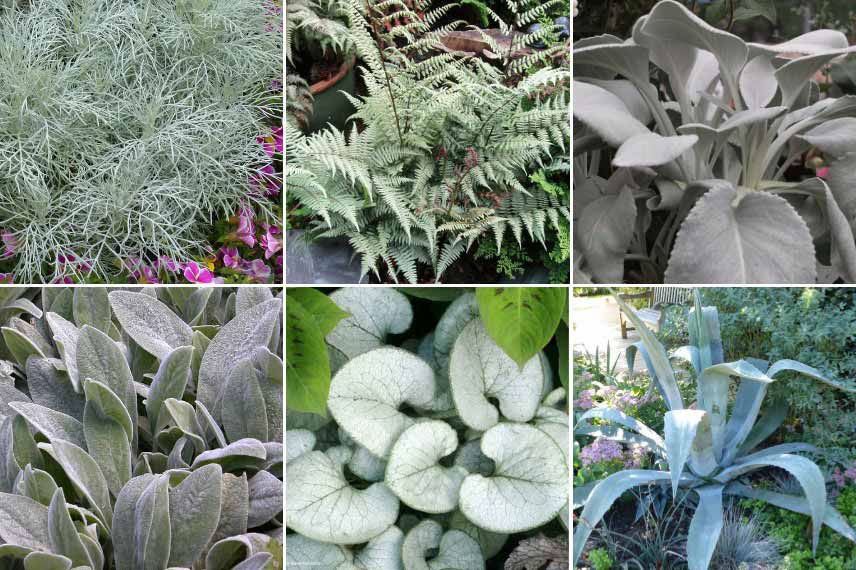
The prettiest perennials with silvery foliage: Artemisia mauiensis ‘Makana Silver’, Athyrium ‘Ghost’ (photo: Leonora Enking), Senecio cineraria ‘Angel Wings’, Stachys byzantina (photo: Carl Lewis), Brunnera ‘Looking Glass’, Agave americana
White-flowering: Climbing rose ‘Iceberg’, Achillea ptarmica ‘Diadem Versdidem’, Japanese anemones ‘Honorine Jobert’, Agapanthus ‘Glacier Stream’, Gaura lindheimeri ‘Snowbird’, Gypsophila paniculata, Lunaria annua ‘Alba’, Dianthus plumarius ‘Haytor White’, Cerastium tomentosum, Magnolia stellata.
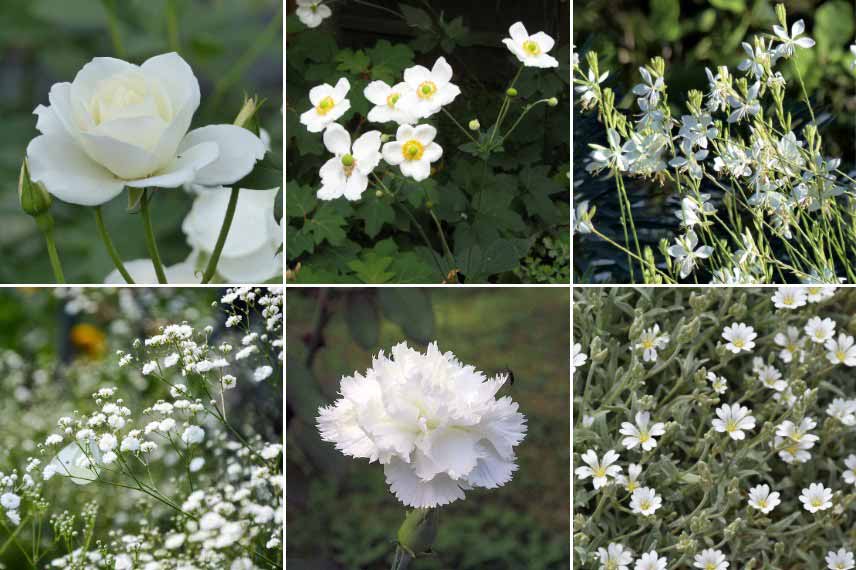
Quelques idées de plantes à fleurs blanches : Climbing rose ‘Iceberg’, Japanese anemone ‘Honorine Jobert’, Gaura lindheimeri ‘Snowbird’, Gypsophila paniculata, Dianthus plumarius ‘Haytor White’ (photo : Maja Dumat), Cerastium tomentosum (photo : Krzysztof Golik)
Grasses : Miscanthus sinensis ‘Variegatus’, Stipa pulcherrima, Sesleria argentea.
Bushes and trees : Olive (Olea europaea), Silver poplar (Populus alba ‘Nivea’), Elaeagnus ebbingei, Buddleia ‘Silver Anniversary’, Salix integra ‘Hakuro Nishiki’, Salix helvetica, Leucophyta brownii, Perovskia, Leucophyllum frutescens (desert sage), Rhamnus alaternus ‘Argenteovariegata’, White Himalayan birch (Betula utilis var. jacquemontii),Sorbus wardii.
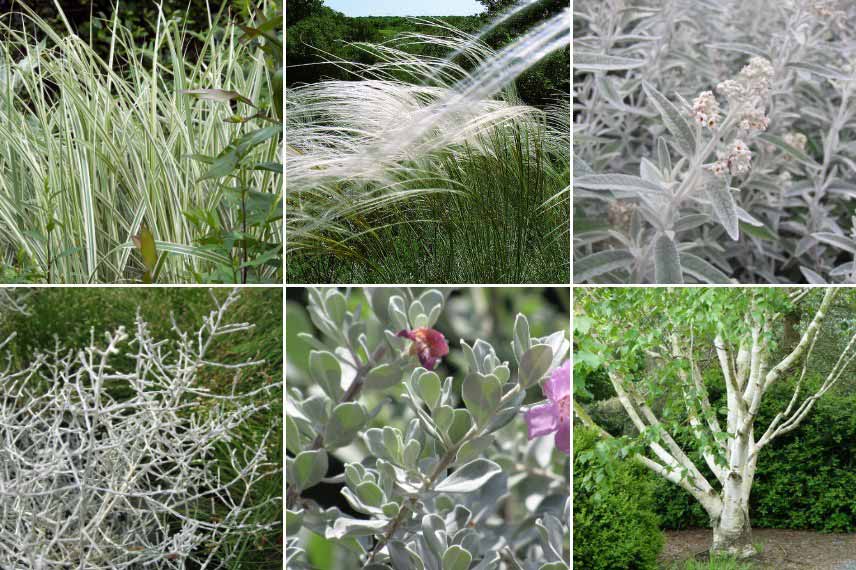
Grasses and bushes perfect to integrate into a silvery-white garden: Miscanthus sinensis ‘Variegatus’, Stipa pulcherrima, Buddleia ‘Silver Anniversary’, Calocephalus brownii, Leucophyllum frutescens (photo: Forest and Kim Starr), Betula utilis var. jacquemontii (photo: Wendy Cutler)
To complete your silvery-white garden, also discover our selection of:
The decorative touch
To decorate a silver-white garden, The idea is to play with materials and objects that catch the light and enhance this calming and elegant ambiance. Integrate white ceramic pots or galvanised metal pots, perfect for showcasing silvery foliage. Silver, of course, but matte or glossy white will also bring a contemporary and light touch. The white wrought-iron furniture or wood in grey or whitened shades can reinforce the elegant and calming feel. Weathered grey wood or patinated stone reinforce the natural and timeless look of the garden. A stone statue or fountain will adorn this monochrome decor.
Use white gravel to create paths and walkways in your garden. This will add texture and reinforce the theme.
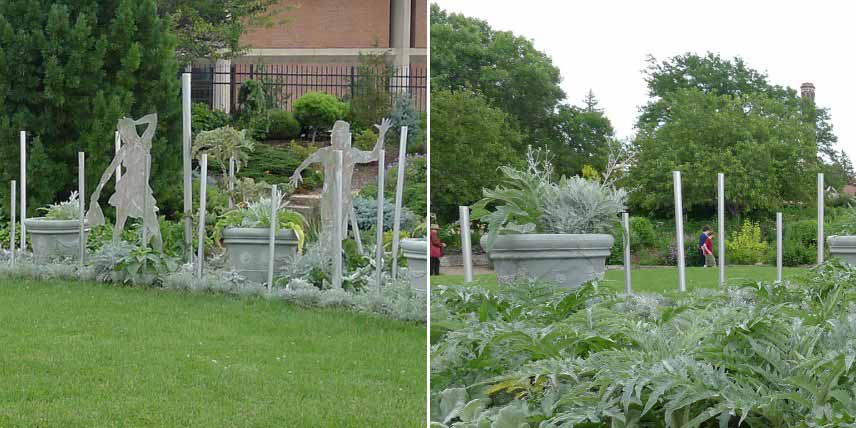
In this park, silvery foliage is highlighted by decorative structures and large pots in the same shade (photos: James Steakley)
- Subscribe!
- Contents
Comments