





























Design a flamboyant garden with autumn foliage
Which plants to choose and how to pair them?
Contents
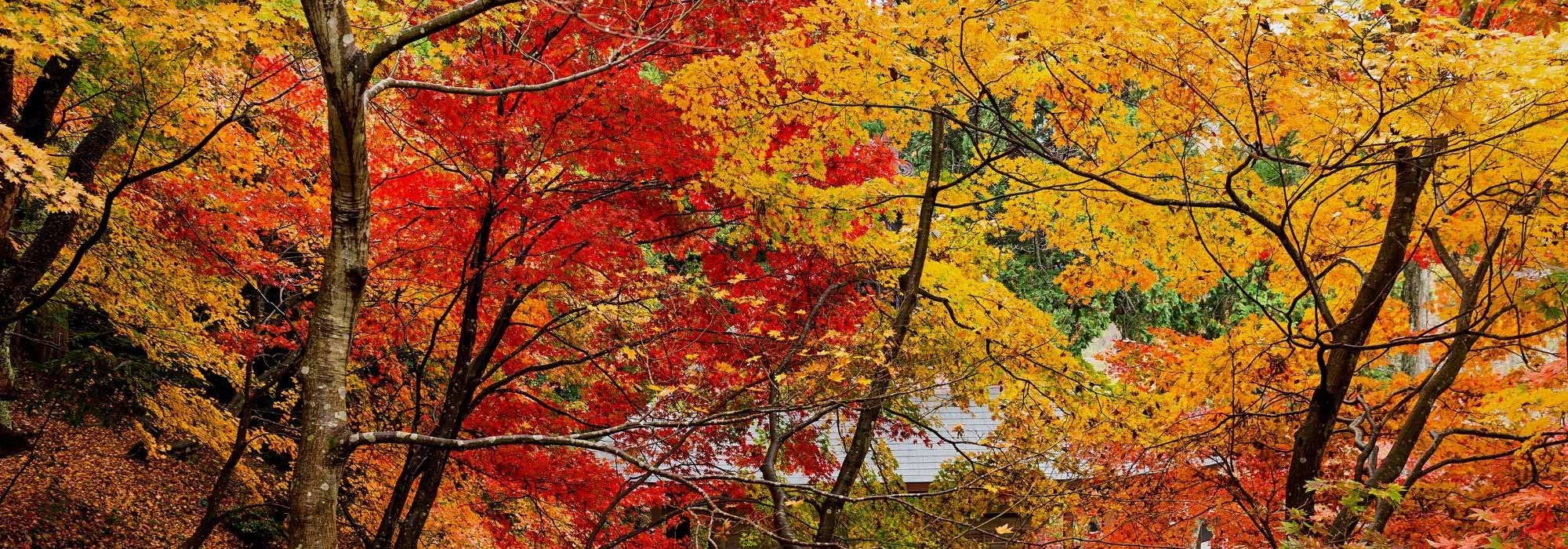
Autumn is a particularly beautiful season, when the garden and nature blaze in a palette of warm colours. The leaves of trees and bushes take on yellow and reddish hues, and some offer very decorative fruiting displays. Autumn is not simply a transitional period between lush summer and austere winter, but a season in its own right where your garden can literally shine. All that remains is to know which trees, bushes and perennials to choose, and how to arrange them to showcase them to best effect. Discover all our tips for creating a flamboyant garden with autumn foliage!

The benefits of an autumn garden
By choosing plants that thrive in autumn, you add appeal to your garden in the off-season, making your outdoor space welcoming and alive long after summer. This allows the pleasure of gardening to be extended and invites you to continue enjoying the outdoors. Some plants are particularly showy in autumn! A few still flower, but many offer a wealth of other attractions: dramatic foliage, decorative fruits, seedheads… Autumn colours are really different from those of the other seasons, and they create a soothing and cosy atmosphere. The plants then take on colours red, orange, golden yellow, amber, beige, purple, chocolate, or pink… Incredible hues, both soft and intense, that catch the light. The colour palette is rich and, far from monochrome, some foliage reveals several of these colours at once. We don’t think of this season often enough when choosing plants, but it is possible to create sumptuous autumn displays!
Which plants should you choose?
Trees
- Parrotia persica : The Persian Parrotia, also known as the Ironwood, is a small tree with a stout trunk and a spreading habit, wider than tall, whose foliage takes on green, yellow, red and orange tones in autumn.
- Cercidiphyllum japonicum : The caramel tree is a tree native to Japan bearing heart-shaped rounded leaves, initially purplish-pink in spring, bright green in summer, finishing in yellow, orange and purple tones in autumn. Its leaves then release a faint caramel scent!
- Liquidambar styraciflua : The American sweetgum features finely lobed leaves resembling maple leaves, which colour in autumn in tones ranging from orange to scarlet red and purple.
- Liriodendron tulipifera : The Virginia tulip tree is distinguished by its tulip-shaped flowers, pale yellow to light green, and by its deeply lobed leaves turning yellow in autumn.
- Nyssa sylvatica : The Nyssa or black tupelo is a tall tree with a conical, broad and elegant habit, whose foliage turns orange-red in autumn.
- Quercus rubra : The American red oak is an imposing tree, which displays vermilion red foliage in late autumn.
- Ginkgo : It owes its nickname the “forty-sous tree” to its leaves turning golden yellow in autumn!
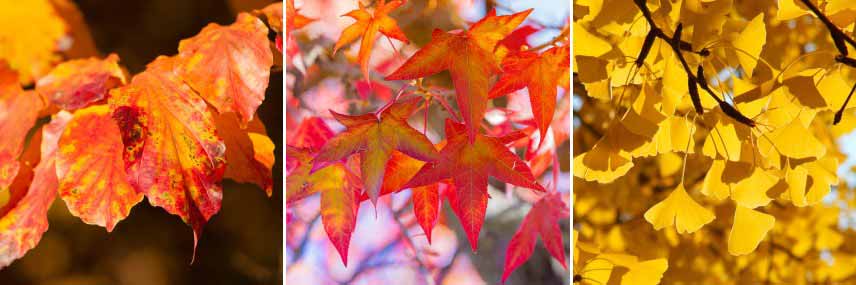
Parrotia persica, Liquidambar styraciflura and Ginkgo biloba
Shrubs
- Japanese maples : they are well known for their superb dissected foliage that takes on fiery colours in autumn. We recommend, for example, Acer shirasawanum ‘Autumn Moon’, in tones from red-orange to salmon pink, or the maple ‘Osakazuki’, turning bright scarlet in autumn.
- Lagerstroemia : the crepe myrtle colours with purple and orange-red, before revealing in winter a superb satin bark, in cinnamon and cream tones.
- Cornus sanguinea : the common dogwood stands out for both its autumn colours and its bright red twigs in winter.
- Viburnums : the deciduous viburnums often take on superb colours in autumn: Viburnum opulus becomes orange-red, Viburnum plicatum turns purple-red, while Viburnum ‘Le Bois Marquis’ becomes pink to copper-red.
- Aronia : this shrub is valued mainly for its edible berries, but it also takes on superb flamboyant colours in late autumn, from bright orange to deep red-purple. We particularly recommend Aronia arbutifolia ‘Brilliant’ and Aronia melanocarpa ‘Autumn Magic’.
- Hydrangea quercifolia : oakleaf hydrangeas are distinguished by their lobed foliage, which colours from orange to red in autumn
- Cotinus : the leaves of the smoketree take on very beautiful autumn hues, varying with the varieties: orange-red, coppery, lemon-yellow, orange, scarlet red, purple, violet, etc.
- Amelanchier : its leaves are bronze-rose in spring, then green-yellow to mid-green in summer, finishing in cinnamon-orange, coppery red to purple in autumn
- Winged spindle : Also called Euonymus alatus, the winged spindle turns in autumn a deep red to brilliant purple. It also bears decorative fruit, red to bright pink, in a bishop’s hat display.
Our whole range of shrubs with beautiful autumn colour.
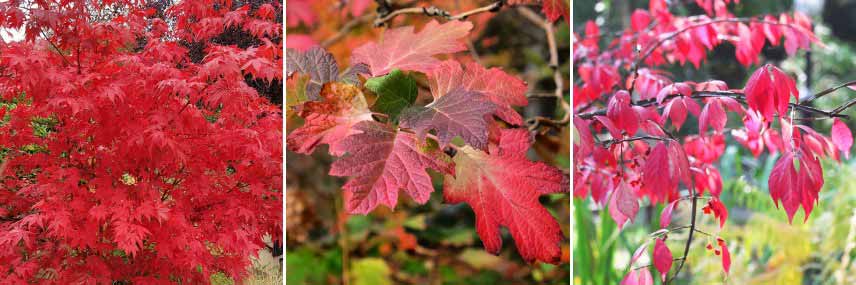
Acer ‘Osakazuki’, Hydrangea quercifolia and Euonymus alatus
Climbers
- Parthenocissus : the Virginia creeper clothes itself in flamboyant autumn colours, from scarlet red to orange.
- Vitis coignetiae : its leaves progressively colour in yellow, coppery-orange, then wine red.
- Celastrus orbiculatus : its foliage becomes yellow in autumn.
- Hydrangea petiolaris : its leaves take on a lovely golden-yellow colour.
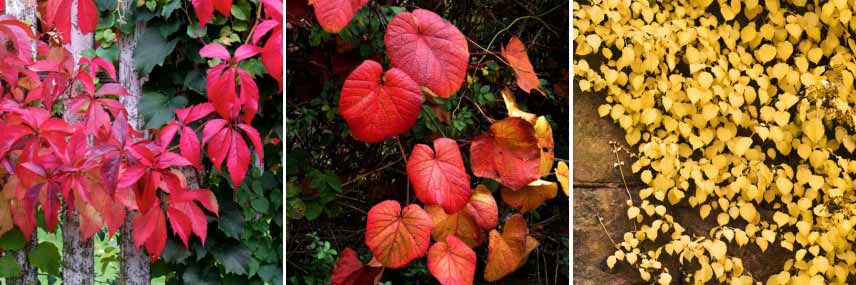
Parthenocissus quinquefolia, Vitis coignetiae (photo : peganum) and Hydrangea petiolaris
Perennials
- Amsonia : its foliage turns golden in autumn
- Osmunda regalis : the fronds of this royal fern vary between yellow, orange and red
- Epimedium rubrum : its leaves become mahogany red in autumn
- Geranium sanguineum : we appreciate this hardy geranium for its deep-pink to violet flowers and its finely cut leaves, which become fiery red in autumn. Also discover Geranium wlassovianum ‘Crug Farm’, which also takes on splendid colours at this time.
- Persicaries : persicaries generally take on beautiful colours in autumn. We particularly recommend Persicaria affinis, whose lance-shaped leaves turn red-brown, and Persicaria amplexicaulis, whose leaves become dark red to bronze.
- Mukdenia rossii : this low-growing creeping perennial forms glossy palmate green leaves, turning red in autumn
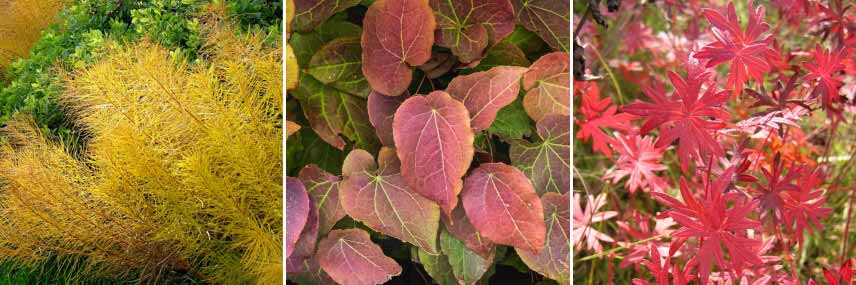
Amsonia hubrichtii, Epimedium rubrum and Geranium sanguineum
Grasses
- Schizachyrium scoparium : this ornamental grass offers slender foliage with changing colours, green in spring, turning blue in summer, then orange to purple in autumn
- Miscanthus sinensis : the Miscanthus or Maiden Grass is a very beautiful structural and graphic grass that produces lovely plume-like seed heads in late summer. We particularly recommend the varieties ‘Purpurescens’ and ‘Afrika’
- Panicum virgatum ‘Rehbraun’ : its foliage turns red-orange in autumn
- Imperata cylindrica ‘Red Baron’ : this grass has upright olive-green foliage, with the tips gradually turning blood red in summer, finishing entirely burgundy-red in autumn
- Stipa arundinacea : this stipa has very fine foliage that becomes a blend of green and burnt orange in summer, finishing a rusty brown in autumn
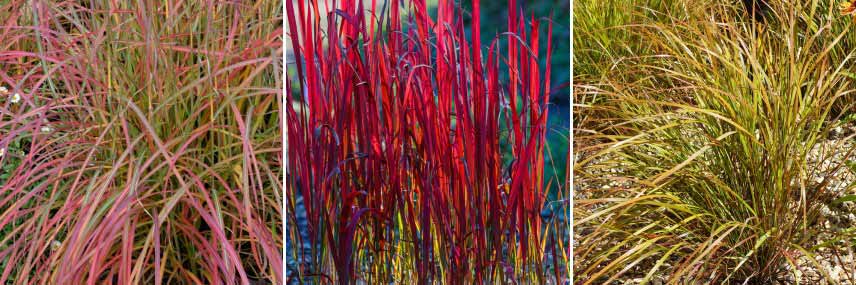
Miscanthus sinensis ‘Little Miss’, Imperata cylindrica ‘Red Baron’ and Stipa arundinacea
How to plan an autumn garden?
Play with colours
To create a harmonious and striking effect, don’t hesitate to group plants by colour, for example pairing several plants turning scarlet in autumn (Quercus rubra, maple Maple ‘Osakazuki’, Geranium sanguineum, Imperata cylindrica ‘Red Baron’…), and a little further away a few plants turning golden yellow at this time (Ginkgo, Liriodendron, Hydrangea petiolaris…). These colours will thus be reinforced and create a pretty contrast. Bear in mind that autumn colours can vary depending on climate conditions, humidity, exposure, etc.
You can pair warm colours, classic autumn garden hues (red, orange, yellow…) with cool colours (notably blue and green, with evergreen shrubs, conifers and asters…). Focus on complementary colours: for example, orange and blue lie opposite on the colour wheel, which means that when paired, these two hues strengthen one another. You can pair orange foliage with the blue-tinged foliage of a Eucalyptus ‘Baby Blue’, a Euphorbia myrsinites and the pretty blue flowers of an aster ‘Prof. Anton Kippenberg’. Likewise, violet is the complementary colour to yellow: Asters ‘Purple Dome’ will wonderfully accompany the autumn foliage of a Hydrangea petiolaris.
Create colour contrasts by pairing, for example, plants with purplish leaves alongside others whose leaves turn yellow in autumn. Group several plants with scarlet foliage to create splashes of bright red.
You can also pair the bright autumn leaf colours with more neutral tones : green (for example evergreen shrubs and conifers), grey or silvery (olive, Pyrus salicifolia Pendula, Salix rosmarinifolia…), blue (juniper ‘Blue Carpet’, Picea pungens ‘Glauca’…)
Play with volume and texture
Create volume and texture with, for example, the fine foliage and the spike-like inflorescences of grasses, or with the delicate fronds of ferns (Osmundas, Dryopteris erythrosora…), which can contrast with lower, massed plants (Bergenias, Rodgersias, Sedum spectabile…). Grasses are ideal for bringing lightness and movement, while low-growing plants help to accentuate a bed or border. Think of the very light spikes of Calamagrostis brachytricha, pennisetums and Miscanthus nepalensis. Also consider structuring your borders with the tallest plants (shrubs, tall perennials…) at the back, those of medium height in the middle, and the shortest at the front.
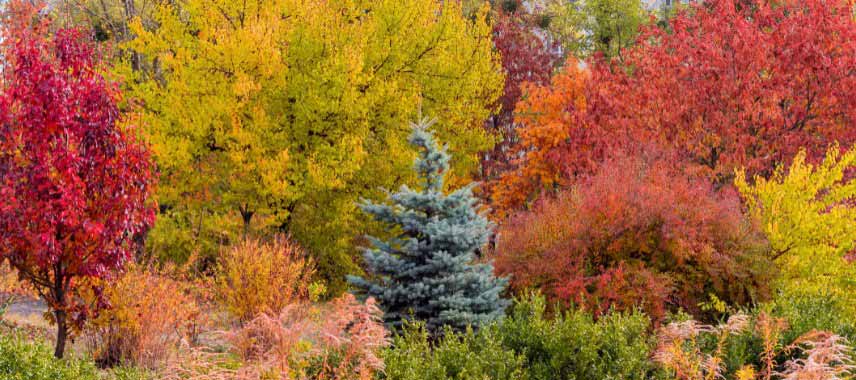
Don’t hesitate to include among the red and orange autumn foliage a few plants with bluish foliage. Here, the Picea pungens ‘Blue Diamond’ really stands out
Incorporate plants with decorative fruits and late flowering
To accompany these autumn foliage, don’t hesitate to include ornamental fruit shrubs as well as late-flowering perennials, which will also enliven the garden at this time. Think, for example, of ornamental fruits of Euonymus, Callicarpa, Cotoneaster, Pyracantha… Take the opportunity to create colour echoes: the red fruits of Cotoneaster, for example, can echo the scarlet foliage of a Japanese maple placed a little farther away, or the fruits of Pyracantha ‘Saphyr Jaune’ will echo the bright foliage of Celastrus orbiculatus, in a very similar tone. For flowering, think of Asters, chrysanthemums, Japanese anemones, Heleniums, dahlias and Sedums. Also rely on the very decorative spikes of grasses: they are ideal for bringing lightness to the garden. Think, for example, of Miscanthus nepalensis, Calamagrostis brachytricha…
Integrate late-flowering perennials as well, such as asters and Sedums (photo © Friedrich Strauss – Biosphoto)
Add decorative elements
Don’t hesitate to add decorative elements, such as sculptures, colourful pots or garden furniture, which complement autumn colours, in tones of yellow, orange, red, bronze or copper, in keeping with your garden’s style. If you’re creating a Zen garden, for example, don’t hesitate to include lanterns, pergolas, etc., in a scarlet red shade. They will echo the glowing red foliage of Japanese maples and Nandina domestica.
- Subscribe!
- Contents
Comments