





























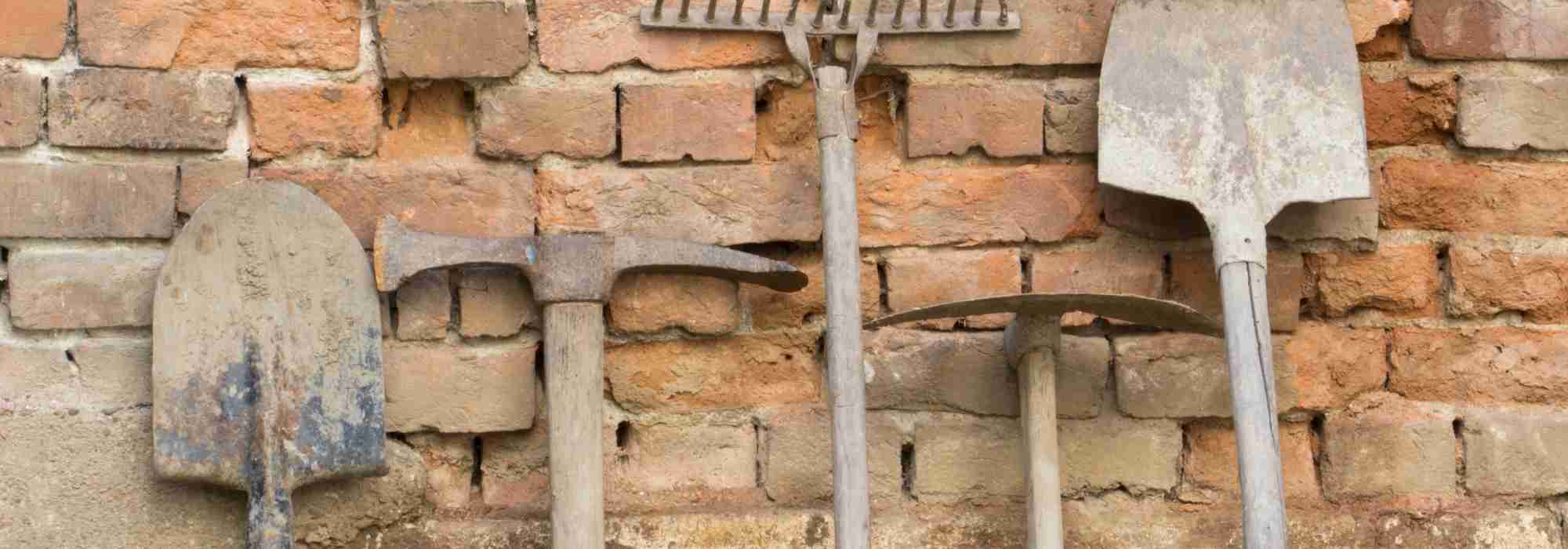
Digging, hoeing, and weeding: the essential tools to work the soil
Overview and use of tools to prepare the garden soil
Contents
Good tools make good workmen! You know that proverb! If it holds true in industry, it also holds true for gardening—and perhaps even more so. Indeed, whether in the vegetable garden or in the ornamental garden, you as a gardener will be required to carry out a variety of tasks. The first and essential task is working the soil, which can be particularly exhausting and cause aches and pains. That is why having good tools will not only make the job easier but also help you achieve soil that is loose, crumbly and well-aerated, ready to welcome your plants or vegetable crops. Tools come in a multitude of materials, some more premium than others, and in a range of sizes, with small formats available for pots and planters. Finally, some are better suited to planters, while others are for children to use.
Let’s discover together the essential gardener’s tools for work and prepare the soil.

Tools to break up and loosen compacted soil
Life as a gardener is punctuated by seasonal tasks that recur each year, especially in the vegetable plot where the soil is heavily worked by successive crops. That is why it is important to work this soil to make it looser, more crumbly to accommodate sowing and planting. Many tools offer this function. Their choice will depend not only on the work to be done but also on the nature of your soil. Indeed, a light and sandy soil does not work in the same way as a heavy, clayey soil. The choice of the right tools therefore hinges on this essential component. Likewise, land that is going to be cultivated for the first time requires specific tools to turn the soil deeply.
To work and loosen the soil, a whole range of tools known as “tillage” or “digging” tools is used. These tools will be used at two times of the year: in autumn to prepare the soil for winter, and, in spring, more superficially, for quick cultivation. These tools are designed to turn the soil without too much disturbance to the soil’s microbial fauna.
The digging fork, or spading fork, ideal for heavy or stony soils
The spading fork or digging fork lives up to its name! It is indeed a tool intended for digging, that is, turning the soil to decompact and loosen it without overly disturbing or destroying the soil’s microfauna. Usually equipped with 3 tines or 4 straight tines, sometimes 5, and with a straight handle, in a “T” or in a “YD”, a shorter handle typical of English tools, the digging fork is easy to drive into the ground. Some digging forks also feature spatulated teeth, i.e. widened at the central part.
The digging fork is really designed to decompact and crumb the soil in depth. It is essential for soil fertility, as it does not kill earthworms as a traditional spade might. However, its tines loosen the soil without turning it over completely. It is especially well suited for working heavy, hard or stony soils.
It can also be used to work the soil in borders where its teeth do not damage the roots of established plants, to divide the crowns of perennials, uproot certain vegetable plants such as leeks or carrots.
Further reading : What is a digging fork used for?
The biofork or aerofork, for working the soil without turning it
Icon of permaculture, the biofork, also called aerofork, eco-friendly digging fork, “biogriff”, or even biobêche, is none other than the famous “grelinette®” invented by André Grelin. Equipped with 3 to 5 tines and two parallel handles, the biofork, quite close to the digging fork, decompacts the soil without turning it over. The soil’s micro- and macrofauna are spared, soil layers are not mixed, and your back is relieved. Indeed, you simply plant the tool into the soil, pull on the two handles, and guide the teeth in an arc to loosen and aerate the soil at depth.
The biofork is better suited to light, sandy soils. In heavy, sticky soils, it is more difficult to handle.
→ For more information, Olivier’s text: What is a biofork used for?
The spade, to loosen at depth
The spade is one of the gardener’s basic tools, as it is used to turn the soil to depth, i.e. about thirty centimetres. Today criticised by gardeners who follow permaculture, the spade inevitably damages soil life by completely upsetting its structure. Moreover, earthworms and other soil creatures fare poorly against the sharp edge of iron. Nevertheless, it still has its utility in very compact, difficult-to-work soils, or for the creation of a vegetable plot or a border.
Furthermore, the spade remains indispensable for dividing perennials, shaping borders, digging planting holes for shrubs or trees.
→ For further reading: What is a spade used for?
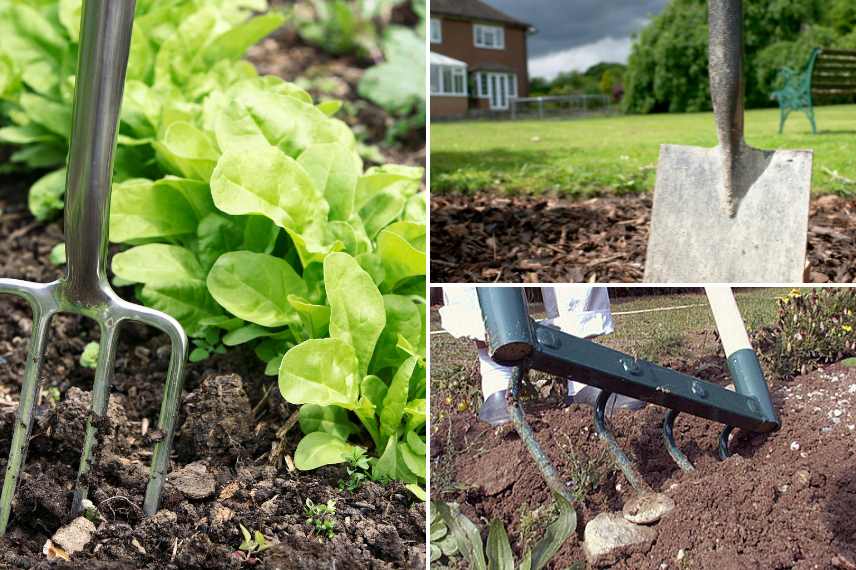
Digging fork, spade and biofork (Girardin© Wikimédia Commons)
The trenching spade, an interesting alternative to the spade or shovel
Sometimes called a nursery spade, the louchet is a kind of spade with a small peculiarity. Indeed, the iron is fitted with a socket that extends into a long ring around the handle. In addition, this iron is narrower and longer than that of a spade.
Primarily used for planting and transplanting trees and shrubs, you can also use the louchet to turn the soil, especially in heavy and sticky soils, because the iron penetrates more easily and deeper into the ground. But that is not its primary use.
For full details: What is the trenching spade used for?
The garden fork, for surface soil loosening
Whether called a croc (for manure) or a garden claw, this tool is very effective for loosening surface soil. Equipped with 3 to 5 curved teeth, the croc, formerly called a “cultivateur”, allows you to give the final touch to soil preparation before sowing or planting, loosening the soil to a depth of 5 to 10 cm.
It can also be used to scoop compost from the bin and spread it on the soil, spread a fine mulch, or to loosen a rocky and hard soil.
Further reading : What is a garden fork or claw used for?
The hand fork, for small plots
Also known as a rotary claw or garden claw, this tool has four tines arranged in a square tilted on a long handle with two separated grips, which you rotate with a rotary motion. Very ergonomic, the rotogriffe allows decompacting and loosening the soil in a small volume, for example in confined spaces such as a flower bed. It is also a tool that spares the user’s back who remains upright.
For further reading: What is a rotary claw used for?
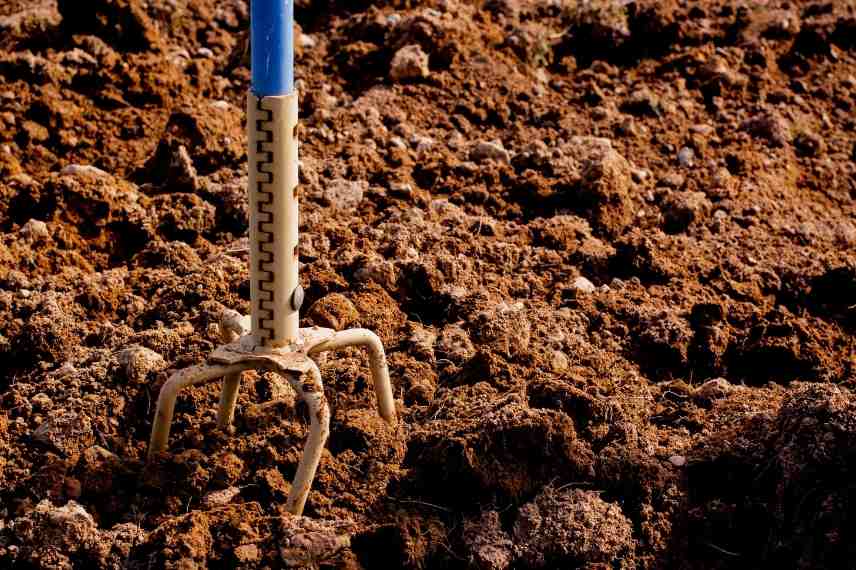
The garden rotary claw, ideal for small plots
The pickaxe, for digging compact soils
Although less used in the garden, the pickaxe can still have a function there. It is primarily used when planting trees and shrubs, to dig very compact soils and loosen the bottom of planting holes. It can also be used to dig trenches for planting a hedge, especially in hard and packed soils. The removal of large subjects and clearing of roots can also be facilitated by using a pickaxe.
Further reading :What is a pickaxe used for?
Soil care tools
What does it really mean to tend the soil? Soil maintenance consists not only of removing adventive weeds and pulling dead plants, but also of lightly working the soil surface to aid aeration and water infiltration. Thus, we break the hard crust that forms on the soil surface under the influence of the weather. Several tools can be used for these aims:
- The Dutch hoe is used for hoeing! You may think so, but what does hoeing mean? With this tool, consisting of a handle and a sharp blade fixed perpendicularly, we break the crust and superficially aerate the soil to prevent water run-off and to promote aeration of the soil at the root zone. Then, to prolong the effect of hoeing, a good layer of mulch is laid. It can also be used to hill up certain vegetables or pull weeds. For more details : What is a Dutch hoe used for?
- The hoe : this tool closely resembles the Dutch hoe, but the blade is wider and longer. It is also used for hoeing (with less precision than the Dutch hoe) or for digging broad furrows, hill up the base of certain plants, and removing adventive weeds. For more details : What is a hoe used for?
- The hand cultivator : it is a particularly versatile tool in the garden, as it performs a multitude of tasks. If there were to be just one tool for soil maintenance, it would surely be a hand cultivator. Indeed, a serfouette is always made up of a head with a blade, or a fork. It therefore enables hoeing, weeding and thinning, digging furrows, hill up the base of certain plants, scratching and aerating the soil. For further reading: What is a hand cultivator used for?
- The push or pull hoe (sarcloir) or rake (ratissoire) used for pushing or pulling: weeding literally means removing weeds by severing them at the collar. So this garden tool does not penetrate the soil. It is best to weed as soon as adventive weeds appear and to rake debris to prevent re-rooting. For more details: What is a rake or a hoe used for?
-
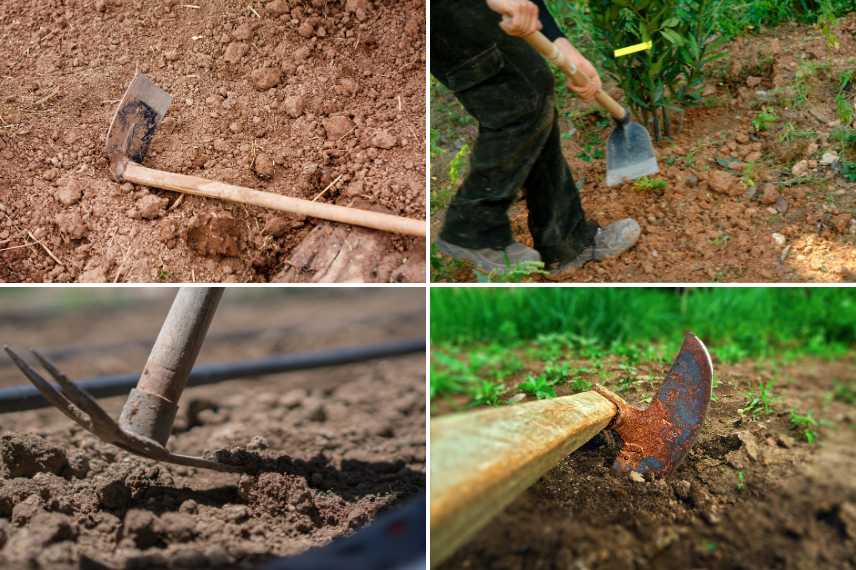
The Dutch hoe, the hoe, the hand cultivator and the push hoe
Levelling tools
Even though leveling the soil isn’t entirely part of soil preparation, it should still be included. It’s the indispensable final touch, for example before sowing. And the essential tool is, of course, the rake. This garden tool, made up of a handle and a crossbar with straight tines, helps remove the last clumps of soil and stones after the passage of the hoe. Once the rake has passed, the soil is level, ready to receive sowings or plantings.
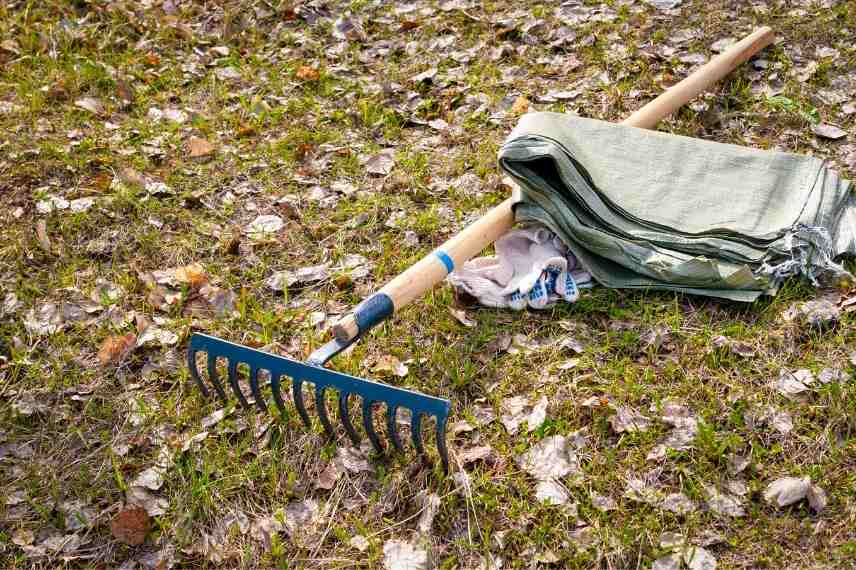
The indispensable rake
And, you can use it for firming sowings in rows in the vegetable garden using the back of the rake. Just tap gently.
To find out a little more : What is a rake used for?
Read also
Hoe: how to choose?Further reading
Also read our articles:
- Gardening for beginners: how to choose the right tools?
- Gardening for beginners: what is weeding? How do you do it?
- Subscribe!
- Contents
Comments