



How to create a natural and elegant woodland garden?
Our tips and inspiration to create a dream woodland garden
Contents
Sometimes you’re lucky enough to have a lovely shaded area in your garden beneath the trees, like a miniature woodland. Under the canopy of deciduous trees, you can enhance this wild impression by introducing plants that will gradually flourish there and that will add an elegant touch, without upsetting the natural, hardy feel of the place.
Chosen plants, small bushes and perennials, should of course be suited to shade and to the type of soil. They will brighten the area with light colours such as white and yellow, or fresh tones like blue, also playing on their variegated foliage.
Here are our tips to transform this initially inhospitable area into a space of delicate charm, with five elegant, natural woodland set-ups adaptable from north to south of the country.
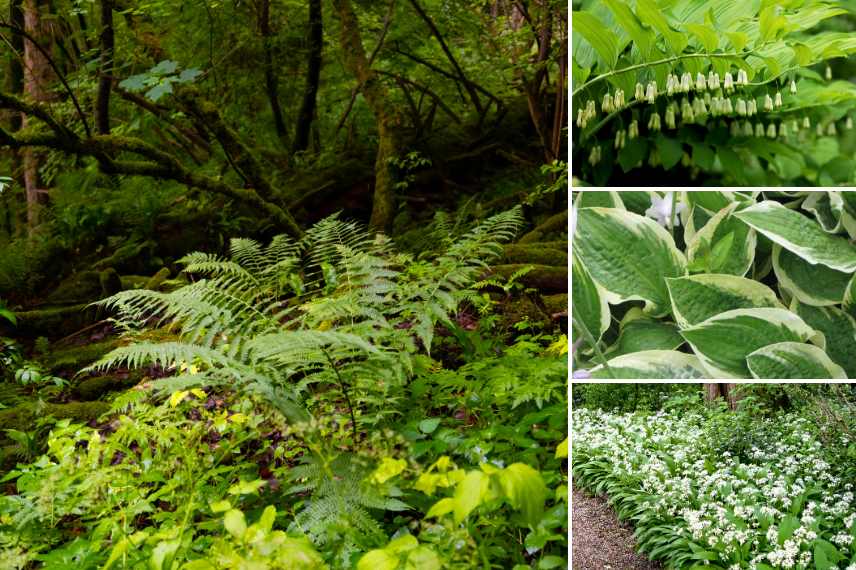
A woodland can quickly take on an elegant air by introducing a few bright perennials, which act as a burst of brightness in the dappled shade…

Tips for creating elegant woodland
- Base on plants with a natural, wild appearance, suited to woodland, taken from those seen in nature (ferns, foxgloves, holly, hornbeams and yew, etc.)
- Choose a palette of fresh colours in flowering: white and nothing but white, or white combined with yellow, or blue and white; purple-and-white duo adds a very chic touch… All these shades will revive woodland
- Prefer elegant, light and graceful floral forms that do not betray the mysterious character of the place: small bells, airy inflorescences, discreet flowering in spikes or umbels, etc.
- Include foliage variegated with cream, unrivalled at creating illusion of light. Golden foliage (yellow-green) is also welcome
- Plant species whose interest will extend from spring to summer and into winter to enjoy woodland all year round
- At woodland edge or beside paths, where light manages to penetrate more, dare to include a few plants that need greater light
- Mix low-growing plants and shade-loving groundcover with more generous, medium-sized plants (small bushes and undershrubs)
- Plant woodland bulbs in large drifts for an enchanting, very natural effect in spring and/or autumn
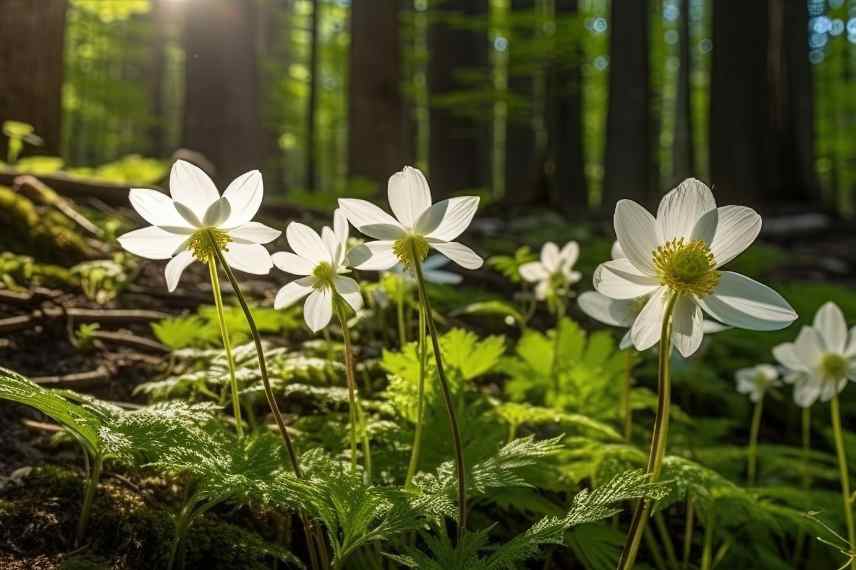
Wood anemones, elegant touch in woodland spring
Five planting schemes for an elegant woodland
Woodlands can quickly take on an elegant air by introducing a few luminous perennials, which act like a flash of light in the ambient half‑shade…
A fresh woodland
In humus-bearing, rich and cool soil, woodland planting options are ideal, because many plants thrive there. The litter layer rich in humus is ideal for numerous refined perennials: Japanese primulas appreciated for their delicate staggered spring flowering, silver or variegated hostas and brunnera for their large decorative foliage and charming flowers, the cimicifugas or silver candles for their white flower spikes above purple foliage (such as Actaea simplex ‘Atropurpurea’ or ‘James Compton’). Also indispensable are lamiums for their groundcover effect and the quality of their foliage on variegated varieties (Lamium maculatum ‘White Nancy’). Cyclamens and Rodgersia, as well as Helleborus niger (Christmas roses) also fit perfectly into this type of woodland.
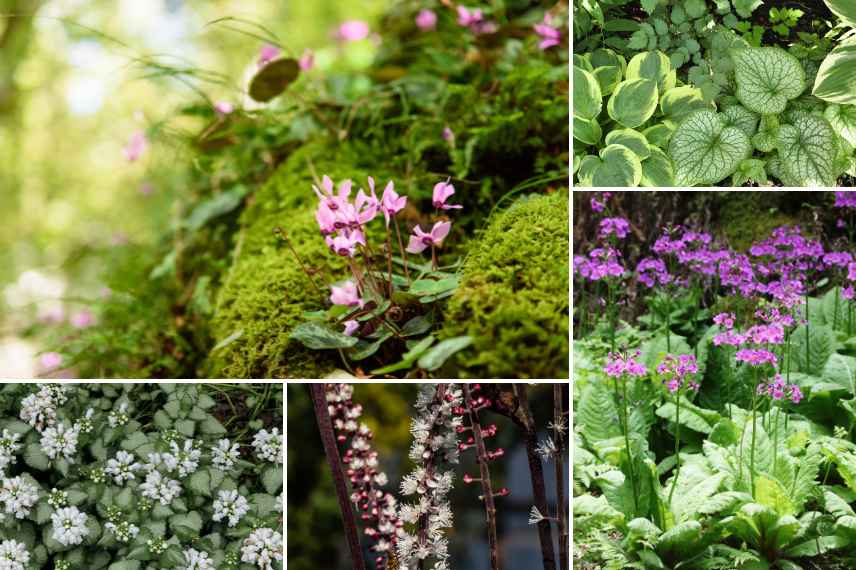
Cyclamen, Hostas and brunneras (Siberian bugloss), Lamium ‘White Nancy’, Cimicifuga and Japanese primulas
A dry woodland
Tree canopy often creates dry soil, full of roots and unwelcoming to many plants. But some accept these conditions, and these are the ones to focus on, notably small spring bulbs that enter dormancy in summer.
A luminous groundcover such as the variegated form of Aegopodium podagraria will persist in dry soil, be easier to control and less invasive than the species type. It brings much brightness and freshness to the woodland. Play with yellow and white flowerings, which bring a lot of life to a half‑shade woodland: Epimedium with delicate flowers, Cyclamen coum ‘white’ flowering in winter and white Chionodoxa in spring. The flowering of a Sarcococca, besides being fragrant, also provides a pure white splash in mid‑winter and persistent volume year‑round. In this scene you can also plant a Mahonia aquifolium whose spiny foliage turns purple in cold and which bears small graceful clusters of flowers in late winter. Finally, do not overlook the refreshing tart yellow of Euphorbia amygdaloides ‘Purpurea’, its purplish stems and foliage making it delightful on a woodland edge. Add some indispensable ferns such as a Dryopteris.
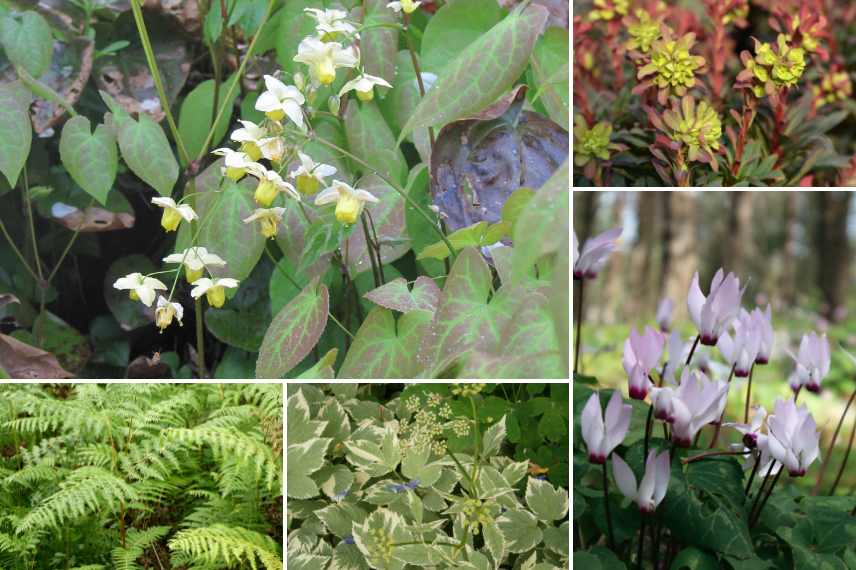
Epimedium, Euphorbia amygdaloides ‘Purpurea’, fern, Aegopodium and cyclamens.
A woodland dressed in whites
This type of woodland creates surprise and wonder with subtle white notes brought by both foliage and small flowers. Plantings will perform well beneath deciduous trees, which provide filtered light in spring and humus, and elegance will prevail while retaining a slightly wild character.
For example, choose a handsome clump of Corydalis ochroleuca or ‘White Swallow’ flowering in spring, placed near large ostrich ferns. A few all‑white martagon lilies of botanical origin will enhance the scene at the woodland edge to catch maximum light. At the woodland fringe plant some astrantias such as Astrantia major ‘Alba’.
Lift the whole composition with Pachysandra terminalis (including variegated forms), hostas edged in white such as ‘Sagae’ and a few foliage plants tinged with purple like Podophyllums, so striking. Finally, again invite elegance with Epimedium whose foliage will form within a few years a superb groundcover.
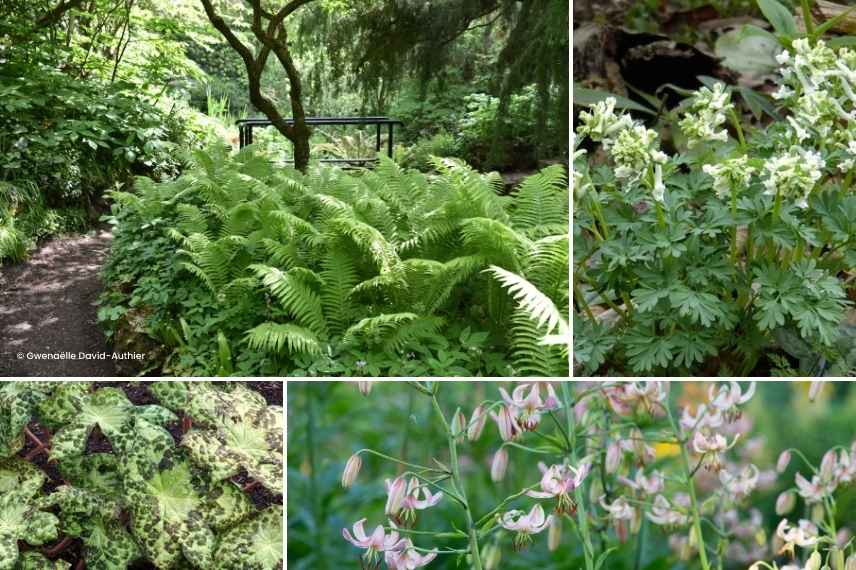
Ferns and white Corydalis, spotted Podophyllum (‘Spotty Dotty’) and white martagon lilies.
A fairytale woodland
Here the aim is to reproduce what nature already does very well: with soft moss, a few trees and carefully chosen wild plants your woodland becomes a fairytale refugium. Moss develops in cool, very shaded positions. A floral palette in soft whites and blues brings back enough light. This time play with bark, foliage and flowering!
Combine the bright whiteness of birches with a carpet of woodland plants flowering from winter to summer for prolonged interest and suited to these testing conditions: Hepatica in vivid blue, Helleborus niger (Christmas roses) and hybrid hellebores, wood anemones in white (Anemone nemorosa), Solomon’s seal (Polygonatum), a duo of wood hyacinths and wild garlic. Later come white‑throated foxgloves, a carpet of fragrant asperula and tiarellas…
→ Also read: Birches, the most beautiful barks.
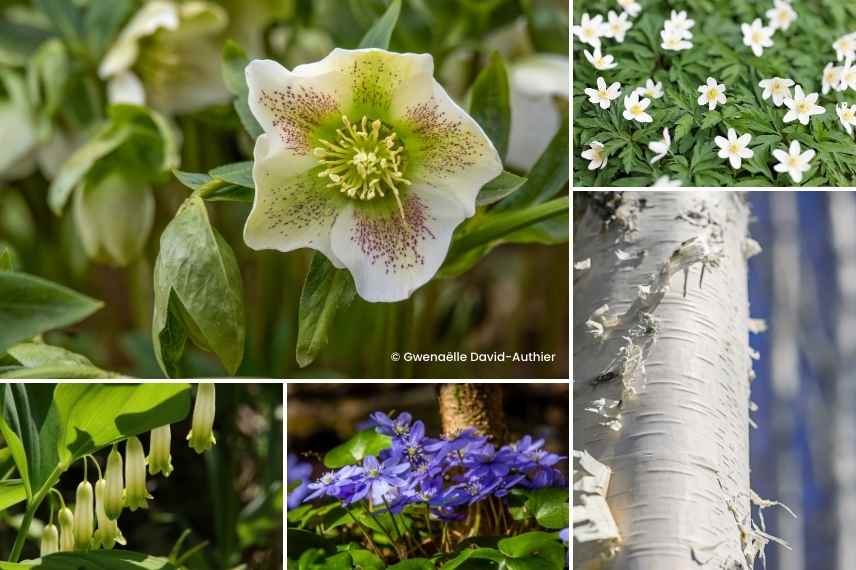
Hybrid hellebore, Anemone nemorosa, Polygonatum, Hepatica and Betula
A yellow version, equally charming, can invite very soft and delicate tones: a combination of winter, spring and summer flowering with hellebores for winter, Mahonia aquifolium for spring and Kirengeshoma palmata for summer. Finally add some bulbs such as Erythronium ‘Pagoda’, dazzling in March–April, barrenwort in yellow‑orange tones (such as Epimedium warleyense ‘Amber Queen’) and Daphne laureola with its surprising lime‑green bracts flowering into May.
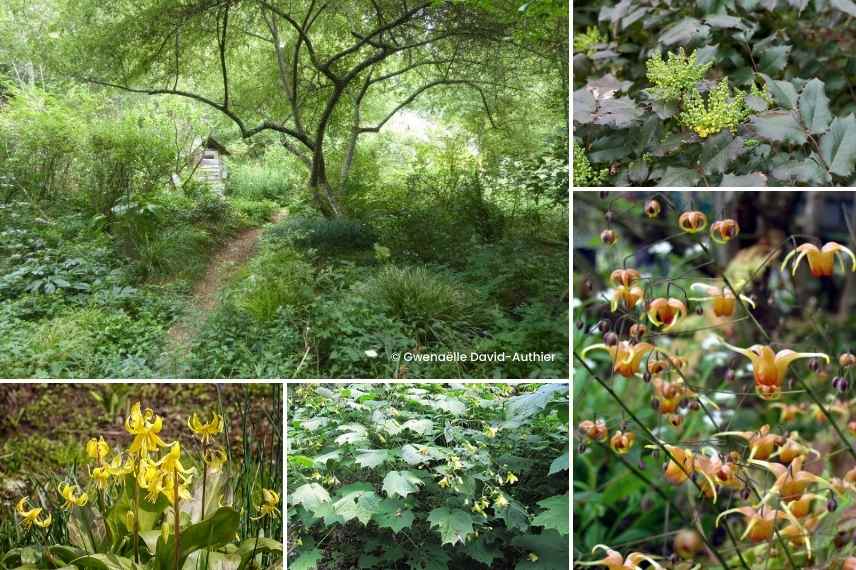
Woodland at Liliane’s garden in Haute‑Vienne (© Gwenaëlle David‑Authier), Mahonia aquifolium, Erythronium ‘Pagoda’, Kirengeshoma palmata and Epimedium ‘Amber Queen’.
Also read: Moss in the garden: let’s make room for it.
The ideal planting palette for an elegant woodland
As a bonus, here is a list of plants that blend naturally into the woodland, useful for composing large scenes beneath leafy trees :
- Ferns
Matteuccia, Dryopteris, Blechnum, Asplenium, Polypodium, etc. - Small bulbs (many will naturalise)
Cyclamen, Galanthus nivalis (snowdrop), Erythronium, Iris sibirica and Iris japonica, crocus, Anemone blanda and Anemone nemorosa, Fritillaria meleagris, Scilla siberica, etc. Read: Brighten shady areas with spring bulbs! - Woodland perennials
They should tolerate partial shade and prefer to grow in cool soils. Favour those that will form groundcover:
Hepatica, Lungwort, Trillium, Lamium, Trollius, Polygonatum, Tiarella, Viola odorata, ramsons, sweet woodruff and Pachysandra terminalis, Japanese primroses, foxgloves, Veratrum nigrum, Ajuga reptans, certain Carex, Brunnera, Corydalis, Euphorbia amygdaloides, bluebell, Cypripedium, Kirengeshoma palmata, Epimedium, Angelica sylvestris, etc. - Semi-shade bushes
Ruscus aculeatus, Symphoricarpos, Hydrangea serrata and Hydrangea aspera, Mahonia aquifolium, Daphne laureola…
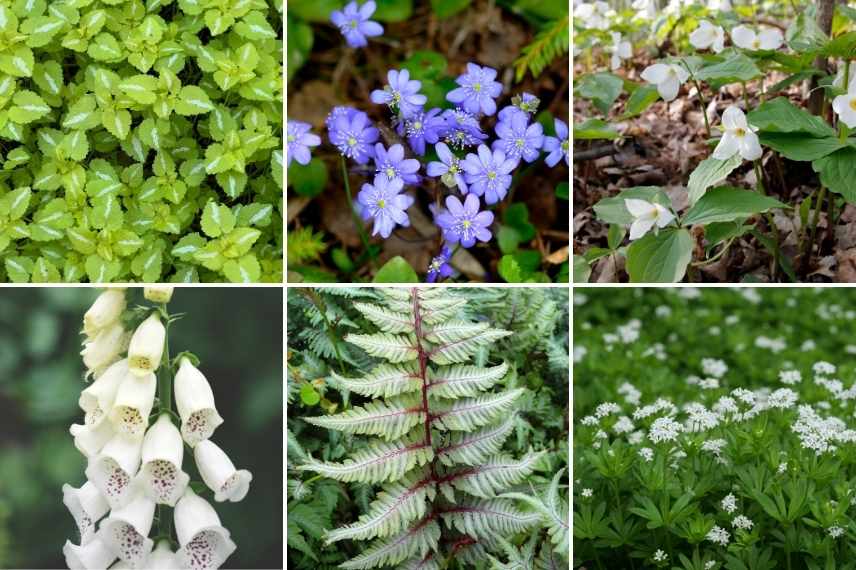
golden Lamium, Hepatica nobilis, Trollius, foxglove, Athyrium niponicum ‘Pictum’ and sweet woodruff
- Subscribe!
- Contents

Comments