





























Fall for original climbing plants that will make a splash in your garden
Some uncommon plants will add a touch of whimsy to the garden, thanks to their flowering, foliage or fruiting
Contents
Wisterias, passion flowers, clematis, roses, honeysuckles, ivies… So many beautiful climbing plants, but already particularly common in gardens. Would you like to add character to your outside space by dressing a pergola, prettifying a fence, or camouflaging an unsightly structure? Choose from our selection of unusual climbers!
These unusual climbing plants are sure to spark curiosity and attract attention. They can be grown in the garden or in pots, to fill every space and to cope with different climates.

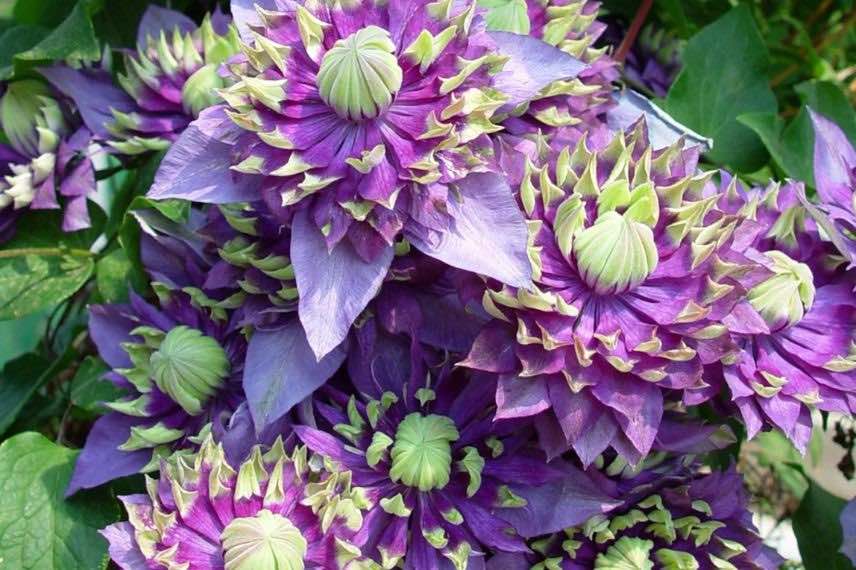
Hybrid Clematis – Clematis ‘Taïga’
One could hardly describe this Clematis ‘Taiga’ as discreet! Throughout the summer, from July to October, it rewards us with a flowering as generous as it is surprising.
It features large 6 cm double flowers, particularly graphic and architectural. They indeed have a hint of cactus dahlias, with triangular and pointed petals, interlocking with one another. The flowering occurs in three distinct stages. First, a large pale-green central bud becomes visible, surrounded by a six-pointed star. Next, the bud gradually opens, forming incurved petals in a blue shade leaning toward violet, contrasting with green tips. Finally, the colours evolve to become purple and pink-tinged cream-white.
The flowering is then followed by silvery-grey, plume-like fruits, quite decorative.
The green foliage is deciduous.
This unusual climbing plant will certainly not go unnoticed and will evoke strong reactions, whether you love it or hate it!
Compact enough to be grown in a container, reaching 2.5 m in height with a 1 m spread. It will inevitably add a touch of character to your gardens, terraces, balconies or patios. This climber clings on its own to any support available, thanks to its voluble stems.
In terms of cultivation, this hardy Clematis has the same requirements as its sisters: the crown in sun that isn’t scorching and the root zone in shade, with soil that stays cool. To help you, don’t hesitate to plant small grasses or hardy geraniums as groundcover with it.
To learn more about growing Clematis, read our guide “Clematis: Planting, Pruning and Maintenance”
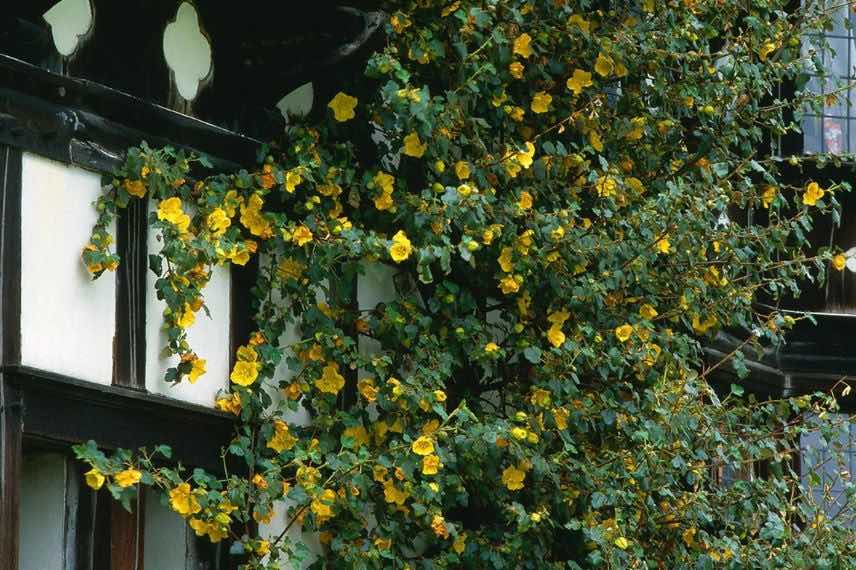
California Fremontodendron - Fremontodendron californicum
California flannel bush is a climbing plant not widely grown in our gardens. However, it is an ideal candidate for mild coastal gardens, in Mediterranean or oceanic climates. This sun-loving, floriferous liana reveals itself in early summer, between June and July. It produces simple cup-shaped flowers of 7 cm in diameter, with petals of a slightly waxy appearance. It is their warm colouring that we like here: they bear a golden-yellow that will be further accentuated by the slightest ray of sunshine.
The green foliage is evergreen. It forms a very dense and rounded silhouette. Moderately hardy, this original climber will withstand frosts down to about -9°C.
This climber develops woody climbing stems that will need to be trained on trellises to brighten many supports (beware of wearing gloves to avoid direct contact with the irritant and allergenic hairs). At maturity, expect about 6 metres in height for 4 metres of span, or more if the climate is particularly mild and sunny.
Easy to live with, it is a fairly undemanding plant: it only dislikes excess moisture. For the rest, it will tolerate very poor soils, sandy or stony, even calcareous, as well as sea spray. Plant it in full sun, sheltered from prevailing winds. It will look wonderful alongside emblematic Mediterranean plants, in complementary violet tones, such as lavender or the rosemary.
To learn more about growing roses, read our dossier “Roses: the best varieties and how to grow them”.
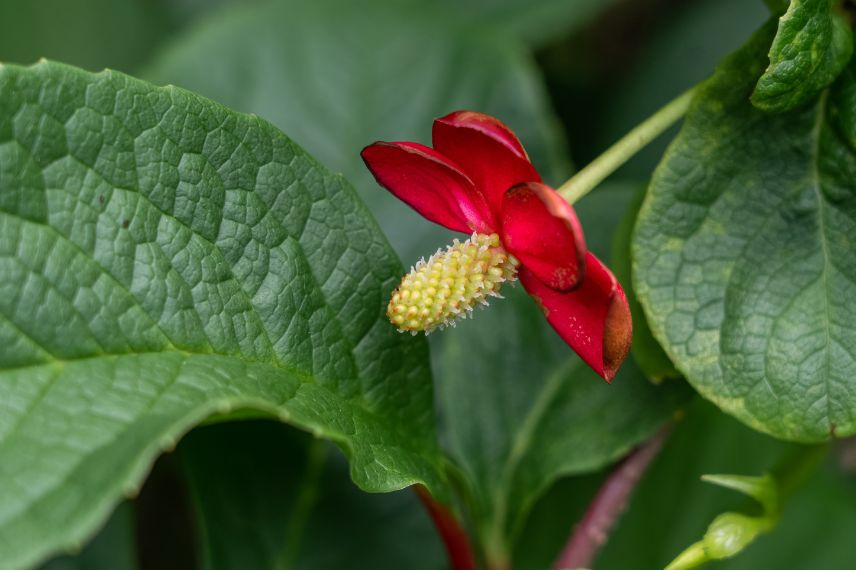
Red-flowered Schisandra - Schisandra rubriflora
The Red-flowered Schisandra is a collector’s climber, a climbing plant for collectors that you won’t often have the opportunity to encounter in gardens. It forms a small liana reaching 3 to 5 metres in height with a 2-metre spread. Its flowering is distinctive, occurs in late spring. It consists of clusters of pendant flowers, bearing shell-shaped petals, in a magnificent carmine red. The following fruiting, in the form of edible red berries, is equally decorative. These fruits emit a spicy fragrance and are prized for their numerous virtues associated with them. To enjoy them, however, note that it is necessary to plant several plants.
The elliptical foliage is also slightly aromatic.
This climber will stylishly dress a drab fence, an unattractive wall or a pergola.
Native to woodland undergrowth, it prefers semi-shade, in soil rich in organic matter and moist, which never dries out completely. It is fairly hardy, down to -15°C, which allows cultivation in many of our regions not too dry.
To learn more about Schisandra cultivation, read our guide “Schisandra: planting, berry harvest and maintenance”
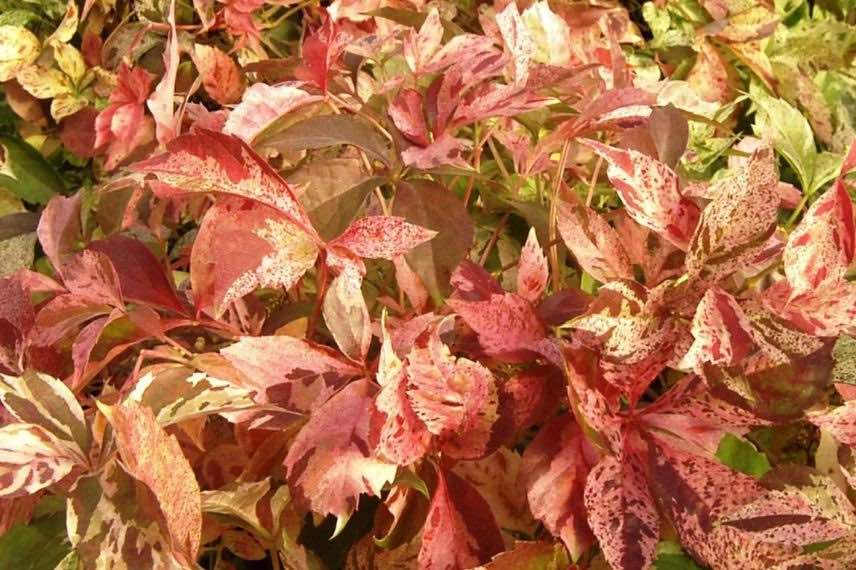
The variegated Virginia creeper 'Star Shower' - Parthenocissus quinquefolia
This Variegated Virginia creeper is a climbing plant that stands out for its foliage. Its foliage offers a colourful, ever-changing display over time, never falling into monotony. New shoots are initially pink, before becoming green with white variegation. In autumn, as with all Virginia creepers, it flames with red and pink-tinged hues of great beauty. The leaves can reach nearly 20 cm in length, adding a considerable degree of lushness.
It will form a handsome plant spanning almost 10 metres in all directions, ideal for covering the walls of large buildings or even the trunk of a large tree. This Virginia creeper clings naturally to supports thanks to its tendrils.
Summer flowering is modest, but it attracts pollinators. It is followed by bluish berries, which will please birds.
Hardy and easy to grow, it will thrive in any exposure. It prefers fairly fertile, well-drained soils.
For more on growing Virginia creepers, read our feature ‘Virginia creeper: planting, care and pruning’
Climbing Celastrus 'Autumn Revolution' – Celastrus scandens
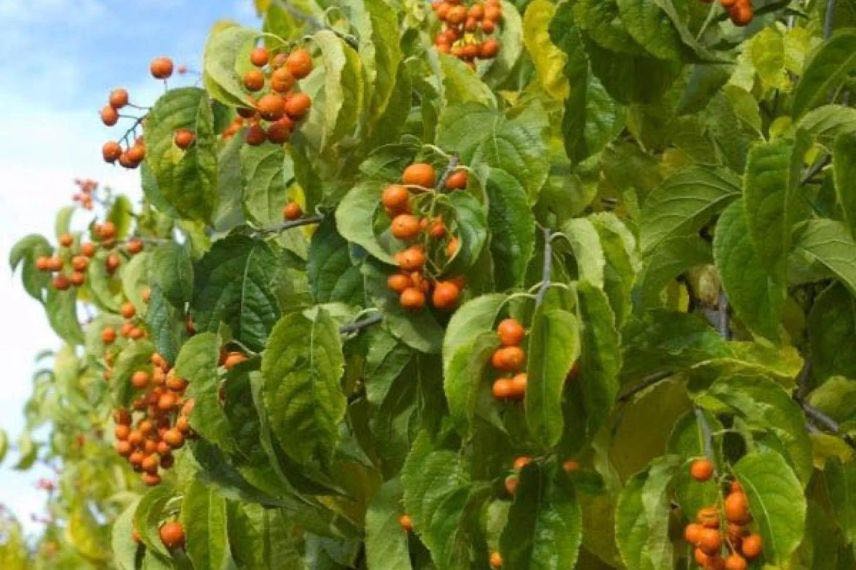
The climbing Celastrus is a climbing shrub with distinctive fruiting. This fruiting lasts from late summer to mid autumn. They are clusters of two-coloured fruits, formed of an orange capsule revealing a red bead. Although the fruits are poisonous, they are highly appreciated by birds, whose aerial ballets you can watch with pleasure.
These decorative fruits contrast beautifully with dark green, glossy foliage. The elliptical leaves reach about 10 cm across. Initially green, they turn yellow in autumn before falling.
This climbing shrub is self-fertile, meaning it does not require other plants to fruit abundantly.
The climbing Celastrus owes its nickname ‘tree-killer’ to its ability to impact the growth of young plants, so avoid companions that are too feeble.
In terms of size, expect around 10 metres in all directions for this vigorous climber.
Plant it in full sun or light shade, in fairly rich soil.
It’s a perfect choice for draping over a pergola. Hardy to -15°C.
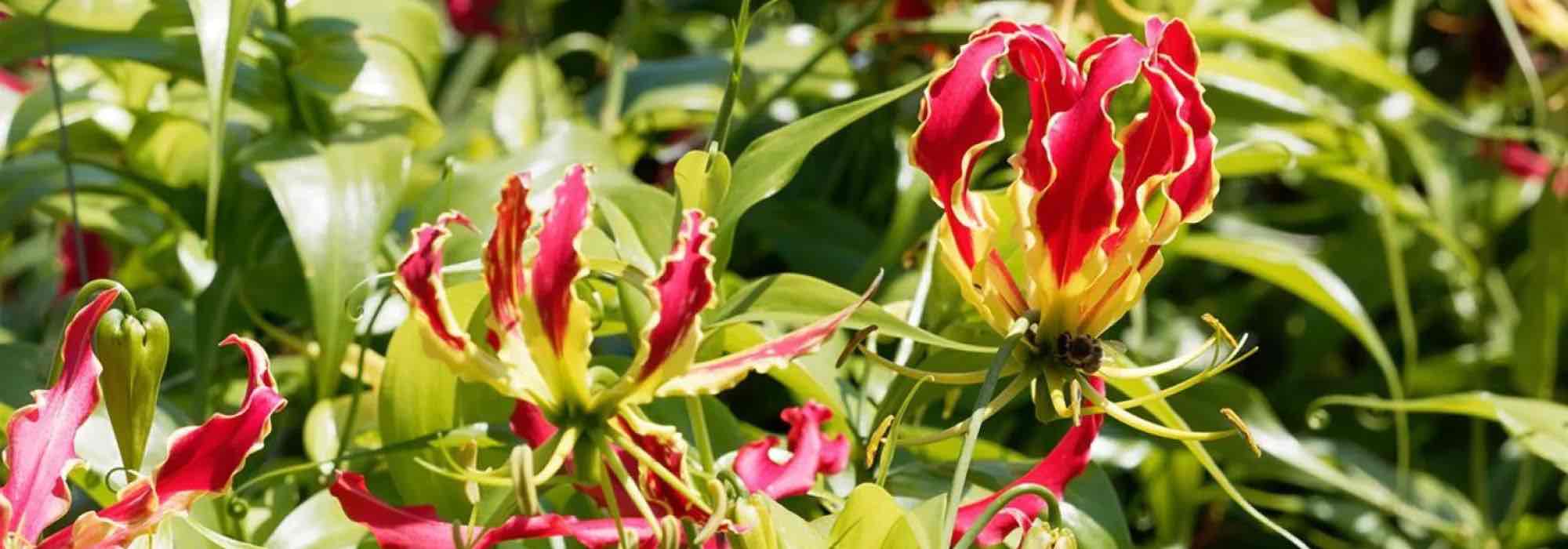
The glorious lily - Gloriosa rothschildiana
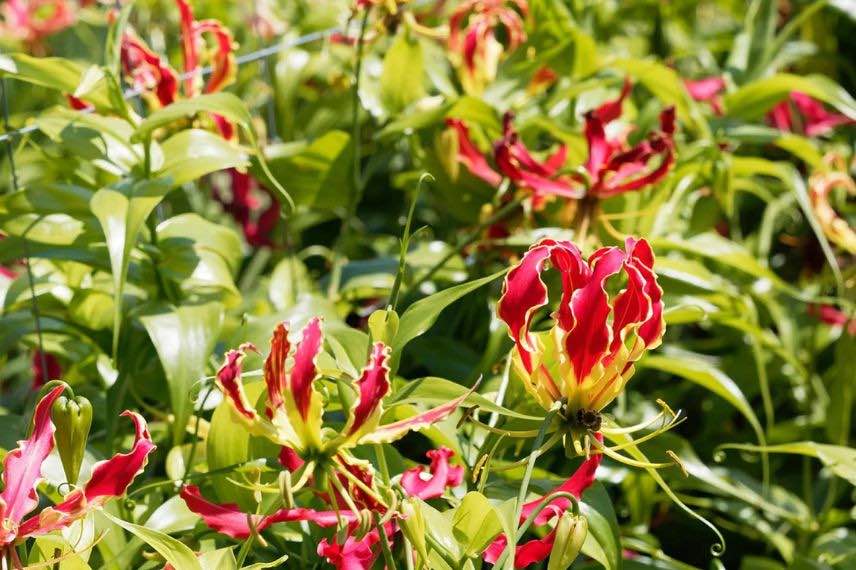
The glory lily, butterfly lily or Malabar lily, is a climbing plant native to South Africa. Its summer flowering is what makes it truly distinctive. Delicately, the flowers, 8–10 cm in diameter, are spider-shaped. They are composed of undulate petals, very colourful, turned skyward. They combine a vivid red edged with yellow, for a flowering display that is decidedly exotic. The yellow-green pistils, for their part, point downward, accentuating the graphic touch brought by these flowers. They will look wonderful in summer bouquets. Regular pruning of the spent flowers will allow you to enjoy this charming flowering for longer.
The dense foliage features a glossy green, which perfectly showcases the striking flowers of this climbing plant.
To emphasise the exotic look, you can pair the glory lily with Crocosmias or Cannas, adding lush foliage, such as that of banana trees.
Its beauty makes us forgive its low hardiness, which does not exceed -4°C. But do not resign yourself to cultivating it: it will grow quite readily in a pot, thanks to its compact silhouette, which measures 2 metres in height for only 40 cm of spread. This will allow it to be kept dry during the cold season, in a cold greenhouse or conservatory.
This tuberous plant will thrive in soil rich in organic matter that remains cool. It requires a sunny, warm exposure, sheltered from prevailing winds.
Note that this plant can be toxic if ingested.
- Subscribe!
- Contents

Comments