





























Growing a Sarcococca in a pot
And enjoy its delightfully fragrant winter flowering.
Contents
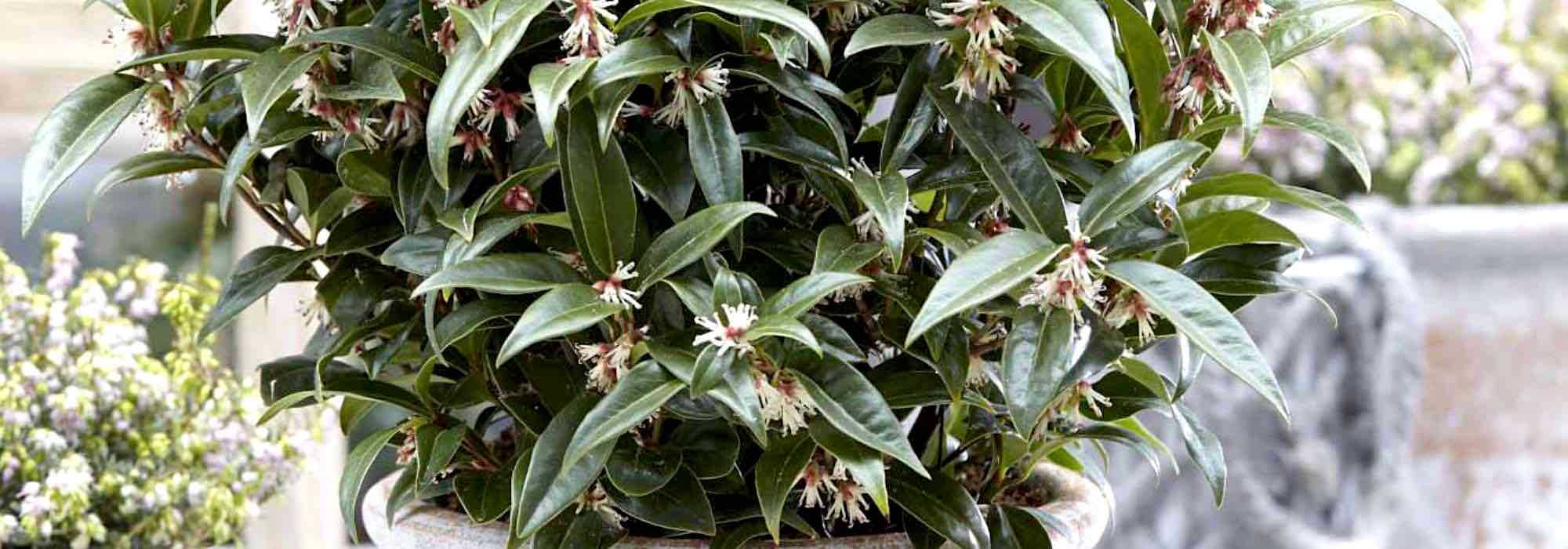
The Sarcococca is a beautiful bush with evergreen foliage and a wonderfully fragrant winter flowering, followed by decorative small black berries. From November to March, it produces clusters of white or pink flowers, with scents of jasmine, hyacinth, and lily of the valley. It is one of the few fragrant bushes in winter and remains magnificent all year round. It grows very slowly and never exceeds 2 m in height, making it particularly suitable for pot cultivation. Perfectly hardy and requiring very little maintenance, space-efficient, it is easy to grow in small partially shaded areas, sheltered from cold, dry winds. Ideal in shade or partial shade, it is perfect for small gardens on a terrace or balcony. Place it near your entrance or under a window to fully enjoy its intense fragrance throughout winter and its lovely appearance reminiscent of an olive tree. Varieties, planting and maintenance tips, here’s how to successfully grow a sarcococca in a pot.
And for everything you need to know about sarcococca, feel free to check out our complete guide.

What varieties?
There are about fifteen species of Sarcococca, as well as a few hybrids selected for their size and the colour of their flowering. All species grow slowly, which is a plus for pot cultivation. Height varies by species, ranging from 60 cm for the smallest varieties to a maximum of 2 m for the Sarcococca confusa. Varieties under 1.20 m are all suitable for pot cultivation. Due to their miniature format, Sarcococca humilis and its cultivars are particularly well-suited for pot growing. Among the most suitable varieties for this use are:
The Sarcococca hookeriana var. humilis ‘Fragrant Valley’ is a brand new variety that forms a dense, compact ball with dark green evergreen foliage covered in a multitude of white and pink flowers. The Sarcoccoca hookeriana humilis is another dwarf form that is equally interesting.
The Sarcococca hookeriana var. digyna is a very attractive form not exceeding 80 cm in height at maturity, distinguished by longer, more flexible leaves, similar to those of a small olive tree. It bears small, cream-white flowers that are highly fragrant, like those of its relatives.
The Sarcococca hookeriana var. digyna ‘Purple Stem’ will not exceed 1.20 m in height and 1 m in width after many years. Its well-scented flowering opens in pink-purple. Its young shoots tinged with pink-purple also distinguish it from other varieties.
The Sarcococca ‘Winter Gem’ has inherited the decorative purplish young shoots from the previous variety. It forms a bush with a well-compact habit, not exceeding 70 to 80 cm in all directions. It reveals fragrant white flowers touched with pink-purple.
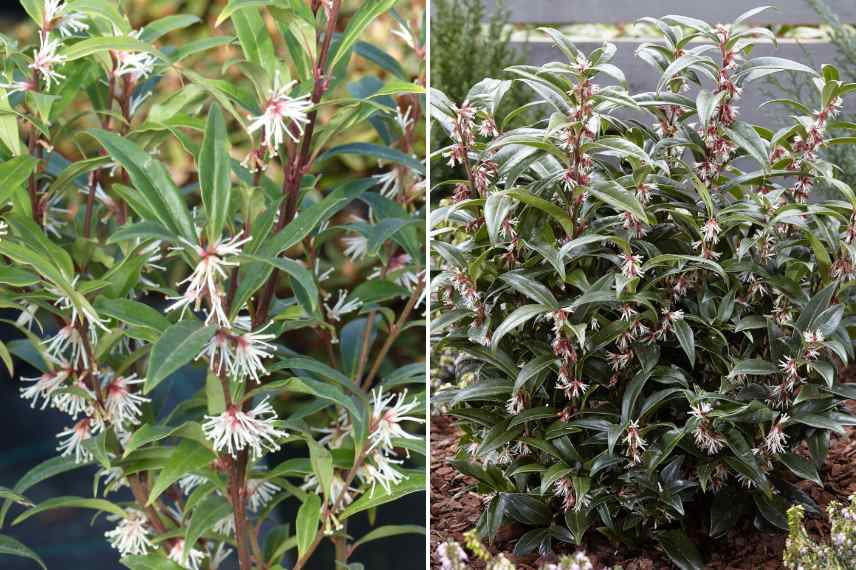
Sarcococca var digyna ‘Purple Stem’ and Sarcococca ‘Winter Gem’
What size and type of pot?
Sarcococca forms beautiful bushy clumps and has a dense, compact habit that is more or less spreading depending on the variety. It is quite vigorous, even when grown in a pot. Therefore, the container must allow this bush to develop properly. The height of the pot depends on the chosen variety. Choose a pot that is at least twice the size of the root ball, approximately 40-50 cm in width and depth. It should have drainage holes at the bottom to allow excess watering or rainwater to escape. You will repot it into a slightly larger pot as it grows.
In terms of material, the substrate dries out more quickly in porous terracotta pots, which will require more frequent watering. Plastic pots have the advantage of being much lighter and more economical, and they tend to retain moisture. This bush appreciates well-drained substrates that remain cool, so the ideal material should retain some freshness.
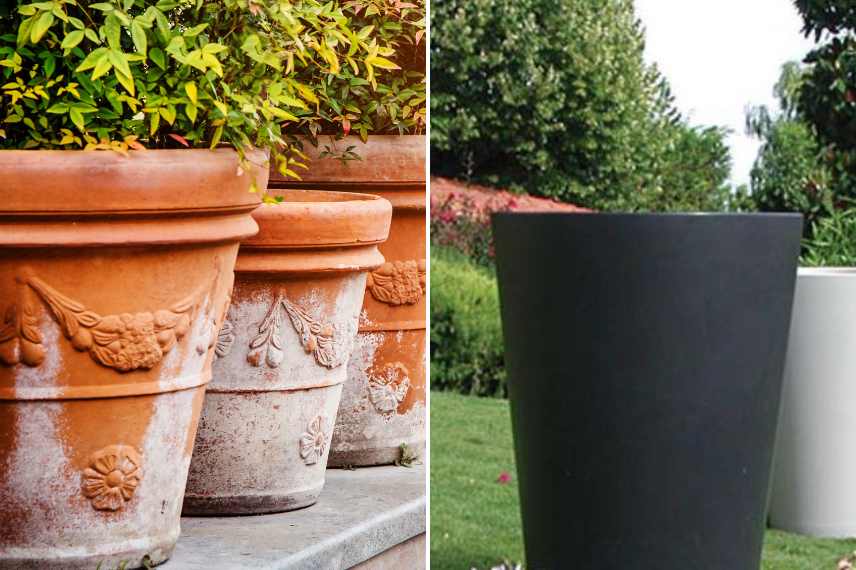
Terracotta or plastic pot, but always with drainage holes at the bottom to allow water to escape
What substrate?
Originating from woodlands, Sarcococca thrives in its natural environment with fresh, humus-bearing, well-drained soil. It only fears full sun, especially south of the Loire, and limestone. In pots, it will require a substrate that is rather acid, fresh without being too wet, and draining. It cannot tolerate stagnant moisture that could rot its roots. You can plant it in a mix of shrub compost and heather soil. If you wish to use your garden soil, it must be non-limestone as this bush does not tolerate it. Add a bit of river sand, at a rate of 10 to 20%, to improve drainage. We recommend spreading a layer of clay balls, pumice, or gravel at the bottom of the pot, once again to ensure proper drainage and protect its roots.
→ To learn everything about substrates, check out our article: «Balcony, terrace and small gardens: composts and fertilisers perfect for small spaces – The latest innovations»
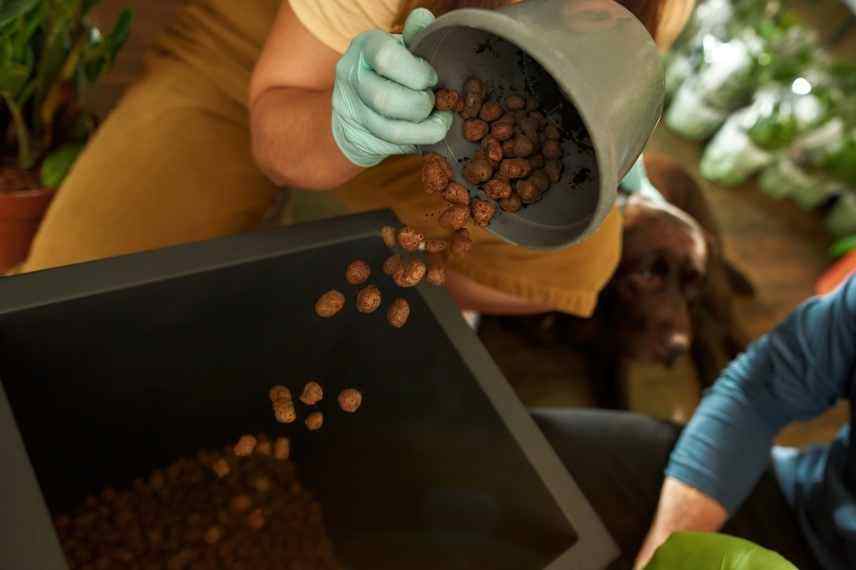
A drainage layer is essential before adding the substrate to the pot
Read also
Sarcococca: 5 companion planting ideasWhen and how to plant?
The best time to plant a Sarcococca sold in a container is from February to April or from September to November, after heavy frosts and extreme heat, while also avoiding snowy periods. For planting, prepare the following:
- Some clay balls or pumice to ensure drainage at the bottom of the pot
- An organic mulch to reduce watering and maintain substrate moisture. Prefer bark or pine needles which are well-suited for this acidophilous bush.
- Moisten the root ball by bottom watering for about 30 minutes
- In the bottom of the perforated pot, spread a drainage layer about 15-20 cm deep
- Pour a portion of the substrate to fill about 1/3 of the pot
- Gently untangle the root ball
- Position the bush upright in the centre of the pot
- Fill in with the remaining mix without burying the collar
- Firm the soil around the trunk by hand
- Water generously
- Spread the organic mulch
Where to install it?
Sarcococca naturally grows in undergrowth and damp forests, even flowering in dense shade. While it can tolerate brief periods of slight drought when planted in the ground, it will suffer more quickly from scorching exposure when in a pot. Place your pot on a shaded terrace, sheltered from cold and drying winds to preserve its flowering, close to the house or under a window, for example, so you can enjoy its fragrance all winter long. Although hardy down to -15 to -20°C, it thrives in an oceanic climate and, being highly resistant to pollution, adapts well to urban gardens.

A shaded terrace or balcony will be an ideal location for your Sarcococca planted in a pot
Maintenance, pruning and care
Easy to care for, Sarcococca tolerates pollution and is resistant to both diseases and pests. It is a low-maintenance bush, requiring little attention. While those planted in the ground tend to be forgotten and need little care, potted specimens require a bit more attention.
Watering
In pots, the soil tends to dry out more quickly than in the ground. In summer, monitor watering to keep the substrate sufficiently moist but not waterlogged. Watering will be more frequent than for those in the ground. Water once or twice a week with non-calcareous rainwater, especially during dry spells and heatwaves. Ensure that water does not stagnate around the roots and that the substrate does not dry out too much.
→ All our tips on watering potted plants in our guide.
Pruning
Due to its slow growth, it is not really necessary to prune it. However, an annual maintenance pruning can help maintain a harmonious shape. After flowering, use a pruning shear to lightly prune by removing branches that disrupt its symmetry. Also, remove any overly long, poorly placed, or dead stems. Be aware that by pruning, you will miss out on its decorative fruiting.
Fertilisation
In pots, the substrate quickly loses its nutritional qualities, with nutrients depleting faster. Sarcococca will appreciate an application of compost each autumn, incorporated by scratching it into the soil at its base.
Wintering
Sarcococca are quite hardy shrubs, with most species tolerating negative temperatures of around -15/-20°C. They can spend the winter outdoors and do not need to be brought indoors. However, potted specimens are more sensitive to cold, and if temperatures drop below -15°C, it is advisable to provide protection. As a precaution, from autumn onwards, mulch the base with a thick organic mulch to keep its roots warm. In regions with very harsh winters, it is better to bring the pot indoors for the winter into a cold greenhouse or a bright, unheated room. You can take it back outside in spring.
→ Unsure about your region’s climate? Check our advisory sheet on climatic zones and USDA zones in France.
Repotting
Repotting may be necessary every 4-5 years, choosing a slightly larger pot each time. Each autumn, top dressing will suffice. This involves renewing a few centimetres of the exhausted substrate with a good nourishing potting soil.
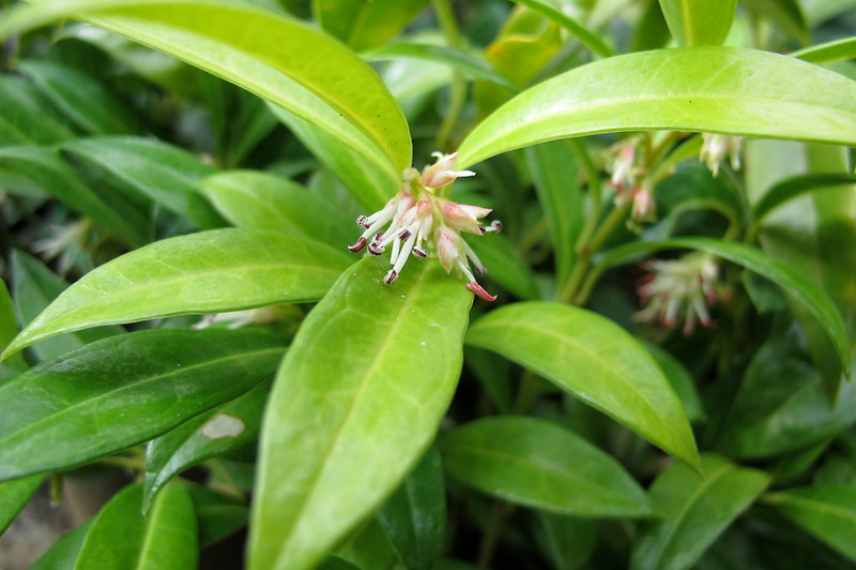
Flowering of Sarcococca var. humilis (© Megan Hansen)
- Subscribe!
- Contents
Comments