





























Growing an Opuntia in a pot
Tips and tricks for success
Contents
The Opuntias are a large family of cacti that, in addition to having many large and small thorns, are easily recognisable by their prickly pear shape. They include over 200 species, including the famous Barbary Fig, known for its delicious fruits.
Native to the arid regions of North America, these prickly pear cacti, also known as Oponces or Nopales, can naturalise around the Mediterranean, due to its drier climate compared to other regions.
Elsewhere, pot cultivation will allow you to control humidity, which is essential for successfully growing Opuntia.

Type of pot and dimensions
First of all, we will check that the pot has proper drainage holes. There’s no need to plan for a water reserve, as we can imagine.
As for the material, terracotta pots have the advantage of being more breathable than plastic ones, which is beneficial for growing Opuntia, as it absolutely detests excess water.
Finally, regarding the pot dimensions, these will depend on the size of your Opuntia. Large specimens, while impressive, tend to be unstable, especially when one of their pads falls. Therefore, it’s better to choose a pot that is relatively shallow to add stability.
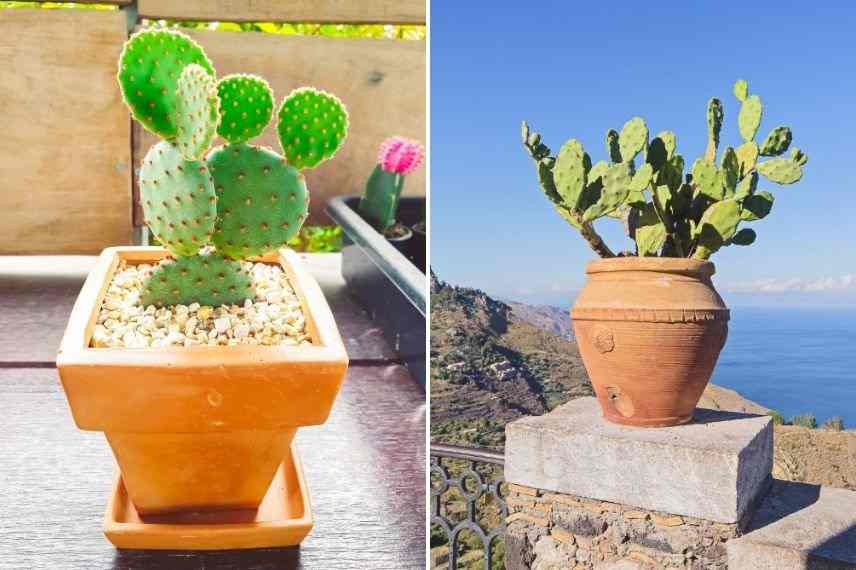
Opuntias in terracotta pots
Read also
Propagating cacti and succulentsDrainage and substrate
Start by installing a good drainage layer at the bottom of the pot, for example by pouring in clay balls, or even terracotta shards or gravel. For instance, in a pot with a diameter of 30 cm and roughly the same height, the drainage layer should be at least 5 cm thick. For larger Opuntias, you can place stones at the bottom to stabilise the whole setup.
Next, fill the pot with a very draining substrate. The simplest option is to use special Cactus compost, specifically designed to meet the needs of this type of plant. This will ensure good drainage for your Opuntia. You can also mix universal compost with a good amount of sand; the latter will not only ensure good drainage but will also add weight to the pot.
You might be tempted to fill the pot with garden soil. Here are a few scenarios:
– if your soil is light – even when wet, it crumbles – you can mix it, in equal parts, with compost and sand to further improve drainage.
– if your soil is clayey – it is sticky and you can easily form a ball with it when wet – forget the idea of filling your container with it, as it would retain too much water at the root level, which would harm your plant.
Discover other Opuntia
View all →
Available in 1 sizes
Available in 1 sizes
Available in 1 sizes
Available in 1 sizes
Available in 1 sizes
Available in 1 sizes
Available in 1 sizes
Available in 1 sizes
Available in 1 sizes
Available in 1 sizes
When and how to plant Opuntia
Opuntia loves heat. Therefore, planting in spring or even summer will suit it, as it will benefit from the mild weather of the season to settle in. However, avoid excessive heat that can put young plants under stress.
Once your pot or container is filled with a drainage layer and suitable substrate, remove the Opuntia from its container, place it on the substrate, and fill in around it with the same draining substrate. Then water the plant very lightly. Be careful not to overdo it. You can also wait 15 days before watering your plant; this delay will allow the roots to heal before watering. Finish by adding a mineral mulch – sand or gravel – which, in addition to giving a southern touch, will have the advantage of weighing down the pot while accumulating the heat that Opuntia enjoys so much.
Indoors or outdoors, Opuntia needs plenty of light. It should be placed in full sun in the garden and indoors just behind a window. Be aware that just a few dozen centimetres from the window, you already lose a significant amount of light, which can be fatal for this type of plant.
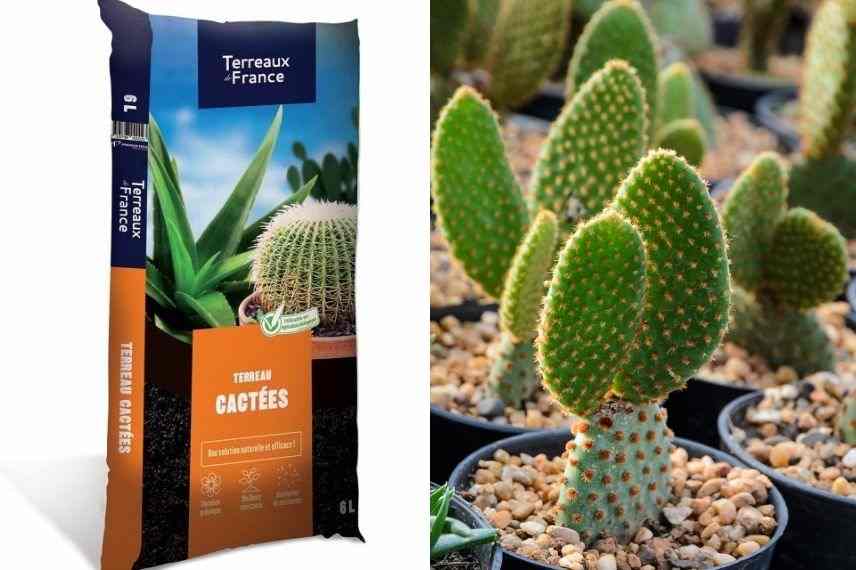 A special cactus compost ensures good drainage. Cover the surface of the substrate with a mineral mulch.
Watering and Maintenance
If your pot is placed outside, you probably won’t need to water in spring and summer. The Opuntia will be satisfied with rainfall.
In winter, however, it will be wise to protect your Opuntia from excess water as much as possible. If you live in the South, the Opuntia can stay outside. In other regions, however, especially if you live in a well-watered area, protect your Opuntia from heavy rains by placing it under a canopy, for example. Or better yet, bring it inside and place it behind a window. Because while some cultivars can withstand temperatures dropping to -15 °C – in extremely well-drained soil -, others are much more sensitive to frost. Keep in mind that this is a plant that particularly enjoys light and warmth.
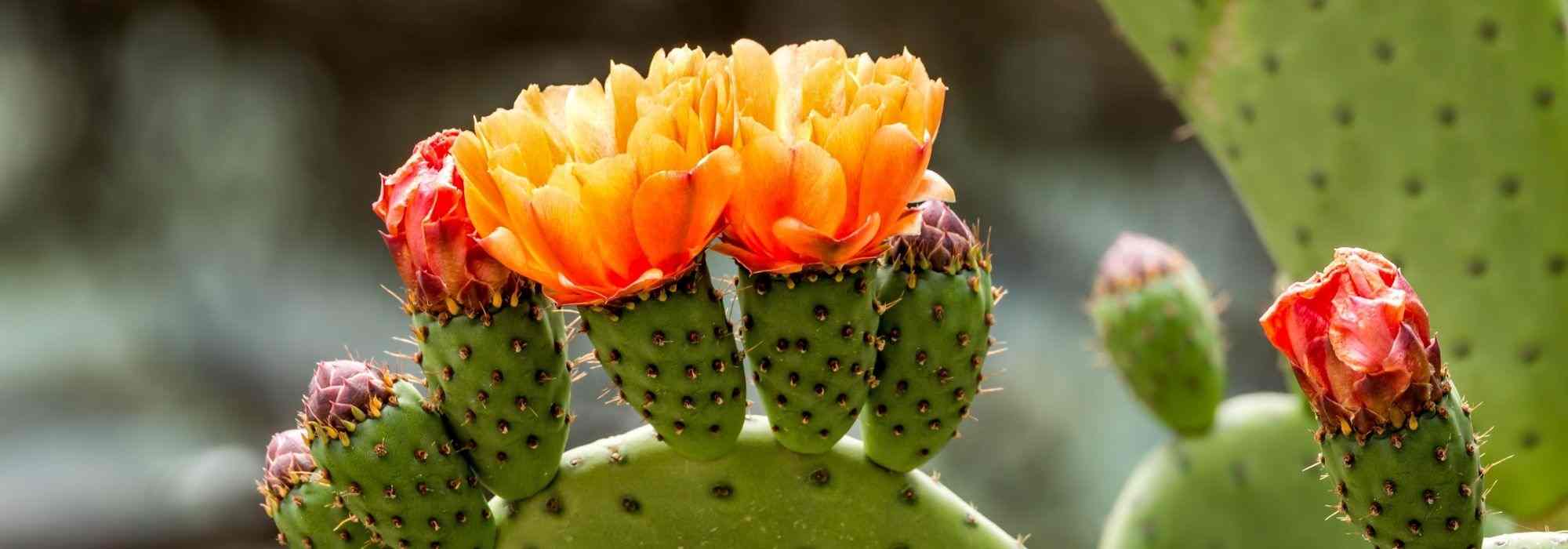
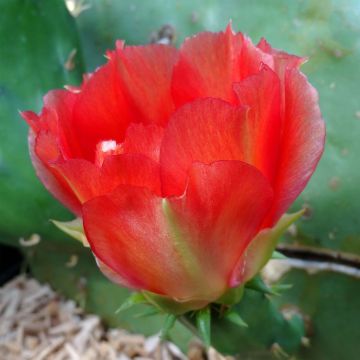
Indoors, the Opuntia should be watered regularly, but sparingly: you should not flood it or soak the root ball! A frequency of once every 15 days in spring and summer should be more than sufficient. Watering will be spaced out further in autumn, and the Opuntia may even go completely without water during winter. This winter rest also has the advantage of promoting the plant’s flowering in the following spring or summer. Some Opuntias are particularly noted for their beautiful flowers, such as the Opuntia anacantha with its yellow flowers and the Opuntia engelmannii ‘Lindheimeri’, which is larger, reaching up to 2 m in height, with beautiful orange-red flowers.
As for water quality, rainwater is always ideal, as it is much less calcareous than tap water, especially in certain regions.
For maintenance, while it is very easy to grow, you can also provide a special Cactus fertiliser to stimulate the plant’s growth and flowering.
And indoors, remember to dust the plant from time to time, so it can breathe well.
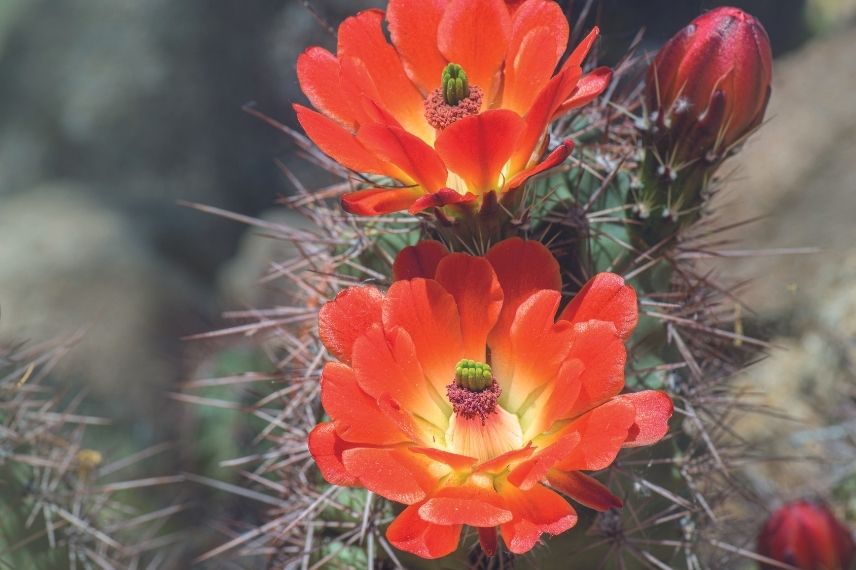
Flowers of the Opuntia engelmannii ‘Lindheimeri’
How to repot an Opuntia
When repotting the Opuntia, you allow it to develop new spikes.
Before you get started, you will need to equip yourself with a good pair of gardening gloves to protect yourself from thorns.
Quick tip: if you wrap your plant in several layers of newspaper, you won’t need overly thick gloves, which will give you more dexterity at your fingertips. After all, you are much more precise with softer gloves.
To learn everything about growing Opuntia, check out our guide Opuntia, Prickly Pear Cactus: Planting, Cultivation and Care.
- Subscribe!
- Contents
![[opuntia pot="cactus pot" bac="trough" jardinière="planter"]](https://en.promessedefleurs.eu/blogwp/wp-content/uploads/2022/04/Cultiver-des-poivrons-et-des-piments-en-pot-1.jpg "Growing a prickly pear in a pot")
Comments