


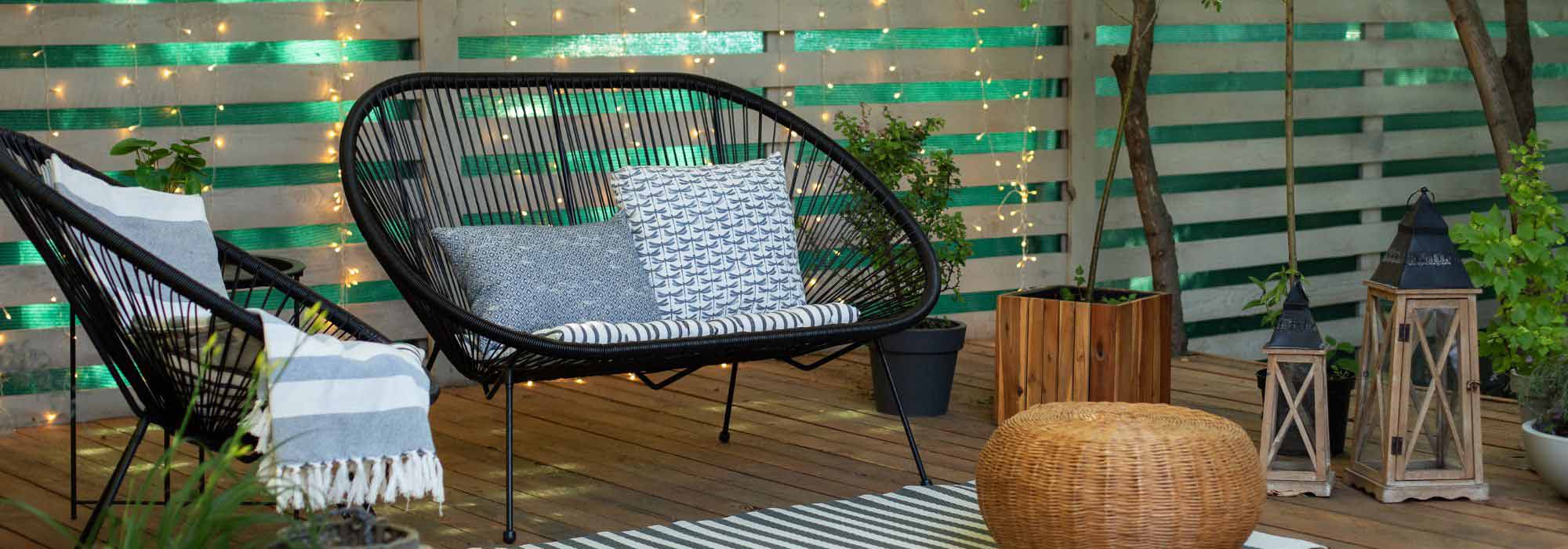
How to arrange a small terrace?
Our tips for optimising space and creating a true outdoor haven
Contents
During fine weather, a terrace often becomes a true extension of the home, turning into a separate room where you can eat, entertain guests, relax, garden, and more. Even if your terrace is small, it is entirely possible to create a pleasant outdoor corner.
Whether in the city or more rural areas, a few well-thought-out arrangements suitable for small spaces will suffice. The goal? To create a terrace that is both functional and optimised. This way, you will have a space where you feel comfortable, without a sense of oppression, even if you only have a few square metres.
Choosing an atmosphere, adding plants, selecting furniture, or incorporating clever visual effects: here are our 6 tips for a successful layout of your small terrace.

Finding Your Style for a Pleasant Terrace
You have plenty of options to create an atmosphere to your taste on your mini-terrace. For a quick and inexpensive setup that will instantly transform the space, consider lighting, cushions, rugs, or fairy lights. These decorative accessories come in all styles.
Choose your own style, for example:
- a lush exotic-inspired terrace, filled with plenty of plants, favouring green tones complemented by a few colourful touches, tropical fauna and flora patterns, all on a decking floor;
- an elegant and modern industrial-inspired atmosphere, featuring metal materials, one or two dominant colours, accessories or paints with graphic patterns, as well as a concrete or tiled floor;
- a true bohemian cocoon, blending warm and natural colours, lots of patterns, an accumulation of rugs and textiles for a very cosy feel;
- a Scandinavian style with very clean lines, consisting of soft colours, natural and understated materials, on a wooden slat floor;
- a rustic atmosphere, with plants that can create beautiful fresh or dried bouquets, natural materials like rattan or rush, weavings with macramé, accessories with floral patterns, and why not, synthetic lawn to serve as flooring;
- a terrace like by the seaside, with sun loungers, marine decor, a colour palette of blues and whites, as well as a surface of pebbles or gravel.
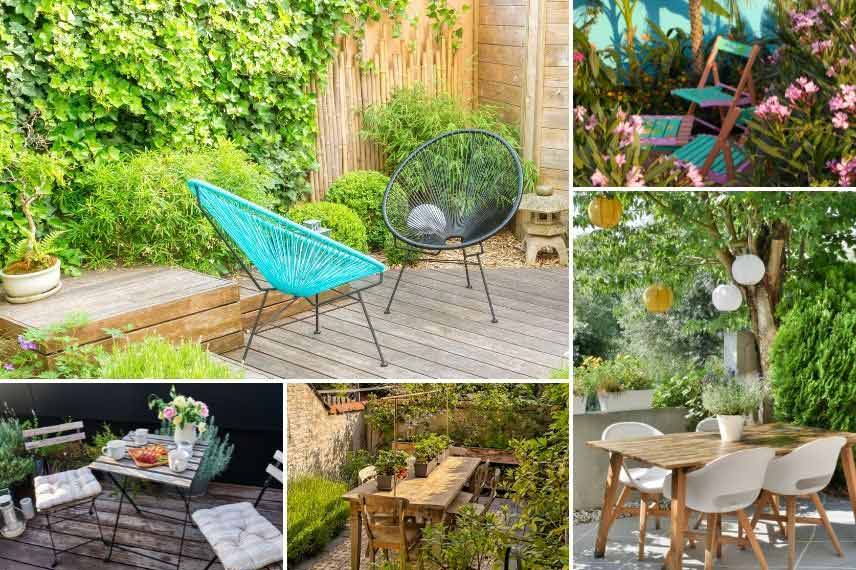
Minimalist, tropical, rustic… find the style that suits you to arrange your pocket terrace!
Read also
8 mistakes to avoid on your terracesChoosing Plants Suitable for Small Spaces
It’s not because your terrace is small that you have to give up on greening it, thinking that plants will take up too much space or require too much maintenance. It’s enough to choose modest-sized plants that do not exceed approximately 1.8 metres in height and 1 metre in spread. Prefer varieties that are not too vigorous to avoid excessive pruning. Of course, opt for plants suitable for container growing.
You can choose or mix pots, planters, troughs, jars, hanging baskets, or even bags. Ingrid explains in her article how to grow in bags on a terrace.
Three essential points to consider when choosing your plants are:
- First, think about orientation. A terrace facing north will accommodate plants that thrive in shade, while a terrace that receives sunlight all day will favour plants that enjoy warmth and light.
- Take into account your climate. If your winters are harsh, choose plants with good hardiness. If your climate is humid, avoid plants that are susceptible to fungal diseases.
- Consider how you wish to use your terrace: should the plants serve as a privacy screen (small evergreen bushes), a windbreak (sturdy plants), dress a structure (plants climbing), provide food (vegetable plants, small fruit trees, dwarf fruit trees), or simply have an ornamental role (bushes, perennials, and annuals)?
In terms of layout, you can choose, depending on the natural arrangement of your terrace, to place the plants around the edges or create a sort of central island around which the furniture will be arranged.
To save space, you can choose specific, compact tools to maintain your plants, such as potting mixes for terraces and small gardens. Virginie explains everything in her article “Balcony, terrace and small gardens: potting mixes and fertilisers perfect for small spaces”.
If you do not wish to spend too much time caring for your plants, choose undemanding varieties that require little maintenance. You can also opt for automatic watering or the installation of ollas. Find our tips in the articles “How to install an automatic watering system on a balcony or terrace” and “Watering solutions for a balcony or terrace”.
Discover other Patios
View all →
Available in 1 sizes
Available in 1 sizes

Available in 1 sizes
Available in 0 sizes
Available in 0 sizes
Available in 0 sizes
Available in 1 sizes

Available in 1 sizes
Available in 0 sizes
Available in 1 sizes
Play with heights to add volume.
To create a sense of volume and make your small terrace appear larger, nothing beats playing with perspectives and heights. This also helps to optimise space and gain floor area.
To achieve this, consider dressing the walls and playing with verticality. For example, you can hang pots or planters, suspend a tapestry, install storage solutions, or put up a trellis for a climbing plant to run along. If drilling into your partition is not an option, simply place a ladder or a screen to hang suspensions and lights.
Balustrades or guardrails can also serve as supports for installing a garland or a climbing plant.
To save space, forget the bulky parasol and opt for shade sails or blinds instead. They also have the advantage of creating lovely light patterns on your small terrace while protecting you from the sun’s rays.
Don’t underestimate the benefits of a large mirror to add depth and create an impression of grandeur.
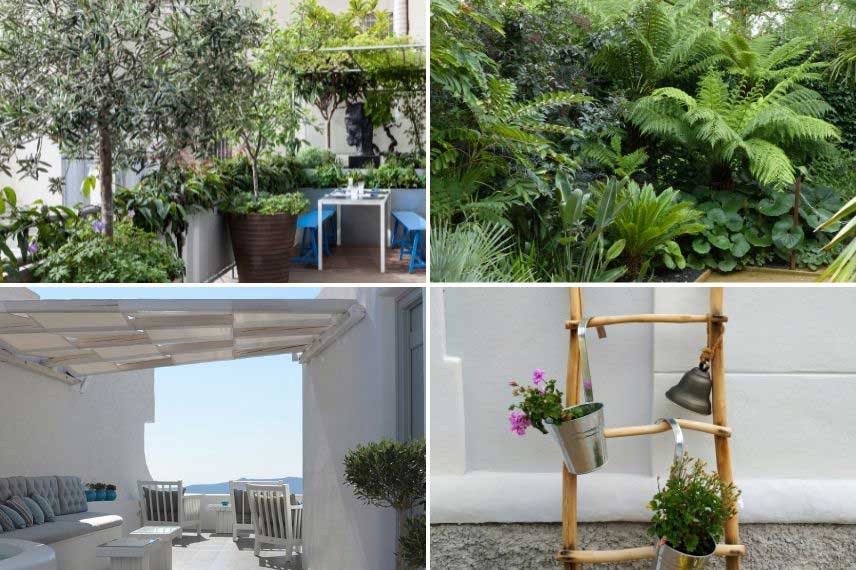
Play with plants and decorative elements to bring verticality and shade with blinds or shade sails
Read also
A beautiful terrace in winterChoose space-saving furniture
To arrange a small terrace, choose suitable, practical, and functional furniture that can be set up and stored away easily. Stackable, multifunctional, or foldable furniture will be your best allies. Conversely, logically avoid bulky furniture that weighs down the space.
Opt for an extendable table that can be enlarged with a leaf when you have guests, rather than a large, heavy table that stays in place all year round. The shapes of furniture can also adapt to small spaces: round tables and curved furniture will be more harmonious. Instead of large armchairs, favour poufs or floor cushions, which are easier to store and move. If your budget allows, you can also obviously opt for custom-made solutions.
Some furniture can even offer multiple uses: a bench that doubles as a storage chest, a sofa with a backrest that serves as a planter, etc.
Kitchen equipment, such as a plancha or barbecue, can be placed on a trolley with wheels. This will simplify their movement, allowing them to be stored away after use.
With these tips, circulation will be facilitated on your small terrace, and the space will be perfectly optimised.
Finally, consider prioritising “outdoor” furniture, especially if your terrace is not sheltered from the elements or is exposed to strong sunlight.
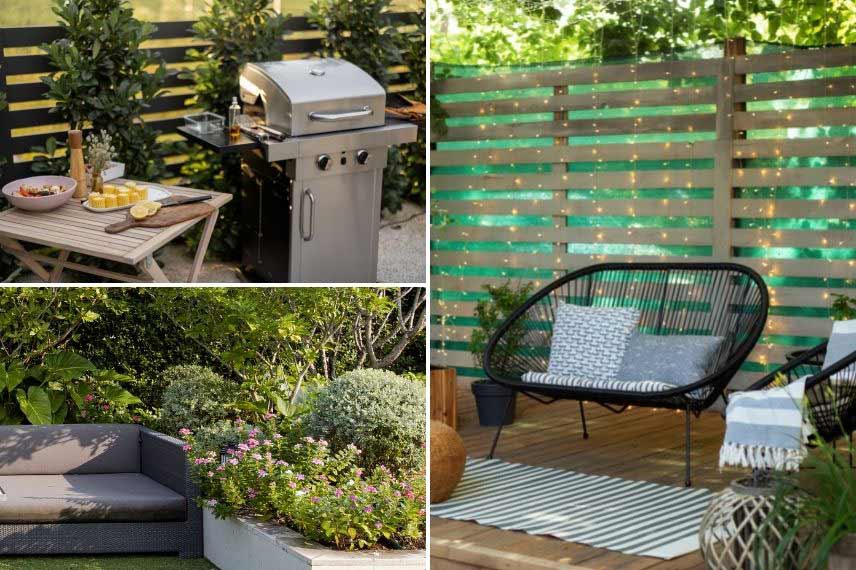
Adapt the elements of your terrace (plancha, furniture…) to the size and configuration of the space
Protecting yourself from prying eyes and the wind without weighing down the space.
For a well-designed small terrace, it is important to have privacy and feel protected from the elements. To create effective screens or windbreaks, turn to climbing plants that will form true green partitions. They will provide a lighter impression than a heavy structure, while adding a natural touch and even a bit of freshness.
Choose plants that are suitable for your climate, of modest sizes, and suitable for container cultivation. With its 1 metre height in all directions, the non-running bamboo Fargesia murielae ‘Bimbo’ is ideal for protecting against gusts as well as prying eyes. To dress up a fence or balustrade, try the dwarf honeysuckle Lonicera periclymenum ‘Chic et Choc’ (1 metre high with a 70 cm spread).
On a small terrace that is little used in winter, choose deciduous plants that will allow light to pass through during the cold season. Conversely, for year-round protection, opt for the Mexican orange blossom Choisya ternata ‘Apple Blossom’ (1.2 metres high with a 60 cm spread) or the Japanese Aucuba ‘Rozannie’ (1.1 metres in all directions), which retain their leaves in all seasons.
Additionally, you can explore our selection of 6 plants to create a privacy hedge on your terrace and our selection of plants to break the wind on a terrace.
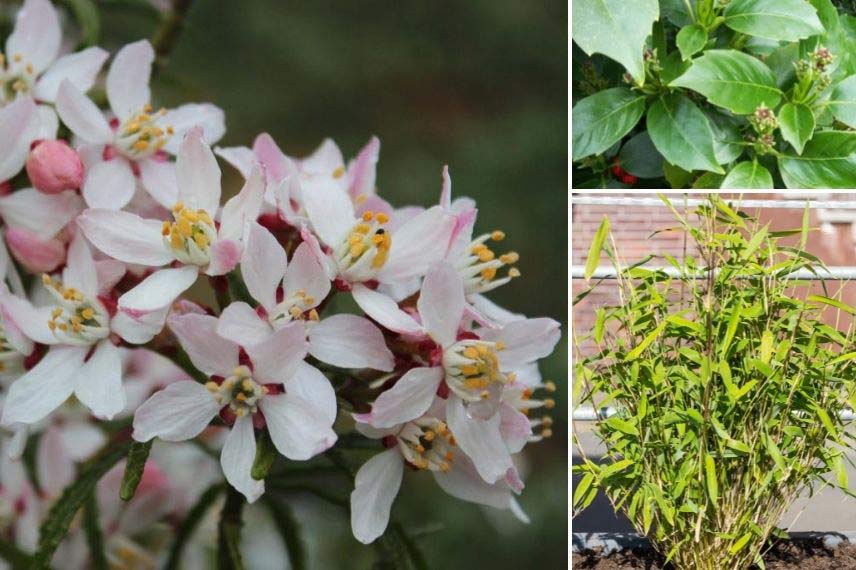
Choisya ternata ‘Apple Blossom’, Aucuba Japonica ‘Rozannie’ and Fargesia murielae ‘Bimbo’
Test complementary arrangements on your small terrace.
And because a small terrace can also be a stage for experimentation, especially if you have a DIY spirit, you can try out foldable arrangements. There are small pools, or even sandpits for children, that can be hidden under the flooring, stored away to be converted into seating, and so on.
Finally, even in a small space, it is possible to enjoy a miniature pond. Find Olivier’s tips in the dedicated article: “Mini pond: a small water garden for the terrace or balcony.”
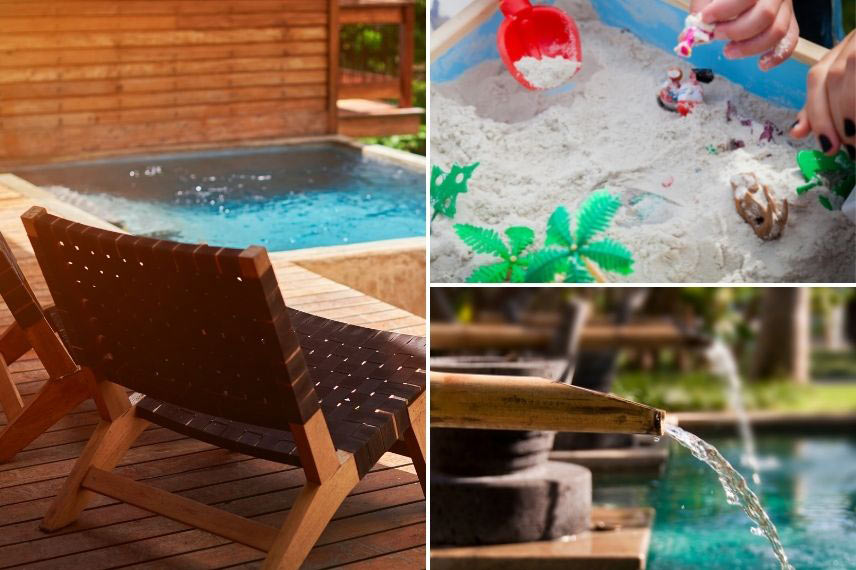
Even small, your terrace can perfectly offer you a small swimming area, play corners for children, and a miniature pond
- Subscribe!
- Contents
![[plantes="petites plantes à feuillage persistant"]
[arbustes="arbustes nains"]
[fleurs="plantes à floraison abondante"]
[mobilier="mobilier compact"]
[éclairage="éclairage discret"]
[décoration="éléments décoratifs minimalistes"]](https://en.promessedefleurs.eu/blogwp/wp-content/uploads/2022/06/amenager-petite-terrasse.jpg "[title]How to design a small terrace
[content]
If you have a small terrace, you can still create a charming outdoor space. Here are some ideas to help you make the most of your {glossary}terrace{glossary}:
1. **Choose the right plants**: Opt for {glossary}ornamental plants{glossary} such as {glossary}lavender{glossary}, {glossary}geraniums{glossary}, or {glossary}petunias{glossary} to add colour and fragrance to your terrace.
2. **Vertical gardening**: Make use of walls or railings to hang {glossary}flowerpots{glossary} or install a {glossary}vertical garden{glossary} to save space.
3. **Furniture**: Select small, foldable furniture like bistro sets or compact chairs and tables to maximise space.
4. **Lighting**: Enhance the ambiance with fairy lights, lanterns, or solar-powered lamps for cosy evenings outdoors.
5. **Decorative elements**: Add a personal touch with decorative items like cushions, rugs, or outdoor artwork.
By following these tips, you can transform your small terrace into a relaxing and inviting retreat.")
Comments