





























How to choose a Beard?
Buying guide and criteria to find the ideal variety
Contents
It is the rock garden plant par excellence, which is grown and propagated with remarkable ease: the Houseleek or Sempervivum!
Very hardy, these small succulents also tolerate the poorest and stoniest soils, drought, and lack of water. Their roots can thrive on very little substrate. They are therefore perfect plants for both dry gardens and mountain rockeries, as well as for filling the gaps in walls.
The varieties differ mainly in the colour of their leaves, but also in their texture or the colour of their flowers. Based on these different criteria, here is our buying guide to help you find the variety that suits you best.

Choosing a houseleek based on the colour of the rosettes
Succulents, known as houseleeks, feature evergreen foliage made up of fleshy, pointed ovate leaves. They are imbricate, forming attractive rosettes that give these plants a “mini artichoke” appearance.
Rosettes in Green Tones
Green is one of the most common foliage colours among houseleeks. It comes in several shades.
The Sempervivum tectorum or common houseleek is undoubtedly the most popular variety. It features rosettes of a medium green, slightly tinged with red. Quite similar to this cultivar, the calcareous houseleek (Sempervivum calcareum) displays pale green leaves, with tips beautifully tinged in red-brown.
On the other hand, the green houseleek with a cottony centre presents a rather almond green colour, while the ciliate houseleek offers a silver-green hue.
The ‘Pseudo-ornatum’ produces rosettes of a olive green tinged with burgundy in summer, then brown in winter.
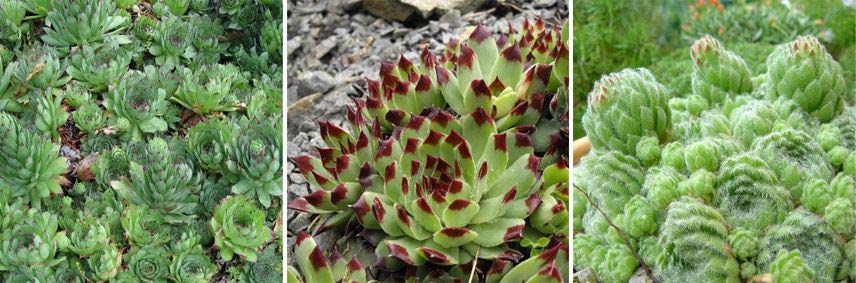
Sempervivum tectorum, Sempervivum calcareum and Sempervivum ciliosum var. borisii
Rosettes in Purple Tones
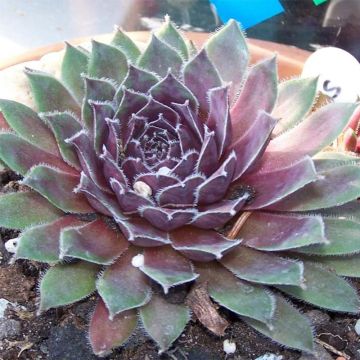
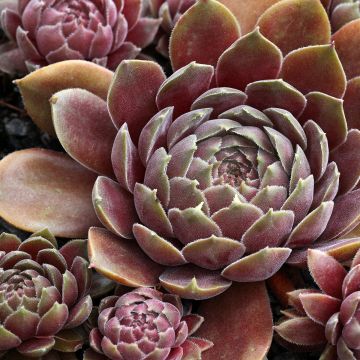
Another very common colour among houseleeks is purple. Its shades range from light to intense, sometimes leaning towards bronze, violet, brown, or even black.
Let’s start with the Sempervivum pilatus, a little gem with violet-purple rosettes, tinged with pink in the sun. The Sempervivum ‘Silberkarneol’ prefers a purple leaning towards reddish-pink, while ‘Othello’ offers a purple shifting towards orange.
With ‘Cranberry Cocktail’, the burgundy-purple leaves are beautifully highlighted by a shiny green at their tips.
More surprisingly, ‘Dark Beauty’ is adorned with dark purple shades, giving the impression that its rosettes are almost black depending on the light. Still within the ‘Chick Charms’ collection, the elegant ‘Chocolate Kiss’ treats us to a delicious chocolate-brown-purple. The ‘Bing Cherry’ prefers a burgundy-purple, shifting to a strong orange and then to light green in warm weather.
Finally, let’s mention the beautiful houseleek ‘Plum Perfect’, whose colour transitions from lavender-purple to violet-purple during the cold season.
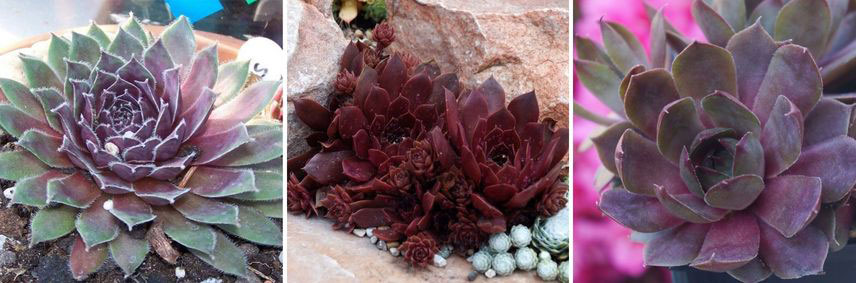
Sempervivum pilatus, Sempervivum ‘Chick Charms ® Chocolate Kiss’ and Sempervivum ‘Chick Charms Plum Perfect’
Other Colours to Discover
Among other interesting colours, we can mention the hybrid houseleek ‘Feldmaier’, with its rosettes flirting between grey and bronze. Their base is beautifully highlighted by a touch of mauve.
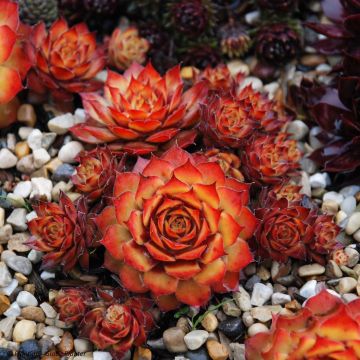
The Sempervivum ‘Chick Charms® Berry Blues’ rewards us with leaves of an evolving colour. Initially bluish-grey, they turn purple-mauve under the influence of cold in autumn or winter. In the same collection, the variety Cherry Berry offers a magnificent bright cherry red, which turns green with red reflections as autumn arrives.
We should also mention the red houseleek, one of the first hybrid varieties of houseleek. Its green rosettes gradually take on red hues, eventually becoming distinctly copper-red in autumn.
Finally, let’s talk about the surprising ‘Purple Beauty’, which also changes colours over time, offering no monotony. Its rosettes first reveal a blue-green with silver reflections. As temperatures drop, they then take on a copper-purple hue.
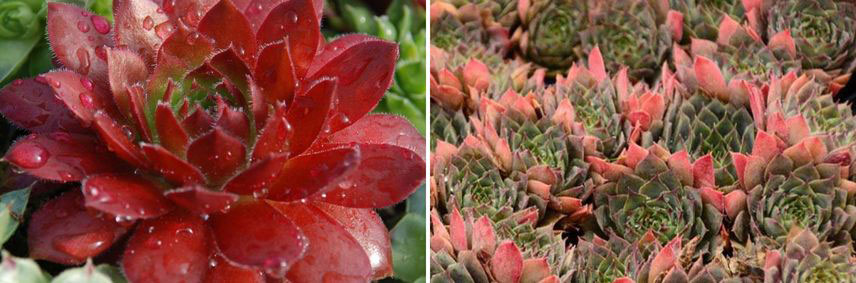
Sempervivum ‘Chick Charms Cherry Berry’ and Sempervivum ‘Purple Beauty’
Multicoloured or Variegated Rosettes
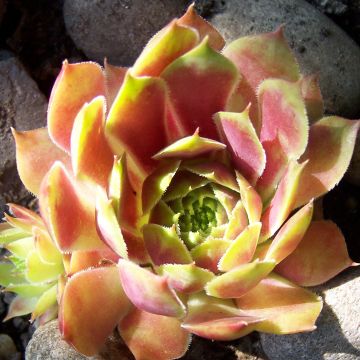
The variety ‘Gold Nugget’ undoubtedly offers one of the most original colours for a houseleek. Its leaves, initially simply bright green in summer, later take on flamboyant shades. They blend gold, lime green, and increasingly bright touches of red-orange as winter progresses. The rosette can even end up becoming entirely bright red. A succulent with a true brilliance to brighten every season!
With ‘Cinnamon Starbust’, the rosettes reveal a bright green centre, surrounded by larger leaves displaying an elegant cinnamon-red.
The Sempervivum ’Commander Hay’ offers us bicoloured rosettes during the beautiful season, combining reddish-purple and apple green at the base and tips of the leaves.
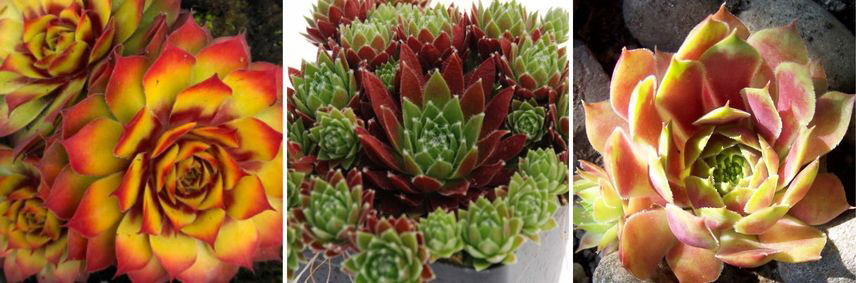
Sempervivum ‘Chick Charms Gold Nugget’, Sempervivum ‘Chick Charms Cinnamon Starbust’ and Sempervivum ‘Commander Hay’
Choosing a houseleek based on the texture of the rosettes
As with all succulents, the leaves of houseleeks are well fleshy and thick, rich in juice, allowing them to endure long periods of drought and lack of water without flinching. Evergreen, they are naturally decorative in all seasons.
Some of them also have the unique feature of revealing a cottony or slightly hairy appearance, which gives them an extra touch of charm. This is the case with the bronze-purple hybrid houseleek, whose leaves are delicately edged with long silver cilia.
On its part, the ciliate houseleek resembles certain varieties of cactus, with its very tight globular rosette, abundantly covered in silky grey-silver threads.
Another curiosity: the Sempervivum ‘Chick Charms® Cotton Candy’, which truly lives up to its name. It indeed reveals a rosette with a cottony heart, as if caught in a perfectly symmetrical spider’s web. In the same vein, the Sempervivum arachnoideum produces woolly rosettes, as if covered in threads of silk that shine in the sun. ‘Rubrum’ is no exception, with its leaves wrapped in silk, as if covered in a delicate sparkling spider’s web.
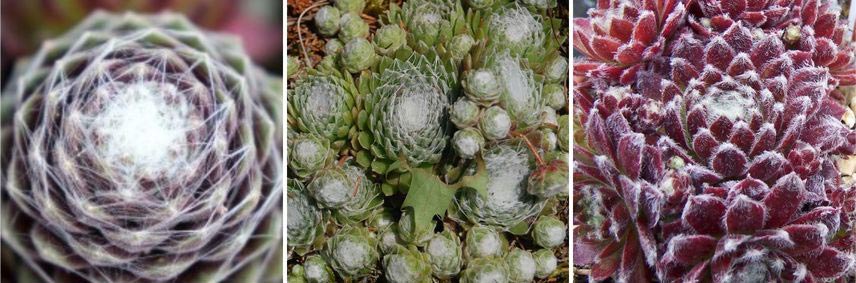
Sempervivum ‘Chick Charms ® Cotton Candy’, Sempervivum arachnoideum and Sempervivum arachnoideum ‘Rubrum’
Discover other Sempervivum - Houseleek
View all →
Available in 0 sizes

Available in 1 sizes
Available in 1 sizes
Available in 1 sizes
Available in 1 sizes

Available in 1 sizes
Available in 1 sizes
Available in 1 sizes
Available in 1 sizes
Available in 1 sizes
Choose a beard according to the flower colour.
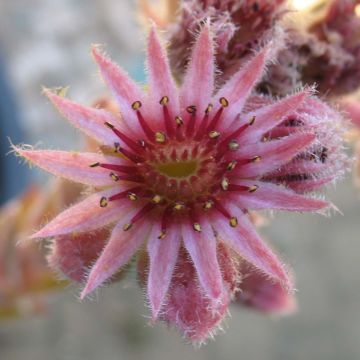
Beyond their highly ornamental foliage, houseleeks can also be appreciated for their delicate star-shaped flowering, which adds a bit of height to the plant in summer. The most common flower colour is pink, which can vary in intensity depending on the varieties.
For example, Sempervivum ‘Alpha’ features a bright carmine pink. In contrast, ‘Appletini’ has a more purplish-pink flowering. Meanwhile, ‘Othello’ produces light pink flowers. The variety ‘Commander Hay’ reveals soft pink flowers with a yellow-green base and a red centre.
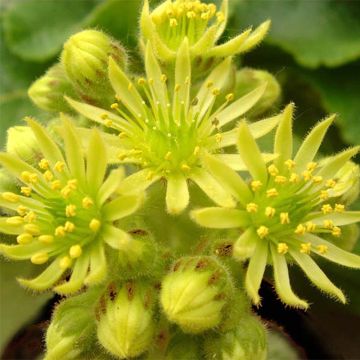
More rarely, there is the houseleek with yellow flowers (Sempervivum ciliosum var. borisii). Its small stars delicately combine yellow and pale green.
It is worth noting that there are also houseleeks with white flowers.
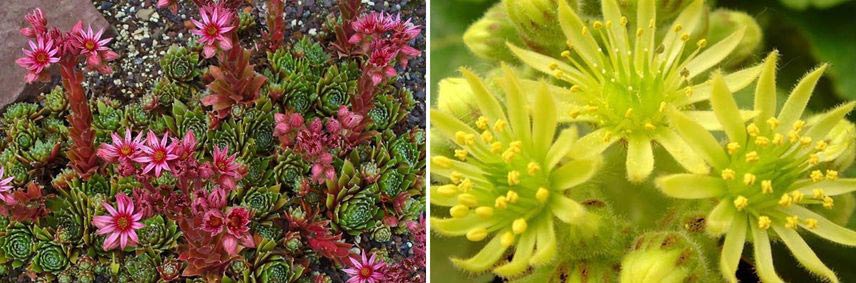
Sempervivum ‘Alpha’ and Sempervivum ciliosum var. borisii
- Subscribe!
- Contents
Comments