





























How to choose a Broom?
Buying guide and criteria to find the ideal variety
Contents
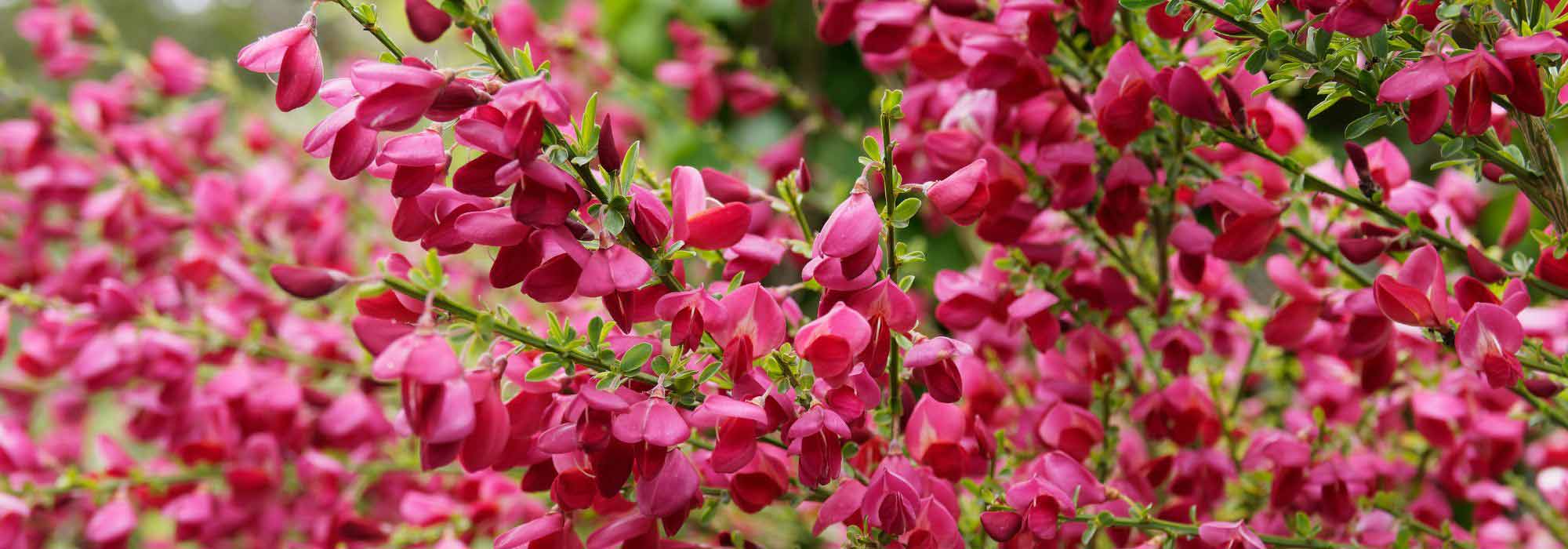
Brooms offer an abundant, colourful, and fragrant papilionaceous flowering. Depending on the varieties, the flowers appear in spring or summer.
These sun-loving bushes thrive in well-drained, poor, or even uncultivated soils, and they tolerate drought very well. These qualities make them essential for dry gardens, rockeries, or sunny borders.
Brooms provide a beautiful diversity of colours, flowering periods, shapes, and uses in the garden. Based on these different criteria, here is our buying guide to find the perfect variety of broom.

Based on the colour of the flowers
Yellow Brooms
Certainly the most common varieties: yellow brooms are perfect for brightening up gardens with their abundant, luminous flowering.
Yellow comes in various shades, for example:
- broom (Cytisus scoparius) ‘Golden Sunlight’ or ‘Luna’ don a beautiful golden yellow, the typical colour of brooms;
- more flamboyant, the variety ‘Apricot Gem’ reveals a golden yellow tinged with red-orange;
- the winged broom (Genista sagittalis) prefers a bright lemon yellow;
- the Tenerife broom opts for a slightly orange-yellow.
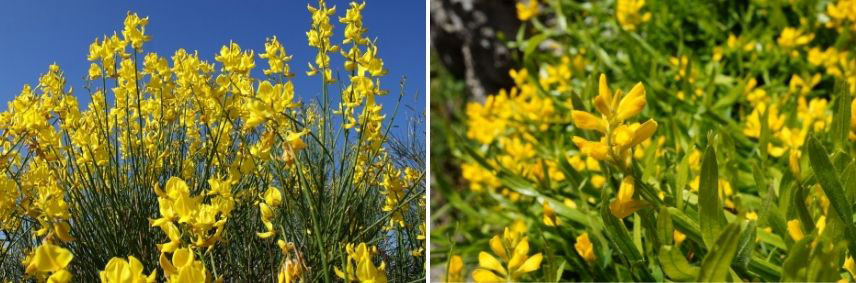
Cytisus scoparius and Genista sagittalis
Red Brooms
Equally dazzling, red-flowered brooms will not go unnoticed.
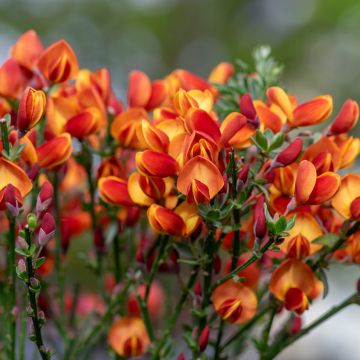
Let yourself be charmed by Cytisus (x) praecox ‘Hollandia’, with its flowers blending cherry red, pink, and cream white.
The broom ‘Boskoop Ruby’ opts for a beautiful ruby red, while ‘Roter Favorit’ features a carmine red contrasting with touches of golden yellow.
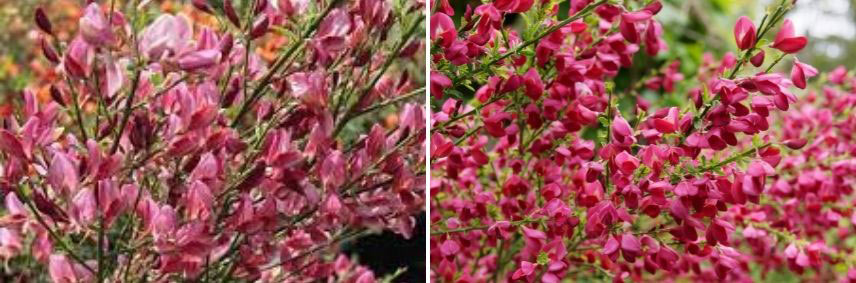 Cytisus (x) praecox ‘Hollandia’ and broom ‘Boskoop Ruby’[/caption>
Pink Brooms
Pink brooms also come in several shades, from the softest to the brightest.
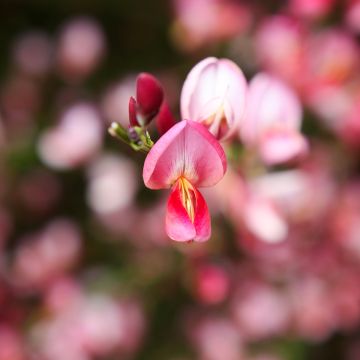
For a delicate touch, opt for ‘Moyclare Pink’, with its mauve-pink and cream flowers.
The purple broom (Chamaecytisus purpureus), as its name suggests, produces pale pink to violet flowers.
The Cytisus procumbens ‘Zeelandia’ prefers a mix of pink-lilac and cream, while C. scoparius ‘Burkwoodii’ graces us with a dark pink tinged with ochre.
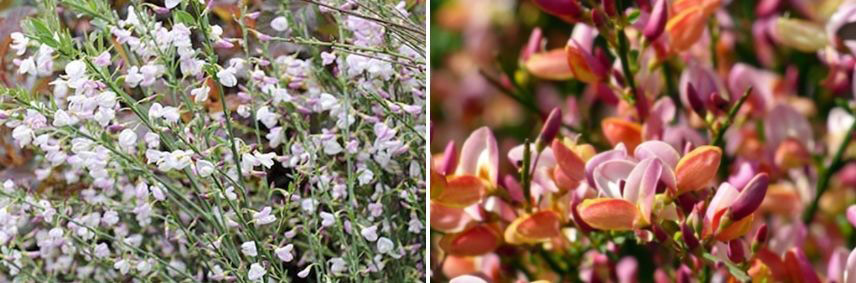 Cytisus scoparius ‘Moyclare Pink’ and Cytisus procumbens ‘Zeelandia’[/caption>
Multicoloured Brooms
Not content with its already rich colour palette, the broom also offers dazzling multicoloured varieties, which will undoubtedly add a sparkling touch to the garden.
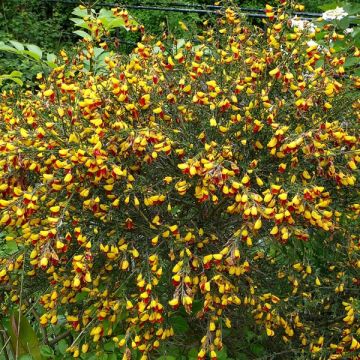
The Cytisus scoparius ‘La Coquette’ features small butterflies in shades of yellow, orange, and pink; ‘Lena’ prefers a rust-orange mixed with golden yellow; ‘Andreanus’ produces well-contrasted yellow and red flowers, and ‘Palette’ offers a flowering mix of red, orange, lilac, and peach. A true explosion of colours!
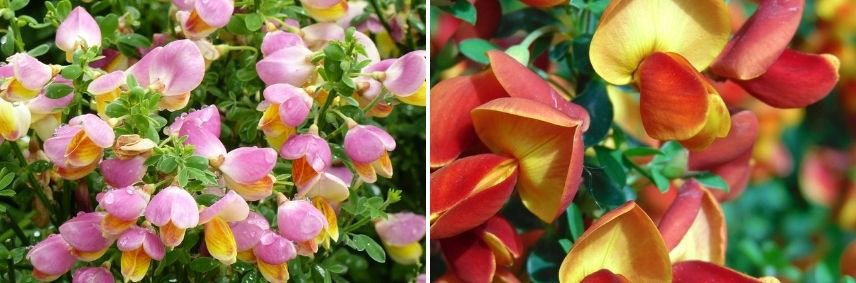 Cytisus scoparius ‘La Coquette’ and ‘Lena’[/caption>
Other Colours to Discover
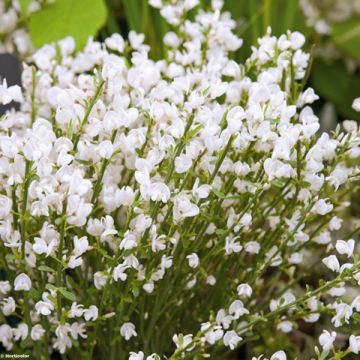
Less common but equally interesting, discover the delicate white brooms (Cytisus praeco ’Albus’ and C. kewensis) or the warm orange-flowering broom (C. scoparius ‘Goldfinch’).
Based on the shape of the flowers
Brooms are recognised by their flowers shaped like small butterflies, similar to those of peas. They are composed of four petals, one of which is larger and stands upright like a banner above the others, delicately closing.
However, as is often the case in the vegetable kingdom, there are varieties that are exceptions. This is the case, for example, with Genista tinctoria ‘Plena’, a variety offering double flowers with numerous petals, creating true clusters of golden yellow at the time of flowering.
On its part, the pineapple broom (Cytisus battandieri) gets its name from the particular shape of its fragrant flowers, reminiscent of the exotic fruit.
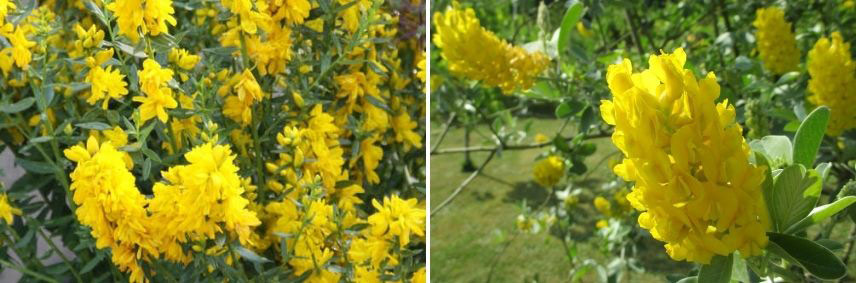
Genista tinctoria ‘Plena’ and Cytisus battandieri
Discover other Broom - Cytisus
View all →
Available in 2 sizes
Available in 2 sizes
Available in 1 sizes
Available in 1 sizes

Available in 2 sizes
Available in 1 sizes

Available in 2 sizes
Available in 1 sizes
Available in 1 sizes
Available in 1 sizes
Depending on the fragrance
Broom flowers are often fragrant, releasing sweet or more pronounced scents, depending on the varieties.
The Tenerife broom offers musky notes that attract foraging insects.
The Genista pilosa ‘Vancouver Gold’ exudes subtle, honeyed, and floral notes.
Almost intoxicating, the powerful scent of the Spanish broom Spartium junceum is never overlooked, with its very sweet and floral notes. Its fragrance is further enhanced in warm, calm weather.
Even more unique, the pineapple broom mentioned earlier spreads a delicious exotic fruit scent.
Read also
12 evergreen bushes to plant in full sunAccording to the flowering period
Brooms flower from spring to summer, peaking between May and June.
The earliest are the Cytisus, flowering in spring, such as the aptly named early brooms (Cytisus praecox ‘Albus’ or ‘Allgold’), in bloom from March to April.
At the beginning of summer, it is the Genista that takes over. Among the later varieties, we have Cytisus scoparius, flowering between June and July.
Some varieties even offer a repeat flowering in mild climates, producing flowers again in early autumn, in September-October. This is the case for the dyeing brooms or ‘Porlock’.
According to its foliage
Brooms generally have a deciduous foliage, which disappears in autumn-winter.
‘Porlock’ still stands out: its leaves are trifoliate, composed of 3 leaflets like small clovers, and are semi-evergreen in the favour of a mild winter (around -5 °C maximum).
The Tenerife broom is another evergreen cultivar, retaining its foliage all year round. However, it is among the tender varieties (hardy down to -6.5 °C).
Finally, the winged broom is also an exception, as it is a persistent and hardy variety.
In terms of colour, our pineapple broom has the unique feature of offering a silky grey-green-silver, while its counterparts tend to have a more classic green foliage.
According to its shape and use
Brooms vary in size and habit. Highly ramified and bushy, they can have a prostrate or upright silhouette. The smallest varieties do not exceed 20 cm in height at ripeness, while the largest can easily reach 4 metres.
Groundcover and Dwarf Varieties
The small creeping varieties of brooms are wider than they are tall. They create vibrant carpet-like displays. Among them, we can mention the creeping broom Cytisus decumbens (20 cm in height with a 1 metre spread), the purple broom (45 cm in height with a 70 cm spread), and the Lydia broom (60 cm in height with a 90 cm spread).
The small varieties, on the other hand, form charming bushes that barely exceed 1 metre in height. This is the case for ‘Palette’ (1 metre in height in all directions), ‘Golden Sunlight’ (1 metre in height with a 1.3 metre spread), or ‘Plena’, the dwarf form of the dye broom (30 cm in height with a 50 cm spread).
These cultivars are ideal for greening a border, brightening a rockery, in the foreground of a flowerbed, or above a low wall. They also provide a good cover at the base of trees or shrubs that are not too dense, allowing light to filter through. In the south-west, brooms naturally grow abundantly at the foot of maritime pines.
These brooms are also perfect for container cultivation, in pots or window boxes. You can enjoy them on the balcony, terrace, or in a small garden.
Shrubby Varieties
These are more imposing and upright varieties. They will find their place at the back of a flowerbed, in a shrub hedge, as standalone specimens, or in large containers.
Some form beautiful compact bushes that are as tall as they are wide (‘Apricot Gem’, ‘Goldfinch’, ‘Andreanus’, …).
Most of these varieties measure between 1.5 and 2 metres, but some cultivars exceed these dimensions. This is the case for the Spanish broom, which reaches 2.5 metres in height at ripeness, or the impressive pineapple broom, measuring 4 metres in height with a 3 metre spread.
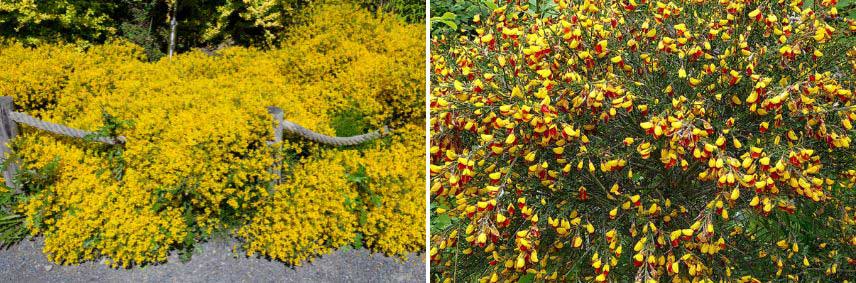 Cytisus decumbens and ‘Andreanus’
Other Uses
In addition to their ornamental qualities, some varieties are used for their natural properties.
The dye broom was, as its name suggests, used for its dyeing properties.
The broom for brooms is valued as a medicinal plant, used to naturally treat certain ailments. Its name comes from the past use of its stripped branches in broom-making.
→ Discover which brooms to plant for a hedge
Depending on the growing conditions
Due to their origins, most brooms prefer mild, even warm climates, full sun or light shade. In terms of soil, while they are not very demanding, they favour poor, well-drained soils with neutral or acidic pH. However, some cultivars are more adaptable.
Hardiness
The hardiness of brooms ranges from approximately -6 °C to -25 °C.
In regions with harsh winters, favour the broom, the hardiest of the genus, which can withstand negative temperatures down to -25 °C. Also consider the creeping broom, hardy down to -29 °C.
Conversely, reserve varieties with medium hardiness (pineapple broom or hybrid broom ‘Porlock’) for regions where temperatures do not drop below -12 °C. The Tenerife broom, one of the most tender, is only hardy down to about -6 °C.
Soil pH
The Spanish broom is one of the least sensitive to lime. It naturally grows either in acidic soils (Corsica) or in very calcareous soils (Provence).
Dyer’s brooms or broom are quite tolerant regarding soil type: they can accept the presence of lime, but not in excess.
Other Conditions
Dyer’s brooms are quite hardy, but they will tolerate drier soils less than other relatives. Avoid them in southern regions with particularly hot and dry summers.
And by the sea, opt for the Spanish broom, which tolerates salt spray well.
- Subscribe!
- Contents
Comments