





























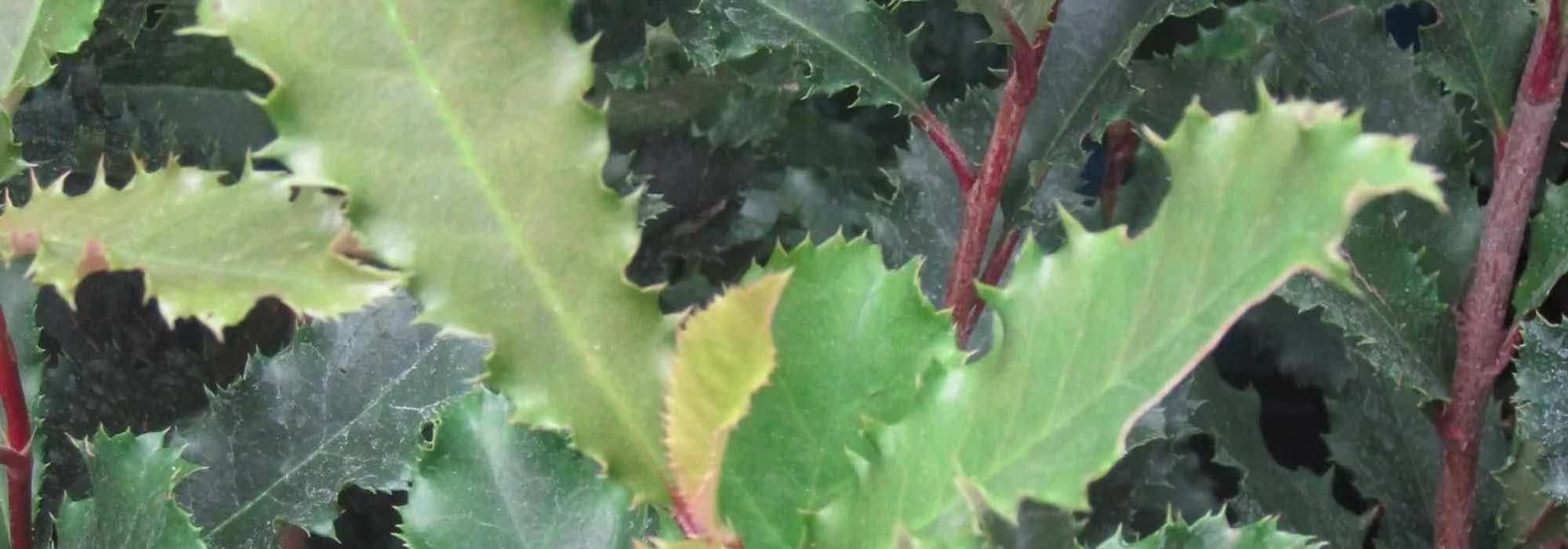
How to choose a Photinia for your garden?
Buying guide and criteria to find the perfect variety
Contents
Photinias are evergreen shrubs with glossy foliage, often brightly coloured. For many years they have taken over hedges in many gardens: these plants are easy to grow, requiring little maintenance, while offering attractive ornamental qualities.
The genus comprises nearly fifty species of shrubs or small trees: how to make the right choice? Discover here our buying guide to choosing a Photinia based on various criteria: foliage, flowering period, silhouette, garden use, or cultivation constraints.
In addition, to learn everything about Photinia cultivation, discover our comprehensive guide: Photinia: planting, pruning and care.

Choosing a Photinia for its foliage
Foliage is Photinias’ number-one ornamental asset. These shrubs produce oval, elongated leaves, often quite glossy, which can be very colourful.
Red foliage
The red is the emblematic colour of Photinias, displayed by the famous ‘Red Robin’. It is the new shoots that colour themselves bright red, alongside the mature foliage in a beautiful glossy green. ‘Carré Rouge’ produces even denser and more colourful foliage than its counterpart, with its vibrant cherry-red colour. This is also the case for ‘Camilvy’ or for ‘Red Robin Blood’.
‘Red Select’ prefers leaves that are more purplish and larger, while ‘Red Light’ stands out with its neon-red young shoots.
For its part, ‘Devil’s Dream’ offers a narrower foliage, but retains its red colour for longer, since it only turns green again in summer. Let us also mention ‘Magical Volcano’, which has dentate leaves that stay scarlet red all year round, from January to December.
Variegated foliage
Even more original still, the Variegated Photinias also bring a splash of colour to the garden, in borders, hedges or pots. The Photinia fraseri ‘Pink Marble’ is one of the most popular. It produces glossy leaves initially purple-marbled with pink. Then the leaves take on a dark green colour marbled with white.
The variety ‘Louise’ is just as interesting with its foliage that is even more colourful. The young red foliage is pink-edged, then turns green marbled with cream.
Let us not forget the Photinia serratifolia ‘Pink Crispy’, with its irregularly dentate foliage resembling holly. In spring, its new shoots display a striking bright pink. Then they variegate with light green and dark green on a cream background.
These varieties will brighten and enliven even the dull corners of the garden.
Other notable foliage
Beyond these fairly widespread varieties, there are other Photinias of interest for their foliage. It’s the case of the Photinia serratifolia ‘Crunchy’, with its holly-like undulate and dentate leaves. It produces coppery new shoots that later turn chocolate.
‘Red Ballcoon’ for its part graces us with changing foliage: its young shoots are bronzed and contrast well with the older, pretty glossy green foliage. In autumn, it then takes on orange and red hues.
Also, Photinia serratifolia for gardeners who prefer a touch more sobriety: this species has young rose-bronze foliage that will turn dark green at maturity.
Most Photinias have evergreen foliage, which is indeed their reputation. But some species stand out by producing deciduous leaves. This is the case of the Photinia beauverdiana var. notabilis, a relatively uncommon species. Its young leaves are initially covered with a down tinged coppery and silvery. As they unfold, they become greener and greener, and this lasts through summer. In autumn, they offer a flamboyant display, revealing yellow, orange and deep red colours before they drop.
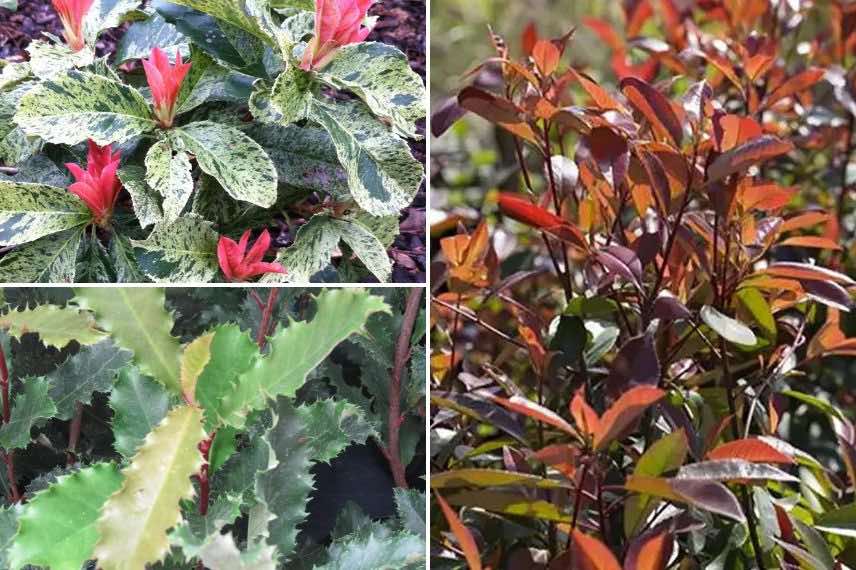
Clockwise: Photinia serratifolia ‘Pink Crispy’, Photinia fraseri ‘Red Ballcoon’, Photinia serratifolia ‘Crunchy’
Read also
Growing a photinia in a potChoosing Photinia for its flowering period
If not pruned, Photinias flower in spring, revealing large umbels of small cream-coloured flowers. They have a hawthorn-like appearance and are highly melliferous. In late summer, the flowers give way to small decorative red fruits.
Flowering occurs between March and June, depending on the variety. For early spring flowering, prefer the Photinia fraseri ‘Chico’, ‘Camilvy’, ‘Dicker Toni’ or ‘Redballcoon’.
For a later flowering, almost at the start of summer, prefer ‘Little Red Robin’, ‘Corallina’, ‘Dynamo Red’ or even the Photinia beauverdiana var. notabilis.
Choosing a Photinia according to its silhouette and its use
Photinias are versatile bushes or small trees that fit anywhere in the garden, but also in pots. They can reach between 60 cm and 5 metres in height.
The smaller varieties
There are several dwarf Photinia varieties, which have a compact, tidy silhouette. They are perfect for dressing a rock garden or a border, but will also make good candidates for container growing, to brighten terraces and balconies.
Among these small varieties not exceeding 1 metre in height, we list:
- ‘Little Red Robin’ (around 1 m tall and 1 m wide) ;
- ‘Little Fenna’ (90 cm tall by 70 cm wide) ;
- ‘Chico’ (1 m tall by 80 cm wide) ;
- the adorable ‘Redballcoon’ (50 cm tall and wide).
The medium-sized varieties
They are ideal for forming well-screening hedges, serving as both privacy screens and windbreaks. But these varieties will also be perfect in borders or in large pots.
They range from 1.5 to 2 metres in height.
Make your choice between the Photinia serratifolia ‘Pink Crispy’ or the Photinia fraseri ‘Louise’ (measuring both 1.75 m in height by 1 m in breadth). Also consider the Photinia fraseri ‘Nana’ (1.50 m tall all round) or ‘Magical Volcano’ (2 metres tall by 1.50 m wide).
The largest varieties
A bit more imposing, these Photinias measuring between 3 and 6 metres in height will, for example, settle at the back of a border or in a free-standing hedge. They will also look very good when planted as a specimen. Among them we may cite ‘Carré Rouge’, ‘Red Select’ or ‘Baton Rouge’. They all reach 3 metres in height by 2 metres in spread.
C’est aussi le cas du Photinia niitakayamensis, which reaches 3 metres in height by 2.50 metres in spread. It also has the feature of producing generous clusters of red decorative berries after flowering.
Even larger, the Photinia beauverdiana var. notabilis is a rare species reaching 6 metres in height by 5 metres in spread. It also bears decorative fruit in the form of berries with colours evolving from green to yellow and finally red at maturity.
Finally the China Photinia, forming a true small, bushy tree with 5 metres in height by 2.50 metres in spread.
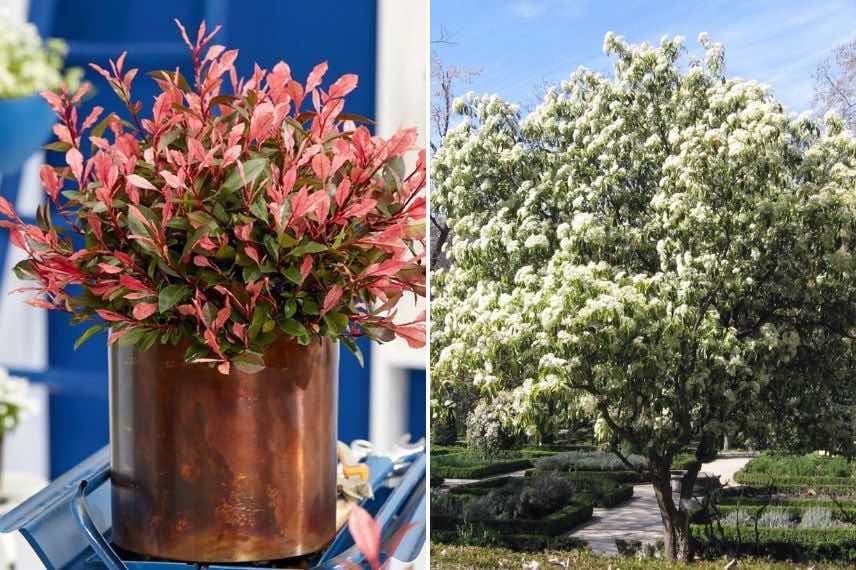
From smallest to largest: Photinia fraseri ‘Little Fenna’ and Photinia serratifolia
Read also
Diseases and parasitic pests of PhotiniaChoosing a Photinia according to its growing conditions
Photinias are easy-care and tolerant bushes.
In soil that is occasionally dry, favour Photinia fraseri. By contrast, the species Photinia serratifolia will tolerate waterlogged soils, as well as the presence of lime.
Photinias are fairly hardy, but can be susceptible to fungal diseases such as powdery mildew. In mild, damp regions, favour Photinia serratifolia, reputed to be resistant to this fungus.
Finally, all possess good hardiness (at least -12°C). But if you live in a region with truly harsh winters, favour the hardier varieties, such as Photinia beauverdiana var. notabilis (down to -20°C).
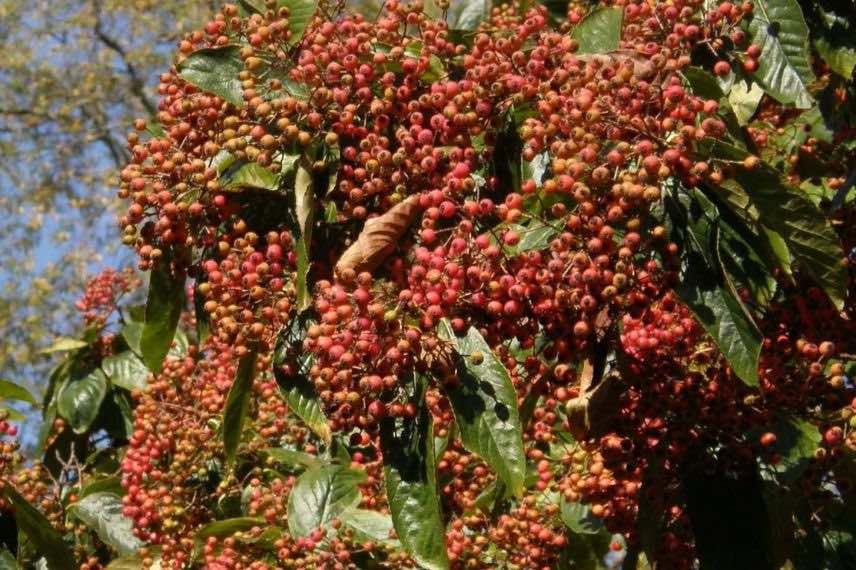
The Photinia beauverdiana var. notabilis is the hardiest
- Subscribe!
- Contents
Comments