





























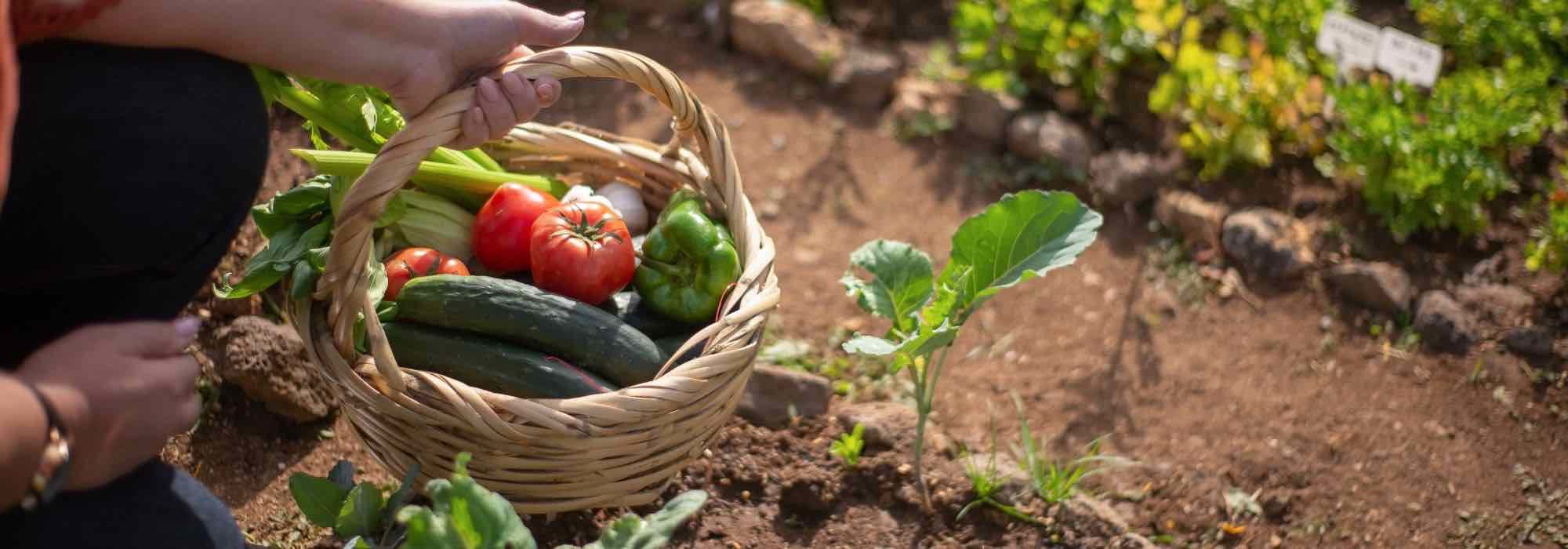
How to choose the right location for your vegetable garden?
The crucial criteria for choosing where to install your vegetable garden
Contents
Whether you’ve just moved into a new house or decided to finally indulge in the joys of vegetable gardening, read this article for the essential aspects to consider before making the first spade stroke. Indeed, while growing your vegetable garden is very rewarding, and you may be looking forward to reaping the fruits of your labour, you might have chosen its future location in a rather unsuitable spot for reasons known only to you: perhaps next to the hammock for a well-deserved nap between sowings, for example. However, there are several points to consider that will guide your choice of the right location to ensure that vegetables grow, that water irrigates your plants rather than those of your neighbour, that you don’t waste time on unnecessary trips, and that your tomatoes don’t get sunburned.
Discover the few essential criteria for the success of your future vegetable garden before you start removing the lawn.
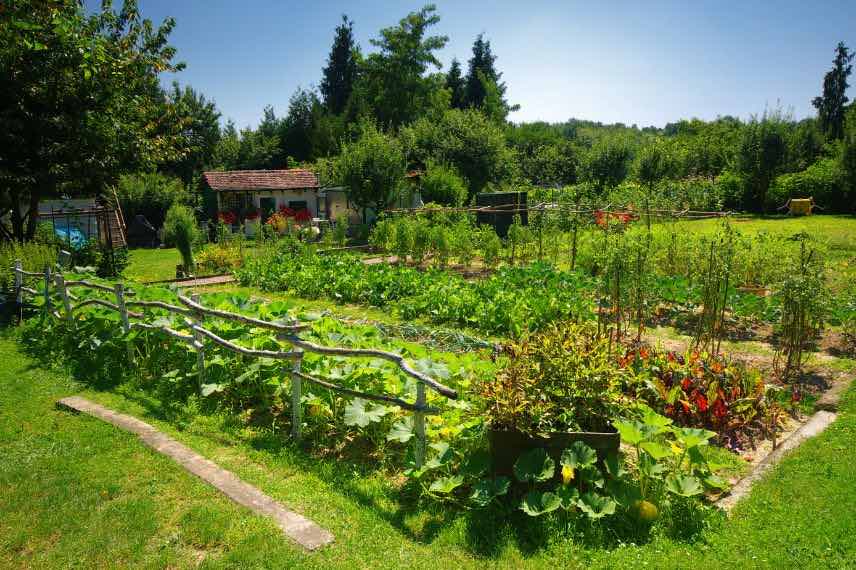
Carefully choose the location of your vegetable garden; it’s a long-term installation

The orientation
When preparing your land, whether for an ornamental garden or a vegetable plot, it is essential to observe the sun’s path and how it affects your garden. Take note of the presence of trees, walls, existing plantings, and structures; patiently look for the different areas of sun and shade in your space, in addition to accurately identifying the four cardinal points. Depending on the time you have to dedicate before the first plantings, it is also useful to observe the changes throughout the seasons. Indeed, the harsh summer sun at its zenith has different effects compared to the gentle, low autumn sun. Feel free to make some sketches and projections if necessary.
For your vegetable plot, you should choose a sunny location, with about 6 hours of sunlight per day. Most vegetable crops require sunlight to grow. However, we will see in a later chapter on shade that it is essential in summer during hot days. But for now, let’s focus on the sun, a major element for the growth of vegetables.
If you do not have such a sunny space, you will need to adapt your plantings and favour leafy vegetables over those in the solanaceae family, such as tomatoes, peppers, and aubergines. These general tips should also be adapted based on your region.
Another factor to consider is the wind: protect your vegetable plot as much as possible from the wind, especially the prevailing winds in your area. This can be done either by choosing your location wisely, planting ornamental or edible hedges like berry bushes, or installing screens or other shading panels. Wind dries out crops, and in spring, when you start your first plantings or sowings, the north wind cools the atmosphere at a time when plants need warmth.

Observe the sunny and shaded areas of your garden in different seasons
Soil quality
Ideally, a vegetable garden soil is rich in humus, well-drained, fairly loose, and not too stony. So that is your goal to achieve, as you won’t often have these qualities from the start. You will regularly nourish it with amendments aimed at improving it; well-decomposed compost will be your best friend (planning a spot for compost from the outset is essential).
These contributions and the modification of the soil structure will happen gradually; patience is always required in the garden.
If, however, the soil is of such poor quality that the best intentions and gentlest care will not be sufficient, for example, in the case of waterlogged soil, sandy soil without a single earthworm, very stony soil, or outrageously acidic or chalky soil, it may be worthwhile to consider raised planting through vegetable beds. This way, you prepare a substrate and choose its composition, just like for pot planting.
→ See François’s article on creating a vegetable garden in stony soil, where he also explains the techniques for raising beds.
 A raised vegetable bed is a solution when the soil is too poor</caption]
Discover other Vegetable gardens
View all →
Available in 1 sizes
Available in 1 sizes
Available in 1 sizes
Available in 1 sizes
Available in 1 sizes
Available in 1 sizes
Available in 1 sizes
Available in 1 sizes
Available in 1 sizes
Available in 1 sizes
Practicality
It is very important to consider practical aspects in your choice, even if you are not always convinced of this at the outset. Even with the best intentions, a great distance between the vegetable garden and the house, complicated access to water, and tools that are “miles away” will wear down even the most motivated.
As you will have understood, make sure to install your vegetable garden not too far from the house. Ensure easy access to water and the ability to reach tools easily. Place your essential compost near the vegetable garden (even if it means having a special bin for vegetable waste at home to limit trips to the compost in the rain during winter).
Don’t plan too large, even if it means expanding later. It would be a shame to tire of the fifteenth kilogram of courgettes. If you apply permaculture principles, which are very interesting, you will have a highly productive vegetable garden in a small area.
Also consider the practicality of movement within the vegetable garden area: being able to access all parts of the plot, having walkable paths, not a muddy terrain.
Once the practical criteria have been reviewed, don’t forget the aesthetic aspects: if the window of your living room overlooks the vegetable garden, it better be attractive! While it can be quite ornamental with careful planting and some flowers, it won’t be so in every season. Ideally, think about your views from the house, and if you have no choice, pay attention to its aesthetics; you will be all the happier for it!
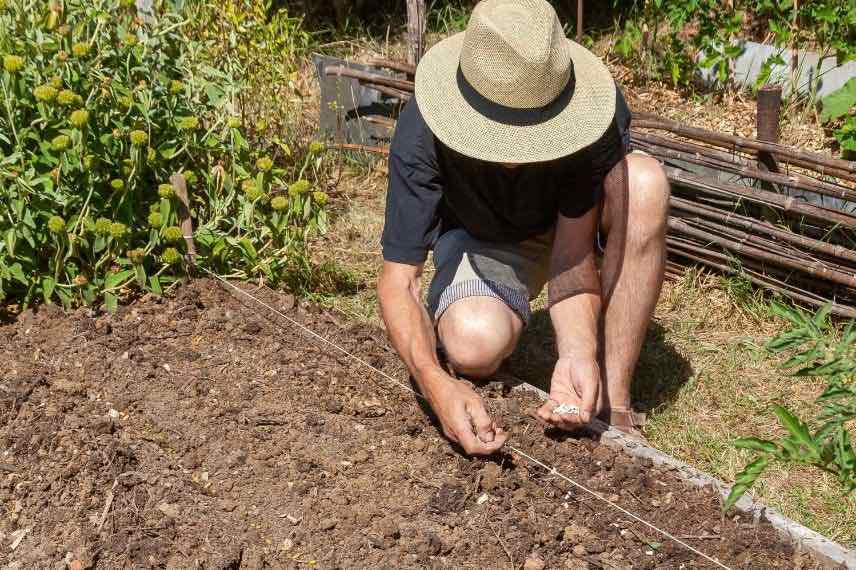
Ensure you can move easily within your vegetable garden and reach all areas of the plots
Read also
Watering the vegetable garden: our tipsA flat plot
Gardening on a flat plot is also essential: imagine watching your watering water leak from your wilted tomato plant to irrigate the adventive weeds a little further away! If the ground isn’t flat to begin with, you should consider levelling it. In case of a steeper slope, think about a terracing system. Between the two, a raised bed can also be a good solution to create a flat surface in a sloped area. Carefully construct your bed with boards to elevate it on the slope.
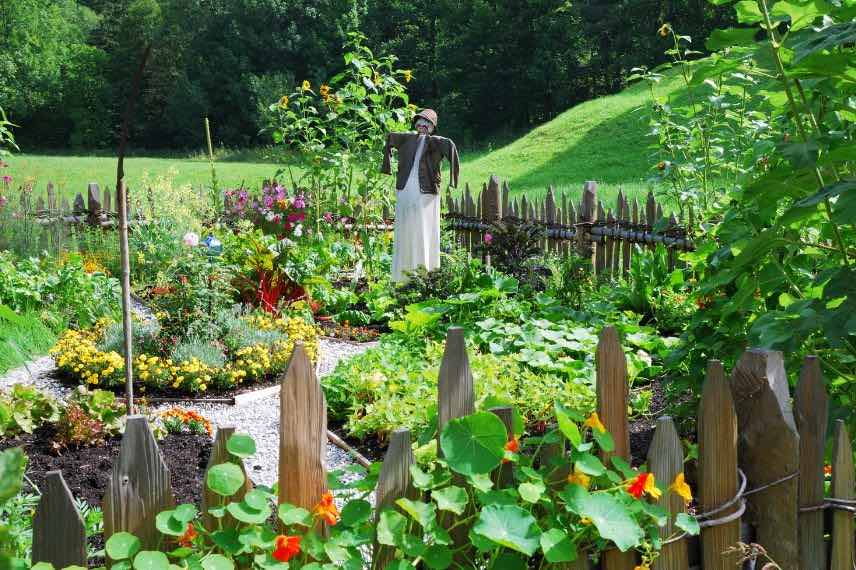
Set up your plot on flat ground to avoid disappointments
The essential shade
Having become a crucial topic in vegetable gardening with climate change and the very hot summers we are experiencing, shade is essential in the garden during summer. Or at least the possibility of shade. How many vegetables suffer from sunburn, scorched by the intense heat? This issue is not straightforward, as it is true that the vegetable garden requires a well-sunny location all year round. It is also true that trees have a bad reputation near the vegetable garden because their roots dry out the soil and their branches cast too much shade all year round.
That said, this is a traditional view of trees in the vegetable garden. With the development of permaculture principles and some very interesting concepts like agroforestry, this perspective is being challenged, and we are rethinking the role of trees in the vegetable garden, in the form of hedges, isolated trees, or orchards. By carefully selecting species with deciduous foliage, paying attention to the tree’s habit, or considering the garden as a system with different layers: orchard, small fruits, and vegetable crops. We think of the whole as a unit, with different leafing, seasons, and possible sizes to bring in light.
Thus, it is a delicate balance to find. Already, if shade is provided by a tree, it should be deciduous for maximum sunlight during the leafless seasons. It may be worthwhile to consider planting fast-growing bushes near the vegetable garden while calculating their shade projection.
Otherwise, we try to create temporary and reversible shade! Growing tall annual plants, which develop very quickly, is a clever solution. Choosing heat- and drought-resistant species is even better.
The other option is to install removable structures without preventing rain from reaching the vegetable garden soil. We can consider shade structures in the form of shade cloths, horizontal canes set high on stakes, or screens on the sides, provided they are placed wisely. Among makeshift solutions, umbrellas or overturned crates over seedlings, young plants, or salads will also do the trick.
These latter solutions are more about remedying a lack of shade while waiting for a tree to grow, for example. But it is better to integrate the shade factor for high heat from the outset with sustainable solutions.
Of course, just as compost is essential; seeking shade in summer without having previously mulched the vegetable garden extensively with a thick layer of organic mulch to limit water evaporation is counterproductive.
→ Read Pascale’s very useful article on the topic of shade in the vegetable garden during summer.
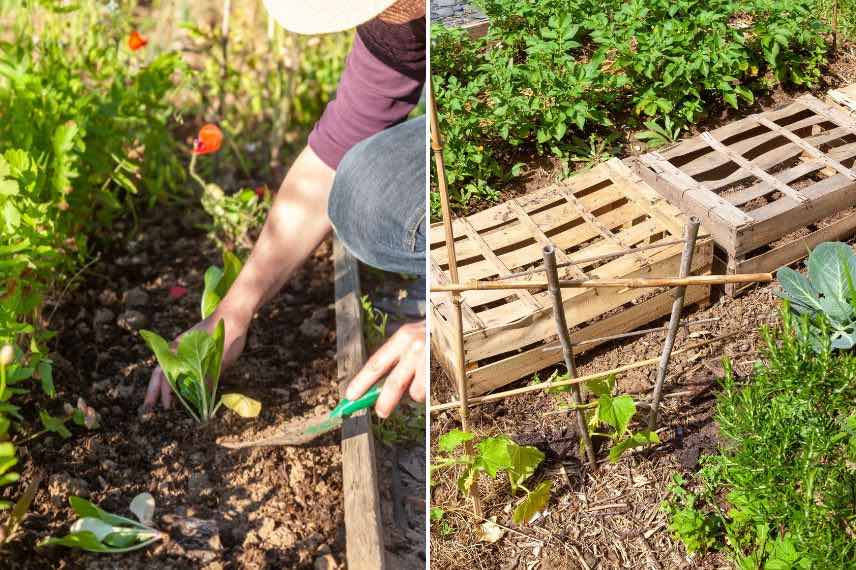
If vegetable crops need sunlight all year round, it becomes crucial to provide shade in summer
- Subscribe!
- Contents
![[title]How to Properly Layout Your Vegetable Garden
[dropcap]W[/dropcap]hen it comes to [link url="https://www.promessedefleurs.com/jardin/potager/"]vegetable gardening[/link], the layout of your garden is crucial for its success. Here are some tips to help you make the most of your vegetable patch:
[subtitle]1. Sunlight Exposure[/subtitle]
Make sure your vegetable garden receives at least [highlight]6 hours[/highlight] of sunlight per day. Place taller plants on the northern side to avoid shading smaller ones.
[subtitle]2. Plant Spacing[/subtitle]
Follow the recommended spacing between plants to ensure they have enough room to grow and receive adequate nutrients.
[subtitle]3. Companion Planting[/subtitle]
Consider [highlight]companion planting[/highlight] to naturally repel pests and improve pollination. For example, planting [link url="https://www.promessedefleurs.com/jardin/potager/legumes/"]marigolds[/link] near tomatoes can help deter pests.
[subtitle]4. Crop Rotation[/subtitle]
Rotate your crops each year to prevent soil depletion and reduce the risk of pests and diseases building up in the soil.
[subtitle]5. Access Paths[/subtitle]
Create paths between your vegetable beds to allow easy access for planting, weeding, and harvesting. This will also prevent soil compaction.
By following these tips, you can ensure a well-organized and productive vegetable garden that will provide you with a bountiful harvest throughout the growing season. Happy gardening!](https://en.promessedefleurs.eu/blogwp/wp-content/uploads/2023/03/Comment-bien-choisir-lemplacement-du-potager-.png "[shortcode identifiant=\"highlight\" color=\"green\"]Choosing the Right Location for Your Vegetable Garden[/shortcode]
When it comes to [shortcode identifiant=\"highlight\" color=\"green\"]choosing the location[/shortcode] for your [shortcode identifiant=\"glossary\" param1=\"vegetable garden\"], there are a few key factors to consider to ensure the success of your crops. Here are some tips to help you make the best decision:
1. [shortcode identifiant=\"highlight\" color=\"green\"]Sunlight[/shortcode]: Most [shortcode identifiant=\"glossary\" param1=\"vegetables\"] thrive in full [shortcode identifiant=\"glossary\" param1=\"sunlight\"], so choose a spot that receives at least 6-8 hours of direct sunlight per day.
2. [shortcode identifiant=\"highlight\" color=\"green\"]Soil Quality[/shortcode]: Make sure the soil is [shortcode identifiant=\"glossary\" param1=\"well-draining\"] and [shortcode identifiant=\"glossary\" param1=\"fertile\"]. Conduct a soil test to determine its [shortcode identifiant=\"glossary\" param1=\"pH level\"] and [shortcode identifiant=\"glossary\" param1=\"nutrient content\"].
3. [shortcode identifiant=\"highlight\" color=\"green\"]Proximity to Water[/shortcode]: Your [shortcode identifiant=\"glossary\" param1=\"vegetable garden\"] should be close to a water source for easy [shortcode identifiant=\"glossary\" param1=\"irrigation\"]. Consider installing a [shortcode identifiant=\"glossary\" param1=\"drip irrigation system\"] for efficient watering.
4. [shortcode identifiant=\"highlight\" color=\"green\"]Protection from Wind[/shortcode]: Choose a location that is sheltered from strong winds to prevent damage to your plants.
5. [shortcode identifiant=\"highlight\" color=\"green\"]Accessibility[/shortcode]: Ensure that your [shortcode identifiant=\"glossary\" param1=\"vegetable garden\"] is easily accessible for planting, [shortcode identifiant=\"glossary\" param1=\"weeding\"], and [shortcode identifiant=\"glossary\" param1=\"harvesting\"]. Consider raised beds for better accessibility.
By considering these factors, you can [shortcode identifiant=\"highlight\" color=\"green\"]select the perfect spot[/shortcode] for your [shortcode identifiant=\"glossary\" param1=\"vegetable garden\"] and set yourself up for a successful growing season.")
Comments