





























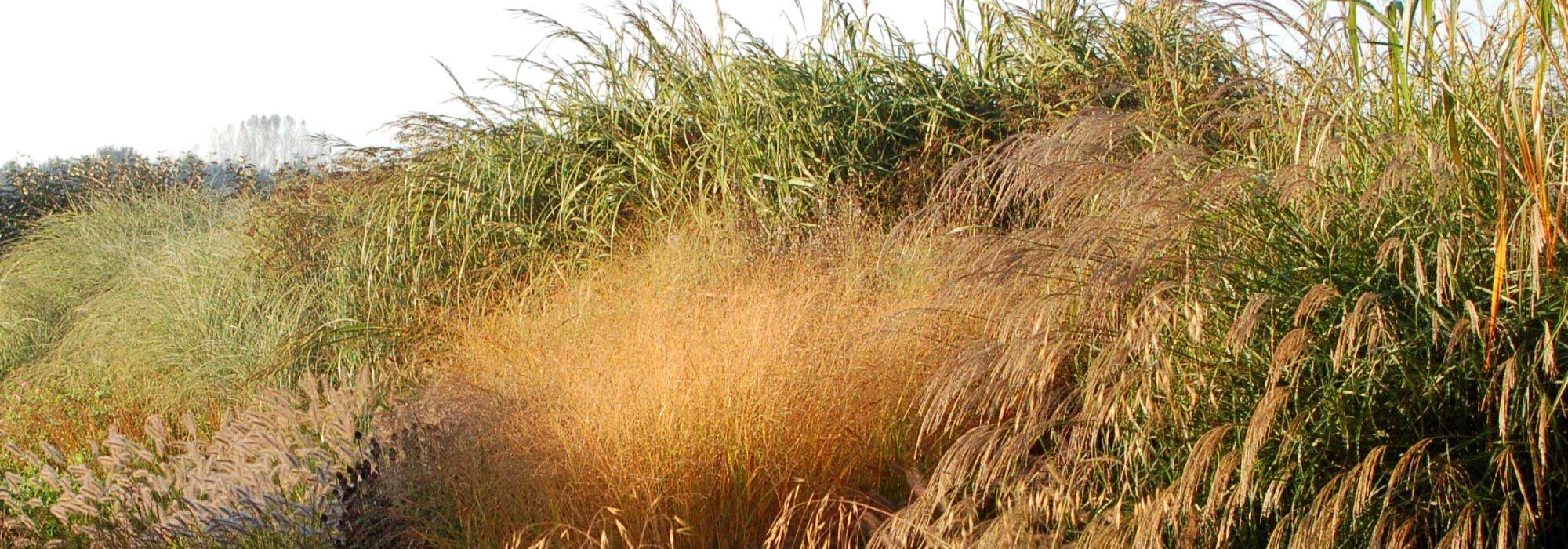
How to create a grass hedge?
The best grasses for creating a privacy or decorative screen
Contents
The primary function of a hedge is to create more privacy by screening an awkward view or to delineate certain spaces. In addition to bushes, often used for this purpose, some grasses are particularly well-suited for this role. Which ones should you choose based on the desired outcome? How should you plant them and at what distance? How do you maintain them? Follow these tips to create a beautiful grass hedge, whether wild, light, or more contemporary, but always aesthetic.

Create intimacy with a grass hedge
Some grasses reach sufficient dimensions to create a screen that protects from view, and their remarkable growth allows for very quick results. By the second year after planting, you can already enjoy a hedge that is dense and opaque. Since many Poaceae are deciduous or at least marcescent (their foliage dries but remains in place), they require cutting back almost to ground level at the end of winter. A period without vegetation is therefore inevitable while the plant develops its new growth. This is a factor to consider during design.
Which grasses for a tall and screening hedge?
The Miscanthus are particularly suited for this purpose. They grow quickly, are decorative from mid-spring, and reach their ripeness in summer, before producing stunning spikes from late summer to autumn, during which some also colour their foliage in incredible hues, rivaling certain bushes. Their silhouette remains prominent and decorative throughout winter.
Miscanthus for very tall hedges
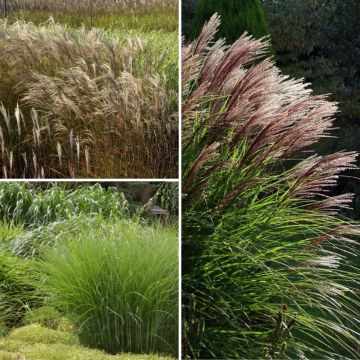
- For the tallest hedges, up to 2.5 metres, or even 3 metres at full spike, consider Miscanthus giganteus, which, as its name suggests, is a giant. It offers beautiful spikes and often lovely autumn colours, or Miscanthus giganteus ‘Alligator’, a slightly shorter but variegated version. However, this species tends to lose its lower foliage by late summer, which highlights its beautiful canes but makes it a bit less screening. Another possible candidate is Miscanthus sinensis ‘Sirène’, with stunning reddish spikes and warm hues in late season.
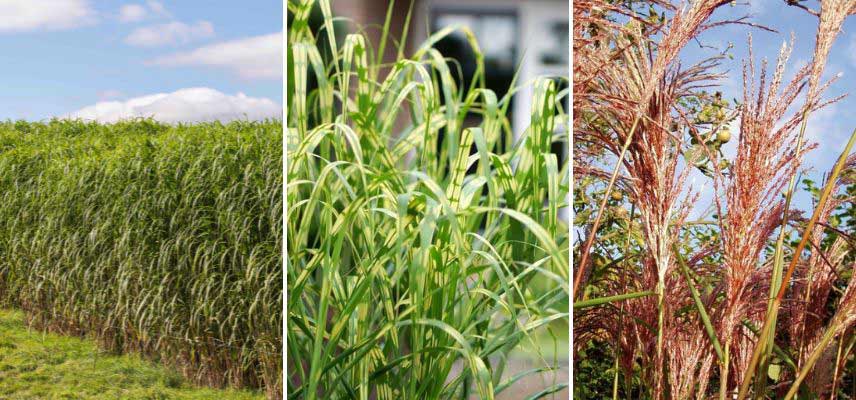 Miscanthus giganteus, Miscanthus giganteus ‘Alligator’ and Miscanthus sinensis ‘Sirène’
- Be cautious, however, with the use of other large grasses, as their more or less invasive behaviour can cause them to exceed the boundaries of your hedge, or even emerge in your neighbour’s garden… or further afield! To avoid this issue, steer clear of Miscanthus sacchariflorus, the Giant Reed (Arundo donax), Common Reed (Phragmites australis), or running bamboos (unless you install a rhizome barrier). In mild and humid regions, Pampas Grass (Cortaderia selloana) has a tendency to reseed itself to the point of becoming invasive.
Miscanthus for medium to tall hedges
For a hedge between 1.5 m and 2.5 m, many other Miscanthus are often used. Miscanthus ‘Gracillimus’ features very fine foliage and a truly graceful fountain-like habit. Miscanthus ‘Malepartus’ is slightly more upright but equally beautiful, and its somewhat broader foliage takes on stunning red to orange hues in autumn. Miscanthus ‘Cosmopolitan’ boasts very bright variegated foliage, while Miscanthus ‘Roland’ is a fairly imposing variety with some of the largest frizzy spikes in the genus.
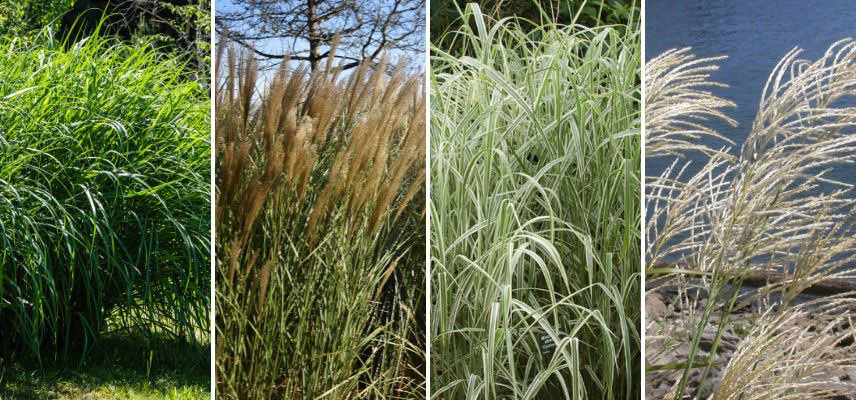 Miscanthus ‘Gracillimus’, ‘Malepartus’, ‘Cosmopolitan’ and ‘Roland’
Planting and spacing
- Install the Miscanthus in full sun, in any type of soil that remains cool during the season to ensure good growth. However, avoid overwatering and fertilising, as this may cause the plants to flop.
- For a dense and opaque hedge, prefer a staggered planting: space your plants about 80 cm apart, and do the same, but offset, in the back row. If you don’t have room for two rows, you can plan for just 70 cm between each plant to densify the final appearance.
Other interesting grasses for tall hedges
It is also possible to consider other tall grasses that are equally decorative:
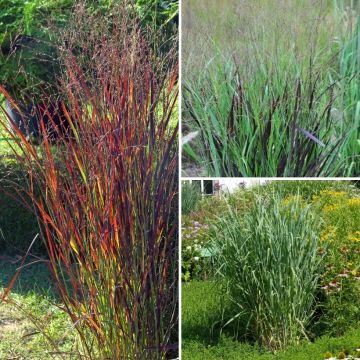
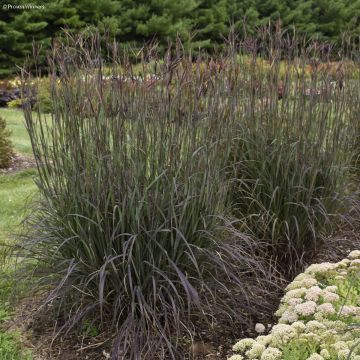
- Upright Panics offer very light spikes and beautiful late-season hues. They thrive in both dry, well-drained soils and heavier, clayey ones, and while not invasive, they can spread a bit more than Miscanthus.
- Calamagrostis acutiflora ‘Karl Foerster’ has a more upright and narrower habit (plan for about 50 cm spacing between each plant), and adapts to any type of fertile, well-drained soil, in full sun or light partial shade. Non-running bamboos, such as Fargesia, create screens with a zen and Japanese tone. In mild climates, Purple Sugar Cane or large gramineous perennials like the tall Phormium are also viable options.
→ Read also XXL Grasses: Must-Have Varieties to Add Volume to Your Borders.
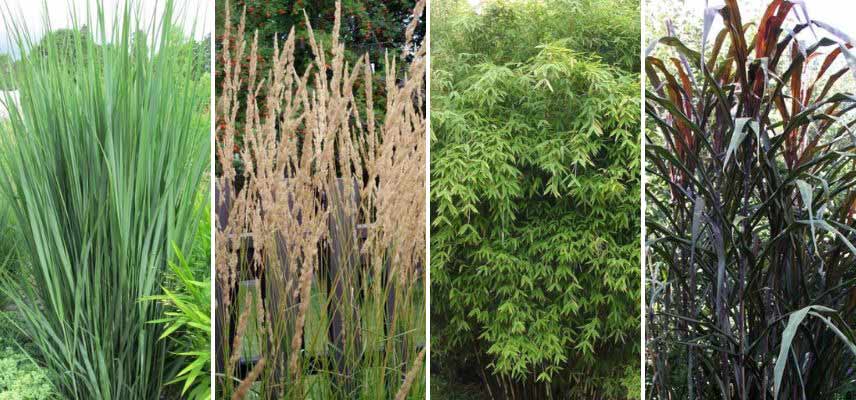 Panicum virgatum ‘Northwind’, Calamagrostis acutiflora ‘Karl Foerster’, Fargesia murielae ‘Dino’ and Saccharum officinarum ‘Violaceum’
Discover other Ornamental grasses
View all →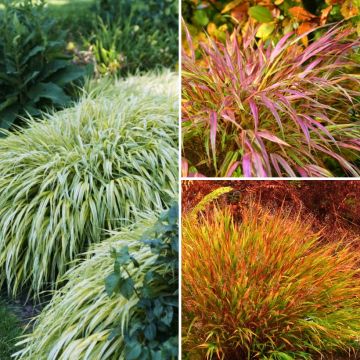
Available in 0 sizes
Available in 0 sizes
Available in 0 sizes
Available in 0 sizes
Available in 1 sizes
Available in 1 sizes
Available in 2 sizes
Available in 1 sizes
Available in 1 sizes
Available in 1 sizes
Which grasses for a decorative low hedge?
To compartmentalise or delineate certain areas of the garden without obstructing the view, using low or transparent grasses is an interesting option. Arranged in a straight line or following a more curved path, these grasses allow the eye to pass through while structuring the space.
Pennisetum for decorative low hedges
The Pennisetum form very wide clumps, with a fountain-like habit and beautiful silky spike flowering. For this type of use, prefer varieties with a small growth habit, which do not exceed 1.20 m, and choose according to your preferences. Pennisetum ‘Hameln’ does not exceed 50 cm. It offers silver-white to brown spikes and takes on a lovely hue in autumn. For dark purple, almost black spikes, opt for the variety ‘Black Beauty’, and if you like pink tones, perhaps ‘Red Head’ will charm you. Pennisetum ‘Hameln Gold’ or ‘Lumen Gold’ have very bright golden-yellow foliage. For darker foliage, Pennisetum ‘Rubrum’ offers an enchanting dark purple, while ‘Fireworks’ mixes green, pink, and red, but be aware that these two varieties are frost-sensitive and should be treated as annuals in our climate.
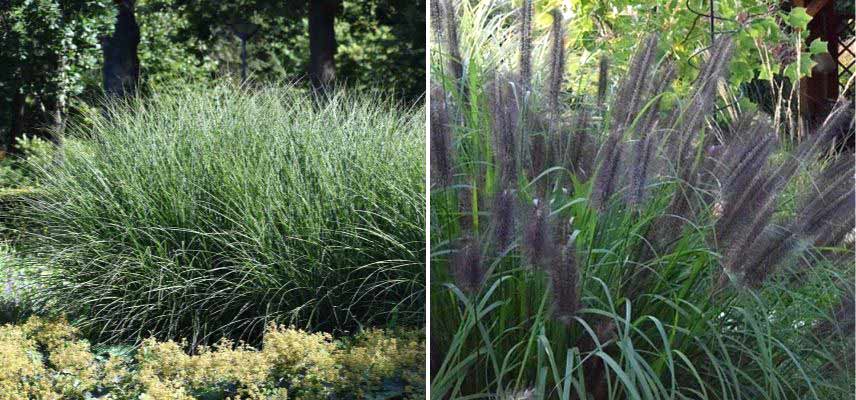
Pennisetum ‘Hameln’ and Pennisetum alopecuroides ‘Black Beauty’
Other interesting grasses for low hedges
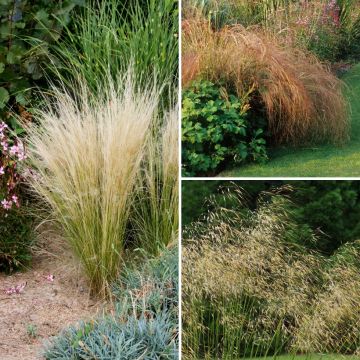
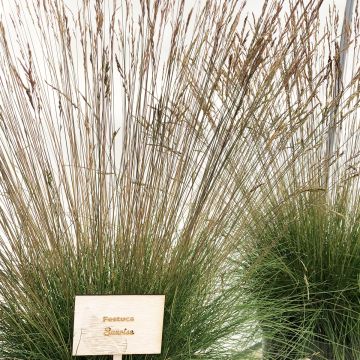
- Among other possible candidates, Stipa gigantea sends up very long flower stems reaching nearly 2 m, but as they lack foliage, they never block the view, and Stipa tenuifolia creates low volumes with unparalleled flexibility. The Fescues form small clumps of very fine, slightly shaggy foliage, strikingly blue in some varieties like ‘Elijah Blue’.
- All these grasses enjoy bright and sunny exposures. The Pennisetum and Stipa gigantea prefer fresh but well-drained soil. The Fescues and Stipa tenuifolia thrive in dry, stony soils.
Grasses for low hedges in shade
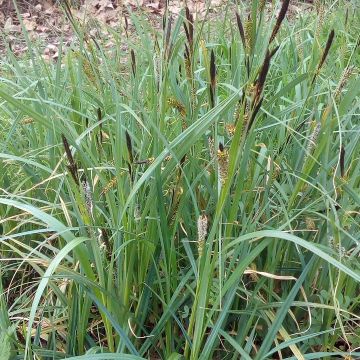
In shadier situations, and in fresh soil, Carex offers a wide range of colours in foliage, from green to bronze, including golden and variegated. Also consider Hakonechloa, which can form miniature hedges, mimicking a stream running through your garden.
Planting distances for a decorative low hedge
- In the case of decorative low hedges, as the aim is not to hide, there’s no need to plant in two rows. Regarding the distance between each grass, space the plants a distance equal to their adult spread or slightly less, so that their respective foliage meets and mingles a bit.
- Note that most of the grasses mentioned are suitable for pot cultivation and can therefore be used as a screen on a terrace or balcony.
Read also
Planting grassesHow to maintain your grass hedge?
Caring for grasses is incredibly simple!
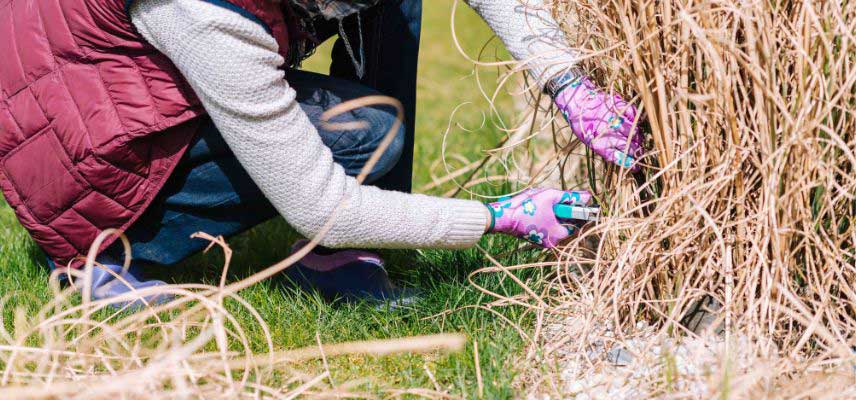
- Deciduous or marcescent grasses should be cut back to about ten centimetres above the soil at the end of winter.
- Evergreen grasses should not be cut, but simply cleaned as one would comb hair.
- If the plants become too large or if you wish to multiply them, for example to enlarge your hedge or to create a new one, you just need to divide the clump.
- Subscribe!
- Contents
![[plantes type="graminées" utilisation="haie"]](https://en.promessedefleurs.eu/blogwp/wp-content/uploads/2022/11/Comment-faire-une-haie-de-graminees-2.png "[plantes type=\"graminees\" utilisation=\"haie\" taille=\"1,5 m\" espace=\"50 cm\"]")
Comments