





























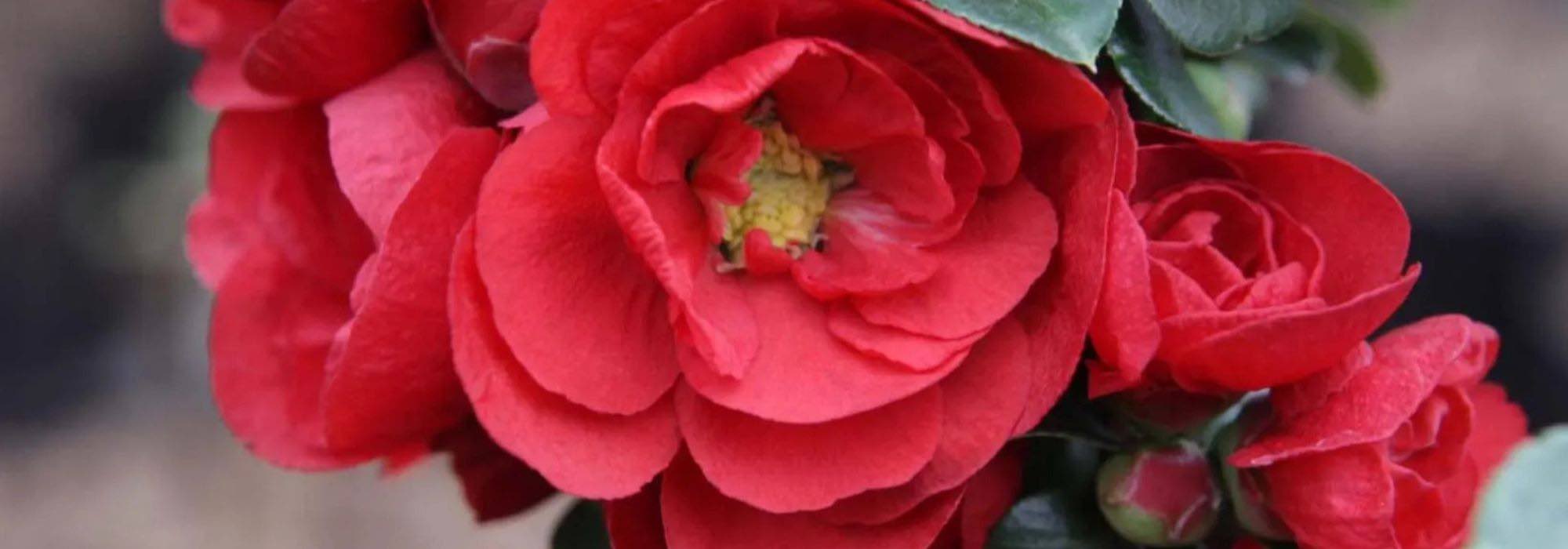
How to grow a Japanese quince in a pot?
Easy planting and care
Contents
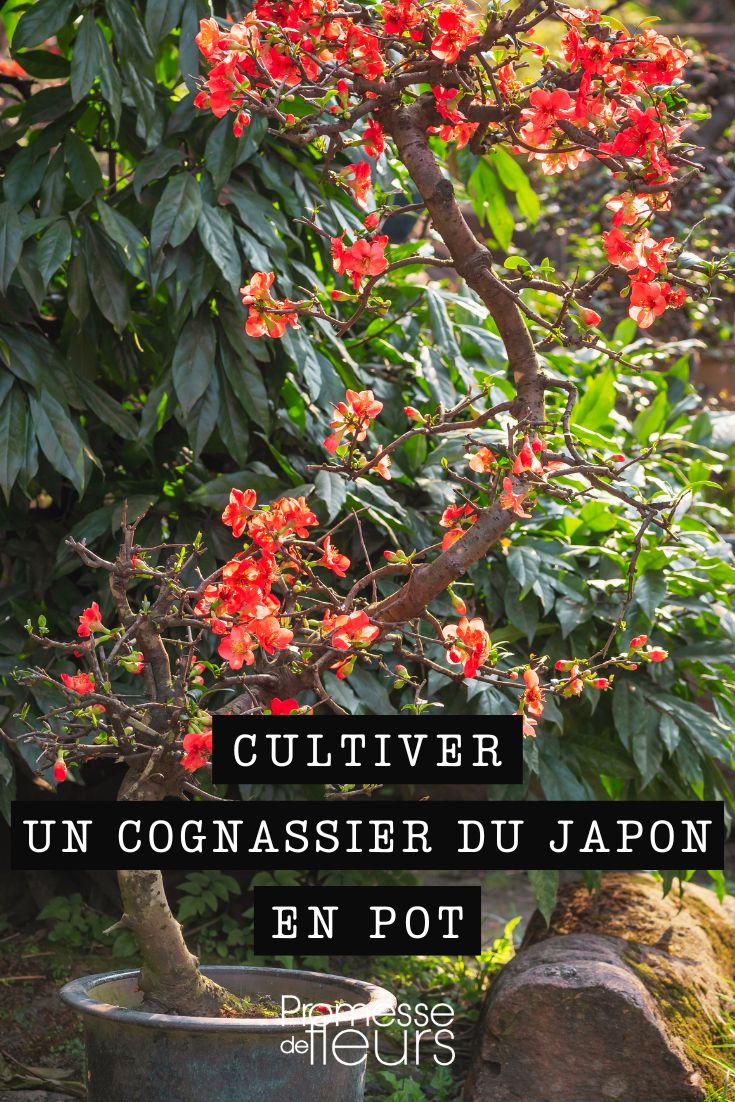
Japanese quince (Chaenomeles) have several decorative qualities, but it is mainly their flowering, which occurs when the garden has not yet fully shaken off its winter torpor, that enchants us. Very poetic, its flowering appears when the branches have no leaves yet, which allows it to be showcased to best effect. Japanese quince shrubs are also grown for their fruiting, although their quinces are considered less tasty than those of the common quince.
There is no need to have a garden or a large space to enjoy the flowering of these beautiful shrubs: container growing is perfectly feasible.
Discover our tips here for successfully growing a Japanese quince shrub in a pot, from planting to maintenance.
And to learn more about its cultivation, view our guide: Japanese quince: planting, pruning and care.

Which varieties of Japanese quince should you choose for growing in pots?
For container growing, it is best to choose the smaller varieties of Japanese quince, which will not exceed two metres in height. You will be spoilt for choice among the following:
- the Japanese quince Chaenomeles superba ‘Cameo’, with double salmon-orange flowers (1.5 metres in height by 1 metre in spread) ;
- the Chaenomeles speciosa ‘Fire Dance’, which flowers in an intense red-orange colour (1.5–2 metres across) ;
- the Chaenomeles japonica ‘Cido’, with its orange flowers and large, fragrant autumn fruits (1.3 metres across) ;
- the Chaenomeles speciosa ’Yukigoten’, with double flowering in pretty cream-white.
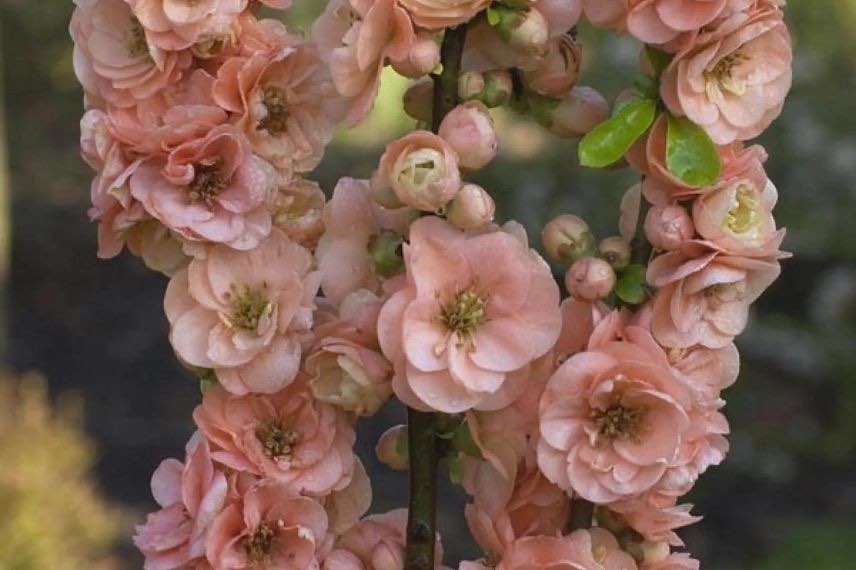
The handsome ‘Cameo’, with double salmon-pink flowers
For cultivation near walked paths, prefer inermous varieties, whose shoots are thorn-free. This eliminates any risk of accidental injury. This is the case, for example:
- the Chaenomeles speciosa ‘Scarlet Storm’, which bears a storm of flamboyantly red flowers, camellia-like (1.0–1.2 metres across) ;
- the Chaenomeles speciosa ‘Pink Storm’, with pink flowering (1.0 metre across) ;
- the Chaenomeles speciosa ‘Mango Storm’, which flowers in coral-orange with salmon reflections (1.0 metre across).
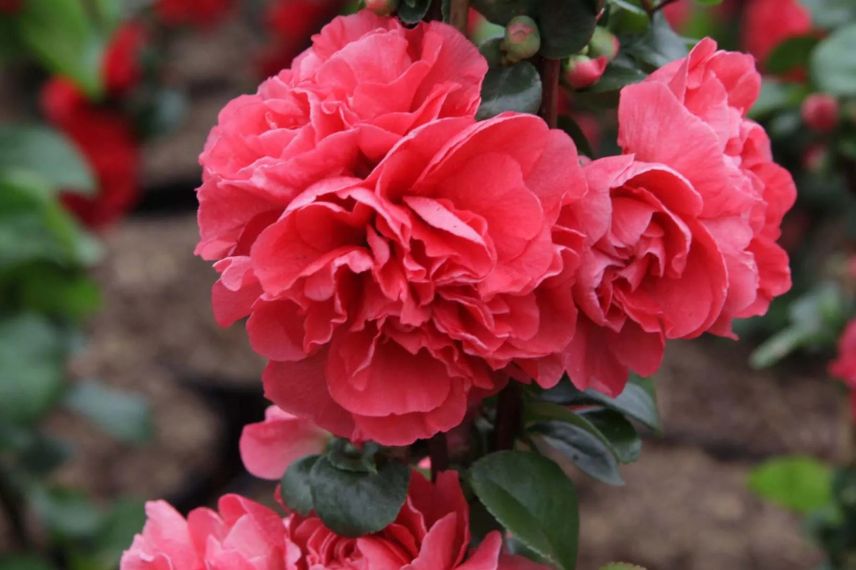
‘Pink Storm’ is a thornless variety, preferable in walkways
When is the best time to pot up a Japanese quince?
Potting takes place between autumn and spring, i.e. during periods of frost. If you live in a region with hot, dry summers, opt for planting at the very start of autumn, so that the bush can establish itself before it experiences its first spell of hot weather.
Planting Japanese quince in a pot
Container
To encourage the development of Japanese quince, choose sufficiently large containers, at least 40 cm in diameter and 60 cm deep.
Make sure the pot is perforated, so that water from irrigation or rainfall can drain away without stagnating.
We generally prefer terracotta, which allows the substrate to breathe more than plastic pots. However, note that this porous material promotes water evaporation and will therefore require more frequent watering.
Substrate
Japanese quince thrive in ordinary soil. The substrate must be well-drained to prevent waterlogging which can be fatal.
You can choose a ready-made potting mix, for example for window boxes and pots. If you prefer to make your own mix, use:
- 2/3 of high-quality horticultural potting mix or garden soil, if not too heavy (clayey) ;
- 1/3 river sand or other draining components (clay balls, perlite, grit…) ;
- 1 to 2 handfuls of well-rotted household compost or manure.
Planting
- Before planting, rehydrate the root-ball of your Japanese quince by letting it soak in a container of room-temperature water. This will also help with removing the container.
- Install a drainage layer 3–5 cm thick at the bottom of the pot.
- Top up with the substrate mix until reaching half the height of the container.
- Plant your Japanese quince, then top up with substrate until the root-ball is well covered, but do not bury the collar (where the roots meet the stem).
- Gently firm with your fingers to drive out air pockets.
- Water well.
- Install an organic mulch (straw, dead leaves, RCW, plant husks…), which will limit weed growth and the evaporation of watering water.
Exposure
Japanese quince grow in sun or partial shade. In hot regions of southern France, however, protect them from scorching exposures.
Note that these bushes are able to tolerate pollution, which makes them good candidates for terraces, balconies and city gardens.
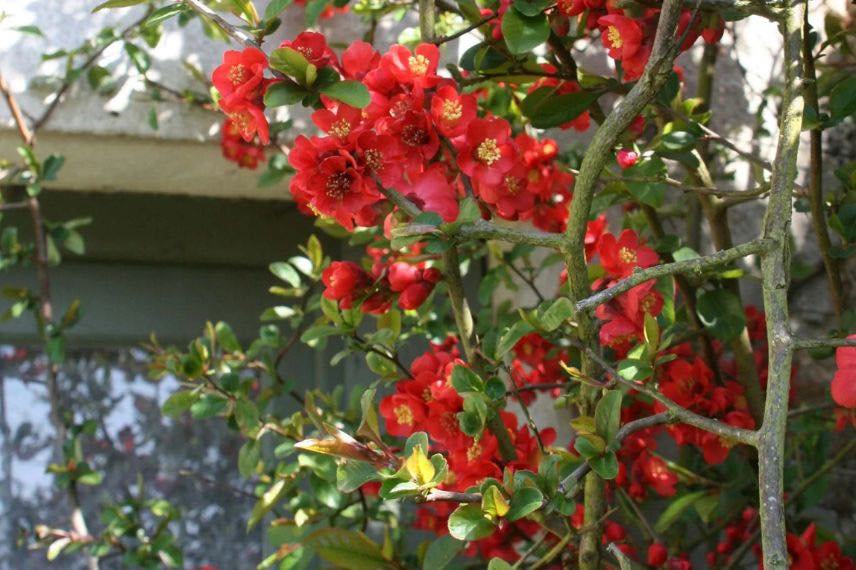
Read also
How to choose a Japanese quince?Caring for the Japanese quince in a pot
Japanese quince shrubs are easy to grow and require little maintenance.
Watering
They prefer soils that stay moist, i.e., never dry out completely. But they do not like waterlogged soils and stagnant moisture. If after a few years they can tolerate occasional drought in the garden, it will be best to avoid water shortage when grown in pots. The roots, in fact, cannot reach deep moisture in the soil, being confined by the container. Moreover, watering must always be more frequent in pots, as water evaporates more quickly.
One watering per week is generally sufficient in spring and autumn. In summer, in the absence of rain and depending on the ambient temperature, two waterings per week may be necessary. To keep it simple, as soon as the surface substrate feels dry to the touch, it’s time to water.
If you have placed a saucer under the pot, remember to empty it after about thirty minutes.
If possible, favour rainwater over mains water.
Note that installing mulch, as we advised at planting, will help reduce evaporation and better retain moisture in the soil.
Fertilising
To support flowering and potential fruiting of your Japanese quince, you can apply fertilisers in spring.
You can choose a fertiliser for fruit trees or a fertiliser to promote flowering. In any case, it is always preferable to opt for a fertiliser rich in potash, but not too rich in nitrogen (which tends to promote foliage). You can also apply ash or well-decomposed compost in autumn.
Pruning
If not essential, pruning will help the Japanese quince maintain a harmonious silhouette.
For this, shorten damaged, broken or entangled shoots that unbalance the shrub’s habit. This will also help to open up the centre, to facilitate air and light passage. Do this in late spring, after flowering.
Remember to wear thick gloves if you haven’t opted for a thornless variety. Always use sharp, pre-sterilised pruning tools to limit the risk of disease transmission between plants.
Diseases and pests
Japanese quince shrubs are not particularly prone to pests and diseases.
Aphids or scale insects can, however, weaken the plant. A simple spray of water can be enough to dislodge a few individuals. In case of heavier infestation, use a natural insecticide based on pure insecticidal soap. For this, simply dilute 1 tablespoon in 1 litre of warm water. Pour into a spray bottle and wait for the mixture to cool. Spray onto the affected parts in the late afternoon (shielded from direct sunlight). Repeat after 15 days if necessary. If the infestation is too severe, cut away the affected parts and take them to the recycling centre. Additionally, read our articles “Aphid: identification and treatment”, “Scale insect: identification and treatment”.
Japanese quince shrubs can be susceptible to apple scab in mild, damp climates. This fungus causes darkening of the leaves and can deform the fruits. To learn more about this fungal disease, read our article “Apple scab on apples and other fruit trees.” Other ailments can affect Japanese quinces, such as powdery mildew, Monilia disease or fire blight. As a preventive, you can use Bordeaux mixture (used sensibly) or plant manures.
Repotting
It takes place approximately every two years, depending on the shrub’s growth. Simply choose a container one size larger. Do this in autumn or spring.
Overwintering
Japanese quince shrubs are very hardy, able to tolerate frosts down to -20°C to -25°C. In pots, even though cold resistance is more limited, they can generally stay outside. If your winters are really severe, don’t hesitate to install a thick layer of organic mulch at the base of your shrubs and move your pot to a sheltered position away from winds and rain.
- Subscribe!
- Contents
Comments