






























How to grow Cape Plumbago in a pot?
Easily planting and care for this climbing plant
Contents
The Cape Plumbago (Cape Leadwort) is a semi-woody, semi-climbing shrub native to South Africa. It pleases us with its generous and long-lasting flowering, which occurs from summer to autumn. It then bears panicles of small flowers in a very fresh pastel-blue colour, a colour not common at this time of year.
If this rather cold-sensitive plant is mainly grown in mild climates, it can readily be grown in a container. This will allow it to be overwintered frost-free in the harsher regions of the country.
Discover our tips for successfully growing Cape Plumbago in a pot and enjoying its lovely blue flowering.
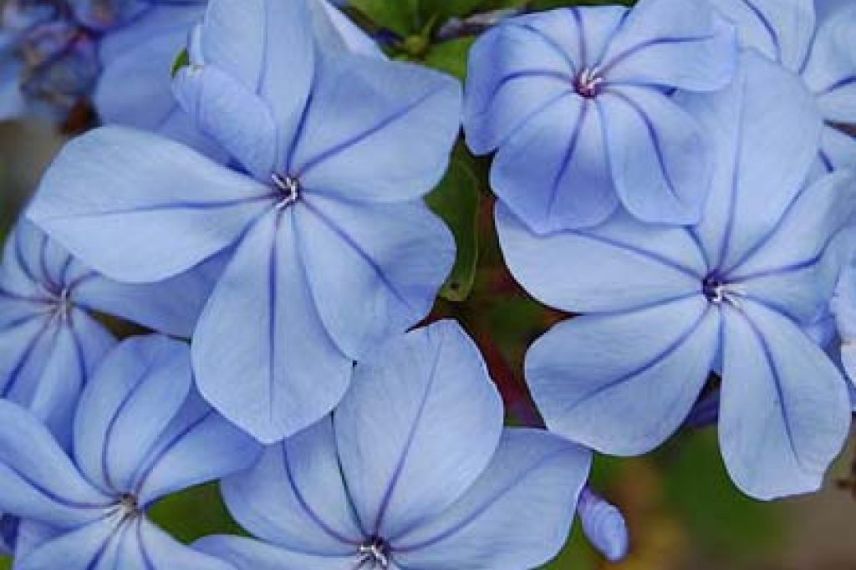
The blue of Cape Plumbago flowers

Which Cape Plumbago varieties should I choose for growing in pots?
Cape Plumbago (Plumbago capensis) can easily be grown in a pot, as its growth will be more modest there than in the ground. It will reach only about 1.5 metres in height and a 1-metre spread.
In addition to the type species, its other varieties are also suited to this mode of cultivation. This is for example the case of the Plumbago auriculata ‘Dark Blue’, whose flowers display a deeper blue, which gives it its name. Also the Alba variety, which produces elegant white flowers.

Plumbago auriculata ‘Dark Blue’
Read also
Pairing ideas with PlumbagoWhen should you plant Cape plumbago in a pot?
In theory, potted plants can be planted year-round, provided there are no extreme frosts or heat waves.
Ideally, Cape plumbago planting should take place in spring, between March and April. Proceed once the last risk of frost has passed.
In regions with mild winters, autumn planting after flowering, around November, is also feasible.
Planting Cape Plumbago in a pot
Container
Cape leadwort loves to develop its roots deeply. Plan a container large enough, at least 40 cm in diameter to provide that depth.
Choose fairly heavy containers, to prevent the plant from tipping over as it grows or in windy conditions.
Be sure to choose a container with a perforated bottom, so water can drain away and not stagnate around the roots.
As usual, we recommend terracotta pots, which allow the growing medium to breathe more easily thanks to their porosity.
Growing medium
Our pretty climbing plant appreciates fertile soils (rich in organic matter), without excess lime. It likes loose, well-drained soils that allow water to drain away.
You can choose a ready-made potting mix, for example for Mediterranean plants or for planters and pots.
If you prefer to make your own mix, combine:
- 2/3 of horticultural potting compost of good quality or non-calcareous garden soil ;
- 1/3 river sand or drainage elements (clay balls, perlite, gravel…)
- 1 to 2 handfuls of compost well-rotted or manure.
Planting
- Before planting, rehydrate the ball of your Cape leadwort by soaking it for 30 minutes to 1 hour. Place it in a container filled with room-temperature water (preferably rainwater).
- Install a drainage layer of 3–5 cm in thickness at the bottom of your container. Use clay balls, gravel or terracotta shards.
- Top up by adding the substrate mix into the container.
- Remove the old container from your Cape leadwort and gently tease out the roots if necessary with your fingers.
- Place the root ball of the Cape leadwort in the centre of the pot, then top up with substrate until the roots are buried.
- Lightly firm with your fingers to expel air pockets.
- Water generously.
- Install an organic mulch on the surface (bark, husks, dead leaves, RCW, etc.). It will limit natural evaporation and the growth of unwanted plants.
Training
Cape leadwort is a semi-woody and climbing plant. You may choose to let it develop as a shrub, which will take a rounded and rather tousled form. You have the option to place it higher up, for example above a wall, from which it will cascade down in a pretty flowering display.
If you prefer to grow it as a climbing plant, you can train it against a wall or any other vertical support: trellis, mesh, pergola, etc. Cape leadwort does not cling on its own: you will need to guide its flexible stems as they grow, attaching them with tree ties.
Exposure
Cape leadwort enjoys sunny exposures and warmth to bloom generously, from July through the first frosts. Place it in a position sheltered from prevailing winds.
It is an excellent outdoor plant in a pot during the warm season, which will brighten a garden, terrace or balcony.
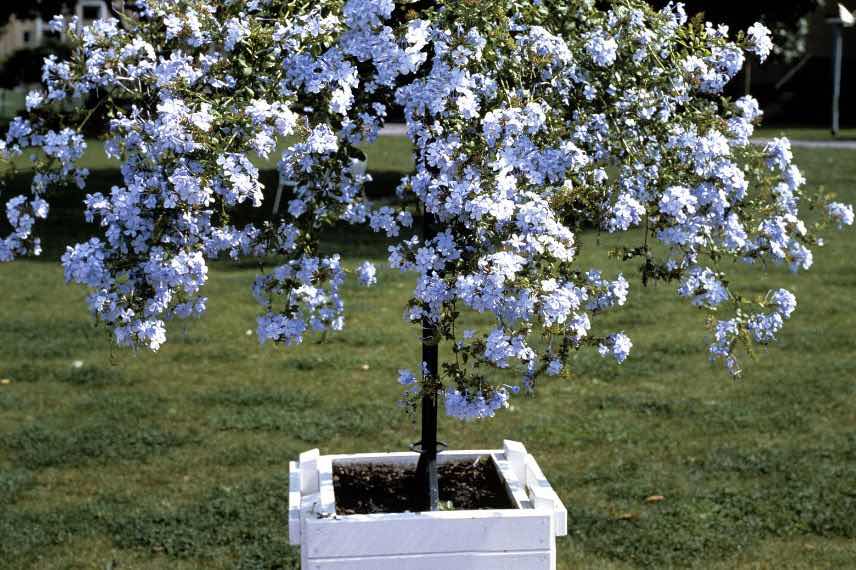
Pot-grown Plumbago capensis care
Watering
Cape Plumbago appreciates moist soil (moist but not waterlogged), though it can tolerate occasional drought. Grown in a pot, it will require more regular watering, as water evaporates more quickly than in the ground.
Watering of about two to three times a week will support flowering. Increase watering during drought and heat, in the absence of rain.
In winter, reduce watering: do so only when the surface of the potting mix is dry.
Prefer rainwater to mains water. The Cape Plumbago is sensitive to lime-scale and hard water, which can cause the foliage to yellow. Optionally, use an anti-limescale treatment for irrigation water or white vinegar.
The installation of mulching, which should be renewed regularly as it decomposes, will help limit natural evaporation and thus space out watering.
Fertilising
Cape Plumbago is a fairly hungry bush, which appreciates regular fertilising. This is all the more true when grown in a pot, as the substrate quickly exhausts its nutrient reserves.
Choose for example a fertiliser for flowering bushes or a fertiliser for window boxes and pots, favouring growth and flowering. The fertilisers that promote flower production are rich in potassium, rather than nitrogen.
Use a liquid fertiliser diluted in the watering water 1-2 times per month, during the entire growing period, that is from spring to the end of summer.
You can also use a solid fertiliser in the form of sticks or granules, mixed into the substrate. Its action is slower, but longer-lasting.
Stop fertiliser applications when flowering ends in late autumn or early winter.
Pruning
The pruning of the Cape Plumbago is not essential, but will help stimulate flowering. To do this, remove faded flowers as they appear.
Pruning also helps our potted plant maintain a harmonious silhouette. Prune in late winter or early spring. If the Cape Plumbago is trained as a climbing plant, prune only the secondary shoots and not the main branches. Reduce them by about one-third to encourage branching.
If the plant has been damaged by frost in winter, cut back all growth to 15 cm above the soil in early spring (in March or early April).
Always use clean cutting tools to prevent the spread of diseases between plants.
For more information: How to prune Cape Plumbago?
Pests and diseases
Cape Plumbago is not particularly prone to pests and diseases. In dry and confined spaces, such as in a greenhouse or conservatory, be mindful of potential attacks by mealybugs, whiteflies or red spider mites. To limit the risks, ventilate regularly and increase humidity. For this, you can mist the foliage with soft water. Do this early in the morning or in the evening, away from direct sunlight.
For more information:
- Mealybug: identification and treatment
- Whitefly: identification and treatment
- Red spider mite: identification and treatment
Excess lime in the soil or watering water can cause chlorosis, which will yellow the foliage. Treat with an anti-chlorosis product as soon as the first symptoms appear and adjust growing conditions. For more information: Iron chlorosis
Repotting
Repotting should take place every 2 to 3 years, at the start of spring. In years without repotting, perform a top-dressing, i.e., replace the surface substrate with fresh potting compost.
Wintering
Due to its origins, Cape Plumbago has retained a certain cold sensitivity. It will lose its foliage as soon as temperatures reach -5 °C. However, it will be able to regrow from the stump in spring if frosts have been occasional and have not fallen below -8 °C. Note, however, that a plant grown in a pot is always more sensitive to cold than a plant grown in the ground.
In regions along the Mediterranean or Atlantic coast, it may overwinter outdoors, possibly with some protection. For example, consider isolating the container from the ground, adding a thicker layer of mulch, and covering the above-ground parts of the bush with a winter fleece. Also protect your climbing plant in a pot from draughts and prevailing winds.
<Elsewhere, in regions with longer and harsher winters, the blue Cape Plumbago should be placed in a frost-free, unheated but bright location (conservatory, cold greenhouse…). Bring it indoors under shelter as soon as temperatures fall below about 8–10 °C.
En savoir plus dans notre article : How to protect Cape Plumbago from the cold in winter?
- Subscribe!
- Contents
Comments