


How to grow Scilla in a pot?
Our tips for successful planting and maintenance
Contents
Scilla are among the earliest spring bulbs. Their delicate blue, white or pink flowering lasts for almost three weeks.
Robust, low-maintenance and hardy, these are easy-to-grow plants. But you don’t need a garden to enjoy their lovely flowering, as these bulbous plants can easily be grown in pots with a little care. You can thus easily brighten terraces, balconies or patios and herald the arrival of warmer days with a touch of poetry.
So discover our tips for planting and caring for Scilla in pots.
→ Find our complete cultivation tips Scilla: plant, grow and care.

Which Scilla varieties should I choose?
Scillas generally reach between 10 and 35 cm in height. This compact habit therefore allows most varieties to be grown in pots without any trouble.. Choose them according to the colour of the flowers and their flowering period.
For example, choose from:
- the wood hyacinth (Scilla nutans), one of the best-known species, with spikes of bright blue-mauve bells that appear in April–May;
- the Spanish bluebell (Hyacinthoides hispanica), which displays bells in blue-lilac, pink (‘Rose Queen’) or white (‘Alba’) from March to May;
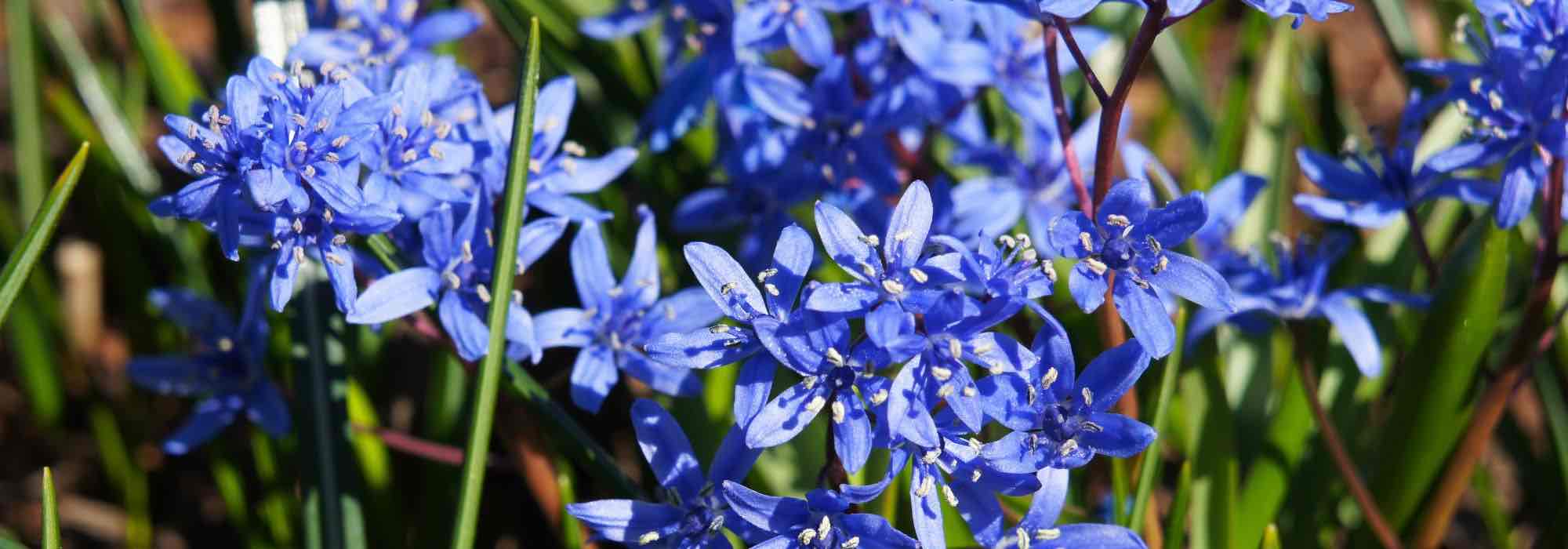
- the Siberian squill (Scilla siberica), one of the earliest to bloom, flowering as early as February in star-shaped blue bells;
- the two-leaved squill (two-leaved squill), which produces clusters of star-shaped flowers between March and April;
- the meadow squill (Scilla litardierei), which treats us to a multitude of small blue-violet flowers in late spring;
- the Peru squill (Scilla peruviana), with its flowers in pretty globe-shaped heads reminiscent of alliums in April–May.

In clockwise order: Scilla bifolia, Scilla nutans, Scilla hispanica, Scilla peruviana, Scilla litardierei, Scilla peruviana
Read also
5 easy spring bulbs for beginnersWhen should you plant scillas in pots?
Planting Scilla in pots takes place in autumn, from September to November.
Potting Scilla bulbs in pots
The container
You can choose from different container shapes, from classic pots or window boxes to troughs. Plan for a depth of at least 40 cm. The width of the container will depend on the number of bulbs you wish to grow, with 5 to 15 cm between each, depending on the species chosen.
Choose terracotta containers: their naturally porous material allows the substrate to breathe better.
Always choose a container with a perforated bottom, so excess water can drain away quickly.
The substrate
Scillas are easy-to-grow plants that generally fear only one thing: stagnant moisture. Their substrate must therefore be perfectly drained to avoid retaining excess water.
Our bulbous plants grow in ordinary soil, fairly rich in organic matter, especially for pot culture.
For planting, mix :
- 2/3 of high-quality horticultural potting compost or potting compost for window boxes and pots or garden soil;
- 1/3 river sand, of garden sand or gravel;
- a handful of well-rotted household compost.
Planting
- Install a drainage layer of about 2 to 3 cm at the bottom of your container: clay balls, gravel, broken terracotta shards…
- Fill with the substrate mix.
- Make planting holes about ten centimetres deep.
- Place the bulbs in the planting holes with the pointed end facing upward. Plant the other bulbs in a quincunx or in a line, keeping a distance of 5 to 15 centimetres between each (depending on their spread at maturity).
- Cover with substrate, then firm down with your hands.
- Mulch to help keep the soil cool.
Notes: you can easily pair your scilla bulbs with other bulbous plants that have the same cultivation needs (narcissi, crocuses, hyacinths, fritillaries…). This allows flowering to be staggered over several months.
Exposure
Place your scillas in pots under partial shade or filtered light. Some species, such as the Peru squill, need sun to flower well, but all dislike scorching exposures.
Also protect them from overly wet exposures, as scillas dislike excess moisture.
These bulbs will make ideal outdoor plants for the terrace or balcony.
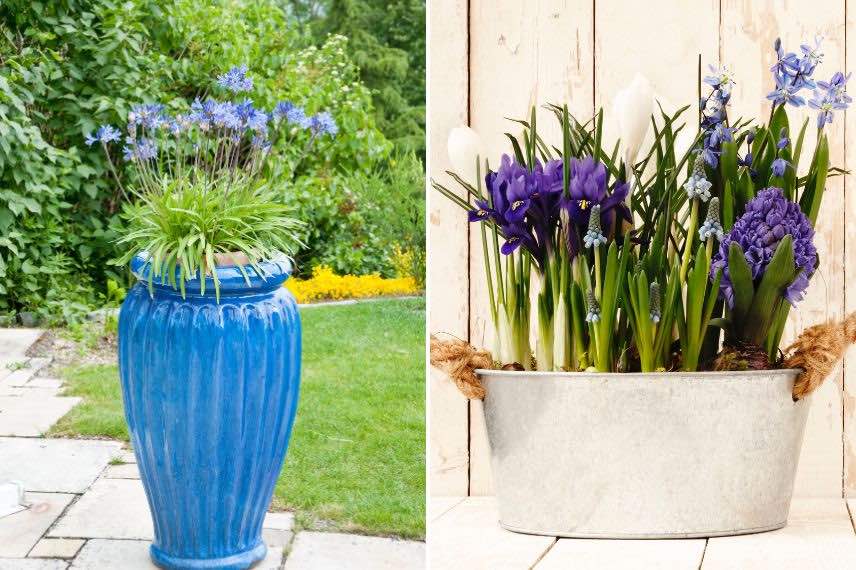
Scillas in pots, alone or in a mix of spring bulbs
Caring for potted squills
Watering
Squills prefer moist soil, i.e. soil that never dries out. Watering should be regular throughout the entire growing season. If there is no rainfall, water when the surface of the growing medium dries out.
From summer onwards, after flowering, stop watering. Squills indeed enter a dormancy period and require dry soil.
Fertilisation
Squills prefer rich soils. This is all the more true in pots, where the growing medium is more limited and nutrients are consumed more quickly.
During the entire growing season, from the end of winter to the end of spring, fertilise with a fertiliser for bulb plants, rich in potash.
If you would prefer a gentle and long-lasting fertilisation, opt for solid fertilisers in the form of sticks or granules. If you favour a quick boost, choose a liquid fertiliser to be diluted in the watering water more regularly. The amounts depend on each product, so be sure to follow the usage instructions.
You can also amend with well-rotted household compost to be gently incorporated into the growing medium.
Pruning
Squills do not require any specific pruning. If you want to avoid self-seeding, you may remove the flowering stems once flowering is finished.
After flowering, the foliage dries out naturally and wilts. Wait until it is fully withered before pruning it, to give the bulbs time to build up their nutrient reserves.
Pests and diseases
Squills are hardy plants, with few pests and diseases. Only excess moisture can cause the bulbs to rot and decline.
Over-wintering
Squills are hardy bulbous plants, at least down to -15°C, which allows them to overwinter outdoors in most of our regions. Some species even have a habit of growing at altitude.
Pot-grown plants are however more sensitive to frosts, so we recommend protecting the container with a thick organic mulch.
Also remember to move your pot to a sheltered spot away from strong weather and to remove any saucer.
Propagation
Proceed with a division by separating the bulblets from the main bulb every 3 to 4 years, to refresh the vigour of your squills in pots. The new bulbs will take about 2 years before flowering.
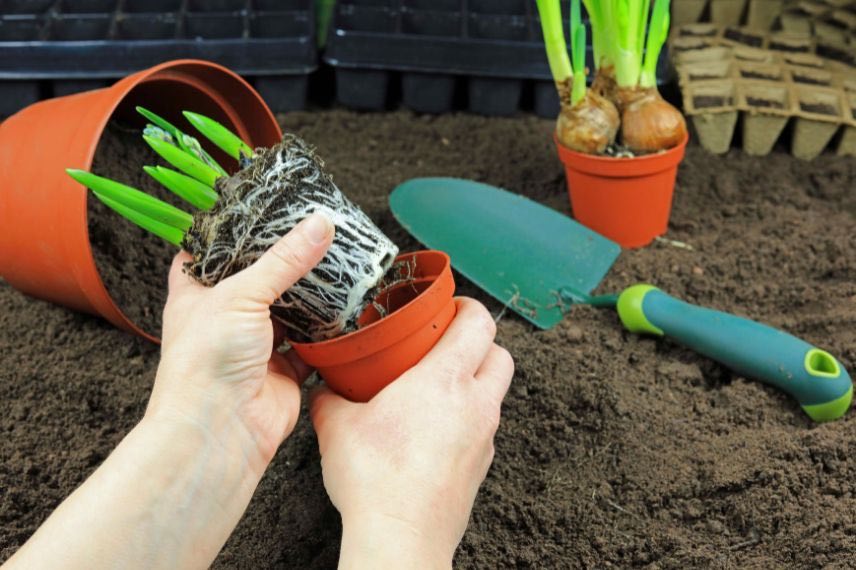
Divide squill bulbs every 3 to 4 years
- Subscribe!
- Contents
Comments