






























Miscanthus: a selection of varieties for pots
For balcony gardening in the city or on a terrace
Contents
Miscanthus are among the most admired grasses for their appeal throughout much of the year. If you grow them mainly in the garden for the generous shapes they create, you can also grow them in pots, selecting the most compact varieties, provided you have a warm enough spot for them to flower and display beautiful colours in autumn.
Here are five Miscanthus we’ve selected for their ease of growing in pots, on a terrace or balcony!

Miscanthus sinensis 'Adagio'
‘Adagio’ is a classic among compact Miscanthus, particularly prized for its fine, trailing foliage that takes on warm autumn hues, from orange to purple. Its pink inflorescences gradually pale to white as winter approaches. It has a notably bushy and trailing habit, which suits pot cultivation well, especially since it is one of the Miscanthus described as “small”, reaching in full flowering between 1 m and 1.3 m.
Like all Miscanthus, ‘Adagio’ is hardy and can be grown in all our regions. It needs exposure to sun and to receive sufficient warmth to encourage flowering (this will be the case for the Miscanthus we’re talking about here, and, in general, for all Miscanthus). Note that if your Miscanthus grown in a pot is too shaded, the clump will lose its neat appearance and tend to flop, and you’ll have fewer flowers. Consider yourself warned!
A substrate formed of potting compost blended with a little sand is suitable. Do not add fertiliser; it does not need any, even in a pot. If you have leaf mould or compost, add a little at planting to feed it just enough. You’ll prefer a plastic pot which has the advantage of better retaining freshness (this tip applies to all those we plant in pots), especially if placed on a balcony or terrace where the slab or railing raises the temperature in summer.
‘Adagio’ can serve, planted in threes for example, each in its own tub, as a handy, lightweight privacy screen on an urban terrace.
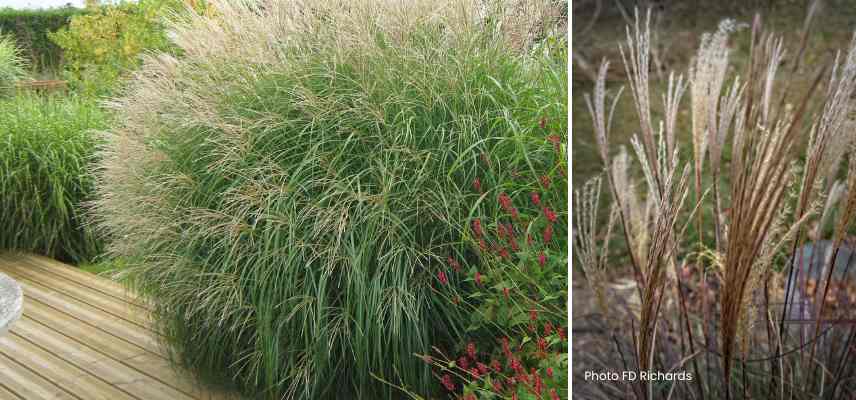
Miscanthus sinensis ‘Adagio’
Read also
Miscanthus: best varietiesMiscanthus sinensis 'Red Chief'
Also reaching up to 1.1 m in height, ‘Red Chief’ is one of the most attractive compact Miscanthus for planting on a terrace or balcony. Why? Simply because beyond its intrinsic qualities as Miscanthus (a superb late-summer flowering, here red), its narrow foliage provides over several weeks an incandescent display: the leaves gradually take on a yellow-orange to red hue, lasting for many weeks. It is simply stunning in a large pot on a terrace and complements the colour changes if you have, as a counterpoint, some of the finest trees and shrubs that colour in autumn.
Let us return to its flowering, which is far from being its least quality: ‘Red Chief’ is one of those Miscanthus whose inflorescences are red to purple. They turn to a silvery hue in late autumn and winter.
Do not give it soil that is too rich, as, like other Miscanthus, it tends—even in a pot—to become a little too loose. The beauty of this variety will harmonise with tawny or orange tones, for example in a handsome display of chrysanthemums, to accompany it for many weeks at the start of autumn.
N.B. : the height we provide here is the height excluding flowering for all Miscanthus. The varieties, whatever they may be, require about three years to reach their mature dimensions.

Miscanthus sinensis ‘Red Chief’
Miscanthus nepalensis
This Nepalese species, less well known than horticultural varieties, is nevertheless valuable for its modest dimensions (1.20 m), as well as for its inflorescences that are very curved, broom-like, bearing a sublime old-gold colour. We therefore do not hesitate to plant Miscanthus nepalensis in a container on a terrace in a wild-garden environment, as its fountain-like habit, very flexible, will link with natural spaces beyond the terrace. The flowering will gradually become very silky and almost white. The gold of its spikes harmonises with many perennials and shrubs, but favour late-summer flowering, purple to blue, to create a striking contrast with stately asters, such as Aster novi-belgii ‘Eventide’.
A west-facing exposure will enhance its dazzling colour in the late-afternoon light!
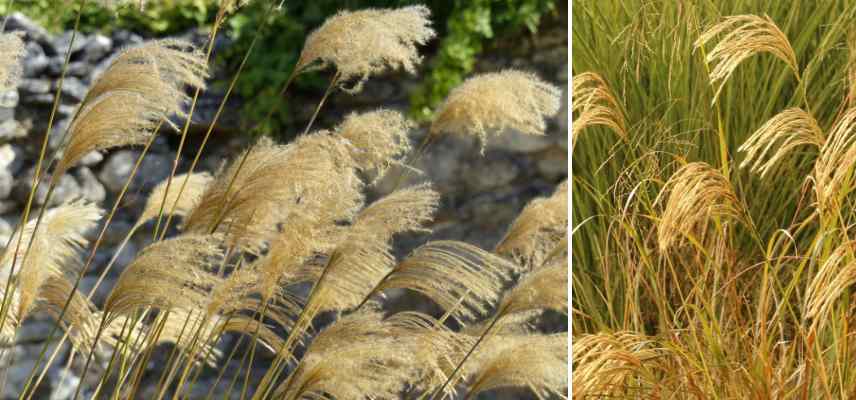
Miscanthus nepalensis
Miscanthus sinensis 'Yaku Jima'
Here is ‘Yaku Jima’, a dwarf variety particularly suited to container planting. It remains relatively compact for a Miscanthus (about 1 m tall) and has a slight tendency to become more rounded with time.
The yellow panicles that make up its flowering barely rise above the foliage and are spread across the entire clump. They fade to a paler colour as the weeks pass, finishing with a silvery hue.
Its foliage is marked by white veins at the centre. You will grow this adorable cultivar in a pot, in a substrate that is always well-drained, adding a little mulch to keep it cool during the summer months. It makes a perfect complement to a large pot display of Alstroemerias from the Majestic series (the tallest), or to the Inca Lily ‘Garden Summer Snow’, a beautiful cream-yellow, which will accompany it well into late autumn.
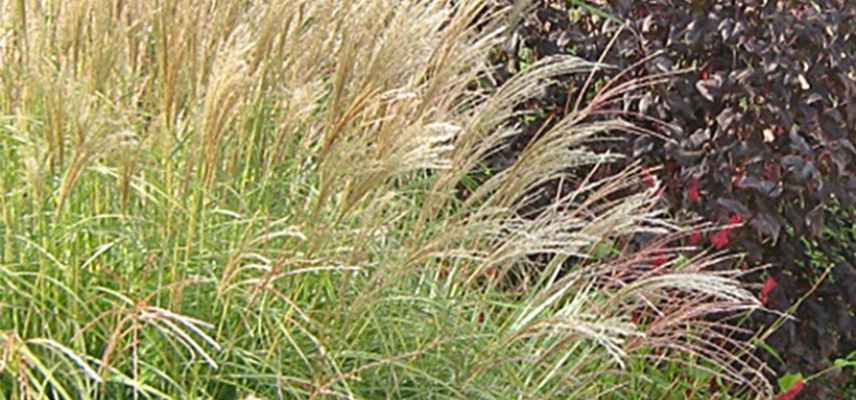 Miscanthus sinensis ‘Yaku Jima'</caption]
Miscanthus 'Kleine Silberspinne'
The Miscanthus ‘Kleine Silberspinne’ is the dwarf form of ‘Silberspinne’, a much taller cultivar.
‘Kleine Silberspinne’ is distinguished by dense, very fine foliage, a well-compact, stocky habit, and culms that are very straight and upright. Its flowering spike inflorescences are very numerous, evolving from purple to burgundy and then to silvery from August.
With it too, the foliage also takes vibrant autumn tones when it receives a good dose of sun during the day (at least 6 hours).
Its culms remain very upright, making a handsome variety for growing in a large tub or pot on the terrace. It will reach around 1.20 m tall when in flower. As with all Miscanthus, which are evergreen, it is advisable to prune the dead culms at the end of winter to make room for new growth.
Pair this very handsome Miscanthus with a pot of autumn-flowering purples such as Salvia guaranitica and a few tickseed, or a Japanese maple also grown in a pot. As it stays quite dense, you can also bring this handsome Miscanthus onto a balcony to screen you from a neighbour.
 Miscanthus sinensis ‘Kleine Silberspinne'</caption]
- Subscribe!
- Contents
Comments