





























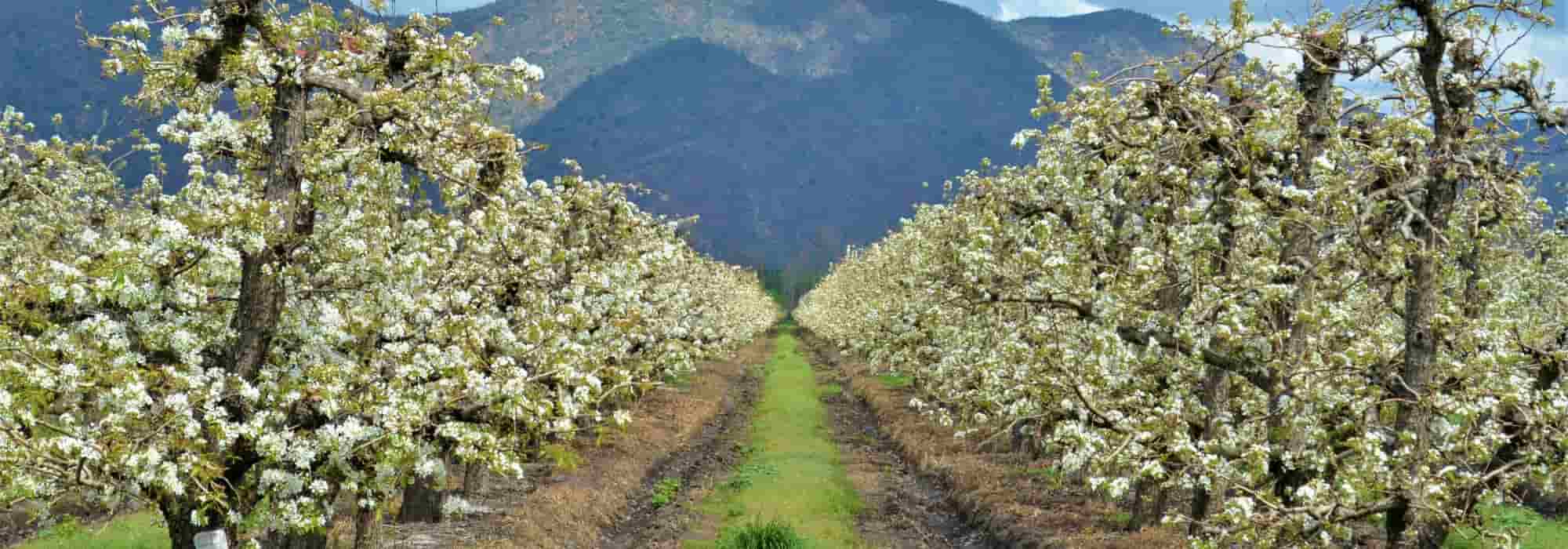
Protecting fruit trees from late frosts
What protections should be installed on fruit trees to protect them from spring frost episodes?
Contents
In some regions, the months of March, but even more so April and May, can be treacherous. Indeed, spring is here, and the shining sun during the day is a testament to that. Often, the daily temperatures encourage us to shed our layers and invest in the vegetable garden. However, spring can also be cruel as late night frosts are not uncommon and can thwart our sowing and planting plans. These same late spring frosts can also have severe consequences for fruit trees, particularly on floral buds, flowers, and the earliest small fruits.
When you have an orchard, or simply a fruit tree in your garden or in a pot on your terrace, these late spring frosts are often seen as a foregone conclusion. However, some precautions can be taken to protect fruit trees against late frosts. Here are our tips and tricks!

What are the consequences of frost on fruit trees?
In general, most fruit trees are very resistant to frost. Thus, fruit trees from the Prunus family, such as plums, cherries, apricots, and even almonds, are hardy down to -20 °C, and even -25 °C. Obviously, these very low temperatures can be tolerated by the tree itself. Fruit trees often require this cold period to trigger floral induction, which means to form their flowers. Indeed, the flowering mechanisms depend on an obligatory cold period, as well as the presence of varying amounts of light depending on the season.
On the other hand, once the fruit tree comes out of its winter dormancy, a period during which the sap does not circulate in the tissues, it becomes significantly more fragile. As soon as a fruit tree exits its resting period, it becomes active. By February-March, some begin to bud burst, leaf out, or even flower and set fruit (the period of fruit formation). Especially the early-flowering fruit trees such as almonds, apricots, peaches, and cherries. For instance, an almond tree can bloom as early as February, the apricot tree in February-March, and the peach and cherry trees between March and April. This is why frosts occurring in March or April, or even in May, can have disastrous consequences: necrosis of tissues, flower drop, “frost ring” on fruits in formation… and ultimately, the entire harvest can be compromised. Depending on the species and varieties, buds can freeze at -2° to -4 °C, flowers do not survive below -1.5° to -3°C, and young fruits at -0.5° to -2°C.
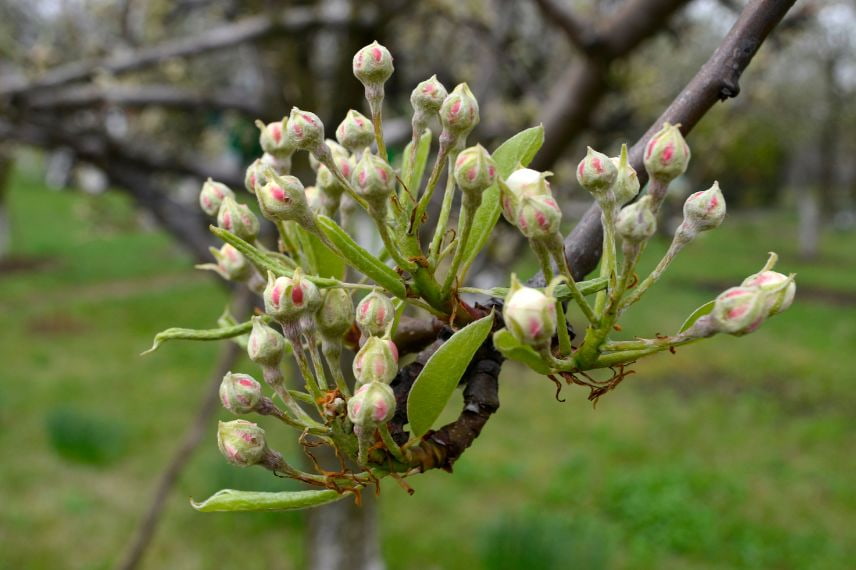
At this stage of development, fruit trees are very sensitive to late frosts
Most often, late spring frosts occur in the early morning, between 4 and 6 a.m.
With climate change becoming more pronounced over the past twenty years, the plant cycle is somewhat disrupted. Indeed, winters are often milder, which advances the flowering of fruit trees. Therefore, late frosts are even more disastrous. And the Ice Saints always lie in wait, from 11 to 13 May, especially in regions with a continental or montane climate.
In contrast, apple, pear, or plum trees bloom a little later in April and are therefore more resistant to frost. Even though they are never safe from the infamous Ice Saints (11, 12, and 13 May), who lie in wait…
Feel free to discover the 6 most frost-sensitive fruit trees to plant in the southern regions of France, which are less prone to late frosts. Although…
The methods of protection for fruit trees employed by fruit growers
For a fruit grower, a single frost night in spring can jeopardise a year’s work by destroying the entire potential fruit production. Each year, the media report on particularly dramatic frost episodes in the main fruit-growing regions of France and Belgium. This is why professionals deploy significant resources to combat frost. And significant often means costly:
- Protection of fruit trees by spraying or micro-spraying: as strange as it may seem, when a frost episode is forecast, fruit growers spray fine water droplets onto the trees. When they freeze, these water droplets form a protective shell over the buds, flowers, or fruits, shielding them from frost. It is a very effective system, but it consumes a lot of water. However, drought is becoming more prevalent, even at the end of winter. Its effectiveness can also be diminished by the presence of wind.
- Installation of candles that heat the orchards: this is a particularly effective frost control device, but it is very costly and requires a lot of labour.
Other methods, such as gas heating by air mixing or wind towers, have been tested in some regions, but without conclusive results.
Discover other Fruit trees
View all →
Available in 1 sizes
Available in 1 sizes
Available in 1 sizes
Available in 1 sizes
Available in 1 sizes
Available in 1 sizes
Available in 1 sizes
Available in 1 sizes
Available in 1 sizes
Available in 1 sizes
Protection of fruit trees with winter fleece
The winter cover made of non-woven polypropylene can be very effective against late spring frosts. It provides excellent thermal protection while allowing water and air to pass through. However, due to its size, it can only be used for potted fruit trees, young fruit trees planted in the ground, or trained fruit trees against a wall or on a trellis. Conversely, it will be difficult, if not impossible, to protect free-standing fruit trees with a winter cover.
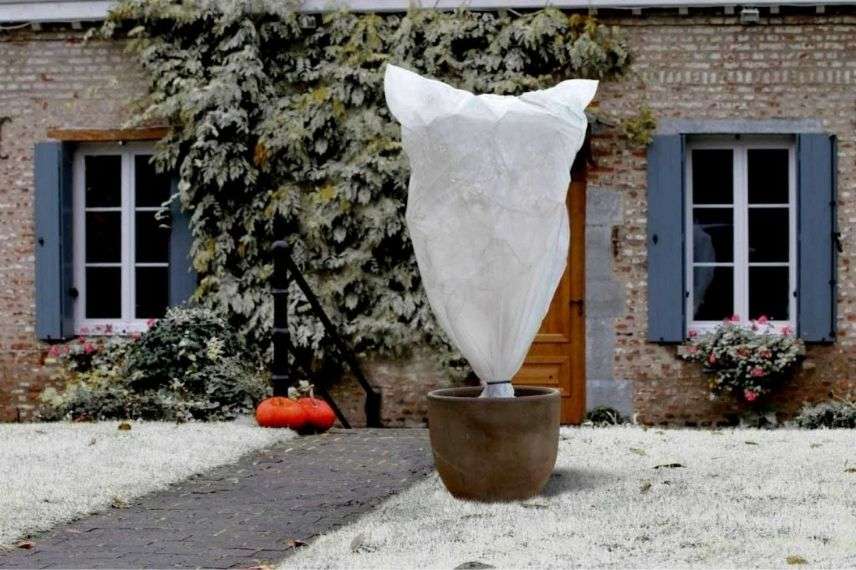
To be effective and truly protective, the installation of the winter cover must be done with some precautions. Indeed, it risks damaging or knocking off the already present and very fragile flowers. That’s why it is preferable to place wooden stakes (4 or 5 are sufficient) or bamboo around your young fruit tree, then attach the winter cover with pins from top to bottom, and don’t forget to create a sort of lid. This way, your tree can breathe. During the day, it is essential to remove or open the winter cover so that your tree can benefit from the sun’s rays. If your fruit tree is trained against a wall, do the same by planting stakes in front.
A winter cover of 45 g/m2 to 60 g/m2 should be sufficient. You can also use an old sheet or hessian.
Fighting frost with mulching of fruit trees
Mulching the stump of the tree with straw or dead leaves is also very effective. Indeed, frost tends to be stronger closer to the ground. Moreover, the soil stores the cold and diffuses it to the tree even after thawing. To prevent the straw or dead leaves from blowing away, you can place a winter cover or a jute sack held down by stones. Again, it is recommended to remove this protective barrier during the day and replace it in the evening.
If you have neither straw nor dead leaves nor commercial mulch, you can simply hill up around the base of fruit trees, especially the younger ones. 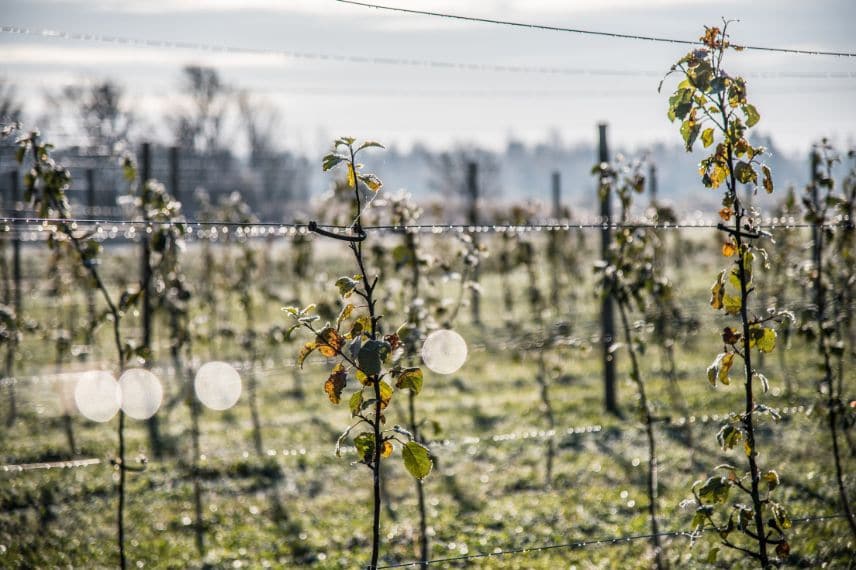
Similarly, surrounding the grafting point with a sleeve made of straw wrapped in a winter cover helps to increase the frost resistance of your fruit tree.
Some fruit growers also recommend mowing the grass very short around the base of fruit trees. Indeed, like the soil, grass retains the cold and transmits it to the tree.
Other techniques to combat frost
For larger orchards, there’s no miracle solution. Even though you can try the method of fine mist watering, this misting must be continuous, especially at dawn. You can also get up as early as 4 a.m. to spray your trees with droplets of water!
Otherwise, in the long term, planting protective hedges can be useful to at least shield your trees from cold drafts and gain 1 or 2 degrees, which can make all the difference in the event of late frosts. Similarly, building a fence from bamboo or wood can protect trees if they are not too large.
Better plant your fruit trees to protect them from frost
If you are considering planting some fruit trees, it is wise to anticipate frost episodes. Here are some sensible tips for planting:
- A fruit tree trained against a south or south-west facing wall of a house or fence retains the warmth of the sun. This helps protect the fruit tree from frost by releasing that warmth at night. Feel free to check Ingrid B.’s article on the different shapes and varieties of fruit trees.
- If you have no support for training a fruit tree, opt for a high-stem fruit tree. This way, the buds, flowers, and small developing fruits will be less sensitive to cold from the ground.
- A fruit tree planted in a valley bottom will be more susceptible to frost, as cold accumulates there, so it should be avoided.
- If you wish to plant early-flowering fruit trees like an apricot or cherry tree in an area where late frosts are common, plant your trees on a north-facing slope. The flowering will be later, making it less vulnerable. You may have slightly fewer fruits, but you will still have some. You can also plant your trees on a west-facing slope, as thawing will be slower there. Often, it is the thaw that can be critical for a fruit tree.
- Choose varieties that are cold-resistant and late-flowering to limit potential damage in areas most exposed to late frosts. For apricots, varieties like ‘Bergeron’, ‘Tardif de Tain’, ‘Rouge Tardif Delbard’ and ‘Tardif de Bordaneil’ are known for their late flowering. For cherries, choose varieties like ‘Tardif de Vignola’, ‘Cœur de pigeon’, ‘Reverchon’. For peaches, opt for the nectarine ‘Fantasia’, the yellow vineyard peach, ‘Sanguine’ or ‘Charles Roux’.
- Subscribe!
- Contents

Comments