





























Scabious: 6 ideas for successful combinations
To create harmonious flower beds
Contents
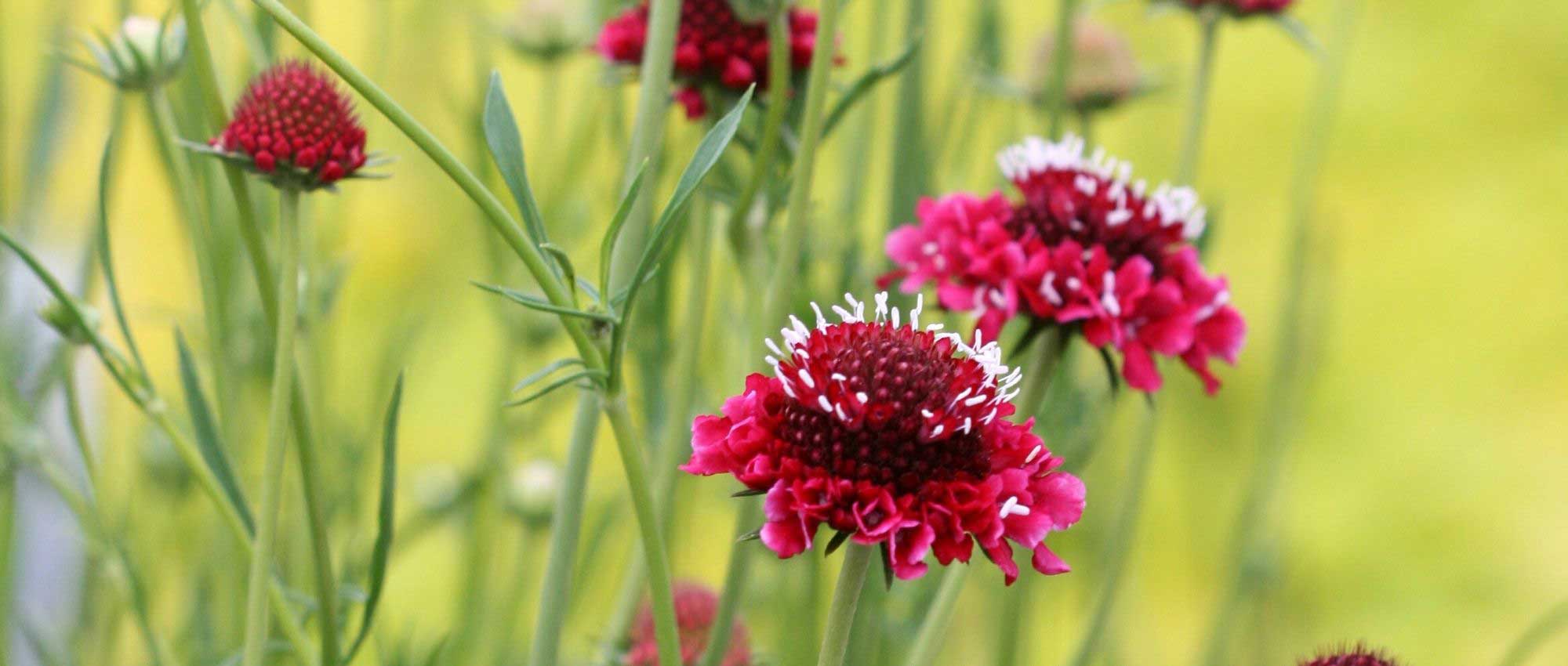
Scabious, or Scabiosa, are charming plants that are generally perennial with a very natural style. They are easy to grow and require little attention. They produce beautiful flowers in soft, pastel shades, often mauve, pink, blue, or white, made up of crinkled petals. Their flowering is particularly graceful and airy! Scabious are quite easy to combine in the garden and fit well into the composition of cottage and naturalistic borders, as well as mixed borders. They thrive in full sun, in ordinary, well-draining soil, as they are sensitive to winter moisture. They also integrate very well into dry and mineral gardens, for example in rockeries, alongside grasses. Discover our ideas and inspirations for combining them in the garden and creating stunning borders!

In a naturalistic style garden
With its delicate flowering, scabious is ideal for natural and wild gardens, especially as it is an excellent melliferous plant that attracts butterflies and other pollinating insects.
Create a beautiful countryside scene with perennials featuring light and airy blooms: Verbena bonariensis, Gaura lindheimeri, Salvia pratensis, perennial flax, Dianthus carthusianorum, phacelias, Penstemon… You can also include cornflowers, poppies, and cosmos. With their very flexible habit, these flowers will undulate beautifully in the breeze. Don’t forget to include grasses, such as Stipa or Chinese fountain grass. Your garden will surely have the feel of a flowering meadow!
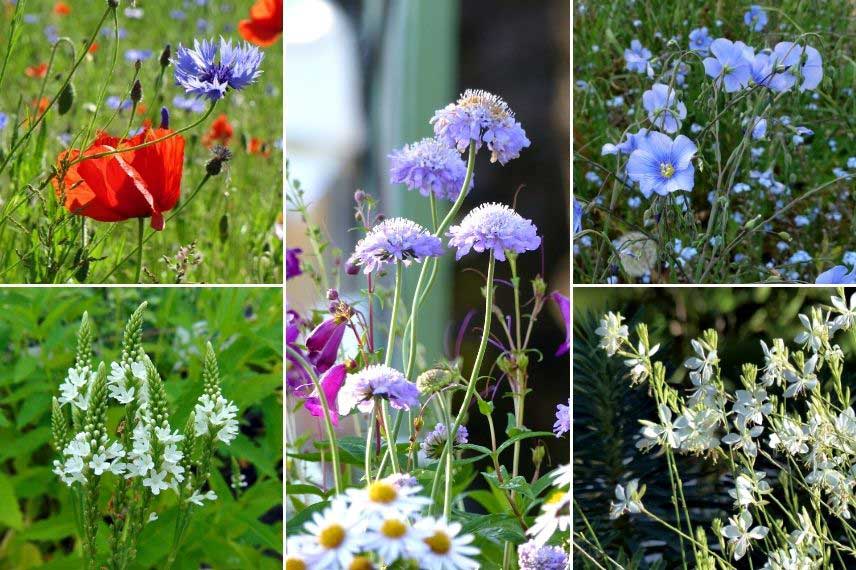
Poppies and cornflowers, Scabiosa columbaria ‘Pink Mist’, Linum perenne, Verbena hastata ‘Alba’, and Gaura lindheimeri ‘Snowbird’
Read also
Scabiosa: sowing, planting and growingIn a cottage garden
As their flowers are delicate and come in very soft shades, scabious easily integrate into cottage gardens. This typically English garden style is perfect for highlighting old stone houses.
Create irregularly shaped flower beds right in front of the house, overflowing with a profusion of flowers, mixed with aromatic plants and a few vegetables! Also, incorporate plants with generous foliage, such as Cynara cardunculus, hostas, and ferns. For flowering plants, choose soft shades, with a majority in pastel tones (light blue, white, soft pink, mauve, apricot…), mixed with a few flowers in more intense colours. Consider, for example, Salvia nemorosa, hardy geraniums, delphiniums, penstemons, campanulas, hollyhocks, foxgloves, phlox… Don’t hesitate to mix flowers, vegetables, aromatic plants, perennials, and annuals in the beds…
Plant densely to create a sense of lushness, an apparent disorder. The plants will seem to overflow from the beds, creating a very natural and wild appearance. Also, consider integrating a few climbers, such as clematis, jasmine, or climbing roses, which you can train to climb against the house wall or on a trellis.
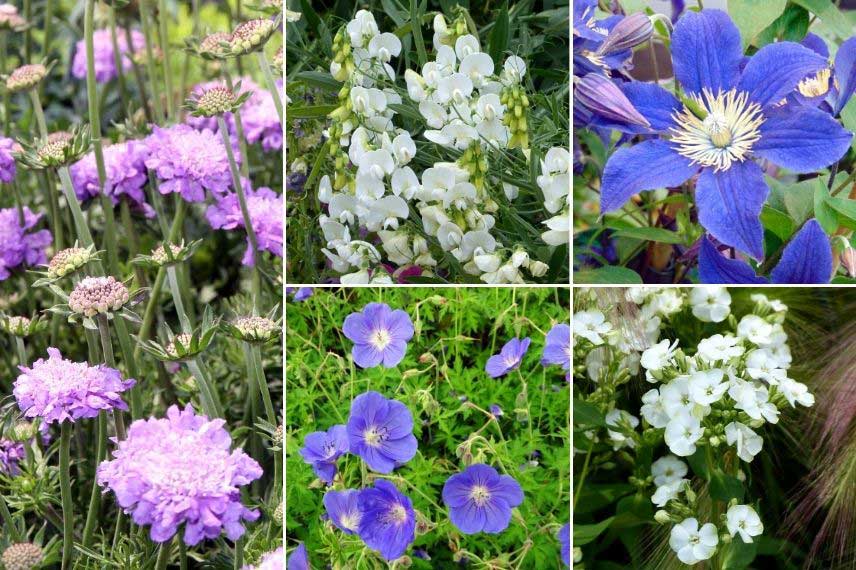
Scabiosa columbaria ‘Butterfly Blue’ (photo David J. Stang), Lathyrus latifolius ‘White Pearl’, Clematis ‘Hudson River’, Geranium ‘Brookside’, and Phlox paniculata ‘Jade’
Discover other Scabiosa - Pincushion
View all →
Available in 0 sizes
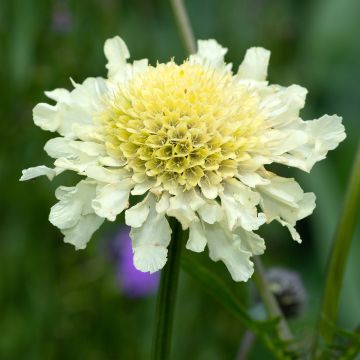
Available in 1 sizes
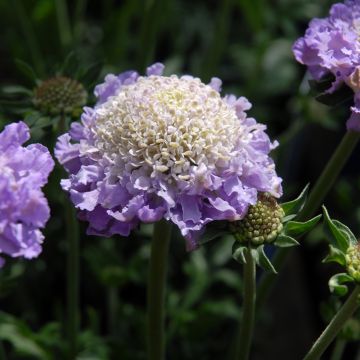
Available in 2 sizes
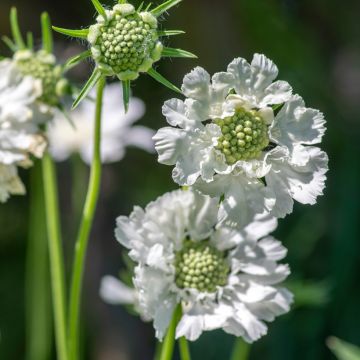
Available in 2 sizes
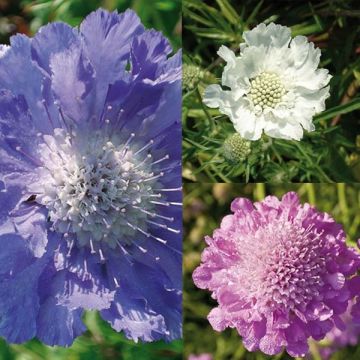
Available in 0 sizes
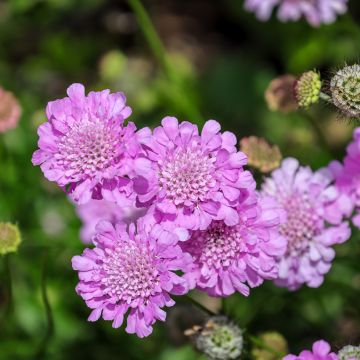
Available in 2 sizes
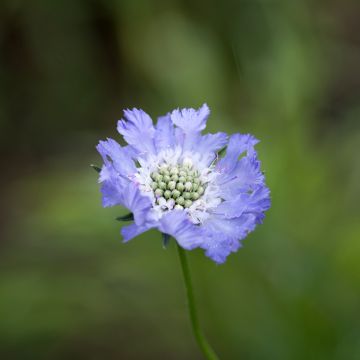
Available in 1 sizes
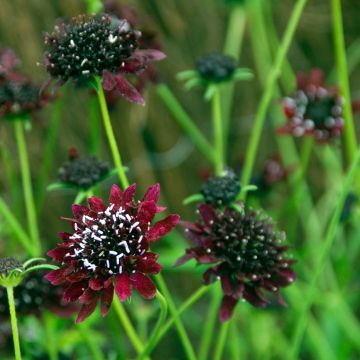
Available in 1 sizes
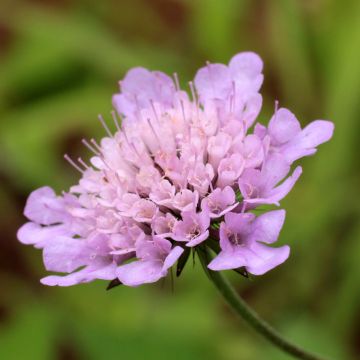
Available in 1 sizes
Available in 1 sizes
In a graphic garden
Scabious can easily be incorporated into the display of a modern and minimalist garden. Topiary bushes will help structure the garden, the flower beds, and define the pathways. They will form the framework, the skeleton of the garden.
Instead of boxwood, consider using Lonicera nitida, Ilex crenata, or Taxus baccata. Alongside them, integrate plants with a free habit to add contrast: scabious, of course, but also Gaura, Verbena bonariensis, and grasses such as Chinese fountain grass or Miscanthus. They will provide a beautiful contrast in shape, with a lot of lightness. For example, choose scabious ‘Chile Black’ or Scabiosa caucasica ‘Alba’, which you can use to border a pathway. Moreover, once it has finished flowering, the fruits of the scabious will add a very graphic touch! You can define the flower beds with small borders of Ophiopogon planiscapus ‘Nigrescens’ or Liriope muscari. The idea is to create a simple and minimalist garden, favouring white and black, with possibly one additional colour, but no more. Similarly, for the plants, carry out mass plantings, without too much mixing. For example, you can create a bed with only one or two varieties, planted in large numbers. This will give you a bed filled with simplicity and elegance!
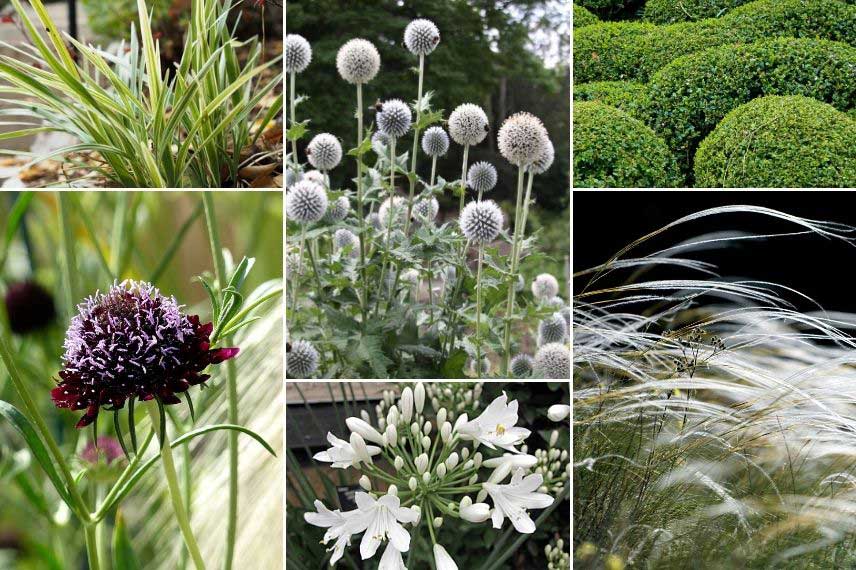
Ophiopogon japonicus ‘Variegatus’, Echinops sphaerocephalus (photo: Drew Avery), Buxus microphylla ‘Faulkner’, Scabiosa atropurpurea ‘Chile Black’, Agapanthus africanus ‘Albus’, and Stipa pennata
In a romantic garden
The delicate flowering of scabious will fit perfectly into a romantic garden! Opt for flowers in soft shades, primarily pink and white, with possible mauve tones. For scabious, consider the ‘Marshmallow Scoop’ variety, which boasts beautiful pink flowers resembling pom-poms!
They will wonderfully accompany the voluptuous blooms of roses, adding a touch of lightness alongside their imposing flowers. The particularly light flowers of persicaria and gypsophila will also bring a touch of delicacy and romance. Alongside them, plant some hardy geraniums, musk mallows Malva moschata, agastaches, and pinks, which will brighten the bed with their flowering. Don’t hesitate to incorporate silver foliage, such as the finely cut leaves of Wormwood or the fuzzy leaves of Stachys byzantina.
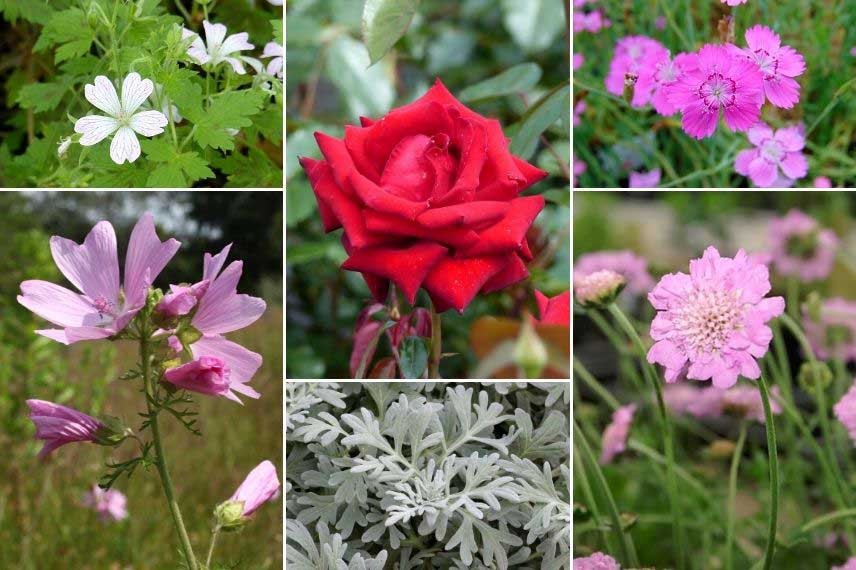
Geranium oxonianum ‘Katherine Adele’, Rose ‘Ingrid Bergman’, Dianthus deltoides ‘Rosea’, Malva moschata ‘Rosea’, Artemisia stelleriana ‘Silver Brocade’ and Scabiosa columbaria ‘Pink Mist’ (photo: David J. Stang)
In a dry and mineral garden
As scabious thrives in full sun, warmth, and well-draining substrates, you can plant it in a dry, mineral-dominated garden. For instance, take the opportunity to create a sunny rockery. Build a raised bed by adding a well-draining, sandy, or gravelly substrate, place some large stones for decorative appeal and to retain the soil, then create planting pockets between these stones.
Plant scabious alongside other perennials that enjoy sun and well-drained soils: consider Jerusalem sage, Phlomis fruticosa, which produces beautiful yellow flowers, as well as yarrow and mullein. You can also incorporate some Mediterranean plants such as lavenders, santolines, helichrysums, and helianthemums. Discover the garden campion, Lychnis coronaria, with its silver foliage and magenta flowers! Also consider grasses, like Stipa tenuifolia and Blue Fescue.
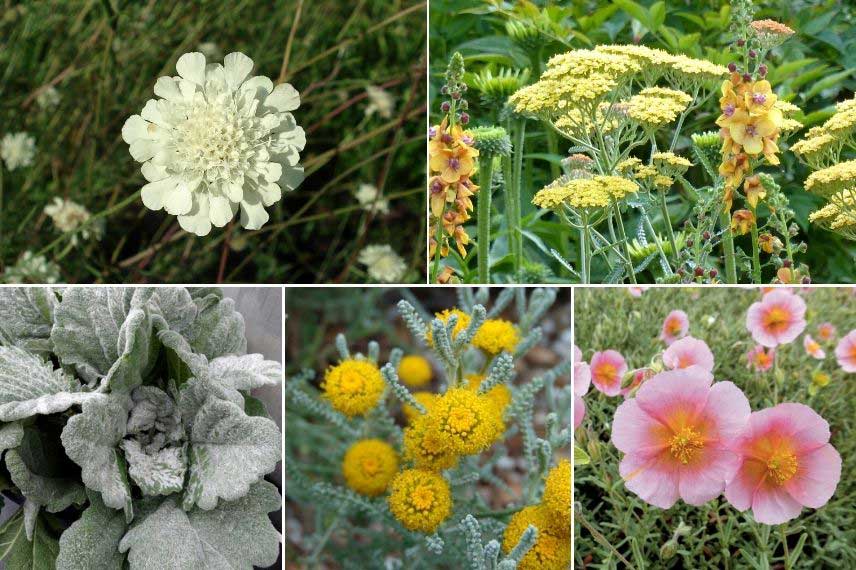
Scabiosa caucasica ‘Alba’, Achillea ‘Terracotta’ and Verbascum ‘Helen Johnson’, Salvia argentea, Santolina chamaecyparissus and Helianthemum ‘Rhodanthe Carneum’
To play with colour contrasts
Enjoy black-flowered scabious, such as Scabiosa ‘Chile Black’, to bring contrast to your borders! It will create an impression of depth and intensity among white or pastel flowers.
Plant it, for example, alongside Gaura ‘Snowbird’, Cosmos ‘Purity’, Campanula lactiflora ‘Alba’, gypsophila, Lychnis chalcedonica ‘Alba’, and Physostegia virginiana ‘Summer Snow’. You can also choose scabious in softer shades (for example, Scabiosa caucasica ‘Alba’ or Scabiosa ochroleuca) and plant them with more vibrant flowers, such as those of rudbeckias, gaillardes, Coreopsis, and Diascia.
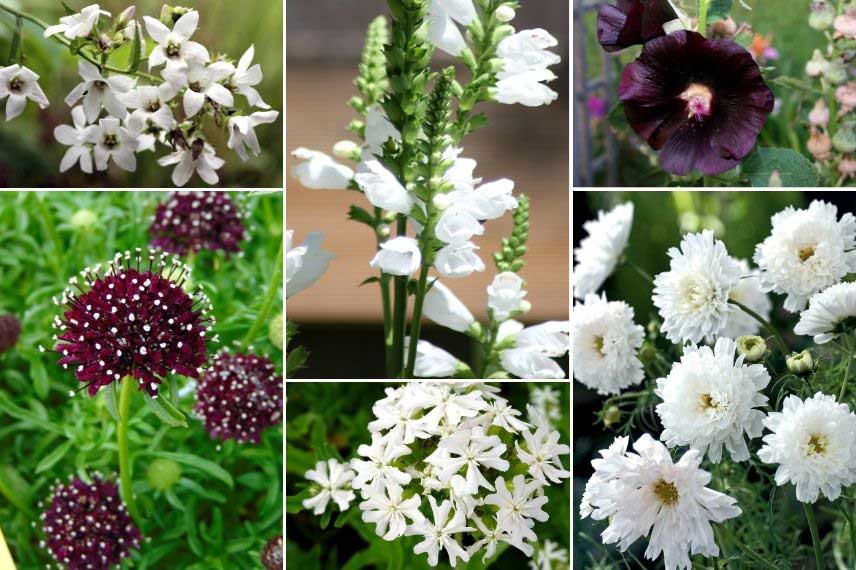
Campanula lactiflora ‘Alba’, Physostegia virginiana ‘Summer Snow’ (photo: P. Standish), Alcea rosea ‘Nigra’, Scabiosa, Lychnis chalcedonica ‘Alba’, and Cosmos ‘White Knight Suttons’
- Subscribe!
- Contents
Comments