


7 pairing ideas with Scillas
Create beautiful displays with these spring bulbs
Contents
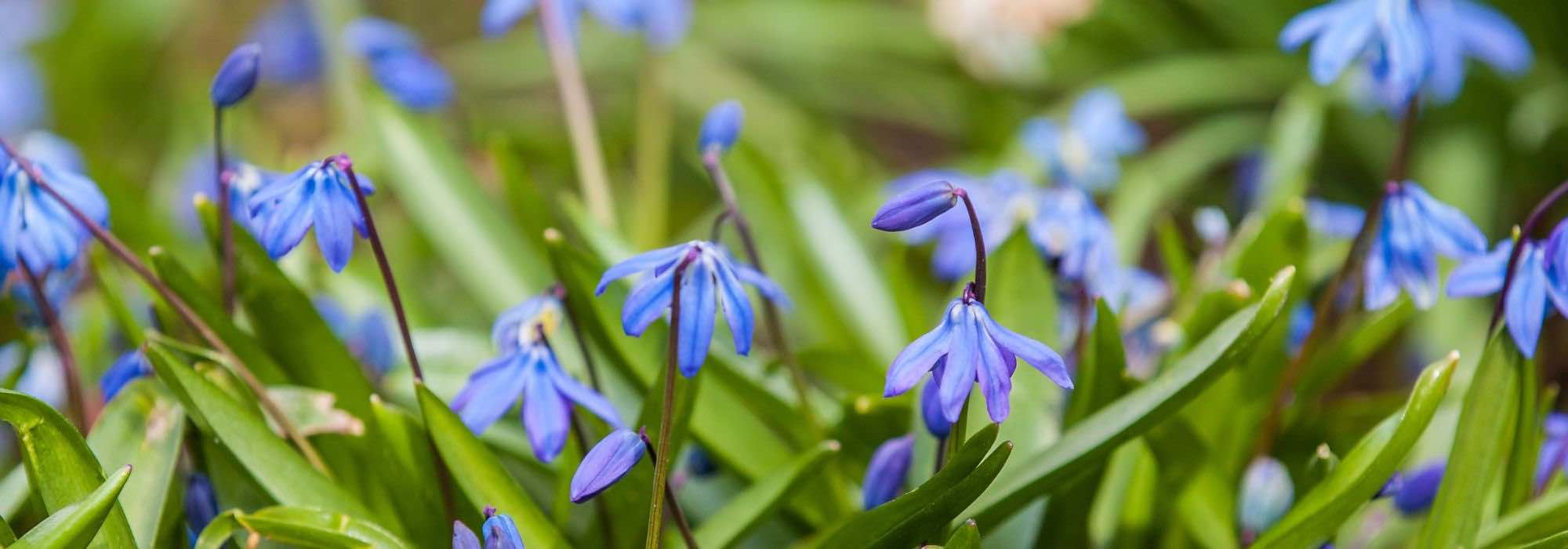
Scillas are early-spring bulbs that delight us from February with a beautiful blue flowering. Most species grow spontaneously in France, and are easy to naturalise in the garden in well-drained soil and exposure to partial shade, shade or gentle sun. One of the best-known scillas is the wood hyacinth, which forms magnificent carpets of blue flowers in our woodlands in April. Scillas have bell-shaped or star-shaped flowers, in beautiful shades of blue. There are also forms with pink or white flowers. Some very special scillas offer a different flowering and prefer other growing conditions. Discover our tips for pairing your scillas in the garden or in pots, and enjoy their elegant and delicate flowering.

As a specimen, in a monochrome woodland carpet
The first impulse when thinking of scillas may be to recreate a superb natural scene as seen on bright woodland strolls, where scillas go all out to form magnificent blue carpets beneath the trees in April and May. In some regions it’s the well-known wood hyacinth, Scilla nutans or Hyacinthoides non-scripta that is observed, and in others it’s the Spanish hyacinth, also called Spanish squill, and its Latin name Hyacinthoides hispanica. These charming scillas stand 30 to 40 cm tall. Their tubular, curled flowers unfold on one side of the stem, and they are mildly scented. They prefer humus-bearing soil, not calcareous, light, a little cool even in summer. As with other spring bulbs, leave the foliage in place until summer.
In a part of your garden that is a little wild or large enough and not mown before summer, plant plenty of bulbs of one of these two blue scillas and let time work its magic. Year after year, they will colonise more of the available space. Even though their intense blue is irresistible, you can choose a white or pink form of one of these two species to suit your preference. Under almond trees and flowering cherry trees, they create a scene of extraordinary charm.

Carpet of wood hyacinth or Scilla nutans
Read also
Scilla: planting, growing, and careWith other spring bulbs, in a natural meadow or a border along a path
It is, of course, just as attractive to mix the small early Scilla with other spring bulbs. Choose the Scilla siberica and/or the Scilla bifolia, blue, pink and/or white. The first blooms in February and March, and the second in March and April.
Growing to about 15 cm, they pair wonderfully with smaller spring bulbs, with flowering periods spanning from February to May. To accompany somewhat taller plants, choose Spanish Hyacinths or wood hyacinths as seen in the previous chapter.
If you want to take inspiration from nature for a slightly wild look, plant them with Bear’s Garlic bulbs with white flowers, with wood daffodils or Narcissus pseudonarcissus yellow, with Anemone blanda or white wood anemone.
For more varied colour, shape and flowering duration, add the botanical Crocuses, the lovely small botanical Tulips, the Chionodoxa, the Muscari, the Ipheion, the Leucojum vernum or Spring Snowflake. Also consider the delicate Eranthis hyemalis, whose yellow flower sits like resting on a carpet of very low foliage.
Install your mixes along a path edge, at the front of a border, or in an unmown meadow before summer. Prepare the soil so it drains well, in a sheltered, sunny spot, beneath shrubs or deciduous trees, for example. You will have a vibrant, energetic and joyful late-winter display lasting for several weeks.
Take the opportunity to compose pretty, fresh bouquets.
In a border or bed, also plan perennials capable of masking the withered foliage of the bulbs once their flowering has finished.
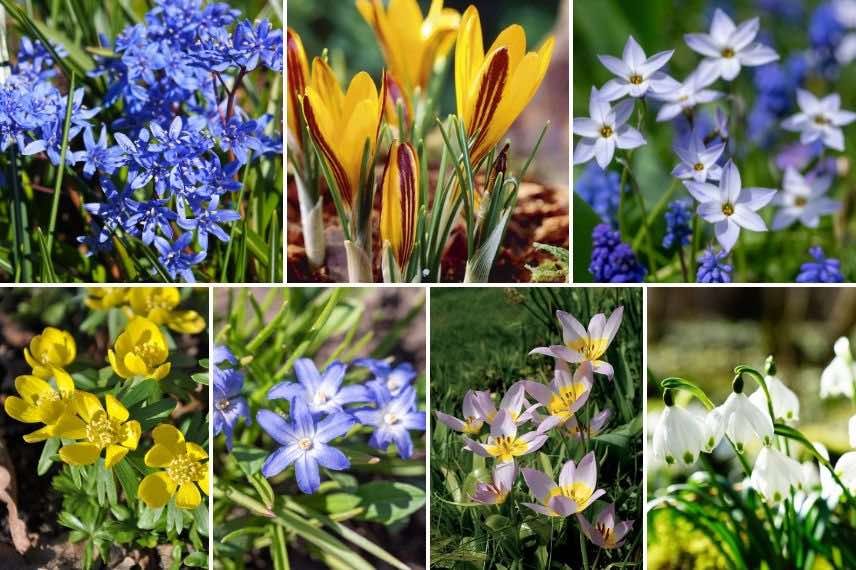
Clockwise: Scilla bifolia, Crocus angustifolius, Ipheion and Muscari, Leucojum vernum, Tulipa ‘Lilac Wonder’, Chionodoxa, Eranthis hyemalis
With jewel plants in a fresh rockery
In a fresh rockery, for a more studied display, plant here and there a few tufts of Scilla mischtschenkoana ‘Tubergeniana’ bulbs, a magnificent Scilla with iridescent flowers, in pale blue highlighted by deeper blue. Thus, planted sparingly between a few stones in a fresh plot, you can admire it at leisure from February, it’s the earliest Scilla of all. Accompany its precious flowering with bulbs of Iris reticulata, these splendid miniature irises with jewellery-like designs. Plant also Ornithogalums, admirable bulbous flowers little-known, also called Dame de 11 o’clock, in reference to the moment their flowers open. Make space beside them for the elegant Tulipa turkestanica and the handsome Narcissus poeticus.
Thus you spread the flowering from February to May. Add perennials and rockery shrubs. All these plants prefer a position between gentle sun and partial shade.
Regarding dwarf irises, to nicely pair with the aforementioned flowering, in tones of soft blue, pale yellow, white, and grey, choose varieties in soft blue and pale yellow such as the Iris reticulata ‘Katherine’s Gold’, ‘Alida’, ‘Katharina Hodgkin’ et ‘Down to Earth’ ou encore ‘North Star’.
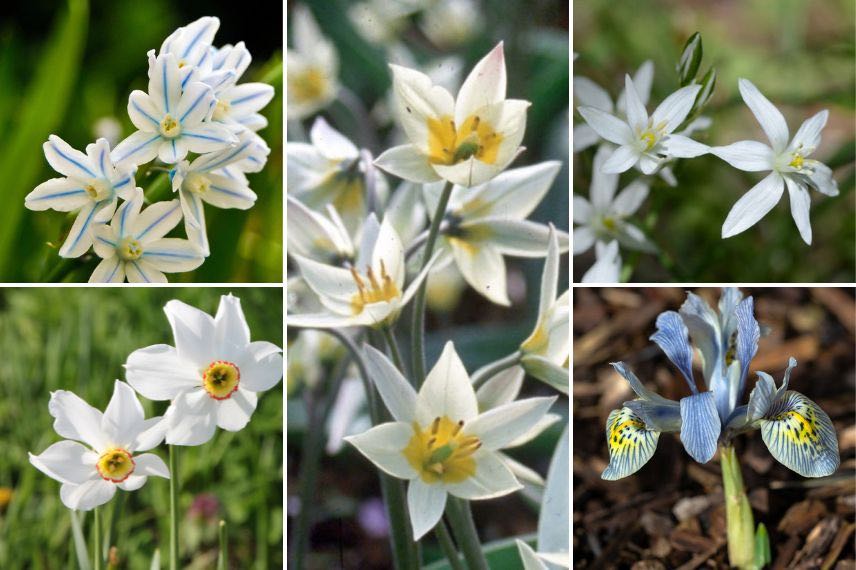
Scilla mischtschenkoana ‘Tubergeniana’, Tulipa turkestanica, Ornithogalum umbellatum, Iris ‘Katharina Hodgkin’, Narcissus poeticus
Sold individually or in mixes, in pots
Squills are well suited to pot culture, in pots, window boxes or planters on a terrace or balcony. Create a mixed bulb window box, planted in lasagne layers, with flowering staggered over time. Take inspiration from the bulbs mentioned in the second paragraph. Add some tufts of low-growing grasses, such as Carex and primroses that provide lasting structure to the container planting. Once the foliage of spring bulbs has withered in summer and their reserves have been replenished, you can cut back the foliage and lift the bulbs or leave them in place for the next year.
The “‘lasagne’ planting” is a technique of layering mixed flowering bulbs in successive layers according to bulb size and height to enjoy continuous flowering throughout spring.
→ To learn more, read Virginie’s article which explains how to proceed.
For a very different effect, plant Urginea maritima or Sea Squill, a bulb with numerous decorative attributes. Its giant bulb can reach up to 20 cm in diameter and 2 kg in weight. Plant it on its own in a pot, with the top third of the bulb at the surface of the pot. This dry, Mediterranean-type plant will initially produce a basal tuft of stiff, lanceolate, upright, slightly twisted leaves, 30 cm to 1.2 m long. The foliage then withers and gives way to a flowering stem about 1.2 m tall, crowned by a spike up to 35 cm long, bearing a multitude of tiny fragrant white flowers. This rarity is fairly undemanding, provided you give it the conditions it favours.
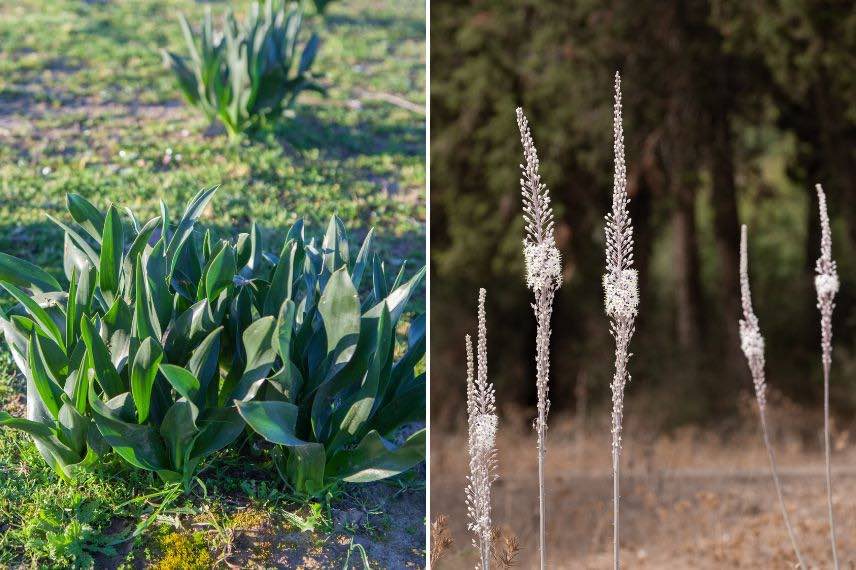
Foliage and flowering of Urginea maritima
At the base of perennials that thrive in partial shade in a border
In a border of partial shade or in light, cool woodland, plant Scillas at the base of your perennials that share the same growing conditions. Choose the Scilla bifolia or the Scilla siberica, in vivid blue, pink or white, or plant them in a mixed planting. They offer a delicate bloom in February–March for the first and in March–April for the second. Grow them in a cool, loose, well-drained, humus-bearing soil, alongside Hellebores, Tiarellas with erect white or pink-tinged spikes, of Corydalis solida, Pulmonarias, Epimediums, Brunneras and with low-growing groundcovers such as the Ajugas.
All this little entourage easily masks the foliage left after the Scillas have flowered. Also plant the splendid Erythroniums.
You will thus have a border with plenty of blue blooms, a colour that shines in partial shade.
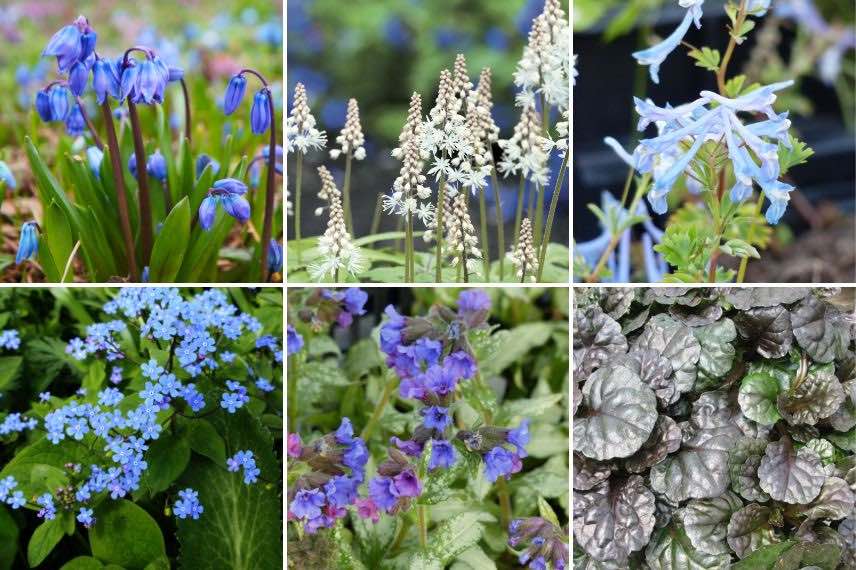
Scilla siberica, Tiarella, Corydalis, Ajuga ‘Black Scallop’, Pulmonarias, Brunnera
With plants suited to dry soil in a Mediterranean garden
The Scilla peruviana or Peru squill, native to the Mediterranean basin—Spain, Portugal, Italy and North Africa—thrives in this warm climate, provided the soil is not too dry. It flowers differently from woodland squills. It forms a basal rosette in autumn or winter, then in April and May develops a single central flowering stem at the end of which forms a large flattened spike. It opens into a multitude of small blue-violet flowers. This scill, which resembles no other, thrives in garigue soils, somewhat poor, very well-drained, but retaining a little coolness. It is hardy to about -10°C.
Plant this lovely southern Scilla, about 40 cm tall and 25 cm wide, with garigue plants such as Lavenders, Thymes, Rosemary, the Sages of small to medium height. Also accompany it with Algerian Iris or Iris unguicilaris.
In a dry, hot climate, also plant the Sea Squill or Urginea maritima on a low-maintenance slope with tall grasses.
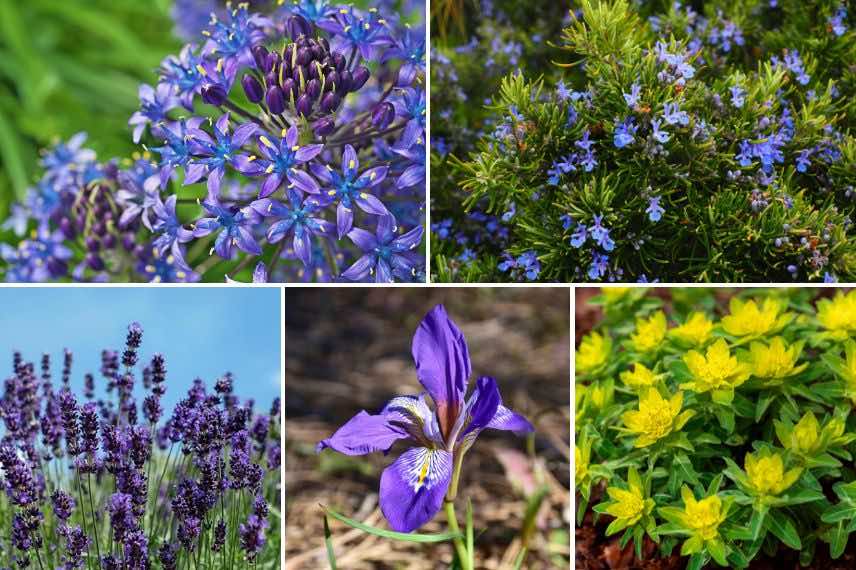
Scilla peruviana, Rosemary, Euphorbia polychroma, Iris Unguicularis, Lavender
At the base of spring-flowering shrubs
In a romantically inspired garden, plant the pink- and white-flowering forms of Scilla at the foot of pink-flowering shrubs for a charming scene. Think of the pink flowers of Japanese quinces, spring-flowering Spiraea and Korean forsythia.
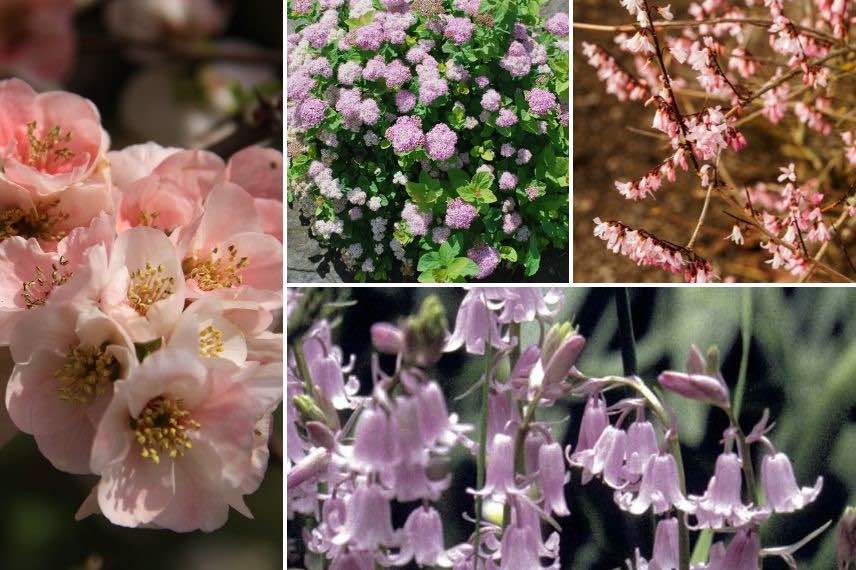
Chaenomeles speciosa, Spirea ‘Pink Sparkler’, Abliophyllum distichum ‘Rosea’, Scilla nutans ‘Rosea’
- Subscribe!
- Contents
Comments