





























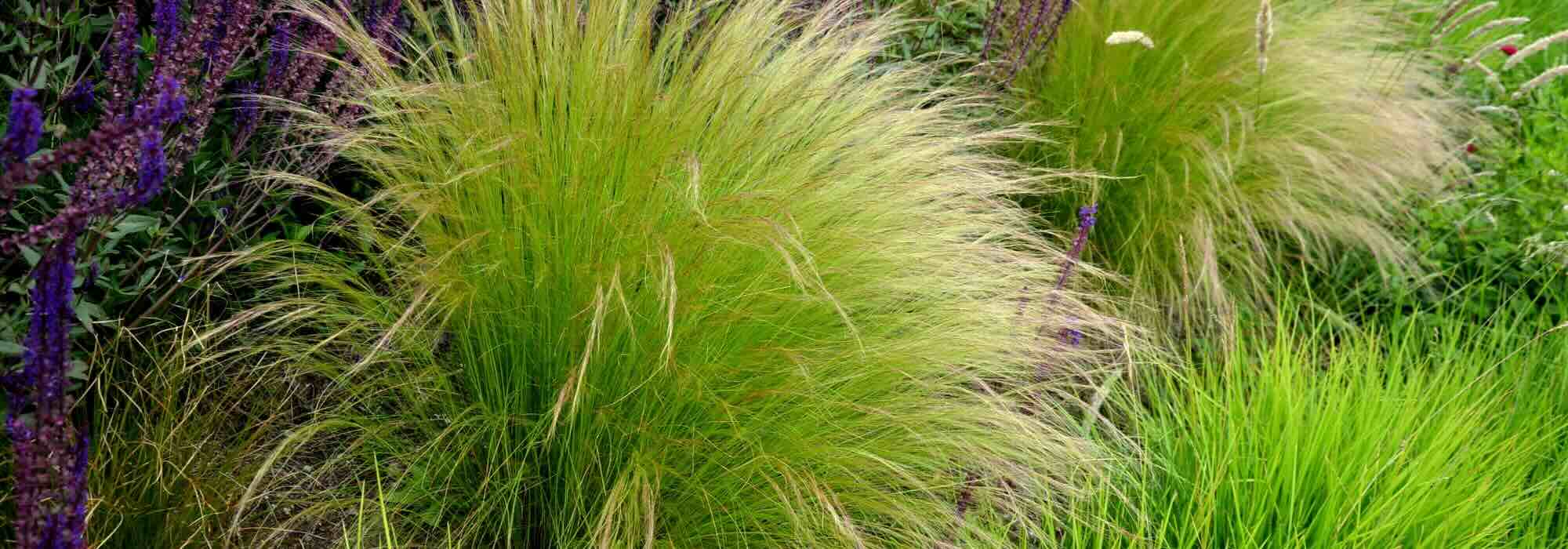
Stipa: which variety to choose for your garden?
Our tips for choosing and growing this grass
Contents
Stipa, also known as ‘feather grass’, is an ornamental grass prized for its lightness and low maintenance
Choose Stipa that best suits your needs and your garden, terrace or balcony.

Choose a feather grass according to its dimensions
The smaller feather grasses (40–60 cm tall)
Among the smaller feather grasses, the following species are found: the well-known Stipa tenuifolia which reaches a height of 40–50 cm and a spread of the same, as well as Stipa pennata. Stipa pulcherrima reaches 60 cm, with a spread of up to 40 cm. Stipa capillata, a little wider, measures 60 cm in all directions. Stipa barbata, more compact, attains the same height but only 30 cm of spread. Finally, the cultivar of Stipa trichotoma ‘Palomino’ , with a rather different appearance, extends to 40–50 cm in height and about 30 cm in width.
Among these small grasses, the narrower species form somewhat sparse clumps, which are largely offset by the fine and very long silvery spikes at flowering. The Stipa tenuifolia (or tenuissima) forms a denser tuft.
The medium-sized feather grasses (90 cm to 1.2 m tall)
Between the most commonly used feather grasses of small or large size, there is a bit of choice among the medium-sized species recently brought to market. Stipa ichu reaches 90 cm to 1.2 m in height in flowering and spans 60 cm in spread. Stipa extremiorientalis also grows tall with a narrower tuft about 40 cm wide. Stipa calamagrostis or its cultivar ‘Allgäu‘, can reach up to 1 m in height with a spread of around 50 cm. Stipa arundinacea, and its cultivar ‘Sirocco‘, are satisfied with a 40 cm spread, but can reach up to 1.2 m in height when flowering.
The large feather grasses (1.5 to 2 m tall)
Stipa gigantea, the most well-known, is the largest, with a height of up to 2 m in flowering and a spread around 50 cm. But outside of its flowering period, it forms a noticeably smaller tuft of 50–60 cm in height. Stipa splendens, develops a very broad tuft that can reach 1 m in spread at maturity, 1.2 to 1.5 m high for non-flowering foliage and up to 2 m in flowering.
Choose a feather grass based on its foliage and flowering
Stipa, a grass with a growth habit that is both erect and supple, stands out for its elegant, graceful silhouette, with bristly foliage or slightly arching leaves that can spread into a fountain. The leaves of the culms are exceptionally fine. Their pliant texture allows them to undulate at the slightest breeze, accentuating movement in the garden. Smooth and robust, they display colours ranging from fresh green to dark green, sometimes shaded with blue-tinged reflections as in Stipa capillata.
The overall impression changes at flowering, with slender, elegant and sturdy culms bearing panicles that are narrow and slightly drooping toward the ground. The spikelets also carry colours that vary with the seasons.
If the shorter species develop silvery, almost white hues in Stipa pennata, or silky blond in Stipa tenuifolia, the tall Stipa gigantea is adorned with spikes first purple-silver, then permanently warm gold.
The Stipa arundinacea, which also bears the name Anemanthele lessoniana, stands out clearly from other species with shimmering colours, as it panaches its green foliage with burnt orange in summer before turning rusty brown once the cold arrives. The cultivar ‘Sirocco’ takes on the same hues. The latter two begin their spring growth in medium green. The tall, plume-like inflorescences are purple-brown spikes.
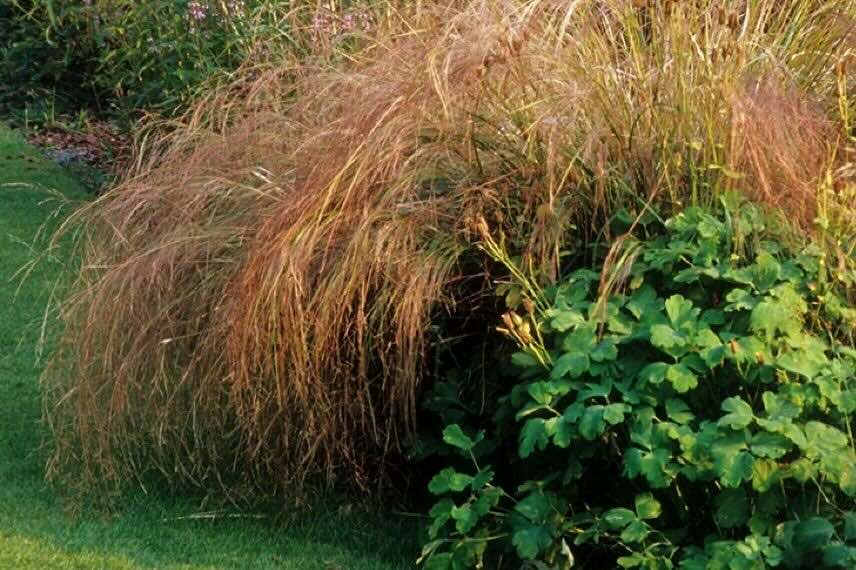
Bronze tuft of Stipa arundinacea
The form of flowering varies by species. Inflorescences are very fine in the smaller species; they gracefully extend the foliage and add a lot of movement, and are particularly long in Stipa pulcherrima.
In Stipa calamagrostis, the flat and plumed inflorescences, larger in ‘Allgäu’, are first silvery then golden at maturity. They evoke Calamagrostis.
The Stipa trichotoma ‘Palomino’ develops soft-spiked inflorescences forming a ball around the foliage, pale green turning silvered then bronze in autumn.
Among the tall species, Stipa gigantea and Stipa splendens, the spikes are loose, incredibly light, like delicate fireworks.
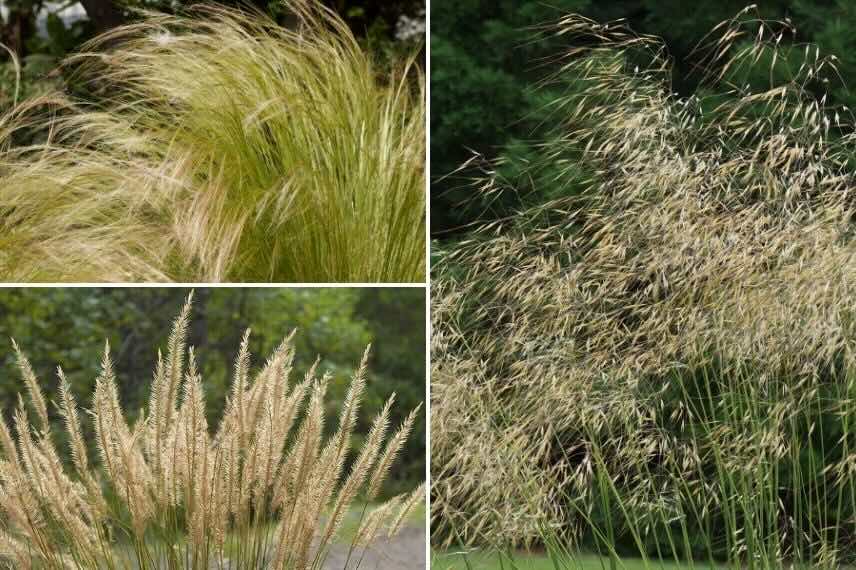
In the top left, Stipa tenuifola, bottom left, Stipa arundinacea ‘Allgäu’ and to the right the spikes of Stipa gigantea
Choose a Stipa according to its hardiness
Regarding hardiness, all low-growing species and among the medium-to-tall ones: Stipa trichotoma, Stipa gigantea and Stipa calamagrostis are hardy to around -15°C.
Two exceptions, however: Stipa arundicea, the most frost-sensitive, and the Stipa ichu. The first comes from New Zealand and does not tolerate temperatures below -9°C; it is best reserved for mild climates. The second, native to the Andes, tolerates frost down to around -10 to -12°C in very well-drained soil.
The hardiest are the Stipa splendens, native to China and Mongolia, and Stipa extremorientalis, native to China, Siberia and Japan. They tolerate frost down to at least -20°C.
For moderately hardy species, improve soil drainage to avoid excess moisture, often more problematic than the cold itself. Keep in mind that young plants are more susceptible to extreme temperatures than established specimens, and that hardiness data are given for established specimens.
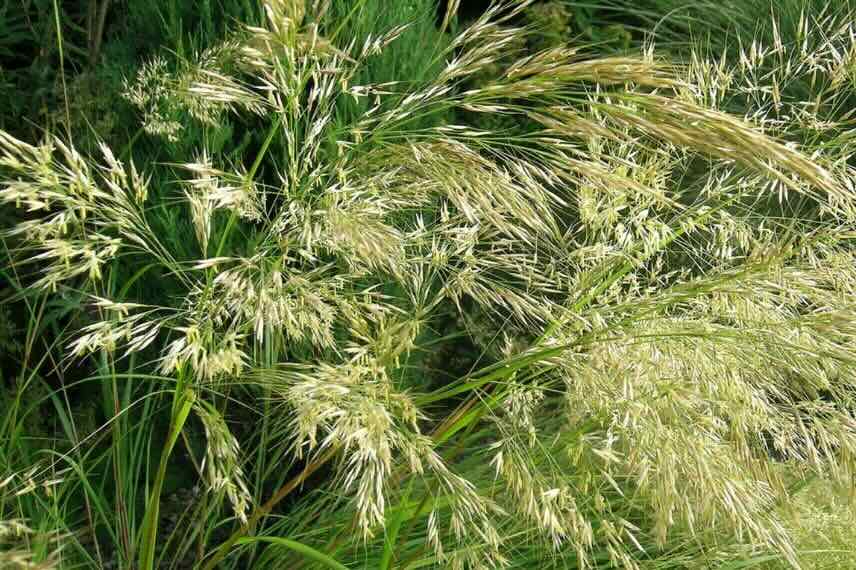
Stipa splendens, very hardy
Read also
7 ideas for pairing StipasChoosing feather grass according to its use.
On borders or rockeries
Small-sized Stipas, such as Stipa tenuifolia, Stipa barbata or Stipa capillata, are perfect for bordering paths or enlivening rockeries in dry, well-drained soil. Their compact habit and graceful panicles bring lightness and movement to restricted spaces.
In the herbaceous borders
Medium-sized Stipas, such as Stipa calamagrostis, Stipa arundinacea and Stipa extremiorientalis, are ideal for structuring the borders. Their flexible habit and fine texture contrast with plants with broader foliage or with colourful flowering. By planting several clumps of the same Stipa, you will create a sense of continuity and harmony in the border.
As a specimen or focal point
Large Stipas, such as Stipa gigantea and Stipa splendens, are interesting choices for creating focal points in the garden during their long flowering period. Their slender stems and golden panicles attract attention and add majestic verticality. These species lend themselves well to a solitary planting, where they can fully display their elegance. Their ability to catch sunlight throughout the day makes them particularly appealing in exposed positions or when backlit.
For natural or wild gardens
If you want to create a natural-looking garden, Stipas are indispensable. Species such as Stipa pennata, Stipa ichu or Stipa pulcherrima fit perfectly into a flowering meadow or a wild garden. Their waving panicles swaying in the wind and their changing hues evoke landscapes of the steppe or savannah. Together with other grasses or native plants, they promote biodiversity while requiring little maintenance.
In pots or large containers
Many species, i.e., all small- to medium-sized Stipas such as Stipa tenuifolia and Stipa arundinacea, are very well suited to pot culture. Their graceful habit and light foliage allow for mobile compositions, ideal for balconies, terraces or small gardens. Pots can be moved seasonally or to protect them from frost, especially for less hardy species such as Stipa ichu.
Ground cover or screening
Dense, vigorous medium-sized Stipas, such as Stipa calamagrostis, can be used in groups to cover the soil aesthetically and limit weed growth. Planted in rows or successive clumps, they can act as a small privacy screen or as a natural separation between different parts of the garden.
In contemporary-style plantings
Stipa, with its pared-back appearance, blends easily into minimalist gardens. In a contemporary garden, the foliage and graphic panicles of Stipas bring a touch of lightness to balance harsher elements such as concrete or geometric edging.
Choose a Stipa according to the soil
A single brief note to clarify that if feather grasses are plants that prefer dry, poor, stony, very well-drained soil, Stipa gigantea appreciates slightly moist soil (but not heavy) to perform at its best.
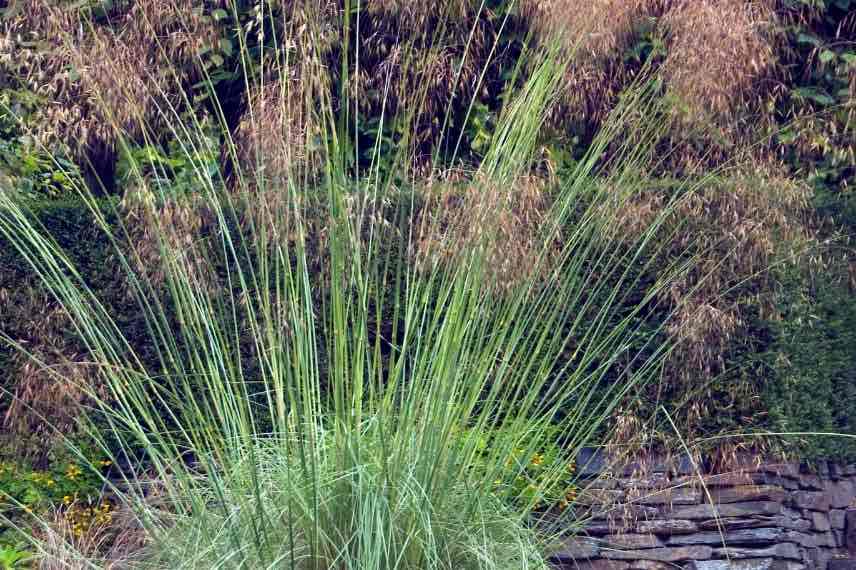
Stipa gigantea appreciates a touch of moisture in the soil
Choosing a Stipa for its rarity
Some Stipa species stand out for their rarity on the market, owing to their geographic origin, their specific habitat, or cultivation that is not yet widespread. These rare grasses are particularly sought after by gardeners in search of unique plants.
Stipa ichu, Stipa extremiorientalis and Stipa pulcherrima are very interesting species, rarely grown, seldom seen, and not widely available on the market or in gardens.
– The Stipa ichu : Originating from the Andes, Stipa ichu, also called Jarava ichu, is a rare species in cultivation, native to the Andean Altiplano, which grows naturally at high altitudes, between 2,500 and 4,500 metres, where it plays an important ecological role in feeding livestock (llamas) and stabilising soils. In gardens, it brings the extreme lightness of its fine and supple tufts and its silvery plumes.
– The Stipa extremiorientalis is a species native to the steppes of the Far East, notably China, Siberia and Japan. Capable of withstanding very low temperatures, it fits perfectly into wild and rural borders. Its leaves are erect and then arching, in bright green. Light and feathery spikes that catch the light appear in summer, then turn bronze-golden in autumn.
– The Stipa pulcherrima is also known as Admirable feather grass, which says a lot about this rare and elegant grass. It is a subspecies of Stipa pennata, with more spectacular flowering, native to Turkey, Iran and Armenia. It forms a slightly arching clump of very fine leaves in medium green. In summer, immense, light as a breath inflorescences emerge, in the form of very long, slender, flexible, soft and silky spikes, a bright white-silver colour, turning golden in autumn. The spikes keep their extraordinary beauty until winter.
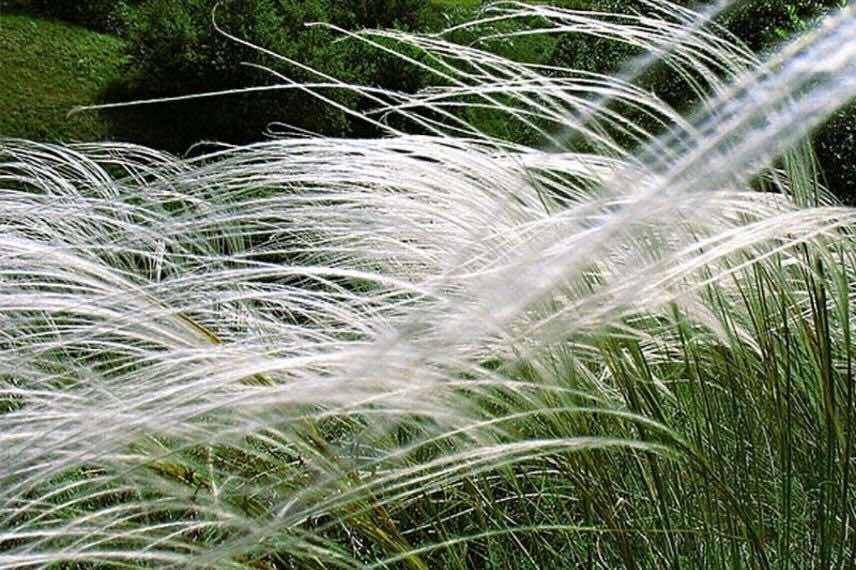
The superb flowering of Stipa pulcherrima
Planting or sowing?
Stipa can be planted as young plants or sown directly, depending on your preferences and the conditions in your garden. Planting in pots is ideal for a quicker effect and allows you better control over their placement. By contrast, sowing offers a cost-effective solution and allows you to obtain a larger number of young plants, but it requires a little more patience. Stipa seeds are usually sown in spring or autumn, in well-drained, lightly firmed soil, taking care not to bury them too deeply.
- Subscribe!
- Contents

Comments