





























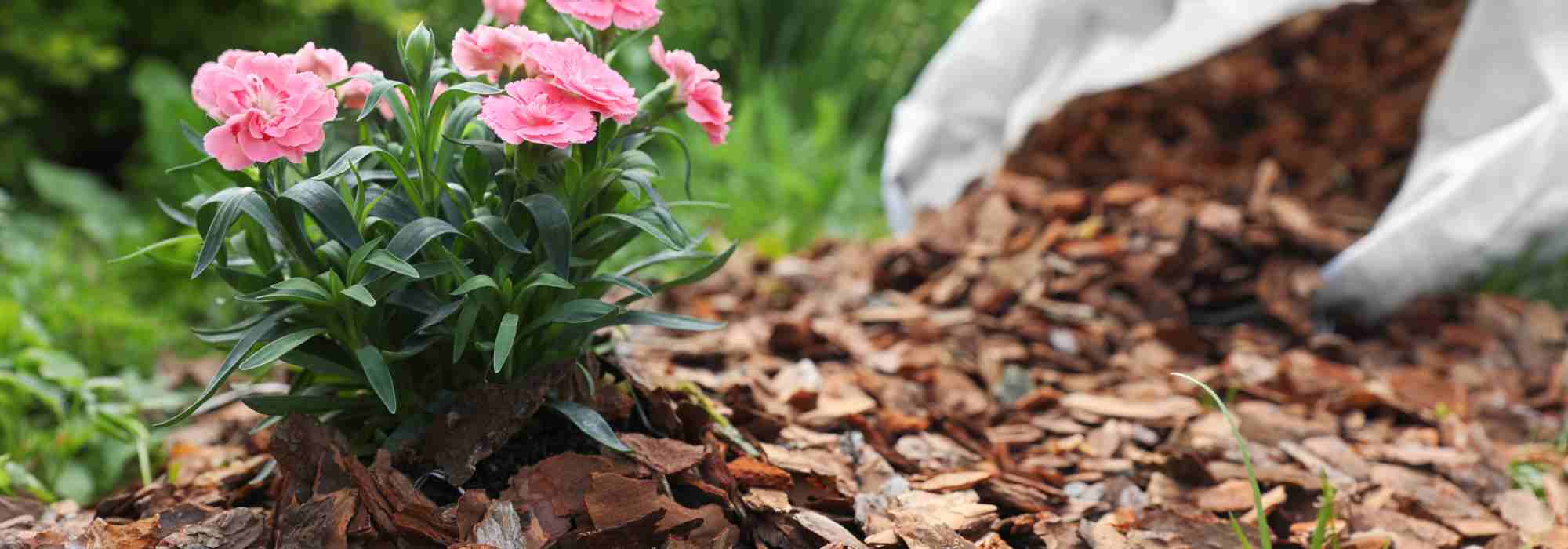
The best mulches to say farewell to weeds
The most suitable mulches to limit adventive shoot growth
Contents
Rumex, oxalis, couch grass, dandelion, bindweed… You may have a certain tolerance, but weeds often put your gardener’s patience to the test! Those that should be called “adventives” rather than “weeds” regularly reappear in your ornamental garden, your beds and hedges, or even in your vegetable plot. If some choose to exterminate them relentlessly, others keep them to avoid bare soil, to attract pollinators or to eat them. You, you are more of a believer: “I stop weeds from growing to spare my back and nerves!” This fight involves laying mulch, whether organic, mineral or synthetic.
Discover all our tips for choosing the mulch best suited to limit the spread of adventives, and, incidentally, enrich the soil of your beds, rockeries and vegetable plots.
And if you feel like making peace with weeds:
- 10 good reasons to let weeds grow
- Yum yum, weeds!

Why is mulching effective against weeds?
As a reminder, mulching involves covering the soil with a mineral, organic or synthetic material. A bit like in nature. Soil never stays bare here, as it is always covered by dead vegetation, such as leaves. In the vegetable plot or in our borders, this cover is not natural and the gardener must intervene.
Mulching has several roles: limit evaporation of water to space out watering, keep vegetables or plants clean and thus prevent the spread of diseases, insulate the soil from the cold or from overheating in summer, create an ecosystem favourable to beneficial insects and nourish the soil… But mulching also has a benefit in suppressing adventive weeds. Indeed, when laid on thickly, it blocks light from reaching the soil. Plants thus deprived of light, photosynthesis does not take place. As a result, wild plants die on their own without having been able to germinate.
Mulching therefore stops weed regrowth, and spares the gardener the chore of weeding. However, some weeds such as bindweed or couch grass prove more resistant and can push through the mulch. Indeed, their long roots or rhizomes allow them to traverse the mulch. Nevertheless, they will be less well anchored in the soil and thus easier to remove. In fact, with mulching, we weed by smothering. And above all, without having to use weedkillers, whether chemical or natural, which are harmful to the soil and its microfauna.
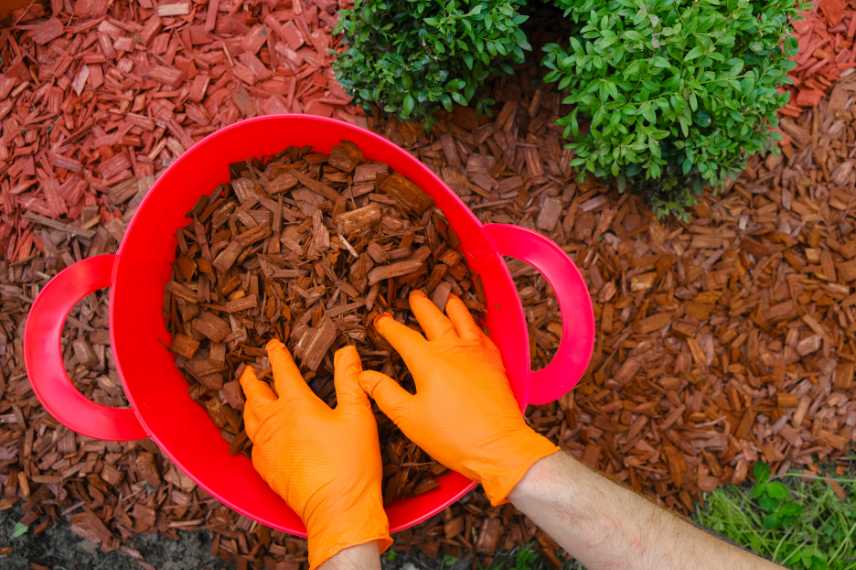
To combat weeds, organic mulching must be thick
To be truly effective against the proliferation of adventive weeds, a good thickness is required to darken the soil. Allow for at least 10 cm for organic mulching. Likewise, before installing any mulching, the soil must be well prepared and, above all, weeded carefully to extract as many rhizomes and roots as possible. Ideally, in the vegetable plot, it is laid in spring when the soil has warmed sufficiently. Elsewhere, in ornamental gardens, installation can take place at any time of year, in a frost-free period, and on soil that is preferably not too waterlogged.
Read also
Which mulch for a slope or sloping bed?Weed-suppressing mulching fabrics
Mulch fabrics are certainly very practical for weed control. Thick, fully opaque, they are easy to lay and relatively durable. In addition to limiting the proliferation of adventive weeds, these mulch fabrics help maintain some moisture and reduce the need for watering. Two types of mulch fabrics are currently on the market:
- The synthetic mulch fabric : it is a fabric or a polypropylene film, a relatively robust plastic, permeable to water and air. In black or brown, this film or mulch fabric is laid on the soil using staples or special nails, it is then cut to install the plants or shrubs. The synthetic mulch fabric is quite handy for slopes and rockeries, areas often inaccessible for weeding, the bases of hedges, or even in the vegetable garden for growing strawberries or lettuces. Widely used in horticulture, this plastic mulch fabric is durable. Available in different grammages hence thicknesses, it is the most durable mulch solution. For all that, these fabrics are not permanent. After a few years they puncture or fray. They become unsightly and are certainly not biodegradable. But their main drawback is that they render the soil sterile since it is no longer enriched with organic matter, which leads to the disappearance of the soil microfauna
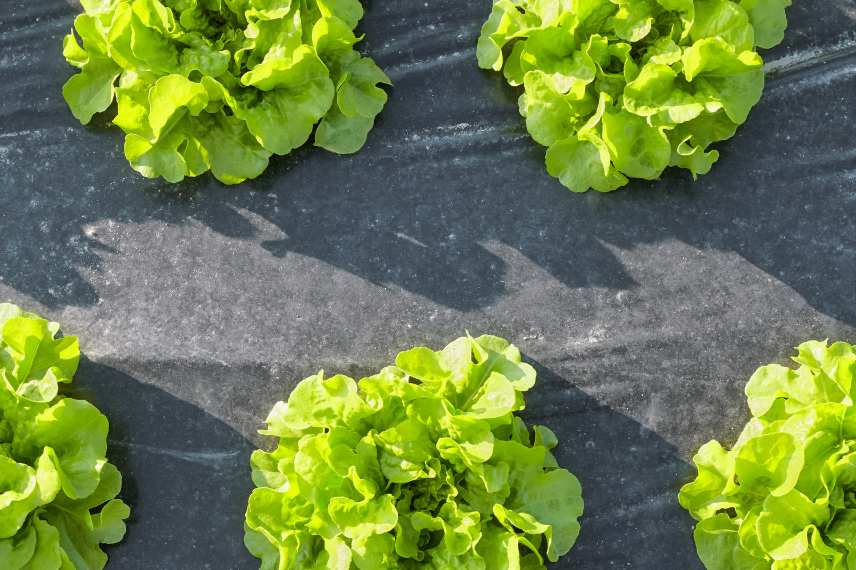
The synthetic mulch fabric is ideal for rockeries and slopes, or in the vegetable garden for lettuces and strawberries
- The biodegradable mulch fabric : as its name suggests, this 100% natural and plant-based fabric disintegrates and breaks down over time. By its degradation, it promotes soil life while protecting it from weeds. This biodegradable mulch fabric, packaged as a roll, in square slabs or in discs, is made up of various materials (hemp, hemp-linen, jute felt, wool, coconut fibres, corn starch…). More permeable to water and air than the synthetic fabrics, these biodegradable mulches are relatively durable (about 2–3 years depending on the material) but less robust than the synthetic fabrics. Additionally, their cost remains higher. As for installation, it is done with biodegradable nails, but the fabric remains somewhat difficult to cut. These biodegradable mulches are perfect at the base of trees, in a hedge, in the vegetable garden or for potted plants.

Natural hemp-linen mulch
Which organic mulch should I use to limit the growth of adventive shoots?
To counter weed growth, organic mulch is relatively effective. Indeed, whether it comprises chips or small wood chips, sometimes coloured, from bark or from pine needles, fibres, but also from buckwheat hulls or cocoa hulls, the mulch must be laid in a thick layer of at least 5 cm to suppress weeds. These mulches are generally very decorative for borders, but they can also be used in the vegetable garden, including among the finer mulches such as the miscanthus, coconut fibre, flax or hemp.
These organic mulches are easy to use and benefit from a good capacity to absorb water thanks to their fibrous composition. They also decompose rather slowly, which helps them last a long time. They promote, more than other mulches, the appearance of mycorrhizal fungi that form a partnership with the roots of cultivated plants. These mulches also foster microbial life and improve the soil by providing humus. To refresh the mulch, simply add another layer. However, they are often lightweight and can be blown by the wind or washed away by rainfall. This is why they are not suitable for rockeries and slopes.
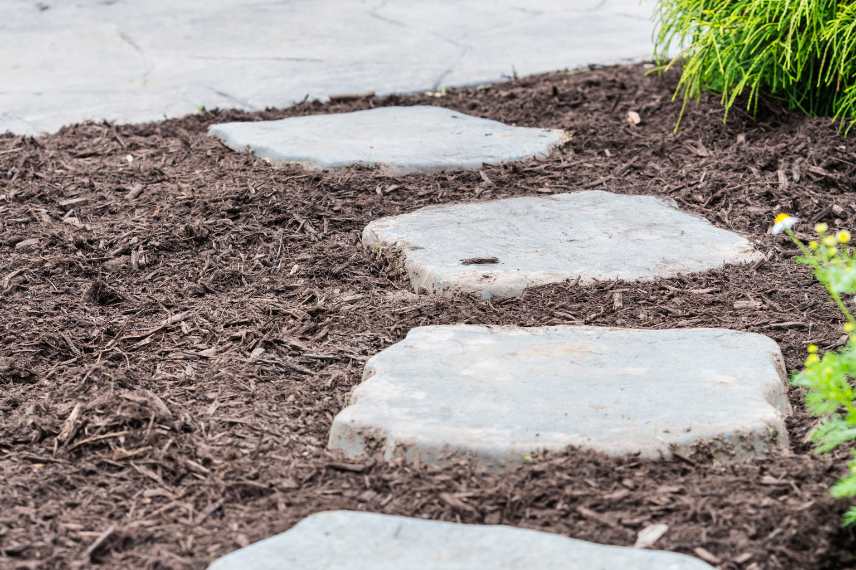
Organic mulch comes in bark, chips, needles, fibres… from different woods or herbaceous plants
These various organic mulches are used in both ornamental gardens and the vegetable garden. Likewise, they perform wonderfully in pots or containers. However, they are fairly low in nitrogen and, ideally, should be used with other organic materials such as lawn clippings. Like other solutions, this mulch is not 100% effective and some adventive weeds can easily creep in to reach light. Note that pine bark and pine needles are better kept for acidic soils and acidophilous plants.
Another solution lies in homemade organic mulch based on dead leaves, collected in autumn and stored in a silo, mixed with dry lawn clippings and with twigs and branches from pruning hedges, trees and shrubs. This latter material, RCW (ramial chipped wood), is obtained from all pruning waste, cut into small pieces in a garden shredder. It is best to favour native species and to avoid walnut, as well as cypress and arborvitae. Beyond its action on weeds, this homemade mulch, properly balanced in nitrogen and carbon, will be ideal for nourishing the soil and the plants.
Read also
What mulch for the vegetable garden?Another solution for weed control is mineral mulch.
Very aesthetic and highly decorative, mineral mulch slows the proliferation of adventive weeds. Very durable, it returns to the plants at night the heat stored during the day. Of course, this mineral mulch does not feed the soil and does not encourage the presence of microfauna, but it can withstand the weather (rain and wind). It is a mulch recommended for beds or borders, including Mediterranean gardens, Japanese Zen gardens and contemporary gardens.
There are different types of mineral mulch:
- Slate: with its grey hue, it is on trend. Slate is sold in chips or flakes. Its relatively acidic pH makes it an ideal mulch for ericaceous plants and shrubs.
- Pozzolana: this is a volcanic rock ground into small pebbles. Very porous, it retains moisture well. Its warm colour looks wonderful in borders.
- Gravels in a range of colours: they are perfect for succulent plants and Mediterranean plants.
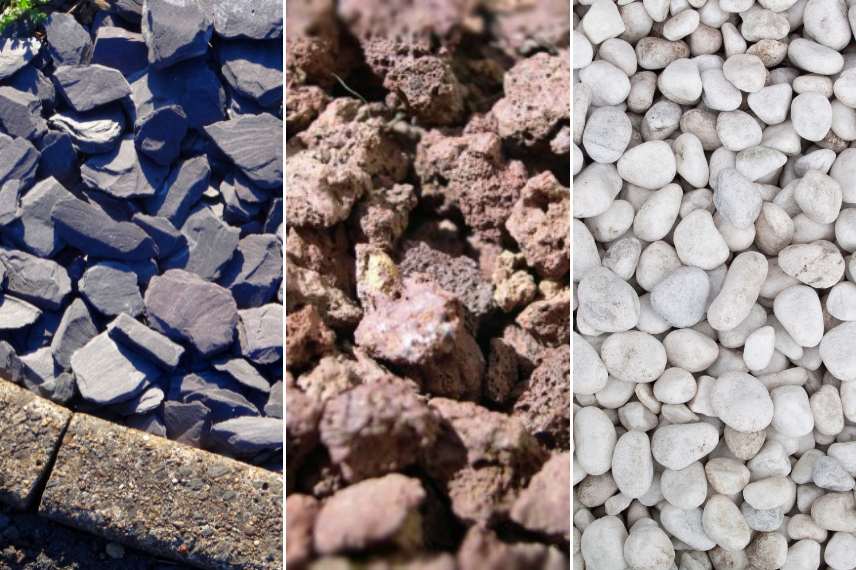
Slate, Pozzolana (©Abrahami Wikipedia) and gravels are very effective against weeds
Also consider groundcover plants.
In beds, borders, hedges or rockeries, to curb weed growth, you can also plant ground-cover plants. Olivier also invites you to discover the 10 best ground-cover plants for weed suppression. And don’t hesitate to browse our wide selection of ground-cover perennials for sun and shade.
- Subscribe!
- Contents
Comments