





























Trees and bushes with large leaves
Our selection of large-leaved trees and bushes
Contents
Large leafy plants irresistibly evoke the tropics and lushness. It is interesting to play with these broad leaves in the garden to create jungle-like atmospheres, providing a sense of travel and exuberance without leaving home. Many plants actually have a large leaf area; they are often of tropical origin, where these plants located under the canopy strategically increase their laminae to capture maximum light and thus ensure their photosynthesis. Several trees and leafy bushes, evergreen or deciduous, also offer exceptional foliage, which we invite you to discover… or rediscover!

Paulownia tomentosa
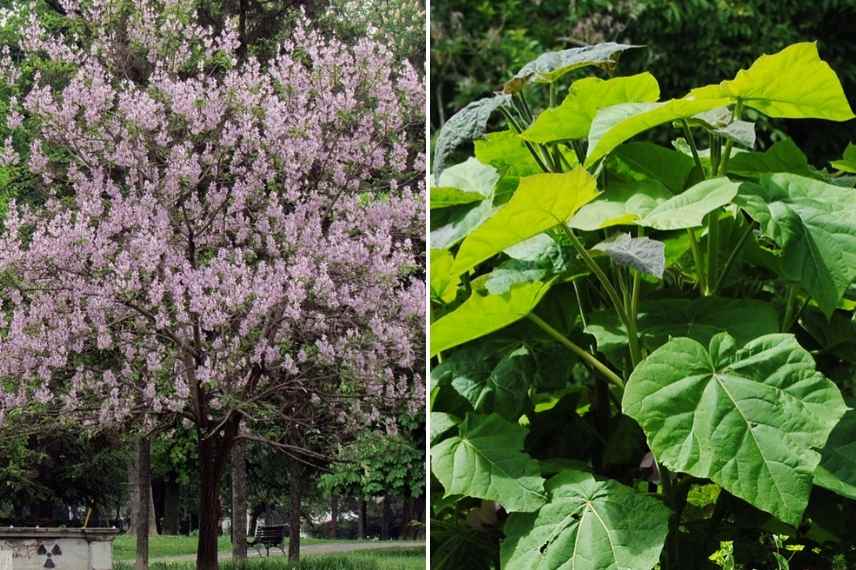
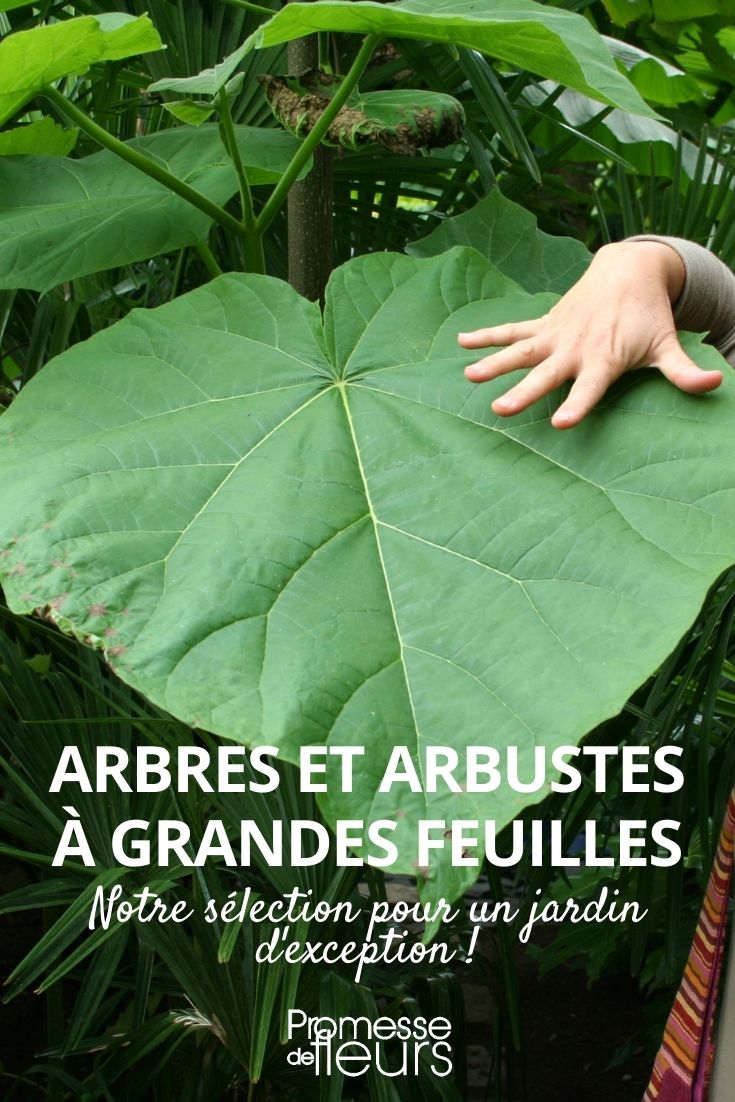
Imperial in every sense, the Paulownia boasts the largest single leaves among leafy trees: they are truly gigantic, measuring between 30 and 50 cm long. This is not the only attraction of this impressive tree, which grows rapidly to reach 10 m in 10 years and typically reaches 15 m in height: its spring flowers on the naked wood stand out beautifully, with an unusual bluish-purple hue for trees, and a trumpet shape reminiscent of foxgloves. It is worth noting that the foliage reaches these giant proportions when pruned short, allowing it to be maintained as a smaller tree, but compromising flowering… The imperial Paulownia is a heat-loving tree that will thrive and enhance a large garden or park for many months (it retains its foliage for a long time).
Paulownia fortunei ‘Fast Blue’ is a smaller cultivar, with a more upright form, sharing the same foliage and floral qualities as the species type.
Paulownia tomentosa
Catalpa bignonioides
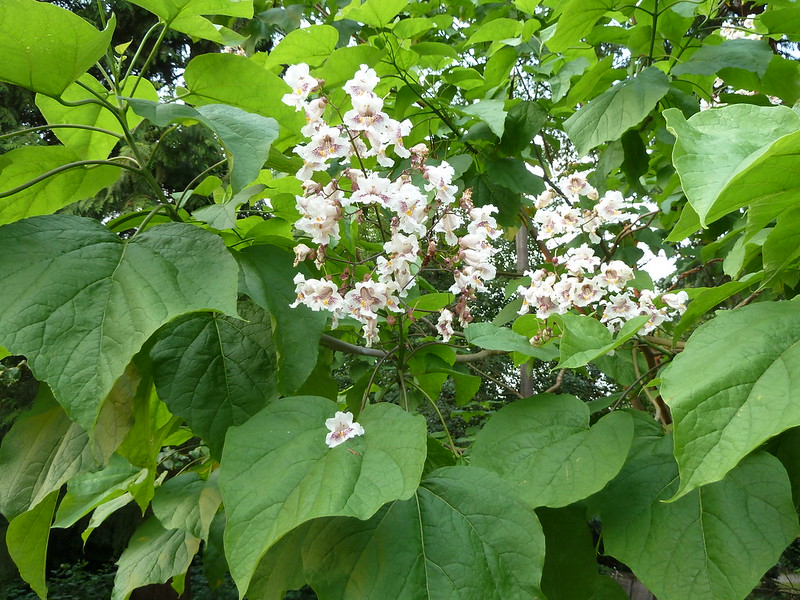
After Paulownia, the Catalpa boasts the largest single leaves among deciduous trees: they measure between 15 and 20 cm. They are heart-shaped, whorled (inserted at the same level around an axis) in groups of three, and have a beautiful light green colour. The Catalpa, with its broad foliage, adds a touch of the exotic to your garden. It is an ideal shade tree for medium to large gardens, reaching heights of 8 m to 13 m with a spreading, even parasol-like habit. Its flowering is another of its charms: it occurs in summer, producing beautiful cluster flowers that are white with purple spots, which will develop into very long pods measuring 30 to 50 cm, enhancing the exotic aspect, and which will persist on the bare tree. The dwarf variety ideal for small gardens (‘Nana’) has slightly smaller leaves.
Read also: Shade tree: adopt the Catalpa for a cool and elegant garden.
Catalpa bignonoides (© Wendy Culter)
Rhus typhina
The Virginia Sumac features a very large odd-pinnate leaf foliage that is remarkable: it changes through the seasons from green to yellow and adorns itself with stunning orange-red to fiery red hues in autumn. The immense leaves are composed of around twenty leaflets and reach between 50 and 60 cm in length. They give this large bush with a spreading habit (wider than tall at ripeness) a very elegant appearance. The Virginia Sumac needs sunlight to achieve its sublime autumn colours. It is adaptable, quite hardy, and tolerant of drought and urban pollution. It has just one small drawback: it suckers easily! To avoid this, opt for new cultivars like ‘Tiger Eyes’ that remain non-invasive. The dissecta varieties, also known as laciniata, have finely cut foliage that is truly stunning (but slightly smaller than the type).
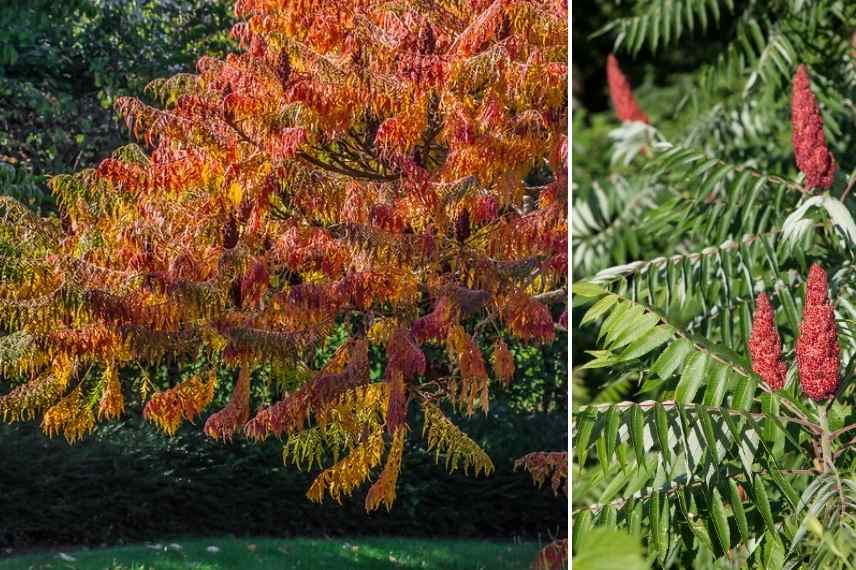
Rhus typhina: autumn foliage on the left (© Finn Termann Frederiksen), summer foliage and fruits on the right (fruits are produced only on female plants)
Fatsia japonica
Here is a bush that is becoming increasingly common in gardens and patios. It must be said that this false-aralia, which our grandmothers often cultivated indoors, has come back into fashion, and that’s a good thing. Sporting a large evergreen leaf superbly palmate, it inevitably catches the eye. The leaves can measure up to 30 cm, and they are a highly decorative glossy green, just like the habit of the Fatsia, which grows upright. In autumn, it produces flowers grouped in umbels, resembling those of Ivy (they are from the same family). The Fatsia japonica is particularly interesting to plant in our gardens as it can transform a dark corner into a small tropical paradise when accompanied by a few other well-chosen plants that thrive like it in partial shade and fresh, well-drained soil. It withstands temperatures down to -15 °C… No more needs to be said! This bush is a gem! You will easily find several varieties with variegated cream foliage (‘Spider’s Web’ or ‘Variegata’).
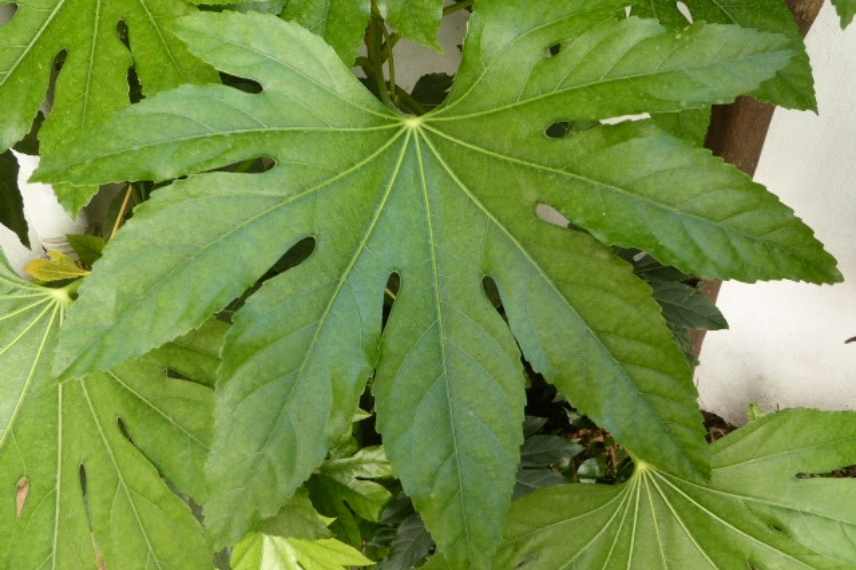
Fatsia japonica (© Gwenaëlle David)
→ Learn more about Fatsia japonica in our complete guide: Japanese aralia: planting, growing, and care
Tetrapanax
In the series of Fatsias, how can we not mention Fatsia papyrifera, now more commonly known as Tetrapanax or rice paper tree? This bush, sometimes classified among perennials, is spectacular for the size of its palmate leaves that resemble— in an extra-large and softer version— those of Fatsia japonica: they have giant, deeply lobed, green and fluffy laminae, rounded in shape, measuring 50 to 80 cm in diameter. Tetrapanax papyrifer thrives especially luxuriantly, even in our latitudes (it is native to southern China), when planted in cool, light, fertile soil in partial shade. Fast-growing, it typically reaches 2 m in height with a spread of up to 8 m! This makes it essential for anyone looking to create an extraordinary tropical decor. You can pair it with a wide range of tropical plants: Dicksonia antartica, Musas, Phormiums, Colocasias…
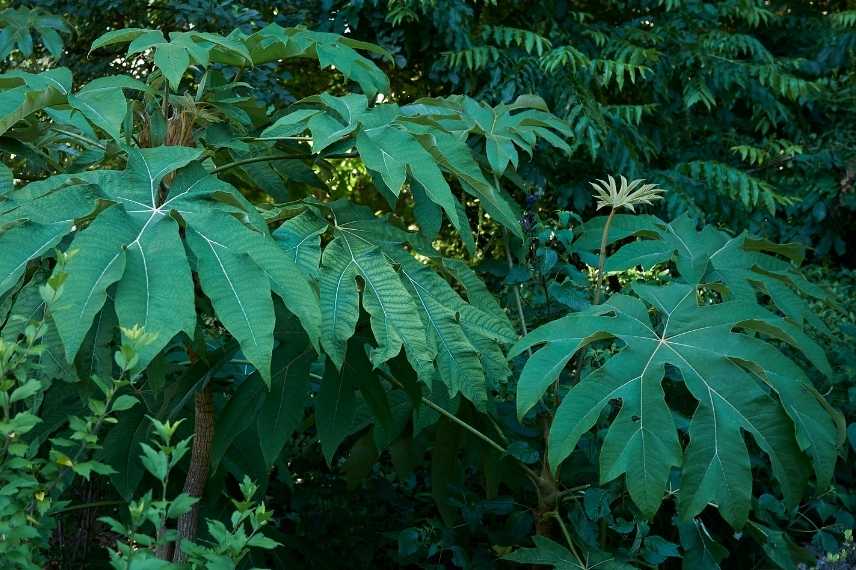
→ Discover our video: the Tetrapanax papyrifera ‘Rex’ and learn all about Tetrapanax in our complete guide.
Magnolia tripetala and Magnolia hypoleuca (obovata)
Deciduous magnolias are known for their beautiful and large glossy foliage. Yet, it is the deciduous magnolias with their remarkable flowers that feature among the most beautiful and broadest foliage: first, an Eastern American magnolia, Magnolia tripelata (also known as umbrella magnolia or parasol magnolia), whose obovate leaves measure up to 60 cm long! It is exceptional with its spreading habit, its white flowers appearing in May-June, and this soft light foliage strongly marked by exoticism that beautifully colours in autumn. You can adopt it even in a small garden, as it reaches 6 to 8 m in height at ripeness.
Another magnolia worthy of inclusion in this selection of broad foliage, even if its leaves measure “only” 40 cm long and 20 cm wide, is Magnolia hypoleuca (also called Magnolia obovata) of Japanese origin. The slightly bluish, satin leaves are stunning, and what can be said about its cream flowering with magnificent prominent stamens? These two beautiful specimens should be planted in slightly acidic soil, in isolation to fully enjoy their beauty.
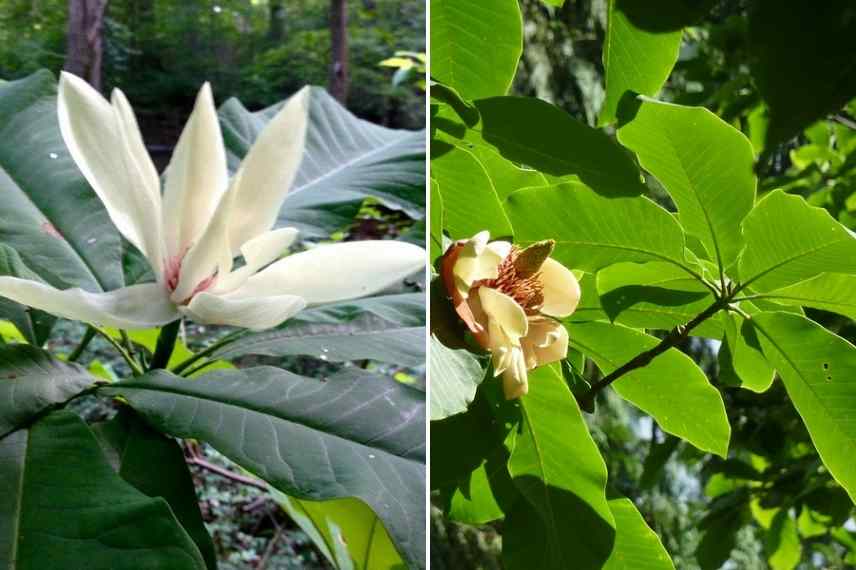
Magnolia tripelata and Magnolia hypoleuca (Leonora Enking)
Melianthus major
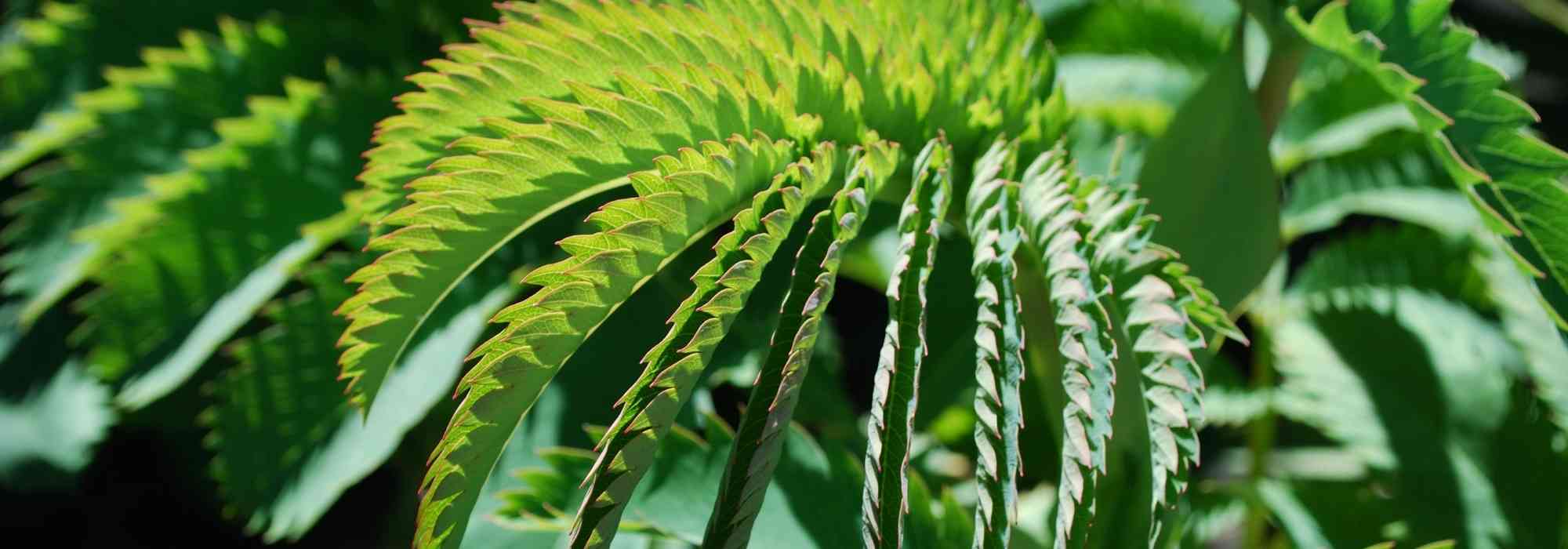
Native to South Africa, the giant Melianthus features ample light foliage, among the most graphic and spectacular, formed of dentate leaflets that create a leaf approximately 40 to 50 cm long. These magnificent leaves are evergreen, with a stunning bluish colour, jade at the bud burst period. The stems are quite rigid, holding the foliage in a suspended manner, giving the plant a habit that is both upright and spreading. Melianthus major grows between 1.5 m and 2 m at maturity. It can be cultivated in a large pot on a sunny terrace in colder regions; it can withstand some frosts down to -5 °C, but will require fleece outside coastal fringes.
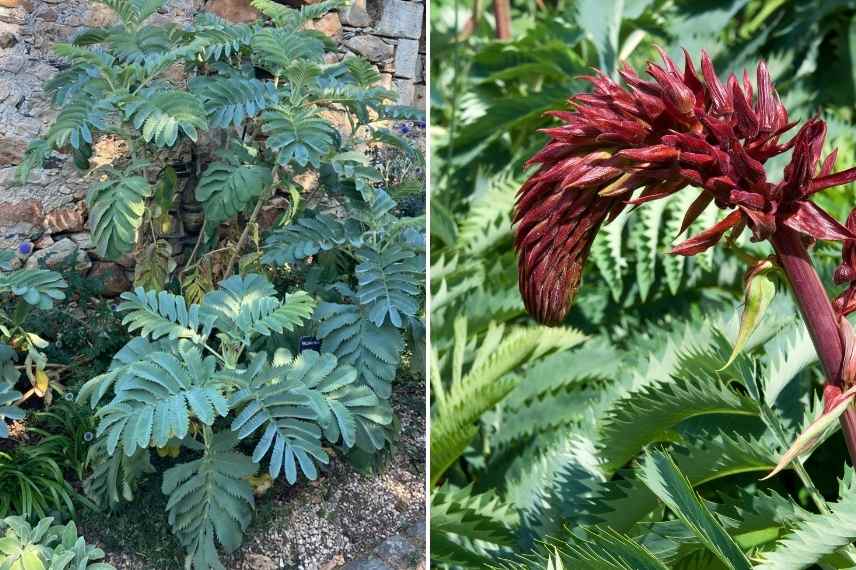
Melianthus major: habit (© Gwenaëlle David), and flower
Eriobotrya japonica
No, large leaves are not just for trees for those lucky enough to have a very large garden! The Japanese loquat is one of my favourite small ornamental trees, thanks to its lush foliage that provides a truly exotic feel all year round: its long, crinkled leaves measure between 20 and 25 cm. They are tough, glossy on the top and fuzzy and russet on the underside. They have strongly marked veins, giving it a really exotic appearance. The habit of this small tree is stunning; it is spreading, almost offering a parasol shape at ripeness. Despite its tropical look, it is hardy down to -12 °C and can thrive in many regions (only the fruiting, with orange fruits appearing in winter -also called bibasses, will be compromised from -4 °C).
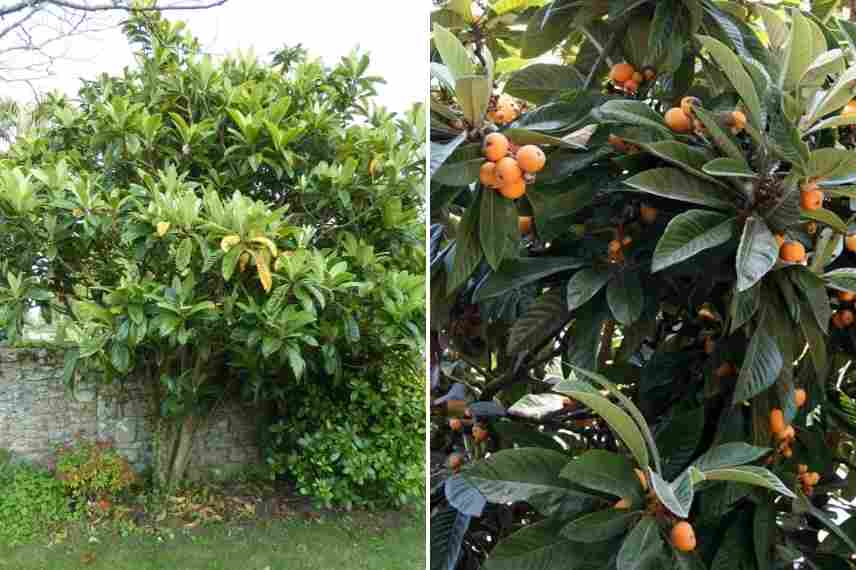
Eriobotrya japonica (© Gwenaelle David)
Liriodendron tulipifera
The Tulip Tree is a very beautiful deciduous tree, whose lobed leaves are quite unique: the terminal lobes are spread apart, giving a very unusual and characteristic appearance to the Liriodendron. The leaf is a lovely light green and measures about 15 cm, turning a magnificent orange-yellow in autumn. The Liriodendron is easily recognised by this foliar characteristic, but also by its stunning summer flowering, which is also unique, in the form of large tulips with upright stamens. Unfortunately, flowering only occurs on specimens around fifteen years old. This large tree, reaching about twenty metres at maturity, prefers rich, fresh, acidic or neutral soils, and will thrive in a large garden or park.
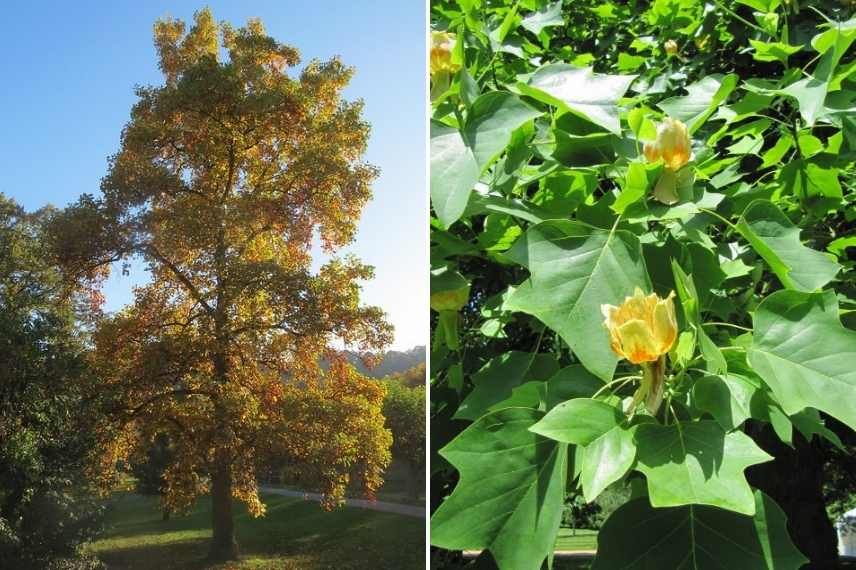
Liriodendron tulipifera: habit (© Andreas Rockstein), leaves and flowers (© Leonora Enking)
Pinus wallichiana
Why mention a conifer among these broad leaves? Because the Himalayan weeping pine is not so common and has some of the longest soft needles in this large family. Its ample, graceful brooms truly deserve attention, giving it a very original style. These are very fine blue-green needles, grouped into a myriad of brooms, measuring between 20 and 30 cm long. Pinus wallichiana can be grown as a single trunk or in coppice (multiple trunks). You will particularly highlight it by planting it in full sun, isolated on a lawn in a large garden (it reaches 15 m). It is particularly hardy and adapts to all types of soil.
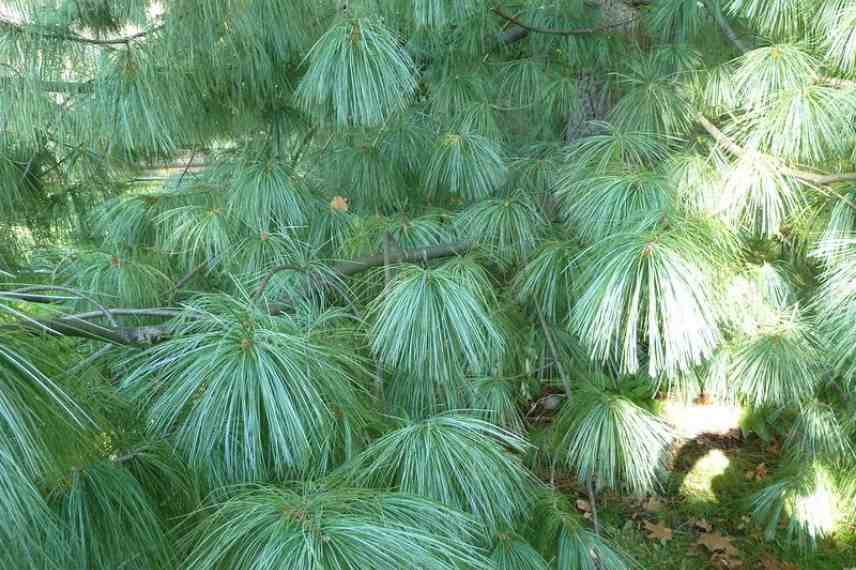
Foliage of Pinus wallichiana (© Wendy Cutler)
Quercus frainetto
More commonly known as the Hungarian Oak, Quercus frainetto is distinguished by its particularly large and unique foliage: the deciduous leaves measure about 20 cm, and are particularly lobed, evolving from light green in spring to glossy dark green in summer, and golden yellow in autumn. The Hungarian oak thrives in full sun or partial shade, and tolerates alkaline soil. Notable for its relatively rapid growth and the light shade it provides in summer, this majestic tree reaches 20 m in height with a spread of approximately 12 m… making it suitable for park-like gardens!
The Quercus dentata ‘Grandifolia’, a marcescent cultivar from Japan (‘Oh-gashiwa’), which is a bit harder to find, boasts incredible leaves measuring 40 cm in length!
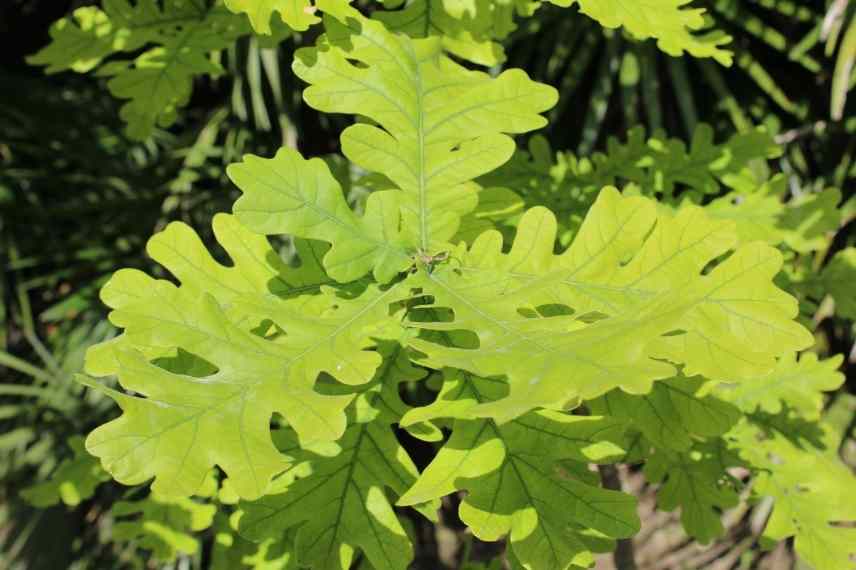
Quercus frainetto: spring foliage
But also a wide range from tropical regions...
This selection is ultimately limited; it could have included the remarkable foliage of other trees, notably the silky Albizia, the Sassafras albidum with its beautiful lobed leaves, figs, and mulberries (including Broussonetia papyrifera), some Mahonia, and many tropical trees and bushes such as the Brugmansia with its fabulous tropical flowers… and many palms ! They almost deserve a separate article, as their impressive foliage is among the most beautiful in the plant world. Not to mention the banana plants and some large succulents like Agaves. You are left with an abundance of choices to create your ultra-exotic garden decor…
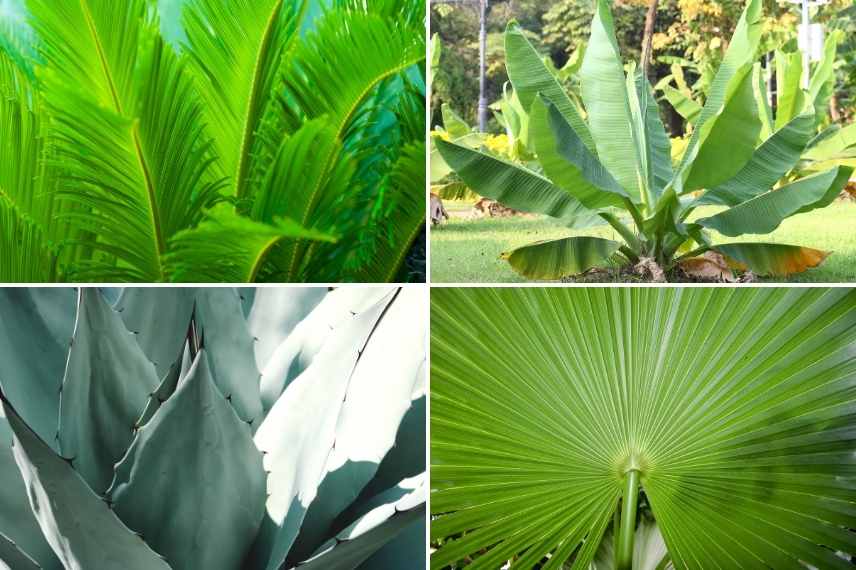
The impressive foliage of Cycas revoluta, Agave, banana plant, and Washingtonia robusta
- Subscribe!
- Contents
Comments