





























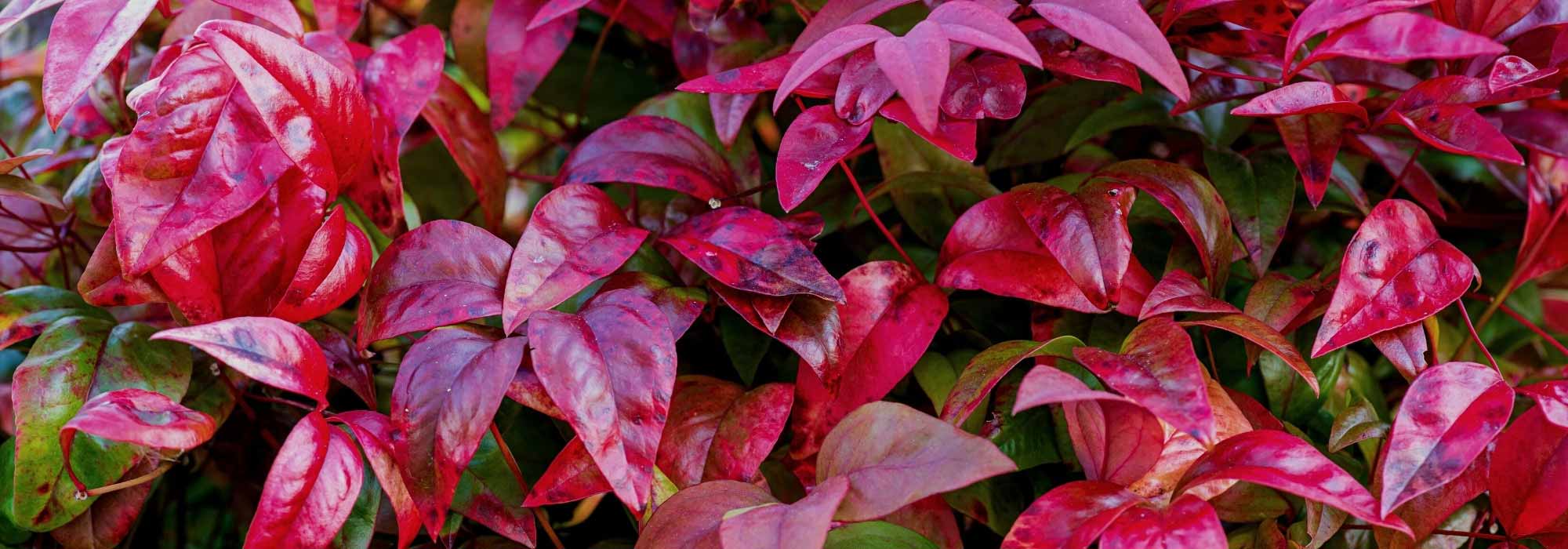
Which evergreen shrubs for a colourful winter?
5 Beautiful shrubs for all seasons
Contents
To maintain an attractive garden all year round, it is wise to turn to evergreen shrubs and conifers that retain their foliage in varied colours during winter. They are perfect for bringing light and a true presence to a garden deserted by most foliage and flowering plants. These bushes, easily spotted from afar, offer a wide range of habits and heights. From traditional conifers to nandinas, including spindle trees or Euonymus, many bushes display beautiful colours between November and March. Depending on their size, they lend themselves to multiple uses, whether in borders, hedges, rockeries, to cover a slope, or even in pots to brighten up the terrace or balcony. There is something for every climate and every soil type. Here is our selection of the most beautiful evergreen bushes with colourful foliage to brighten up the garden, terrace, or balcony in winter!

Euonymus fortunei 'Goldy'®
This variety of spindle tree is incredibly bright! At maturity, the Euonymus fortunei ‘Goldy’ forms a compact bush about 50 cm high and wide. Its evergreen foliage displays a golden yellow colour that tends to turn green over time, which does not detract from its charm. As a bonus, this bush produces very decorative red fruit during winter, which is also highly appreciated by birds. With excellent hardiness, tolerating temperatures down to -23°C, it adapts to all regions. This spindle tree can structure a low shrub border or a rockery and can be grown in pots due to its small size. It thrives in light shade, in any well-drained soil, remaining cool, and withstands salt spray and wind very well. Little prone to diseases, it is an interesting alternative to replace boxwood in a border. It forms a dense groundcover with a consistently tidy appearance and can be paired with Cotinus coggygria ‘Golden Lady’ with golden green foliage, or Physocarpus ‘Black Light’ which has dark purple foliage almost black for a strong contrast.
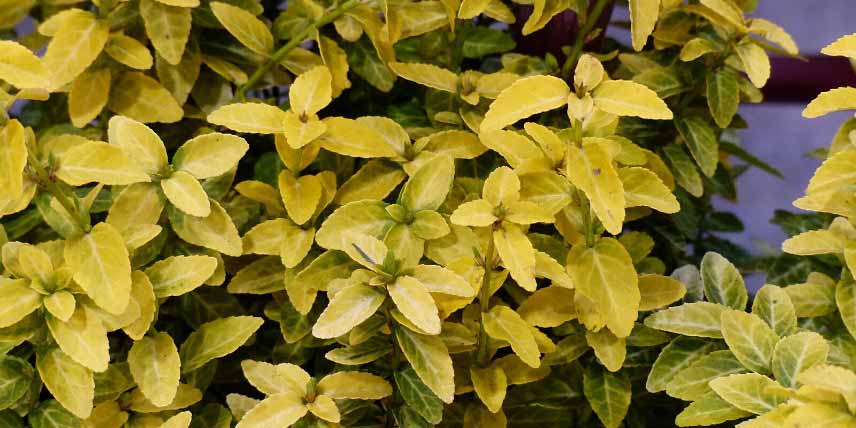
The golden foliage of the spindle Euonymus fortunei ‘Goldy’
Pieris japonica 'Flaming Silver'
Another beautiful specimen that brightens up semi-shaded spots in the garden or on the terrace during cold days! This variety is remarkable for its foliage, which is the site of an uninterrupted colour waltz. In spring, its young scarlet leaves turn dark red, then pale pink, before becoming green finely marginate with cream white. The young shoots coexist with mature leaves, offering a striking contrast. ThePieris japonica ‘Flaming Silver’ is also interesting for its fluffy, white, pleasantly fragrant spring flowering that adorns this beautiful glossy evergreen foliage. It forms a lovely compact, bushy, upright bush, about 1.25 m in height and 80 cm in width at maturity, making it suitable for use in pots as well as in the ground, in low hedges, in shaded rockeries, or in shrub borders. Hardy down to -15°C in perfectly drained soil, very easy to grow, it thrives in partial shade or gentle sun, in acidic, cool, light, humus-bearing soil. Pair the magnificent colours of the Pieris with other decorative foliage, lighter ones like those of ferns, grasses like Uncinia rubra, or heavenly bamboo.
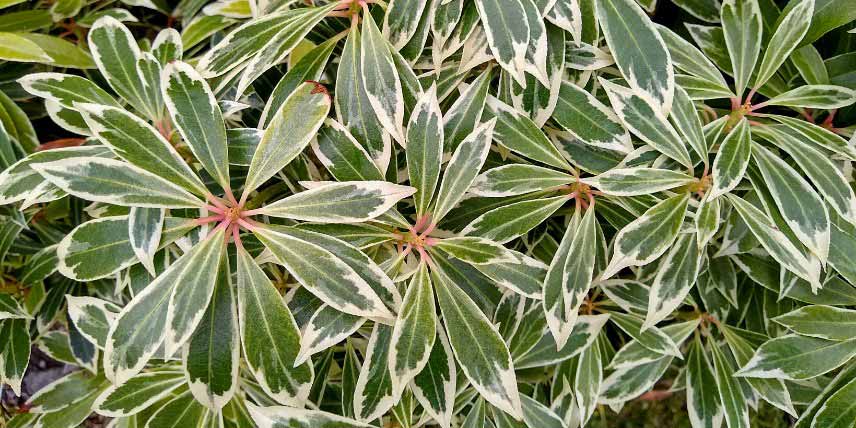
The variegated foliage, marginate with white, of Pieris ‘Flaming Silver’
Nandina domestica 'Fire Power'
This small heavenly bamboo stands out for the colourful variations of its foliage throughout the seasons. In spring, the young shoots of the Nandina domestica ‘Fire Power’ are a coppery red to burgundy, adding a warm hue to the garden. As summer approaches, the leaves take on a blue-green colour before turning purple in response to the cold. It is also distinguished by its flowering, which consists of small white flowers arranged in panicles, typically in May and June. The red berries that follow are very decorative when the cold season sets in. This is a dwarf variety that does not exceed 60 cm in all directions. Thus, it is perfectly suited as groundcover or at the border, and even in pots to enhance a terrace. Its cold resistance is limited to -15°C, and it is sensitive to drying winds. A well-sheltered planting site is therefore recommended. It will thrive in neutral to slightly acidic soil in partial shade as well as in full sun. You will create a beautiful vibrant association by placing it near decorative dogwoods, such as the coral-red stems of Cornus alba ‘Baton Rouge’, for example.
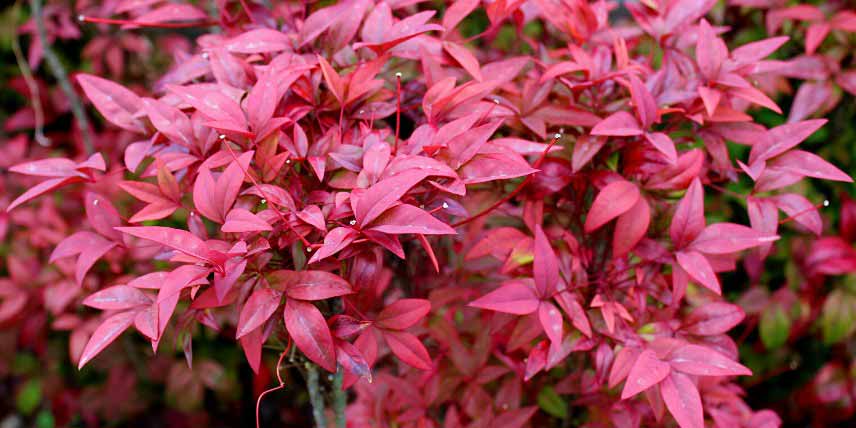
The Nandina ‘Firepower’ offers flamboyant and changing foliage
Read also
The most colourful decorative dogwoodsLeucothoe keiskei ‘Burning Love’
The Leucothoe keiskei ‘Burning Love’ is remarkable for its wonderfully coloured foliage, changing through the seasons from purple to green. Its bright red stems support elongated leaves that, in winter, display a dark purplish-red hue, which lightens to bronze, shifts to green in summer, and then returns to a deep purplish tone in autumn. In spring, the bush is adorned with short, pendulous clusters of white bell-shaped flowers, earning it the lovely nickname “Pearl Flower.” Growing to 80 cm in height and 1 m in spread at maturity, it can be cultivated both in the ground and in pots. It prefers acidic, cool soil and thrives best in dappled light, between shade and sun. Watering should be moderate but regular, especially during dry periods. Although hardy (down to -18°C), protection from strong, cold winds can be beneficial to maintain the optimal appearance of its foliage. With its ample foliage changing from red-purple to bronze-brown from summer to autumn, the Rodgersia ‘Bronze Peacock’ will make a beautiful companion for this shrub.
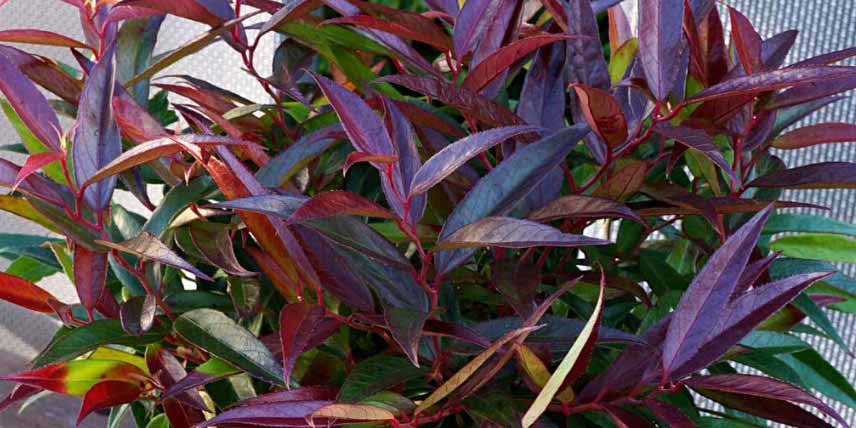
The foliage of Leucothoe ‘Burning Love’ takes on a dark red-purple hue in winter (photo © Denolf)
Pinus mugo 'Ophir'
The Pinus mugo ‘Ophir’ is a dwarf conifer that forms a large, bright cushion in the garden during the shortest days of the year. With a slow growth rate (only 3 to 4 cm per year), it will not exceed 1 m in all directions after 10 years of cultivation. Its evergreen foliage, composed of very fine needles, changes colour with the seasons, shifting from a vibrant light green to a golden-yellow and orange during winter, especially intense when exposed to sunlight. Its compact ball shape and slow growth make it ideal for pot cultivation, such as being shaped into a bonsai, although it also fits well in borders and rockeries. Perfectly suited to montane climates, it withstands temperatures down to -35°C and thrives in ordinary soil, provided it is not too dry. You can pair it with dwarf creeping conifers like the Juniperus horizontalis ‘Blue Chip’, whose bluish-grey foliage takes on a grey-violet hue in cold weather.
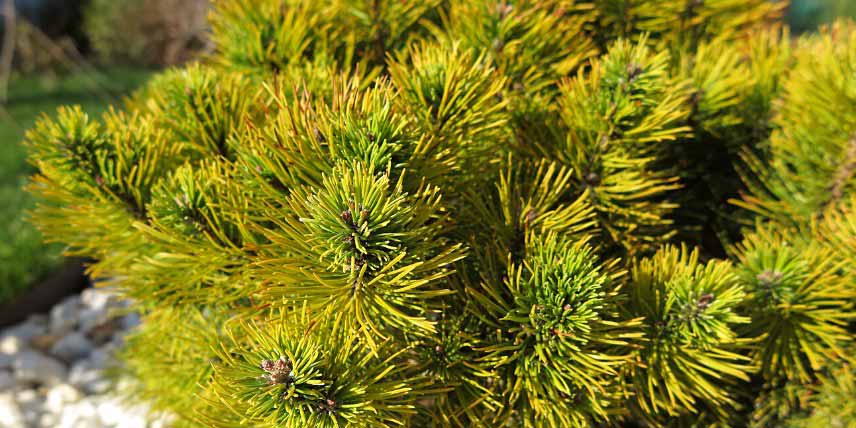
The Pinus mugo ‘Ophir’ is light green in spring and summer, but takes on a golden-yellow hue with orange highlights in autumn and winter.
- Subscribe!
- Contents

Comments