





























Which white-flowering ornamental cherry trees choosing for your garden?
Our selection of Prunus to bring poetry and purity to the garden
Contents
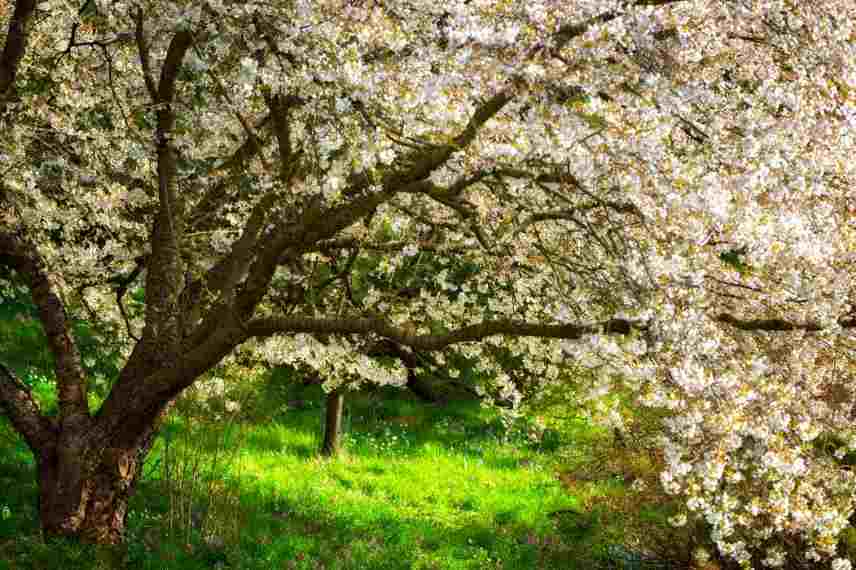
Every year, Japanese people gather in public parks to admire the flowering of ornamental cherry trees. A true ritual, experienced as a suspended moment, imbued with poetry and serenity. It must be said that ornamental cherry trees, or flowering cherries, possess all the charms. Starting with a spring flowering of breathtaking beauty, heralding spring. Although fleeting, these flowers are of incomparable delicacy and lightness. And when these cherry trees bloom in white, they cast a cloud of softness and purity over the garden.
Let’s discover together the most beautiful varieties of ornamental cherry trees with white flowering, not forgetting our tips for planting, pruning and pairing them with the garden.
Further reading: Japanese cherry trees: planting, pruning and care.

Why planting a white-flowering ornamental cherry tree in your garden?
Why planting a white-flowering ornamental cherry in your garden? The first reason (and surely the most logical) stems from your passion for white (it’s the case with me too!). You love white and have a genuine admiration for Magnolia grandiflora, Deutzia, the Mexican orange blossom or Exochorda… So, a white-flowering ornamental cherry can only find its place in your garden, a symbol of serenity, innocence and purity.
However, if your garden isn’t bathed in white, the flowers of these cherries remain fairly easy to pair with a wide palette of colours. White has even a tendency to bring clarity and freshness and to serve as a transition.
This small tree is a true ambassador of spring, being one of the first to offer its clouds of flowers from March, even February for certain varieties planted in regions with mild climates. These flowers in pure white are all the more striking as they often open before the bud burst period of the foliage. They bloom in abundance to form a cottony cloud that lights up the end of winter. Although the flowering is relatively ephemeral (the flowers persist for about a fortnight), the display continues after fading. Petals litter the ground to form an immaculate carpet.
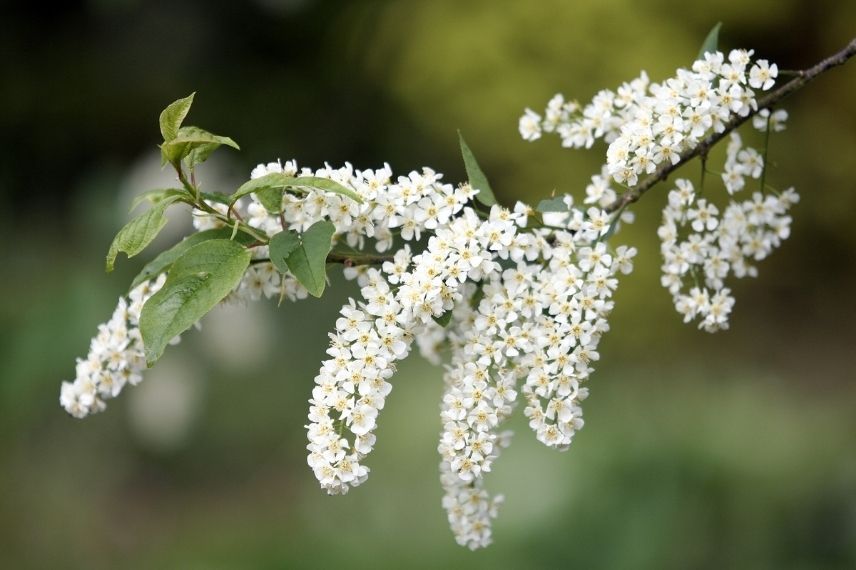
The long clusters of white flowers of Prunus padus
During this short period, when few trees or shrubs are in bloom, your white-flowering ornamental cherry will attract swarms of insects that will feast on pollen and nectar.
Finally, if you were not yet convinced, know that ornamental cherries boast many advantages beyond their splendid flowering: beautiful autumn foliage, horizontally striate bark that is highly decorative, rapid growth and easy cultivation.
Read also
How to propagate Japanese cherry?Which white-flowering cherry tree variety should I choose?
The Japanese cherry most commonly grown, to which the Japanese themselves pay true homage, is Prunus serrulata. The cultivar ‘Shirofugen’ offers flowers of pure white which blush slightly as they fade. At the same time the first shoots appear, tinged with bronze-red. This cherry blossoms in dense clusters that literally cover the bare crown of its dark branches. The variety ‘Sunset Boulevard’ is very slightly different with its white flowers delicately tinged with pink.
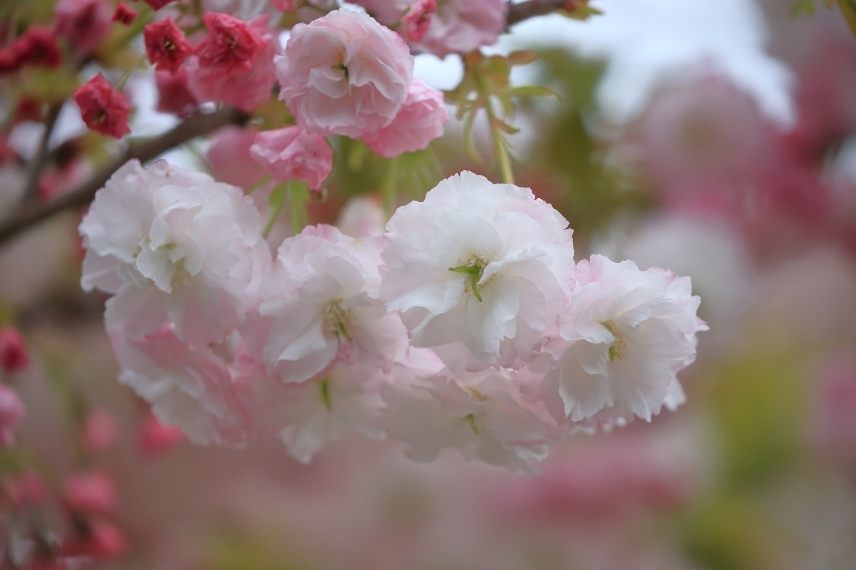
The wonderful white bloom tinged with pink of Prunus serrulata Shirofugen
The variety of Tibetan cherry (Prunus yedoensis) also proves to be a reliable choice with its flowers of immaculate white at the pink heart that open on bare wood.
To have twice as much pleasure, opt for the Prunus x subhirtella ‘Hally Jolivette’ since this flowering cherry offers double blossoms of cream-white, enhanced by a pretty dark pink heart. The variety Prunus glandulosa ‘Alba Plena’ also offers a magnificent double bloom of pure white. It is moreover a flowering cherry that, by its size (about 1.5 m across), adapts perfectly to pots. It will look stunning on a balcony or a terrace.
Very ornamental, Prunus padus takes its vernacular name from its long clusters of white flowers that are particularly melliferous and open later, in May–June. They also emit a delicious almond fragrance. Fairly close, the variety ‘Le Thoureil’ stands out, however, for a narrow, upright habit that gives it a certain grace.
To stay with cherries of original habit, the hybrid cherry Prunus incisa x serrulata ‘Umineko’ stands out for its columnar crown and upright branching, which makes it the ideal candidate for planting in a line or as a backdrop in a border.
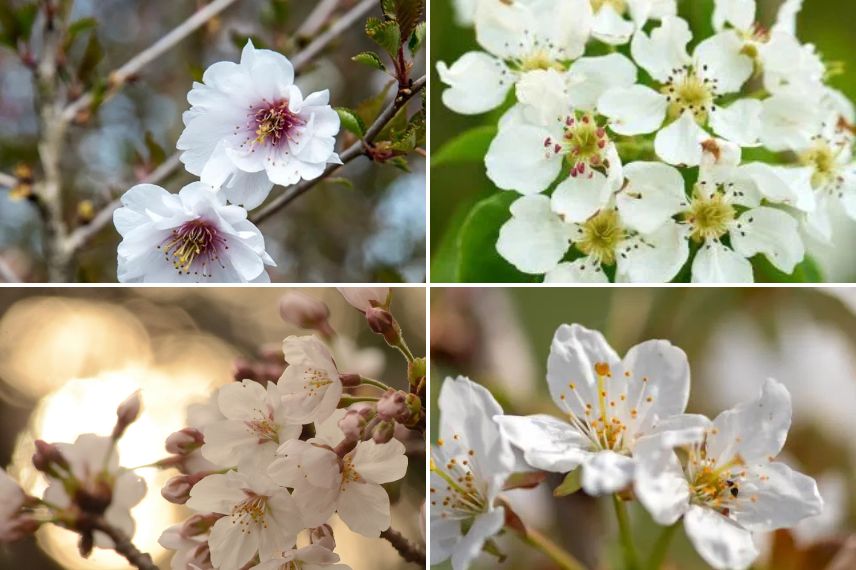
The extraordinary variety of flowers on ornamental cherries (Prunus x subhirtella ‘Hally Jolivette’, Prunus padus, Prunus yedoensis and Prunus ‘Umineko’)
For those with only a small garden, a balcony or a terrace, no reason not to enjoy the wonderful white flowering of a cherry tree! Prunus incisa ‘Mikinori’ and ‘Yamadei’ are two dwarf varieties, very floriferous, that do not exceed 2 m to 2.5 m across. ‘Mikinori’ has the feature of producing pink flower buds and semi-double white flowers. As for the remarkable Prunus pumila ‘Depressa’, it is not only a dwarf variety, but also has a creeping, prostrate and spreading habit. It forms an excellent groundcover about 50 cm high and 2.5 m wide.
If white flowering is a criterion for selecting a Japanese cherry, the foliage can be too. Prunus virginiana ‘Canada Red’ has very dark burgundy-red foliage and Prunus incisa ‘Frilly Frock’ features bright green foliage with a pale-yellow margin. This last one has a weeping habit.
To stay with flowering cherries of original habit, the hybrid cherry Prunus incisa x serrulata ‘Umineko’ stands out for its columnar crown with upright ramifications, making it the ideal choice for planting in a line or as a backdrop in a border.
How to plant and care for these white-flowered cherry trees?
The white-flowered ornamental cherry is not a difficult tree to grow. However, it does require appropriate cultural conditions to prevent disease and to ensure it lasts.
Planting flowering cherries
Thus, flowering cherries prefer neutral to slightly calcareous soils, rather rich and fresh, and above all well-drained. They particularly dislike acidic, heavy, and clay soils. When planting, drainage should be provided by a bed of gravel or pozzolana. It will also be essential to supply a good amount of compost.
In terms of exposure, the ornamental cherry likes sun, provided it is not too hot. In the south, it is best planted in partial shade. Likewise, the chosen location should be sheltered from winds and from cold air currents.
Finally, a solitary planting is ideal for several reasons: it highlights the beauty of its flowering, its autumn foliage and its silhouette. Not to mention that some varieties can reach a handsome size.
Prunus incisa
Care of ornamental cherries
- Water regularly in the years after planting, and during periods of hot summer weather
- Apply compost in autumn
- Do not prune
- Monitor for any signs of disease or infestation by aphids and scale insects. To guard against these diseases and act as quickly as possible, I invite you to read the article: Diseases and pests of flowering cherry trees. Nevertheless, if your ornamental cherry benefits from good cultural conditions, it should be thriving!
Read also
Growing a Japanese cherry tree in a potHow to pair them in the garden?
The white-flowering ornamental cherry is a showpiece in its own right, thanks to its flowering. Nevertheless, these white flowers can be highlighted with spring-flowering bulbs such as the daffodils, the tulips, the scillas, the hyacinths… or even long-flowering hellebores such as Helleborus sternii or the hybrids Helleborus lemperii. Lungworts can also accompany the flowering of the ornamental cherry with striking effect.
To fill the space at the foot of an ornamental cherry, planting hostas or heucheras, accompanied by Japanese (forest) grass (Hakonechloa) or Miscanthus sinensis can be very striking. Later in the season, the flowering of a Mexican orange blossom will highlight the bark and the foliage of the ornamental cherry.
The white-flowering ornamental cherry can also thrive in the company of a Magnolia soulangeana ’Alba superba’ at nearly-white flowers. Their opulent flowering will create a true spring enchantment in your garden. For a more zen-inspired garden, the pairing of the Japanese cherry with the Japanese maple, the Fargesia bamboos and cloud-pruned pines works very well.
If you want to integrate a white-flowering cherry into a flowering hedge, the presence beside it of hornbeams (Carpinus) or laurustinuses works quite well.
- Subscribe!
- Contents
Comments